How to Prepare a Custom-Home Retainage and Final-Payment Release Plan Before Signing
Prepare a custom-home payment exhibit that defines retainage, completion evidence, lien releases, inspections, lender review, disputes, and the final-payment handoff.
The short answer
Before signing, turn the last dollars into a written release sequence: reconcile the contract and approved changes, define the reserve’s purpose and amount, name the verifier for each gate, require completion and inspection records, specify the jurisdiction’s lien or payment protections, and state how an undisputed amount is paid when one item is disputed. California and New York examples are not a national rule; confirm the final exhibit with local counsel and the lender.How to Prepare a Custom-Home Retainage and Final-Payment Release Plan Before Signing
Before signing, turn the last dollars into a written release sequence: reconcile the contract and approved changes, define the reserve’s purpose and amount, name the verifier for each gate, require completion and inspection records, specify the jurisdiction’s lien or payment protections, and state how an undisputed amount is paid when one item is disputed. California and New York examples are not a national rule; confirm the final exhibit with local counsel and the lender.
1. Decide what the final-payment plan is supposed to protect #
The final-payment plan should protect a defined handoff—not give either side an indefinite right to delay payment. Before signing, decide which amount is earned, which amount is intentionally reserved, what evidence releases the reserve, who verifies that evidence, and what happens to a genuinely disputed item.
The reader decision is not simply “What retainage percentage should I use?” The useful decision is: “What must be true, and what record must exist, before each dollar moves from the contract balance to the builder, a subcontractor, a lender-controlled account, or a documented dispute?” A percentage can be one input. It cannot be the whole control system.
The four amounts that are often mixed together
Use separate labels in the proposed contract exhibit. The labels below are Brictale’s planning taxonomy, not a statement that every jurisdiction uses the same terms.
| Amount or status | What it means in the worksheet | What should release it | What it is not |
|---|---|---|---|
| Earned progress payment | The value of work or eligible materials that the contract’s payment rules say is complete or properly stored | Application, schedule-of-values reconciliation, verifier approval, and any required supporting records | A deposit for work not yet earned |
| Contractual retainage | A pre-agreed reserve withheld from otherwise payable progress amounts until a named milestone | The contract’s stated release gate, such as accepted final completion or an agreed split release | A surprise percentage invented when the final invoice arrives |
| Punch-list holdback | An amount tied to specific incomplete, defective, or unaccepted items that remain after the home can otherwise be used | Item-level completion, correction, acceptance, or an agreed substitute remedy | A reason to withhold the entire contract balance for a small unresolved item |
| Unpaid invoice or disputed amount | Money that the contract says is due, but payment is pending or contested | Payment deadline, written dispute notice, resolution, or contract remedy | Retainage merely because the owner has not yet sent the check |
This distinction matters because a builder needs to price and finance an intentional reserve, while a homeowner needs a clear reason for every dollar that remains unpaid. If the exhibit calls everything “retainage,” no one can tell whether the amount is a planned holdback, an unapproved change, an incomplete item, a lien concern, or a late payment.
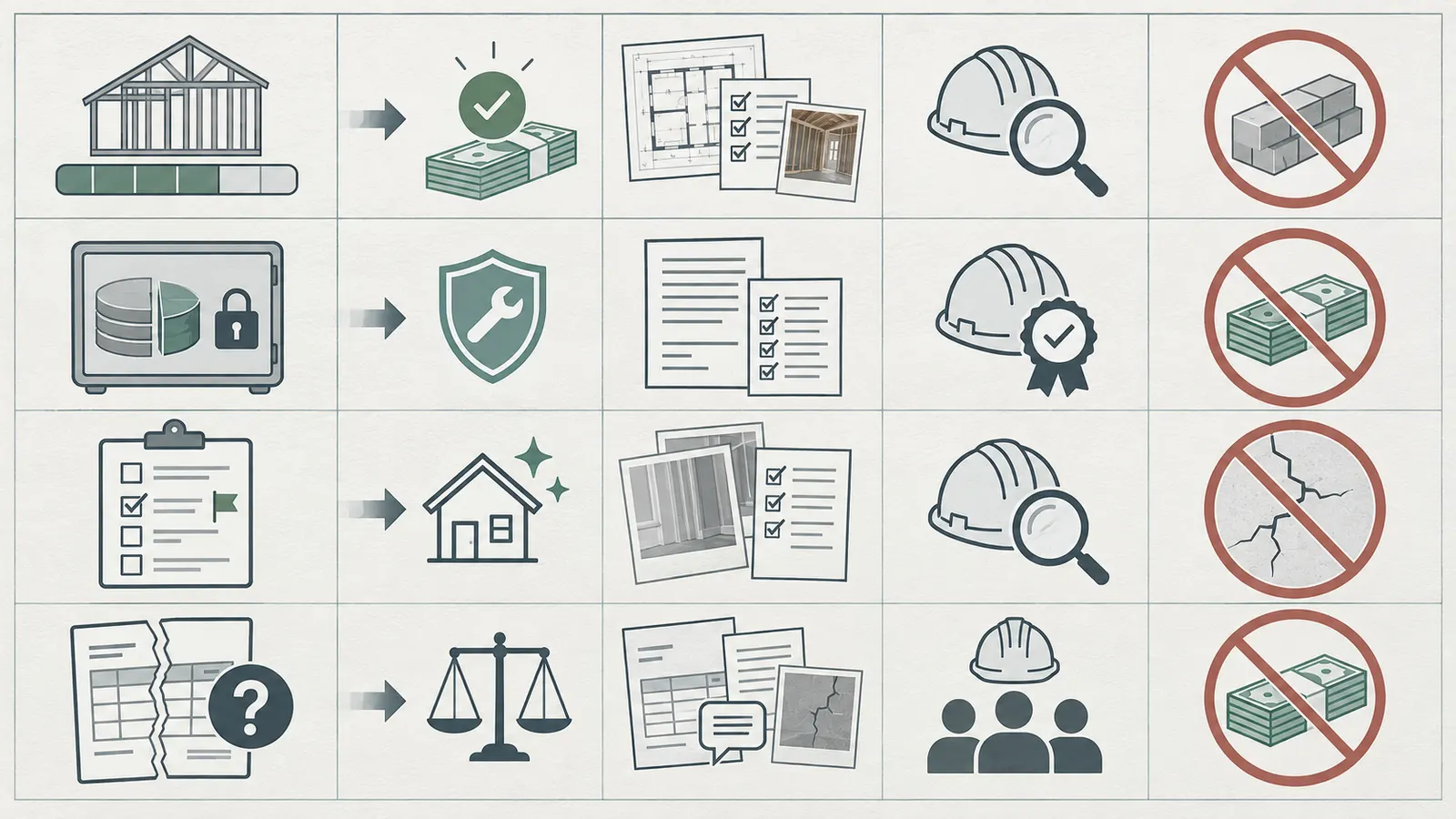
California’s Contractors State License Board says that, for California home-improvement projects over $500, a written contract must include a detailed payment schedule and that payments cannot exceed the value of work performed, subject to the permitted down payment. That is a California consumer-contract rule in the scope described by CSLB, not a universal retainage percentage for every ground-up custom-home contract. Start by asking a California construction attorney whether the project and proposed agreement fall within that particular statutory category. Read the California CSLB contract guidance.
New York’s Attorney General gives a different consumer-facing example: establish a payment schedule, withhold final payment until the work and required inspections and certificates of occupancy are finalized, and put the arrangement in a written contract. That fact sheet addresses New York home-improvement work, so it should be treated as a jurisdiction-labeled input to your drafting conversation, not as a national rule or an automatic ground-up home rule. Read the New York Attorney General fact sheet.
What to decide before asking for a percentage
Write answers to these questions before negotiating the number:
- Is the proposed reserve a percentage of the original contract price, the current contract value after approved changes, each progress application, or a fixed dollar amount?
- Does it apply to allowances, owner-supplied items, stored materials, design services, permits, builder overhead, and approved changes? If not, what is excluded and why?
- Is the reserve held from every progress payment, only the last payment, or both?
- Does the reserve release in one payment, in stages, or by line item?
- Is substantial completion distinct from final completion? If so, what can remain at substantial completion without blocking occupancy or use?
- Who decides that a gate is met: the builder, architect, owner’s representative, independent inspector, lender, building official, or more than one of them?
- What record proves the decision? A signed certificate, inspection report, permit closeout, certificate of occupancy, updated schedule of values, receipt, conditional waiver, unconditional waiver, warranty register, or something else?
- If one item is disputed, can the undisputed amount be paid while a stated amount remains reserved?
- What is the notice period for a dispute, the cure period, the review period, and the escalation path?
- Which state, county, city, lender, contract form, and lien rules must be confirmed before the exhibit is signed?
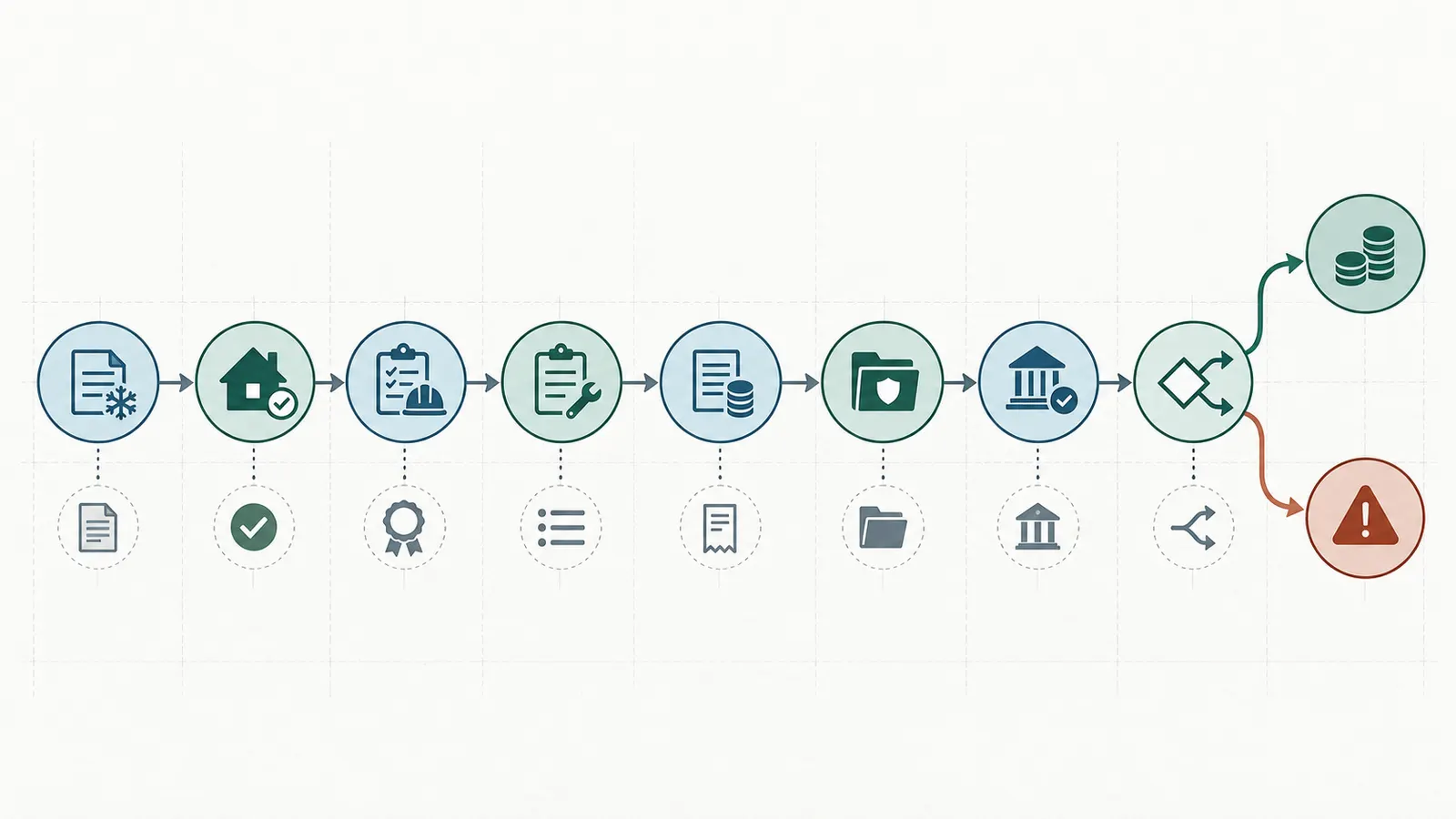
The sequence should be visible in the contract. A reasonable homeowner-facing sequence is: scope and price reconciliation, change-order reconciliation, completion review, inspections and occupancy status, payment and lien evidence, warranty and closeout records, lender draw confirmation, then release or a documented dispute handoff. A lender may impose a different order for a construction loan. Ask the lender before signing and attach its draw checklist or incorporate it by a dated exhibit.
The next decision
If you cannot state the purpose of the reserve in one sentence, do not negotiate its percentage yet. Ask the builder to identify each proposed final-payment component and label it as earned payment, contractual retainage, punch-list holdback, approved change, allowance adjustment, or disputed amount. Then choose whether an independent construction professional and a local attorney should review the exhibit before signature.
Compact originality brief
Current answers generally say to use written payment schedules, avoid paying the entire price upfront, document changes, and delay final payment until completion. Standard contract administration materials describe schedules of values, applications for payment, retainage, and releases, but they are usually written for industry users.
The missing decision is a homeowner’s jurisdiction-labeled method for deciding whether the proposed reserve is retainage, a punch-list holdback, or an unpaid invoice, then connecting each release condition to a responsible verifier, record, approved change, inspection status, lender constraint, and dispute handoff.
This article’s original contribution is the source-labeled homeowner worksheet and the illustrative reserve calculation below. It can be checked by tracing every legal or administrative input to the linked California, New York, federal, Los Angeles, Caltrans, and AIA sources, then replacing the illustrative assumptions with the project contract, local requirements, lender instructions, and attorney-approved forms. It is a synthesis, not firsthand testing, interviews, or collected project data.
Contribution title: Source-labeled homeowner worksheet: retainage and final-payment release plan.
Method: Build one row for each payment or release gate; reconcile the current contract value and approved changes, then attach a responsible verifier and a named record before deciding what amount is releasable. Label California and New York rules separately from general contract practice and test an illustrative reserve at several percentages.
Limitations: This is a planning and conversation tool, not a contract, legal opinion, lien-waiver form, inspection, lender approval, or recommendation of a universal retainage percentage. State, county, city, lender, contract type, and project facts can change the required form and timing; a local construction attorney and the building official must confirm them.
2. Choose a release architecture that matches the work #
Choose the reserve architecture by matching each release to a verifiable completion condition; do not use one percentage as a substitute for scope definition, inspection responsibility, or dispute procedure.
Architecture A: progress retainage with a final release
Under this architecture, each eligible progress payment is reduced by an agreed retainage amount. The reserve accumulates and is released after the contract’s final-completion gates. It can be easy to administer because the calculation repeats, but it can also create a large end balance that does not correspond to the cost or risk of remaining items.
If the contract uses this method, define the base. “Five percent retainage” is incomplete unless the contract says five percent of what: each approved application, the current contract value, the earned amount excluding stored materials, or another base. Define whether approved change orders increase or decrease the reserve. Define whether a credit change order reduces the accumulated reserve or only the final contract balance. Define rounding and the treatment of a negative or zero balance.
The official AIA instructions for A105 treat retainage as a payment procedure to be inserted if applicable and separately call for a schedule of values allocating the Contract Sum among portions of the work. That is useful drafting practice, not a law that dictates a homeowner’s percentage. See the AIA A105 instructions on schedule of values and retainage.
Use progress retainage only when the project team can keep the application current. Each application should show the prior approved amount, current earned amount, retainage withheld, approved changes, stored materials if eligible, previous payments, and the balance. If the builder’s payment application is only a single invoice with no line-item status, a percentage reserve will not make the process verifiable.
Architecture B: a final reserve tied to named gates
Under this architecture, the parties agree that a specified dollar amount or formula remains unpaid until a final release sequence is completed. The reserve may be simpler for a fixed-price home, but it requires unusually clear gates because an end-loaded balance can give both parties leverage at once.
Name the gates in order. For example:
- The current contract value, approved additions, approved credits, allowances, and payments reconcile.
- Work is substantially complete under the defined occupancy or intended-use standard.
- The local building official’s required final inspections are passed or otherwise closed in the jurisdiction’s records.
- The builder delivers the contract’s closeout documents, including warranties, manuals, record drawings where required, and unresolved-item list.
- The owner or designated verifier accepts the identified final items or records an itemized exception.
- Required conditional or unconditional payment and lien releases are obtained in the form required by the project jurisdiction.
- The lender confirms that the draw or final disbursement package is complete, if financing is involved.
- The undisputed amount is released, while any stated disputed amount follows the dispute procedure.
This architecture makes the payment date depend on records rather than an argument about whether “the house feels finished.” It also helps the builder identify what must be delivered to receive the reserve. The risk is that an overbroad gate can make the reserve indefinite. A contract should not say “all matters satisfactory to owner” without also naming the standard, the notice period, and the remedy for disagreement.
Architecture C: a punch-list holdback alongside ordinary final payment
Under this architecture, the parties separate the ordinary final payment from a smaller amount connected to specific remaining items. The owner pays the amount that is not reasonably in dispute after the final review, and the holdback releases item by item when the listed work is corrected or accepted.
This can be more proportionate than withholding the entire final balance for a cabinet adjustment or a missing manual. It also requires a method for valuing an item. The exhibit can use a mutually agreed schedule of values, a reasonable completion estimate from an independent professional, or a stated remedy such as correction within a deadline. Do not invent a cost after the dispute begins unless the contract gives a process for doing so.
The public AIA A105 sample is narrower than a general owner holdback clause. Under Section 7.3, if the contractor defaults or neglects the work and fails, within seven days after written notice, to commence and continue correction with diligence and promptness, the owner may correct the deficiencies; the architect may then withhold or nullify a payment certificate in whole or in part only to the extent reasonably necessary to reimburse the owner, and only if the architect approves the owner’s actions and the amounts charged. Separately, Section 12.6 says the architect issues a final certificate after finding the work acceptable and fully performed, and final payment is not due until the contractor submits releases, lien waivers, and supporting payment or satisfaction data. It does not give a homeowner a general right to invent a holdback amount or establish a payment-after-cure rule for every contract. Review the AIA sample’s payment and completion provisions.
For a homeowner, the key is to write “sufficient” into an operational method. For each item, record the location, contract reference, observed condition, responsible trade, evidence, date noticed, proposed correction, verifier, estimated or agreed value, deadline, and release event. If the item affects life safety, water intrusion, structural performance, required code compliance, or occupancy, do not reduce it to a cosmetic punch-list value. Escalate it to the architect, engineer, building official, or qualified professional responsible for that issue.
Architecture D: an escrow or controlled-disbursement path
Under this architecture, money is held or released through a lender, escrow agent, or a state-required payment-protection mechanism. It can reduce the risk of a direct payment bypassing required documentation, but the agent cannot decide construction facts unless the agreement gives it that role. A lender’s draw review is not automatically a quality inspection, and an escrow account is not automatically a lien clearance.
New York’s Attorney General states that, for the covered home-improvement context in its fact sheet, payments before substantial completion must be placed into a New York escrow trust account within five business days with location disclosure within ten business days, or the contractor must provide an alternative bond or contract of indemnity within ten business days. Treat those as New York-specific legal inputs requiring applicability review, not as a model for every state. Read the New York payment-protection summary.
If a lender controls draws, obtain its written requirements before signing. Ask whether it needs a schedule of values, inspection report, title update, sworn statement, lien waiver, certificate of occupancy, insurance evidence, builder’s risk evidence, or final budget reconciliation. Ask who can reject a draw, whether rejected items delay the whole draw, and whether the lender’s approval changes the owner’s rights under the contract. The CFPB specifically advises homeowners to check with the mortgage company or servicer about how and when funds are distributed and to keep records and receipts. Use the CFPB rebuilding guidance as a recordkeeping prompt.
The next decision
Select one primary architecture and identify any secondary holdback. If you choose progress retainage, define the calculation base and accumulated balance. If you choose a final reserve, define every release gate and a deadline. If you choose a punch-list holdback, define item valuation and partial releases. If money is controlled by a lender, escrow agent, or New York payment-protection mechanism, put that party’s role and documents into the handoff map.
3. Build the evidence stack and assign a responsible verifier #
Every release condition should have one observable record and one named verifier; the homeowner can coordinate the packet, but should not remotely self-certify technical, legal, inspection, or lender facts.
Start with the contract document map
Before signature, assemble a version-controlled list of documents that define the payment decision:
- The signed owner-contractor agreement and all incorporated drawings, specifications, allowances, alternates, exclusions, and addenda.
- The schedule of values or equivalent line-item budget.
- The payment schedule, including the timing of applications, review, approval, payment, retainage, and any interest or late-payment rule.
- The change-order form and notice procedure.
- The inspection and testing matrix, including who schedules each inspection and who receives the official result.
- The closeout and handover list, including manuals, warranties, record information, keys, maintenance instructions, and training.
- The lender’s draw instructions, if any.
- The state-specific lien, payment bond, escrow, notice, release, and record-retention requirements that counsel has confirmed.
The list itself is a control. If the contract refers to “the lender’s requirements” but the lender has not issued them, mark the row “open before signature.” If the builder proposes a generic release form but the project state regulates waiver language, mark the form “attorney confirmation required.” A missing document is not proof that a gate has failed; it is proof that the release decision is not ready.
Assign roles without assuming a particular project team
Use roles rather than titles, because a custom home may have an architect, construction manager, builder, owner’s representative, independent inspector, or none of those. The proposed exhibit should name the person or organization performing each role.
| Decision role | Typical responsibility | Evidence they should produce or confirm | What they should not silently decide |
|---|---|---|---|
| Owner | Confirms household scope, selected finishes, owner-supplied items, receipt of records, and written acceptance or exceptions | Signed review, selections log, received-document register, itemized exception notice | Whether a structural, electrical, life-safety, or legal condition is safe or compliant without the qualified verifier |
| Contractor | Maintains the schedule of values, payment application, current contract value, change-order log, subcontractor and supplier information, correction plan, warranties, and receipts | Updated application, approved changes, invoices or delivery evidence when required, closeout packet | Unilaterally declaring an owner dispute resolved or issuing a state-specific lien release for another claimant |
| Architect or design professional | Reviews design-related payment applications or completion where the contract assigns that role; records design changes and observations | Certificate or review note within the agreed scope | Becoming the building official or guaranteeing hidden work that was not observed |
| Owner’s representative or independent inspector | Performs the contracted observation or inspection and records limitations | Dated report, photographs, item list, recommendation, and reinspection note | Issuing a permit final, legal opinion, or engineering certification outside credentials and scope |
| Building official | Conducts inspections and issues the jurisdiction’s official approval or certificate when authorized | Inspection record, correction notice, final approval, certificate of occupancy or equivalent if applicable | Certifying private contractual quality, payment, or warranty performance |
| Lender or draw administrator | Applies financing and draw instructions, verifies the documents required for disbursement, and communicates funding status | Draw approval, conditions, title or lien documentation, funding confirmation | Replacing the owner’s contract review or guaranteeing that all work is defect-free |
| Construction attorney | Confirms governing law, contract classification, notices, releases, dispute remedies, and state/local modifications | Written legal comments, revised exhibit, approved form or advice to obtain a local form | Performing an engineering, building inspection, or lender underwriting function |
This role table prevents a common failure: one person says “approved” and everyone assumes that approval covers every subject. An architect’s payment certificate may address design administration, while the building official’s final inspection addresses public-code approval, while the lender’s draw approval addresses loan documentation. These are different approvals.
Use a record that can be audited later
A release packet should allow someone who was not at the meeting to reconstruct the decision. Use a naming convention such as 2026-09-08_Payment-Application-08_Current-Value.xlsx and store the signed application, supporting records, changes, inspection results, releases, and payment confirmation together. Keep the prior version rather than overwriting it.
The Los Angeles Bureau of Engineering’s public-works procedure is a useful process example: it assigns review of the schedule of values and payment estimate to defined roles, requires review of completed quantities and change-order work, and checks math, insurance, final change orders, payments to date, retention, and disputed funds. Those are not private-home legal requirements, but they show why the worksheet should contain the same kinds of traceable fields. See the Los Angeles progress-payment procedure.
Caltrans offers another public-administration example: payment measurements and calculations are recorded with the item, location when applicable, calculations, preparer, and independent checker, with an audit trail back to the first measurement. For a homeowner, the transferable lesson is to name the source of a number and the person who checked it. It does not mean a homeowner must recreate a Caltrans measurement system. See the Caltrans source-document and audit-trail guidance.
What a homeowner can verify safely
The homeowner can safely assemble the contract, compare versions, check arithmetic, photograph visible conditions from a safe location with permission, log dates, match invoices to approved changes, ask for receipts, verify that an inspection record names the correct property, and record whether a document was received. The homeowner should not enter an active excavation, climb scaffolds, open energized equipment, disturb structural work, perform testing, or direct a subcontractor’s method to prove a payment gate.
If the property is an active construction site, follow the builder’s access and safety rules. Falls, electrical exposure, excavation collapse, moving equipment, and contaminated or confined spaces are not payment-document problems that can be resolved by a remote article. Use qualified professionals for site observations that require access, instruments, trade judgment, engineering, or code authority.
The next decision
For each proposed gate, write one role and one record. If a row has two competing verifiers, define which one controls which question. If a row has no record, change the gate to an observable condition or remove it. If a row requires legal, engineering, code, or lender judgment, mark it for that professional instead of treating the owner’s photo or the builder’s invoice as sufficient.
4. Reconcile the contract value, approved changes, and payment history #
Do not calculate the final reserve until the current contract value and prior payments reconcile to the same version of the scope; an old percentage applied to a new contract balance is not a reliable payment control.
Use a current-value bridge
At every payment application, maintain a bridge from the signed base contract to the amount currently owed:
Current contract value = signed base contract + approved additions − approved credits ± allowance adjustments
Then calculate the remaining balance:
Remaining contract balance = current contract value − approved payments to date
If the contract has a separate treatment for disputed amounts, show the disputed amount as a separate line rather than subtracting it invisibly. If retainage is calculated on earned work, show the earned base, retainage withheld to date, retainage previously released, and retainage currently proposed for release.
The line-item table below is a practical minimum:
| Field | Enter before signature or at each application | Verification question |
|---|---|---|
| Signed base contract | Dollar amount and contract date | Does it match the signed agreement and all incorporated exhibits? |
| Approved additions | Change-order ID, date, description, amount | Is the order signed by the people the contract requires? |
| Approved credits | Change-order ID, deleted scope, credit amount | Does the credit remove the work from the schedule of values and future payment? |
| Allowance adjustment | Allowance, selected item, actual or agreed adjustment, markup/tax treatment | Does the contract require a written change order or other written approval? |
| Current contract value | Formula result | Do all parties’ spreadsheets show the same number? |
| Payments approved | Application number, date, amount | Is payment evidence attached and is the amount undisputed? |
| Retainage withheld | Application, base, rate or fixed amount, cumulative total | Was the agreed base used, and was the amount already withheld counted only once? |
| Retainage released | Date, gate, amount | Does the release leave the intended reserve for unresolved items? |
| Disputed amount | Issue ID and amount | Is the amount tied to a contract line or written change, not a broad estimate? |
| Balance claimed | Calculation and application date | Does balance equal current value less approved payments and releases? |
Make changes payable only after the contract accepts them
A payment plan fails if the change process is informal. “We discussed it in the site meeting” is not the same as a signed change order when the agreement requires a written change. California CSLB guidance says changes to the contract price or scope must be in a written change order signed by the customer and contractor before the change, and the guide says the order should describe the scope, price addition or subtraction, and effect on the progress-payment schedule. Use the California change-order guidance as a jurisdiction-specific check.
The public AIA A105 sample provides a narrower drafting pattern: it lists written orders for changes under Article 10 as Contract Documents; Article 10.1 says additions, deletions, or other revisions within the general scope adjust the Contract Sum and Contract Time in writing; and Article 10.2 requires written authorization for minor changes that do not adjust either amount. The sample does not use or establish a construction change directive, and it does not categorically say that changed work is unpayable without a particular form. The practical control is still useful: require each payment application to identify the written authority for every amount that changes the current contract value, then have counsel confirm the signed agreement’s actual remedy and payment effect. Review the AIA sample’s written change provisions.
A useful change-order record has these fields:
- Change ID and date proposed.
- Trigger: owner selection, concealed condition, code request, design correction, allowance decision, builder request, or other defined category.
- Before-and-after scope, drawing or specification reference, and excluded work.
- Addition or credit in dollars, including tax, markup, and allowance treatment.
- Effect on time, inspections, lender budget, and the payment schedule.
- Who reviewed technical impact and who has authority to sign.
- Signature date and whether work began before or after approval.
- Payment applications in which the amount appears.
If emergency work is necessary to protect people or property, use the contract’s emergency procedure and document why ordinary prior approval was not possible. Do not use “emergency” to bypass all recordkeeping. The next application should identify the event, action taken, cost basis, photos or reports, and the follow-up authorization.
Distinguish an allowance from a change
An allowance is a stated amount for a selection or quantity that was not final when the contract was priced. A change order changes the contract scope or price after the contract is signed. They can interact, but they are not interchangeable. The California CSLB guide describes allowances as dollar amounts set aside for items not yet selected and says a written change order adjusts the contract price when the final cost is higher or lower. The treatment of overhead, profit, tax, delivery, and installation must be stated rather than inferred. See the allowance and price examples in the CSLB guide.
Before signing, ask for a list of every allowance that can affect final payment. For each allowance, record the included scope, excluded installation or preparation, selection deadline, approval method, markup, tax, freight, storage, and what happens if the item is unavailable. A large unexplained allowance can look like a low contract price while creating a high final balance. A reserve does not fix an underdefined allowance.
Reconcile materials on hand carefully
Some contracts permit payment for materials delivered or stored under stated conditions; others do not. Do not assume a box on site is earned work. Verify title, location, protection, quantity, contract eligibility, delivery receipt, insurance, and whether the material is actually intended for this project. If the item is owner-supplied, distinguish the owner’s purchase from the builder’s installation obligation.
The Los Angeles procedure explicitly distinguishes work acceptably completed, eligible materials or equipment delivered but not incorporated, and change-order work for which an approved change order has been received. It is a public-works example, but it shows why “materials delivered” should be a separate column rather than silently treated as installed completion. See the Los Angeles review steps.
The next decision
Do not sign until the proposed payment exhibit can reproduce the current contract value from signed documents and show where each approved change enters the payment schedule. If the builder will not provide a schedule of values or equivalent breakdown for a large custom home, ask why and have the attorney or construction manager decide whether the contract is sufficiently auditable.
5. Separate California, New York, federal, and standard-form inputs #
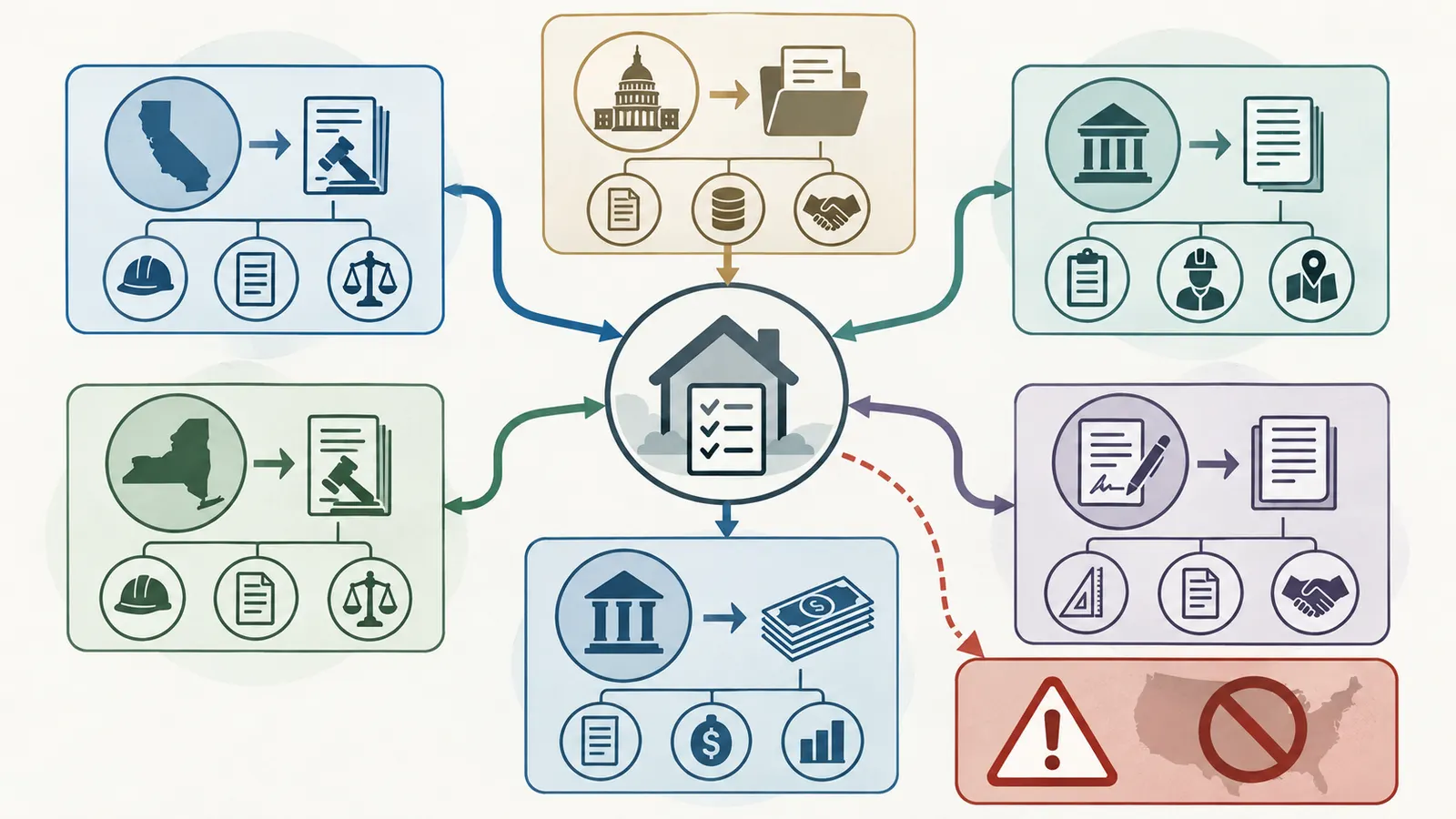
Use the project’s actual jurisdiction for legal gates and use federal or industry sources only for broadly scoped recordkeeping and contract-practice examples; never turn a California, New York, Los Angeles, Caltrans, or AIA example into a national homeowner rule.
California: written payment, change, and release controls
For California home-improvement work in the scope of CSLB’s consumer guidance, the contract should be written and detailed, and the payment schedule should describe the work or materials tied to each progress payment. Read CSLB’s contract guidance. Read CSLB’s progress-payment guidance. Changes should be written and signed before the changed work starts. Read CSLB’s change-order guidance. CSLB’s homeowner guide also describes a mechanics-lien risk that can remain even after a homeowner pays the direct contractor if subcontractors, suppliers, or workers are unpaid. Read the California homeowner mechanics-lien guide.
For the release sequence, CSLB describes conditional and unconditional forms for progress and final payments. A conditional release can be used before the claimant has actually received the payment; it becomes effective only under the conditions stated, such as evidence of payment. An unconditional release is used when the claimant asserts payment has been received. CSLB cautions that the actual claimant must sign and deliver the release and that paying the direct contractor or obtaining a release from that contractor does not guarantee that other claimants have been paid. Review the California waiver and release form guidance.
This yields a California worksheet sequence:
- Identify preliminary notices or other notices received and preserve them in the job file.
- Match the payment application to the work and the parties who may have supplied labor or materials.
- Obtain the appropriate conditional release before paying when the form and project circumstances call for it.
- Pay through the agreed method, keeping the cancelled check, receipt, or other evidence.
- Obtain the corresponding unconditional release after payment and verify that the actual claimant signed it.
- At final payment, use the correct California form and attorney-approved exceptions rather than an improvised “paid in full” email.
This is a planning sequence, not a completed legal form. California Civil Code forms and timing can matter, and the project may not be classified as a CSLB home-improvement contract. Have a California construction attorney confirm the project classification, notice handling, payment schedule, and release language.
New York: payment schedule, final gate, and payment protection
The New York Attorney General says a home-improvement contract should be written and include the timeline, payment schedule, project specifics, and required consumer notice. It also says a progress-payment schedule must have a reasonable relationship to work done, materials purchased, or other project-related costs. Read the New York payment-schedule summary.
The same fact sheet tells homeowners not to pay the full price upfront and to withhold final payment until work is complete and required inspections and certificates of occupancy are finalized. Put that into the worksheet as separate rows: “work complete,” “required inspection status,” and “certificate of occupancy or local equivalent.” Do not collapse them into a single checkbox. A certificate may be issued by a building official, while work completion and contractual acceptance may still require the owner’s or design professional’s review.
New York payment protection also needs its own row. The Attorney General says covered progress payments received before completion are to be protected through an escrow trust account or an alternative bond or contract of indemnity, with specific timing and disclosure requirements summarized in the fact sheet. The contract exhibit should identify the selected method, account or bond evidence, responsible recipient, disclosure date, and what happens when the protection is unavailable. Confirm the legal requirements for the actual project and county before relying on this summary.
New York has local licensing differences as well. The Attorney General notes that home-improvement contractors must be licensed in New York City and in Suffolk, Nassau, Westchester, Putnam, and Rockland counties. Licensing, payment protection, lien law, building permits, and certificate-of-occupancy requirements are separate questions. Keep separate rows and name the relevant county, city, or authority. Review the New York local-licensing note.
Federal guidance: records and lender handoffs, not a federal retainage rate
The CFPB guidance in this article is about rebuilding after a disaster, not a national custom-home payment statute. Its recordkeeping advice is still useful: check with the mortgage company or servicer about the timing and distribution of funds; keep written records and receipts; track contractor payments and progress; obtain signed contracts, guarantees, and warranties; record who pays for materials, permits, dates, total price, and payment schedule; and get receipts instead of paying cash. Use the CFPB checklist as a record-control prompt.
Do not tell the lender that a final inspection passed merely because a contractor’s application says “complete.” Give the lender the document issued by the authority or qualified verifier, if its draw instructions require one. Conversely, do not tell the builder that the lender’s draw approval confirms workmanship. Record both decisions separately.
Los Angeles and Caltrans: administrative examples only
The Los Angeles Bureau of Engineering manual is valuable for its roles and fields: schedule of values, completed work, materials delivered, change orders, math, insurance, payments to date, retention, and disputed funds. It is not a private-home contract statute. Its page identifies a public procedure revised May 15, 2018, so it should be labeled as a dated example rather than current local law for a homeowner. Read the Los Angeles procedure and its scope.
Caltrans provides a similar audit-trail example for public construction payments. It emphasizes source documents, independent checking, records of quantities and calculations, and final-estimate support. It does not set a private homeowner’s retainage rate or tell a homeowner how to certify a custom home. Use the principle—each number has a source, preparer, and checker—without importing Caltrans forms or public-contract deadlines. Read the Caltrans payment manual.
AIA: a contract-practice pattern, not a statute
AIA’s official instructions say a schedule of values allocates the Contract Sum among portions of the work and that payment procedures should address monthly or phase payments, retainage if any, and review time. The public A105 sample describes final payment after acceptable completion and submission of lien releases, waivers, and information establishing payment or satisfaction of obligations. Its separate Section 7.3 example allows the architect to withhold or nullify a payment certificate only within the written-notice, failed-correction, reasonable-reimbursement, and architect-approval conditions described above. Read the official AIA instructions. Read the public A105 sample.
AIA also warns that lien-waiver and release forms may be state-specific and recommends attorney consultation before completing or modifying them. That warning matters even if the builder proposes an AIA-based form. A standard form is a starting architecture, not evidence that the form is valid for California, New York, the county where the project sits, or the actual financing arrangement. Read AIA’s state-specific waiver guidance.
The next decision
Make a jurisdiction column mandatory. Enter the actual state, county, city, building authority, lender, governing-law clause, and contract classification. Then mark each row as legal requirement, lender requirement, contract term, public administrative example, or Brictale synthesis. If a row cannot be labeled, it is not ready to become a contract condition.
6. Write the release sequence from substantial completion to closeout #
Write the final-payment sequence as dated handoffs with notice and cure periods; “pay when finished” is too vague for a custom home because completion, inspection, occupancy, payment, lien, warranty, and lender records may mature at different times.
Gate 1: announce readiness and freeze the accounting snapshot
The builder should send a written notice that the project or defined portion is ready for substantial-completion review. The notice should identify the contract version, current contract value, payment application, proposed retainage release, approved changes, outstanding changes, allowances, stored materials, known defects, and requested inspection dates.
The owner or designated reviewer should respond with a dated record of what was reviewed and what remains open. The contract should state whether silence is acceptance. Do not let silence become accidental approval unless local counsel has deliberately drafted that result and the owner understands the risk.
Freeze the accounting snapshot at this gate. If an owner selection changes after the review, create a new change record rather than editing the old application. If the builder discovers a concealed condition, follow the notice and change procedure. If the lender requires a draw inspection, schedule it separately from the owner’s walk-through.
Gate 2: define substantial completion without pretending everything is perfect
Substantial completion should be tied to intended use or the project-specific definition in the contract. The AIA sample uses an intended-use concept for substantial completion, but an AIA definition does not automatically govern your agreement. The contract should state what can remain: minor cosmetic items, seasonal work, owner selections, manuals, testing, landscaping, or other specifically identified work.
For a new custom home, ask whether the owner can legally and safely occupy the home. The answer should come from the applicable building authority’s records, not a contractor’s promise. A permit final, certificate of occupancy, temporary certificate, or local equivalent can have different meanings. Name the issuing authority and the document required in the project jurisdiction.
Substantial completion is not a waiver of defects. The contract should say whether payment, occupancy, or a lender draw changes the owner’s right to require correction. The public AIA sample expressly says a progress payment or partial use or occupancy does not constitute acceptance of work that does not conform to the contract documents. That is a standard-form example, so make the intended rule explicit in the signed agreement. See the AIA sample’s payment and completion language.
Gate 3: complete inspections, tests, and authority records
Build an inspection matrix before construction starts. For each required inspection or test, list the authority or qualified professional, responsible scheduler, prerequisite, expected record, result, corrections, reinspection date, and effect on payment. Include the local building department’s final inspection and occupancy status when applicable. Include special systems only when the contract or local authority requires them.
The owner should not sign a statement that a hidden electrical, structural, fire, or life-safety condition is acceptable based only on a remote photograph. Ask the relevant licensed professional or building official. Do not perform energized testing, structural inspection, excavation entry, roof access, or confined-space work as a payment ritual. A payment gate cannot justify unsafe behavior. The homeowner must not remotely diagnose, pressurize, or perform pressure testing on plumbing, gas, fire-suppression, or any other pressurized system. Route pressure-test results, leaks, and acceptance to the qualified trade and/or building official responsible for that system.
If the local authority has not issued a required final record, label the status “pending authority action,” not “owner accepted.” If an inspection failed, attach the correction notice, assign the responsible party, and set a reinspection gate. If the permit is closed but a contract item remains incomplete, keep the contract item open. Public approval and private performance are distinct.
Gate 4: reconcile the punch list and disputed amount
The punch list should be specific enough that another person can locate and understand each item. Use an ID, room or location, drawing/specification reference, description, priority, responsible trade, date reported, correction deadline, verifier, status, and holdback amount if one is contractually agreed.
Separate observation from conclusion. “Water staining below north window after rain on March 2” is an observation. “Envelope failure caused by incorrect flashing” is a technical conclusion that may require a qualified building professional. “Cabinet door rubs at upper hinge” is an observable item. “Cabinet installation violates the code” is a code conclusion for the appropriate authority or professional.
If the owner disputes the cause or value, the notice should say what is undisputed, what is disputed, the document or contract clause relied upon, and what inspection or response is requested. A general statement that “the house is not acceptable” does not give the builder a cure target. A builder’s general statement that “everything is complete” does not answer a numbered item list.
Gate 5: collect payment, lien, and title-protection evidence
The final packet should show who has been paid, for what period and scope, and what release or payment record is required by the project jurisdiction. Do not treat a contractor’s invoice as a subcontractor release. Do not treat a conditional release as unconditional. Do not sign a broad waiver that erases an unresolved claim without attorney review.
California CSLB’s release guidance is a clear example of why the sequence matters: conditional and unconditional releases have different purposes, and the actual claimant must sign. A separate California CSLB homeowner guide says the homeowner may withhold the next payment until unconditional releases for the previous payment are received; treat that as a California-specific safeguard, not a national payment entitlement. New York’s Attorney General also warns that an unpaid contractor or subcontractor may have a claim against the property under the Lien Law. These statements are jurisdiction-specific and should lead to a local release plan, not an assumption that one national form works everywhere. Review California’s release-form guidance. Read California’s homeowner lien-safeguard guide. Review New York’s lien warning.
For each required release, record the claimant, scope through date, payment amount, conditional or unconditional status, exceptions, signer authority, date received, and whether counsel approved the form. If a payment bond exists, identify whether the release affects bond rights as well as lien rights. If the lender requires a title update or sworn statement, record that as a separate lender gate.
Gate 6: deliver the closeout and warranty package
The final-payment exhibit should list closeout records rather than using “all documents.” Possible records include approved as-built information, equipment manuals, model and serial records, warranties, maintenance schedules, inspection approvals, testing reports, keys, access codes, utility account information, spare materials, paint colors, approved substitutions, training records, and a list of remaining warranty obligations.
The list must match the project. Do not require record drawings that were never part of the contract unless the parties agree to add them. Do not accept a generic warranty summary when the contract promises manufacturer documents. Record who delivers each file, in what format, and whether it has an expiration date or claim procedure.
The builder should identify the warranty contact and response method. A warranty is not proof that the underlying work is complete, and a final payment is not proof that every warranty issue is resolved. Keep those states separate in the worksheet.
Gate 7: release the undisputed amount and document the handoff
The release notice should state the current contract value, amount paid, reserve, approved release, disputed amount, new balance, records received, records outstanding, and payment date. If the contract permits partial release, release only the amount that the evidence supports. If the lender will fund the release, record the draw number and funding confirmation.
If an amount remains disputed, the notice should preserve the owner’s stated claim and the builder’s response without implying that either party has conceded. The contract should set the next step: correction, inspection, meeting, mediation, architect decision, dispute board, arbitration, court, or another legally reviewed method. Do not choose a forum casually; dispute clauses can affect rights and cost.
The next decision
Turn the sequence into an exhibit with named dates or time periods: notice, review, inspection, response, cure, release, lender submission, and dispute escalation. Ask counsel whether the exhibit conflicts with payment timing, lien deadlines, prompt-payment law, escrow requirements, or the contract’s termination and suspension provisions.
7. Use the worksheet to test a reserve and expose failure cases #
Use a worksheet that makes the reserve calculation reproducible and the release decision inspectable; the number should change when the contract value, approved changes, or selected reserve rate changes.
Source-labeled homeowner worksheet
Copy this structure into the proposed contract exhibit or payment-control file. “Confirm locally” means a state-specific attorney, building official, lender, architect, engineer, or other qualified professional must decide; it does not mean the homeowner should fill the field by guesswork.
| Row | Contract amount | Proposed reserve | Completion gate | Responsible verifier | Required record | Approved changes | Lien or release evidence | Inspection or occupancy status | Release date | Disputed amount | Local confirmation |
|---|---|---|---|---|---|---|---|---|---|---|---|
| Base contract and first payment | $_____ | $_____ | Signed scope and payment schedule | Owner and attorney | Signed agreement and exhibits | None or IDs | State-specific prepayment or notice records | Permit path identified | _____ | $_____ | Contract classification and down-payment rule |
| Progress application _____ | $_____ | $_____ | Line items complete or eligible materials documented | Contractor plus assigned reviewer | Application, schedule of values, receipts or delivery records | IDs _____ | Progress release forms if required | Current inspections listed | _____ | $_____ | Lender draw conditions |
| Approved change reconciliation | $_____ | $_____ | Every addition/credit signed and entered | Owner and contractor; design reviewer when needed | Signed change-order log and revised value | +$_____ / −$_____ | Release scope updated | Change-related inspection identified | _____ | $_____ | Notice and signature rules |
| Substantial completion | $_____ | $_____ | Home or defined portion usable under contract definition | Named architect, owner’s representative, or other qualified verifier | Dated certificate/report and exception list | IDs _____ | Interim releases through date | Authority status _____ | _____ | $_____ | Contract definition and local occupancy rules |
| Punch-list release | $_____ | $_____ | Listed items corrected, accepted, or priced by agreed method | Named verifier for each item | Item log, correction evidence, reinspection | IDs _____ | Conditional/unconditional form as applicable | Corrections and reinspection _____ | _____ | $_____ | State form and legal remedy |
| Final completion | $_____ | $_____ | Scope, cleanup, testing, and closeout complete | Contract-defined verifier | Final acceptance or completion record | Final IDs _____ | Final releases, waivers, payment evidence | Final inspection/CO or equivalent _____ | _____ | $_____ | Lien, prompt-payment, and notice timing |
| Warranty and handover | $_____ | $_____ | Required manuals, warranties, training, keys and records delivered | Owner confirms receipt; professionals confirm technical records | Closeout register | None unless added | Exceptions preserved | Occupancy and utility handoff recorded | _____ | $_____ | Lender and local record requirements |
| Dispute handoff | $_____ | $_____ | Undisputed amount released; issue isolated | Contract dispute decision-maker | Notice, evidence packet, response and cure plan | ID _____ | Releases limited to paid scope | Authority status not misrepresented | _____ | $_____ | Attorney confirms remedy and forum |
The worksheet is intentionally not a universal form. It forces the contract drafter to choose the applicable jurisdiction, define the evidence, and state who is accountable. A blank field is a decision to make before signature, not a permission to defer the issue until the final invoice.
Illustrative calculation: show the inputs and units
The following is an illustrative modeled example, not a quote, survey, test, or recommendation. It uses a hypothetical fixed-price custom-home contract so the method can be checked.
Inputs (the accounting basis is part of the example):
- Signed base contract: $640,000.
- Approved additions: $24,000.
- Approved credits: $8,000.
- Cash paid to date, net of the separately stated retainage: $588,000.
- Proposed reserve rate: 5.0% of the current contract value, used only to demonstrate the formula.
- Retainage already withheld in prior applications: $22,000.
- Proposed release at final completion: $18,000.
- Itemized punch-list holdback if still unresolved: $6,500.
Step 1, calculate current contract value:
$640,000 + $24,000 − $8,000 = $656,000
Step 1A, reconcile the payment basis before calculating a reserve:
Gross approved work to date = cash paid to date + retainage already withheld
$588,000 + $22,000 = $610,000 gross approved work to date
Gross remaining approved balance = current contract value − gross approved work to date
$656,000 − $610,000 = $46,000 gross remaining balance
The $22,000 retainage is already unpaid and held separately. Therefore, the total amount not yet paid in cash is $46,000 + $22,000 = $68,000, but only the $46,000 is the current gross balance from which additional retainage can be withheld. This distinction is why the ledger must say whether “payments to date” means gross approved work or cash actually paid.
Step 2, calculate the illustrative reserve at 5.0%:
$656,000 × 0.050 = $32,800
Step 3, compare the illustrative reserve with retainage already withheld:
$32,800 − $22,000 = $10,800 additional reserve needed to reach the modeled target
That $10,800 is not automatically due or automatically withholding authority. It is the additional amount that would need to remain unpaid from the $46,000 gross remaining balance to reach the modeled $32,800 total reserve. If the contract calculated retainage on each application’s earned amount rather than the current value, the result may differ.
Step 4, show a proposed release ledger:
| Modeled line | Amount |
|---|---|
| Current contract value | $656,000 |
Gross approved work to date ($588,000 cash paid + $22,000 retainage) | −$610,000 |
| Gross remaining balance before additional reserve and disputes | $46,000 |
| Retainage already withheld and still unpaid | $22,000 |
| Modeled reserve target at 5.0% | −$32,800 |
Additional reserve needed to reach modeled target ($32,800 − $22,000) | −$10,800 |
| Illustrative amount above the additional reserve that may be payable if otherwise approved | $35,200 |
| Proposed final-completion release | $18,000 |
| Proposed punch-list holdback if the listed $6,500 remains unresolved | $6,500 |
| Remaining amount requiring reconciliation or later release | $10,700 |
The last line is calculated from the $46,000 current gross balance: $46,000 − $10,800 − $18,000 − $6,500 = $10,700. It is a warning, not a result to pay or withhold. It may include unpaid approved work, unprocessed changes, uncredited payments, warranty or closeout amounts, or an arithmetic error. Reconcile it before signature or payment.
Now test the other interpretation instead of silently switching bases. If the $588,000 had meant gross approved work before the $22,000 retainage, gross remaining balance would be $656,000 − $588,000 = $68,000; cash paid would be $588,000 − $22,000 = $566,000; and the additional reserve to reach $32,800 would still be $10,800. The amount above that additional reserve would be $68,000 − $10,800 = $57,200, not $35,200, and the analogous unallocated line after the same $18,000 release and $6,500 holdback would be $32,700, not $10,700. The example therefore relies on the stated net-cash basis for the $35,200 and $10,700 figures.
Sensitivity: the reserve changes with the base and rate
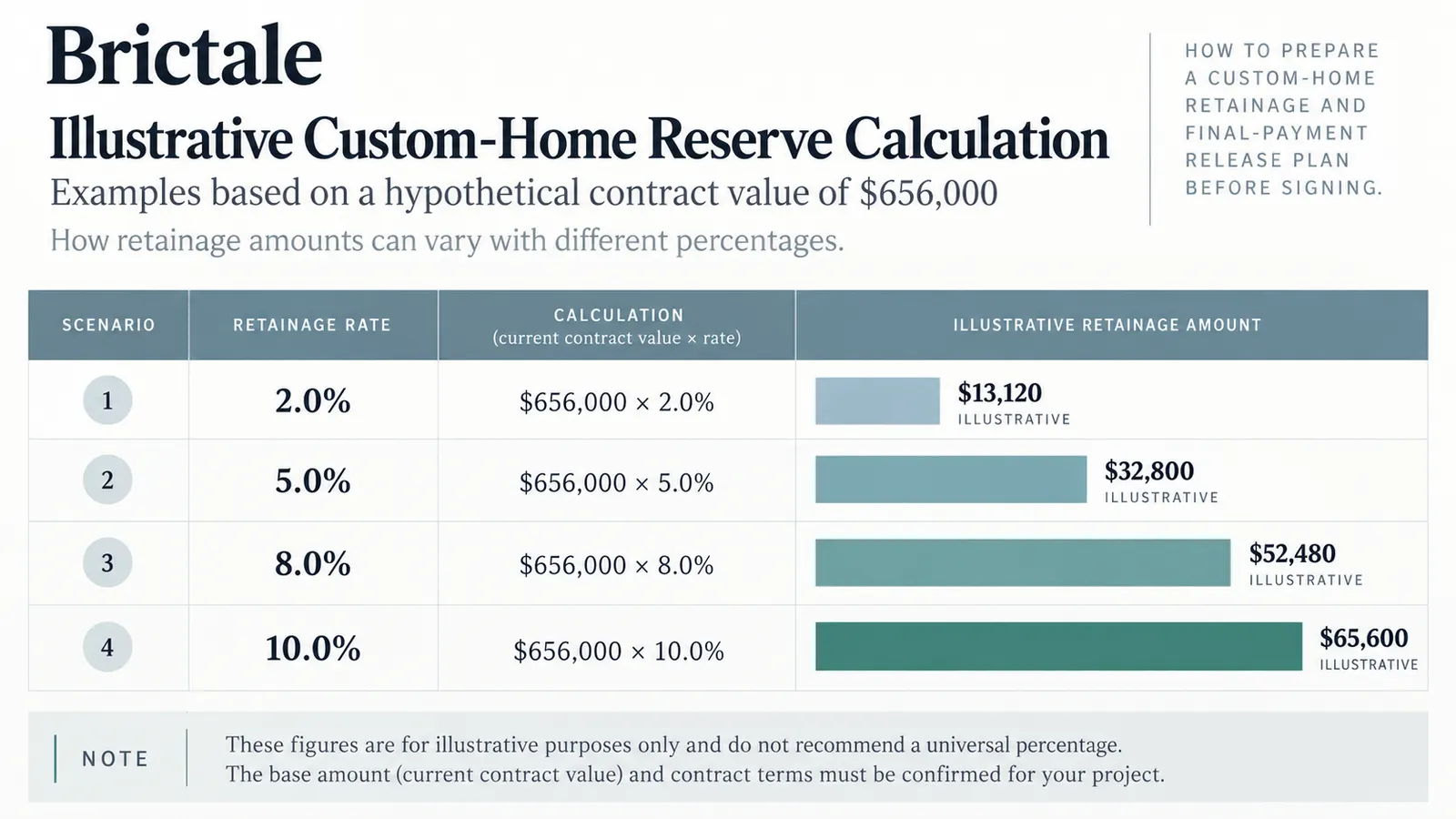
Using the same hypothetical current contract value of $656,000, the modeled rate sensitivity is:
| Illustrative rate | Formula | Modeled reserve |
|---|---|---|
| 2.0% | $656,000 × 0.020 | $13,120 |
| 5.0% | $656,000 × 0.050 | $32,800 |
| 8.0% | $656,000 × 0.080 | $52,480 |
| 10.0% | $656,000 × 0.100 | $65,600 |
The sensitivity shows why Brictale does not recommend a universal percentage. A 10.0% reserve in one contract can be less protective than a smaller, well-defined punch-list holdback in another, and it can materially change a builder’s cash flow. The contract should explain the business reason, base, release event, and dispute remedy. A rate is an input to negotiate with the builder and counsel, not a legal conclusion.
Failure case 1: the reserve is a percentage with no base
Symptom: the builder’s application uses 5.0% of the original contract, while the homeowner’s spreadsheet uses 5.0% of the current contract after changes.
Interpretation: the parties are not measuring the same reserve. The difference may be small or large depending on changes and credits.
Safest next step: stop the release calculation, write the alternative bases side by side, and have the contract or amendment choose one. Do not settle the difference by email shorthand.
Bring to the professional: signed agreement, all changes, payment applications, prior retainage ledger, current schedule of values, and the lender’s balance if financed.
Next handoff: revised payment exhibit and a new application number.
Failure case 2: “final” payment is requested before required authority records
Symptom: the builder says the home is complete, but the final inspection, certificate of occupancy, or local equivalent is pending.
Interpretation: contractual completion, public approval, and lender funding may be on different clocks. The homeowner should not represent the authority gate as passed.
Safest next step: record the exact authority status, ask the builder who scheduled the inspection, obtain the correction or appointment record, and ask the lender what document it needs. In New York, the Attorney General specifically tells homeowners to withhold final payment until required inspections and certificates of occupancy are finalized for the covered home-improvement context. Read the New York guidance.
Bring to the professional: permit number, inspection log, correction notices, proposed final application, and contract completion definition.
Next handoff: building official or qualified professional, then lender, then contract payment reviewer.
Failure case 3: the final invoice includes unsigned changes
Symptom: the final amount includes owner selections, upgrades, concealed-condition work, or credits that are absent from the signed change log.
Interpretation: the current contract value cannot be proven. The amount may be a legitimate claim, but it is not an approved contract balance until the agreement’s change procedure is satisfied or a dispute process decides it.
Safest next step: create a change ledger and separate signed changes from proposed or disputed changes. Do not sign a blanket acceptance to unlock a payment if it would erase the right to review the changes.
Bring to the professional: drawings, selection records, site instructions, emails, invoices, photos, notices, and the change-order clause.
Next handoff: design professional for scope, attorney for contract effect, lender for budget effect.
Failure case 4: a direct-contractor release is treated as everyone’s release
Symptom: the builder supplies a “paid in full” statement, but subcontractor or supplier releases are absent.
Interpretation: payment to the direct contractor does not necessarily prove that other claimants have been paid. California CSLB expressly warns homeowners about that risk and explains that actual claimants sign the relevant releases. New York’s Attorney General likewise warns of lien claims when contractors or subcontractors are not paid. Review California’s homeowner lien guidance. Review New York’s lien warning.
Safest next step: stop using the generic statement as the release gate, identify the jurisdiction-specific notice and waiver procedure, and ask counsel what releases, affidavits, bonds, title updates, or joint-payment methods are appropriate.
Bring to the professional: preliminary notices, subcontractor list, supplier list, payment ledger, proposed releases, and title or lender requirements.
Next handoff: construction attorney or title professional, then lender and payment reviewer.
Failure case 5: the lender approves a draw but the owner thinks the work is accepted
Symptom: a draw is funded and the builder says that the lender “signed off” on quality.
Interpretation: the lender may have reviewed a cost or collateral condition, while the contract requires a separate owner, architect, inspector, or public-authority determination.
Safest next step: ask the lender what its approval means and record it narrowly. Keep the contract acceptance and lender draw rows separate.
Bring to the professional: lender draw report, inspection report, payment application, contract acceptance definition, and open-item list.
Next handoff: owner’s contract reviewer and, if needed, independent inspector or attorney.
Failure case 6: a small cosmetic item blocks an undefined large balance
Symptom: one unresolved item is used to justify withholding the entire final payment, or the builder refuses to correct it because the owner has no defined holdback.
Interpretation: the contract lacks proportionality, item valuation, or partial-release mechanics.
Safest next step: document the item, obtain a qualified valuation or agreed completion amount, release undisputed funds if the contract allows, and reserve only the amount the agreement supports. Do not make a technical cause finding from a photograph.
Bring to the professional: contract clause, item list, correction history, independent estimate or professional opinion if necessary, and proposed partial-release calculation.
Next handoff: designated verifier, then the contract’s dispute decision-maker.
The next decision
Run at least the six failure cases against the proposed exhibit. If the document cannot say what happens in one of them, the release plan is not finished. Add a specific branch, not a general sentence promising cooperation.
8. Sign only after the release exhibit passes the pre-signature review #
Sign the contract only when the payment exhibit can be followed by a person who did not negotiate it, and when any legal, building, engineering, lender, or lien question has been handed to the right qualified professional.
Pre-signature review checklist
Use this checklist in the final contract meeting:
- The contract identifies the project location, governing law, parties, responsible roles, and incorporated plans and specifications.
- The payment schedule says when an application may be submitted, what it must contain, who reviews it, when comments are due, and when an undisputed amount is paid.
- The schedule of values or equivalent breakdown reconciles to the contract value.
- The retainage base, rate or fixed amount, accumulation, accounting treatment, and release events are explicit—or the contract expressly says no retainage applies.
- Any punch-list holdback is separate from retainage and tied to itemized work, an agreed valuation method, a cure period, and partial release rules.
- The contract distinguishes approved, proposed, emergency, and disputed change orders.
- Change orders identify scope, amount, schedule effect, inspection effect, allowance treatment, and signatures required before work begins when applicable.
- Owner-supplied materials and builder-supplied materials have separate responsibility, delivery, title, storage, damage, warranty, and payment rules.
- Required permits, inspections, tests, final records, certificates of occupancy, or local equivalents are named by jurisdiction and responsible person.
- The lender’s draw checklist is reviewed and does not conflict with the contract payment sequence.
- The project-specific lien, payment-bond, escrow, notice, and release procedure is confirmed for the state and local jurisdiction.
- Conditional and unconditional releases are not treated as interchangeable.
- The packet specifies what proof of payment and signer authority must accompany each release.
- Warranties, manuals, record information, training, keys, and closeout documents have a named delivery owner and acceptance record.
- A final application can show current value, approved changes, payments to date, retainage, releases, disputed amount, and requested release without hidden spreadsheet adjustments.
- The dispute process says how to notify, cure, inspect, pay the undisputed amount, preserve claims, and escalate.
- The contract does not let a vague “satisfactory to owner” or “complete in all respects” phrase decide a large payment without a measurable process.
- The attorney, lender, design professional, inspector, and building official have each been asked only the question within their role.
What to carry into the contract meeting
Bring a one-page decision record with the proposed architecture, modeled reserve calculation, list of open legal and lender questions, and the worksheet. Bring the current drawings and specifications, scope exclusions, allowances, proposed schedule of values, change-order form, lender instructions, local permit path, insurance evidence, and the contractor’s proposed closeout list.
Ask the builder to explain the payment exhibit using a hypothetical application. Choose a line item, a signed change, a stored material, an incomplete punch-list item, a passed inspection, an unresolved lien release, and a lender condition. Have the builder show where each one appears, who reviews it, and how the resulting payment is calculated. If the explanation requires an undocumented promise, add the promise to the contract or remove it from the decision.
Ask the attorney to review the actual project jurisdiction, not just the form name. California CSLB material, New York Attorney General material, an AIA form, and a city or state public-works manual can each be useful while still answering different questions. The attorney should determine which rules apply, which notices and releases are required, and whether the proposed holdback or payment timing is enforceable.
Ask the lender to provide written draw conditions. Confirm whether the lender’s inspector observes progress, whether the lender requires a certificate of occupancy or final inspection, how it handles disputed work, how long review takes, and whether the owner must fund a gap if the contract payment is due before a draw is released. Record the answer as a financing condition, not as a workmanship approval.
Ask the building official or permitting authority what final approval means in that jurisdiction and whether any separate utility, fire, health, elevator, septic, driveway, or other authority record is needed for the intended use. Do not ask the official to interpret your contract or approve private warranty work.
Keep the payment exhibit connected to the rest of the build decision. The team and scope questions belong with choosing your team, the inspection and change sequence with managing the build, and the records, warranties, and ownership handoff with handover and ownership. Those are journey routes, not substitutes for the project’s contract, local rules, or professional review.
When to pause signature
Pause and obtain professional review when the builder asks for full payment before documented completion; refuses to provide a written schedule or current-value breakdown; includes unsigned changes in the final number; provides a generic lien release without jurisdiction review; says a lender draw is the same as acceptance; refuses to identify who pays subcontractors and suppliers; makes the reserve indefinite; or requires the owner to perform technical, unsafe, or unauthorized inspections.
Pause when the contract’s completion definition conflicts with the local authority’s occupancy process. Pause when a lender’s conditions are missing. Pause when the property is in California or New York and the agreement’s classification, payment-protection, or release rules have not been confirmed for the actual project. These are not accusations against a builder; they are evidence that the decision surface is incomplete.
Final release decision
At signature, you should be able to answer five questions without improvising:
- What amount is the current contract value, and how will approved changes update it?
- What exactly is being held, and is it retainage, punch-list holdback, or a disputed invoice?
- Which person verifies each release gate, and what record proves the gate?
- Which California, New York, federal, local, lender, or standard-form input applies—and which does not?
- If one item remains disputed, when is the undisputed amount paid and where does the dispute go next?
If the answer to any question is “we will decide at the end,” the proposed contract does not yet contain a final-payment release plan. Convert that uncertainty into a field, a named responsibility, a document, a date, and a handoff. Then have the appropriate local professionals confirm the parts this planning worksheet cannot decide.
The practical next decision is whether the proposed builder contract can accept this transparent release architecture. If it can, attach the completed exhibit, the schedule of values, the change-order process, the jurisdiction-specific payment and release forms, and the lender’s draw requirements before signing. If it cannot, do not solve the gap by choosing a larger percentage. Ask why the information is unavailable, have counsel assess the risk, and decide whether the scope, team, financing, or contract should change before the build begins.
Cite this guide
Brictale. “How to Prepare a Custom-Home Retainage and Final-Payment Release Plan Before Signing.” Published 2026-09-24; updated 2026-09-24.
https://brictale.com/build/contractors/prepare-custom-home-retainage-final-payment-release-plan · Read the Markdown version
Original contribution: Source-labeled homeowner worksheet: retainage and final-payment release plan. A row-by-row release sequence that separates contractual retainage, punch-list holdback, and an unpaid invoice while assigning evidence, responsibility, inspection status, lender review, and dispute handling.
Sources and scope
Evidence behind this page
- For California home-improvement projects over $500, CSLB says the contract and changes must be in writing, the contract must contain a detailed written payment schedule, and payments cannot exceed the value of work performed except for the permitted down payment; this consumer guidance is scoped to California home-improvement contracts.
California Contractors State License Board consumer guidance for home-improvement contracts; not a universal rule for every ground-up custom-home agreement.
Accessed · Link to this claim - The California Contractors State License Board's Contracting for Success guide says each progress payment should be stated in dollars and cents and specifically reference the work or services to be performed and the materials and equipment to be supplied; the guide also says the progress-payment schedule must describe each phase and its proposed payment in the California home-improvement contract context.
Contracting for Success: A Contractor’s Guide to Home Improvement Contracts
California CSLB guide for home-improvement contracts; use this as California-specific contract guidance and confirm whether the actual ground-up project falls within that category.
Accessed · Link to this claim - California CSLB guidance says a change to the contract price or scope must be a written change order signed by the customer and contractor before the change, and the change order becomes part of the contract.
Contracting for Success: A Contractor’s Guide to Home Improvement Contracts
California CSLB guide; applies to the home-improvement contract context described by the guide and does not replace project-specific legal review.
Accessed · Link to this claim - The California Contractors State License Board's Contracting for Success guide describes allowances as dollar amounts set aside for materials, finishes, fixtures, or other items not yet selected, and says that if the final cost is higher or lower than the allowance, the contract price is increased or decreased by a written change order; the guide also says the allowance example includes overhead, profit, and applicable sales taxes.
Contracting for Success: A Contractor’s Guide to Home Improvement Contracts
California CSLB guide, including its home-improvement contract example; use the allowance treatment as California-specific guidance and confirm the actual contract and governing law.
Accessed · Link to this claim - California CSLB explains that conditional and unconditional waiver-and-release forms exist for progress and final payments, describes when each form is used, and says a release is not binding unless the claimant signs and delivers it; paying the contractor does not guarantee that other claimants were paid.
Conditional and Unconditional Waiver and Release Forms
California mechanics-lien release guidance and statutory-form context; do not copy it as a release for another state without local confirmation.
Accessed · Link to this claim - California CSLB's homeowner guide describes a sequence of obtaining signed conditional releases before a payment and signed unconditional releases after payment from the actual claimants, and states that by law a homeowner may withhold the next payment until the unconditional releases for the previous payment are received.
California Contractors State License Board homeowner brochure on mechanics-lien safeguards; its withholding statement is California-specific and must not be generalized to other jurisdictions.
Accessed · Link to this claim - The New York Attorney General advises homeowners to establish a payment schedule, withhold final payment until the work is completed and required inspections and certificates of occupancy are finalized, and use a written contract with a timeline, payment schedule, project specifics, and required consumer notice; the fact sheet is about New York home-improvement work.
New York Attorney General consumer guidance, including the state’s home-improvement context; not a national final-payment rule or a substitute for local building-official and attorney confirmation for a ground-up home.
Accessed · Link to this claim - The New York Attorney General states that any progress-payment schedule agreed to in a covered home-improvement contract must bear a reasonable relationship to the work done, materials purchased, or other project-related costs; this is a New York-specific consumer-law input, not a national retainage formula.
New York Attorney General summary of home-improvement law; applicability to a particular custom-home agreement, project classification, county, and payment term requires New York legal review.
Accessed · Link to this claim - The New York Attorney General says home-improvement contractors must be licensed in New York City and in Suffolk, Nassau, Westchester, Putnam, and Rockland counties; the statement identifies those local jurisdictions and does not establish a national licensing rule.
New York Attorney General consumer guidance about local licensing coverage; verify the actual municipality, county, project classification, and current licensing authority before relying on it.
Accessed · Link to this claim - The New York Attorney General warns that an unpaid contractor or subcontractor may have a claim against the homeowner’s property under New York lien law; the warning is a New York-specific risk signal and does not determine whether a lien is valid or what release procedure applies to another jurisdiction.
New York Attorney General home-improvement consumer guidance and lien warning; obtain project-specific New York legal and title advice before selecting releases or withholding payment.
Accessed · Link to this claim - The New York Attorney General states that, for covered home-improvement contracts, payments received before substantial completion must be placed into a New York escrow trust account within five business days with disclosure to the customer within ten business days, or be protected by an alternative bond or contract of indemnity delivered within ten business days.
New York Attorney General summary of New York home-improvement payment protections; applicability to a particular custom-home contract requires New York legal review.
Accessed · Link to this claim - The CFPB advises homeowners working with contractors to check with the insurance and mortgage company or servicer about how and when funds are distributed, keep written records and receipts, track payments and progress, obtain signed contracts and warranties, and get receipts for payments rather than paying cash.
How can I find and work with contractors to rebuild after a disaster?
Federal CFPB consumer guidance written for rebuilding after a disaster; the recordkeeping and lender-handoff practices are used here as planning guidance, not as a universal construction-loan term.
Accessed · Link to this claim - The CFPB's contractor-rebuilding checklist tells homeowners to keep records of who paid for materials, permits, dates, total price, and payment schedule, and to keep written records and receipts, track contractor payments and progress, obtain signed contracts, guarantees, and warranties, and get payment receipts instead of paying cash; the guidance is for disaster rebuilding.
How can I find and work with contractors to rebuild after a disaster?
Federal CFPB consumer guidance for disaster rebuilding; these fields are used as a record-control prompt, not as a universal custom-home contract or lender requirement.
Accessed · Link to this claim - The Los Angeles Bureau of Engineering manual describes an approved Schedule of Values for lump-sum work as cost-loaded activities totaling the current contract value and uses it as the basis for estimating the value of work performed; it also assigns review roles to the contractor, construction manager, lead inspector, and payment office.
19.2 Progress Payment Procedures
City of Los Angeles public-works payment administration; a labeled process example, not a rule for a private US custom-home contract.
Accessed · Link to this claim - The Los Angeles payment procedure checks mathematical computations, insurance, final change orders, total payments, total retention, and disputed funds, and describes payment net of disputed funds or monies held for stop notices; this is a public project control example.
19.2 Progress Payment Procedures
City of Los Angeles public-works procedure; use as a design pattern for fields and handoffs, not as a private-home withholding entitlement.
Accessed · Link to this claim - The City of Los Angeles Bureau of Engineering Project Delivery Manual page for 19.2 Progress Payment Procedures identifies the procedure as revised on May 15, 2018; it is a dated public-works administrative example, not current local law for a private homeowner contract.
19.2 Progress Payment Procedures
City of Los Angeles Bureau of Engineering public-works procedure and its displayed revision date; do not present the date or procedure as a private-home rule.
Accessed · Link to this claim - Caltrans requires payment measurements and calculations to be entered on source documents with the item, location when applicable, measurements, calculations, preparer, and independent checker, and calls for a clear audit trail back to the first measurement or calculation.
Chapter 3, General Provisions, Section 9: Payment
California Department of Transportation public-works payment manual; a source-document and audit-trail example, not a homeowner law or private-project inspection standard.
Accessed · Link to this claim - AIA’s official A105 instructions say the Contract Sum should be allocated among portions of the work in a schedule of values and that payment procedures should address monthly or phase payments and retainage if any, with time for owner and architect review before payment is due.
Instructions: A105–2017 Standard Short Form of Agreement Between Owner and Contractor
AIA standard-form drafting guidance; a nonbinding contract-practice example that requires modification for project facts and governing law.
Accessed · Link to this claim - The public AIA A105–2017 sample states that the architect inspects the final work and issues a final payment certificate when the work is acceptable and the Contract is fully performed, and that final payment is not due until the contractor submits releases and waivers of liens plus data establishing payment or satisfaction of obligations. Separately, Section 7.3 permits the architect to withhold or nullify a payment certificate, in whole or in part, only after the contractor defaults or neglects the work, fails for seven days after written notice to commence and continue correction with diligence and promptness, and the architect approves the owner's corrective action and amounts charged.
AIA sample standard form; use as a contract-structure example only, not as law, a completed custom-home contract, or a recommendation to withhold an unspecified amount.
Accessed · Link to this claim - The public AIA A105–2017 sample lists written orders for changes issued under Article 10 as part of the Contract Documents; Article 10.1 says additions, deletions, or other revisions within the general scope adjust the Contract Sum and Contract Time in writing, while Article 10.2 requires written authorization for minor changes that do not adjust either amount. The sample does not establish a construction change directive or a universal rule that changed work is categorically unpayable without a particular form.
AIA A105–2017 public sample, Article 1 and Article 10; a nonbinding contract-practice example that must be adapted to the signed agreement and governing law.
Accessed · Link to this claim - AIA warns that lien-waiver and release forms may be regulated or require state-specific content and formatting and encourages attorney consultation before selecting or modifying a form.
Important Considerations for Sworn Construction Statements and Lien Waiver and Release Forms
AIA Contract Documents guidance on state-specific forms; not a substitute for the law of the project jurisdiction.
Accessed · Link to this claim