How to Handle a Home Construction Quality Concern Before a Progress Payment
A step-by-step US homeowner workflow to document a construction concern, map it to the contract, protect the payment record, verify correction, and escalate by jurisdiction.
The short answer
Before a progress payment, preserve the condition, map the concern to the signed contract and current drawings, and send a written notice that separates observed facts from conclusions. Ask the responsible builder, designer, inspector, or engineer to verify the issue. Pay or dispute only the contract-defined amount you can support, document undisputed work separately, and use your state’s correct complaint, mediation, lien, or legal channel when the handoff fails.How to Handle a Home Construction Quality Concern Before a Progress Payment
Before a progress payment, preserve the condition, map the concern to the signed contract and current drawings, and send a written notice that separates observed facts from conclusions. Ask the responsible builder, designer, inspector, or engineer to verify the issue. Pay or dispute only the contract-defined amount you can support, document undisputed work separately, and use your state’s correct complaint, mediation, lien, or legal channel when the handoff fails.
This guide is for a United States homeowner managing a site-built single-family build or substantial remodel after a contractor has started work. It is a project-control workflow, not a remote inspection and not personalized legal advice. A photo can show a condition; it usually cannot establish structural adequacy, code compliance, concealed damage, or the legal amount a party may withhold. Keep those conclusions with the appropriate qualified person and the actual contract.
For the wider sequence of decisions around a home, see Brictale’s planning, building, and ownership blog. This guide stays focused on one live handoff: a quality concern that appears before a progress payment.
1. Decide what must happen before this payment #
The immediate decision is usually not “pay everything” or “stop everything.” It is: identify the affected payment line, preserve the condition, notify the responsible parties, and decide whether the next handoff can proceed while the disputed item is corrected, verified, priced as a change, or escalated. A quality concern should narrow the next action to the affected scope unless the contract, safety condition, or professional verifier requires a broader pause.
The owner’s safest first output is a dated record with five statements:
- What was observed, where, and when.
- Which contract document appears relevant.
- What is still unknown.
- Who is being asked to verify or respond.
- What payment or handoff is being held for review, if any.
That record prevents several common errors at once. It stops a concern from disappearing when drywall, insulation, soil, waterproofing, or another trade covers it. It prevents a homeowner from calling an owner preference a defect. It gives the contractor a fair opportunity to respond and correct. It also makes a later discussion with a designer, building official, mediator, insurer, or attorney less dependent on memory.
Do not use a quality concern as a reason to issue a blanket instruction such as “no one gets paid.” A payment schedule, retainage, notice procedure, lien exposure, right-to-cure rule, or lender draw process may affect the consequences of that instruction. California CSLB says a home-improvement payment schedule must be written and that payments generally cannot exceed the value of work performed, while a scope or price change must be in a written change order signed before the change. That is a California rule, not a national permission to withhold a payment in every state or contract. California CSLB’s contract guidance
For a concern discovered before a progress payment, use this order:
| Decision gate | Owner output | Responsible verifier or handoff | Payment implication to record |
|---|---|---|---|
| Is there an immediate danger? | Keep people away; record the condition from a safe location | Contractor’s site safety lead, qualified trade, engineer, or emergency service as appropriate | Safety pause is not the same as a payment determination |
| Is the condition about incomplete work or a prerequisite? | Identify the exact unfinished prerequisite and the next trade affected | Superintendent, project manager, designer, or trade lead | Ask which payment line depends on it; do not assume all work is unearned |
| Does the work differ from the contract documents? | Mark the drawing, specification, allowance, or schedule line | Contractor plus architect/designer or engineer where the design is involved | Classify as possible nonconforming work; separately list undisputed earned work |
| Did the owner request a different result? | Record the request and whether it was signed and priced | Owner and contractor under the change procedure | Treat as a possible change order, not a defect, until scope is compared |
| Is this a permit or code question? | Record the permit number, inspection status, and exact question | Authority having jurisdiction or licensed design professional | Do not self-certify compliance or make payment depend on an unsupported code conclusion |
| Is the evidence inconclusive? | Preserve it and state the unknown | Neutral qualified verifier selected under the contract | Mark the amount as under review only as the contract and local law permit |
The next decision after this first gate is one of six bounded outcomes: release the undisputed amount, request correction, document a disputed scope item, approve a defined change order, pause the affected handoff, or escalate. The rest of the guide explains how to reach one outcome without confusing the categories.
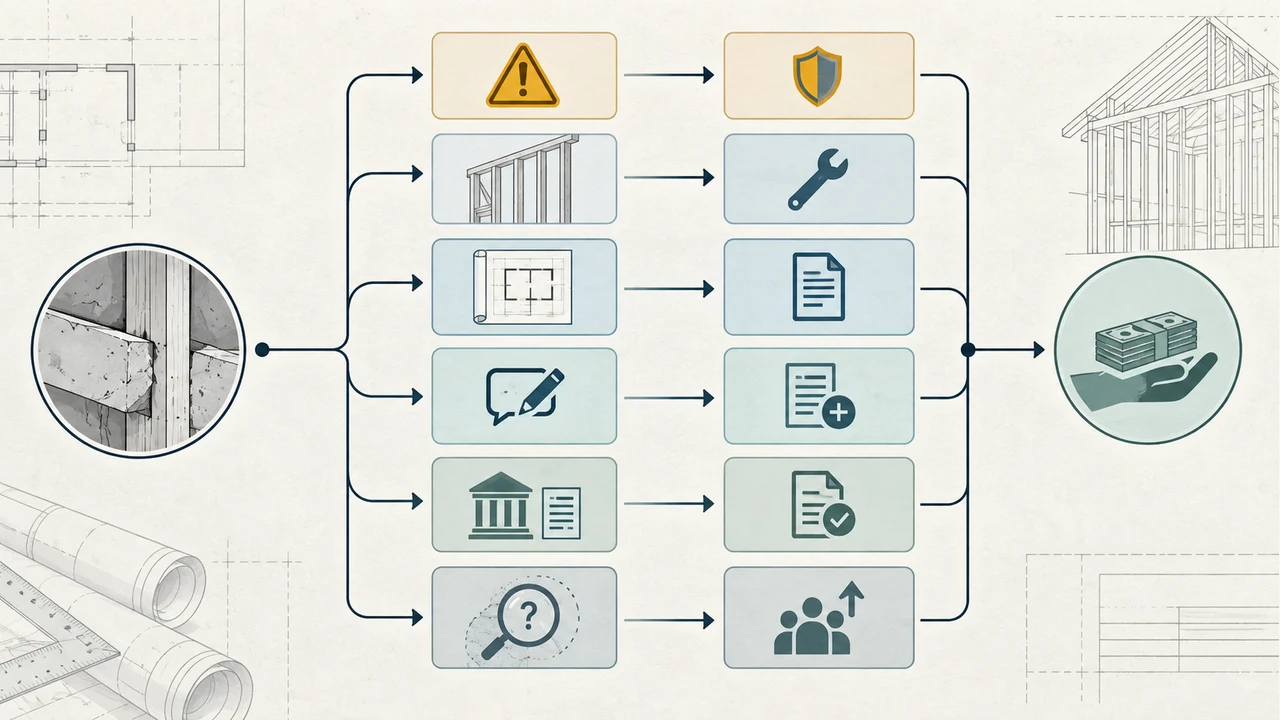
What “before payment” does and does not mean
The invoice date is not automatically the verification date. A contractor may invoice after completing the contract milestone, after purchasing materials, or according to a calendar schedule. Your contract should tell you which event controls. If the invoice says “rough-in complete,” compare that phrase with the payment schedule, the scope definition, the current drawings, and any approved changes. If the invoice is a draw request to a lender, use the lender’s draw requirements as an additional record; do not assume the lender’s inspection replaces your contract review or the authority’s inspection.
Similarly, a visible imperfection is not automatically a breach. A variation may be within a stated tolerance, an allowance may permit a range, a finish may be incomplete by design, or the photograph may show a temporary condition. The proper question is not “Does this look wrong to me?” but “What document, requirement, sequence, or verified condition does this observation contradict, if any?”
Safety boundary
Keep the inspection of the record separate from entry into a hazardous area. Construction can expose workers and visitors to falls, electrical incidents, struck-by hazards, and trenching or excavation hazards; OSHA identifies these as serious construction risks. Its trenching guidance says a worker should not enter a trench unless it has been properly inspected by a competent person. A homeowner should not enter an unprotected excavation, climb an unguarded structure, energize or test wiring, disturb shoring, open a pressurized system, or remove protective work merely to get a better photograph. OSHA’s construction safety guidance
Do not enter a confined space, even to take a photograph or retrieve a record. OSHA’s construction confined-space standard assigns identification and entry controls to the employer’s competent person and requires a written program and related controls for permit-space entry; it does not make a homeowner a qualified entrant. OSHA’s confined-spaces-in-construction standard
If material may be contaminated, do not sample, open, cut, scrape, bag, or otherwise disturb it yourself. That includes suspected asbestos or an unknown residue, dust, sewage-affected material, or other substance whose hazard is not known. EPA says trained and accredited asbestos professionals should take asbestos samples because incorrect sampling can increase risk, and advises using an asbestos professional or health department before disturbing asbestos. EPA’s asbestos exposure guidance Hand off to the contractor’s qualified safety lead, a qualified environmental or industrial-hygiene professional, the health/building/fire authority, or emergency services as appropriate. The credential and reporting route depend on the material and jurisdiction; confirm the local rule instead of treating OSHA or EPA guidance as a private-home license rule.
If the concern is a smell, energized component, gas line, unstable wall, active leak near electrical equipment, exposed fall edge, excavation, suspected contamination, or other condition that could injure someone, give a short safety notice and let the contractor control access. Ask for the qualified person or authority who will assess it. Your worksheet can say “access restricted; professional verification required” without guessing the cause.
2. Preserve the condition and build the input record #
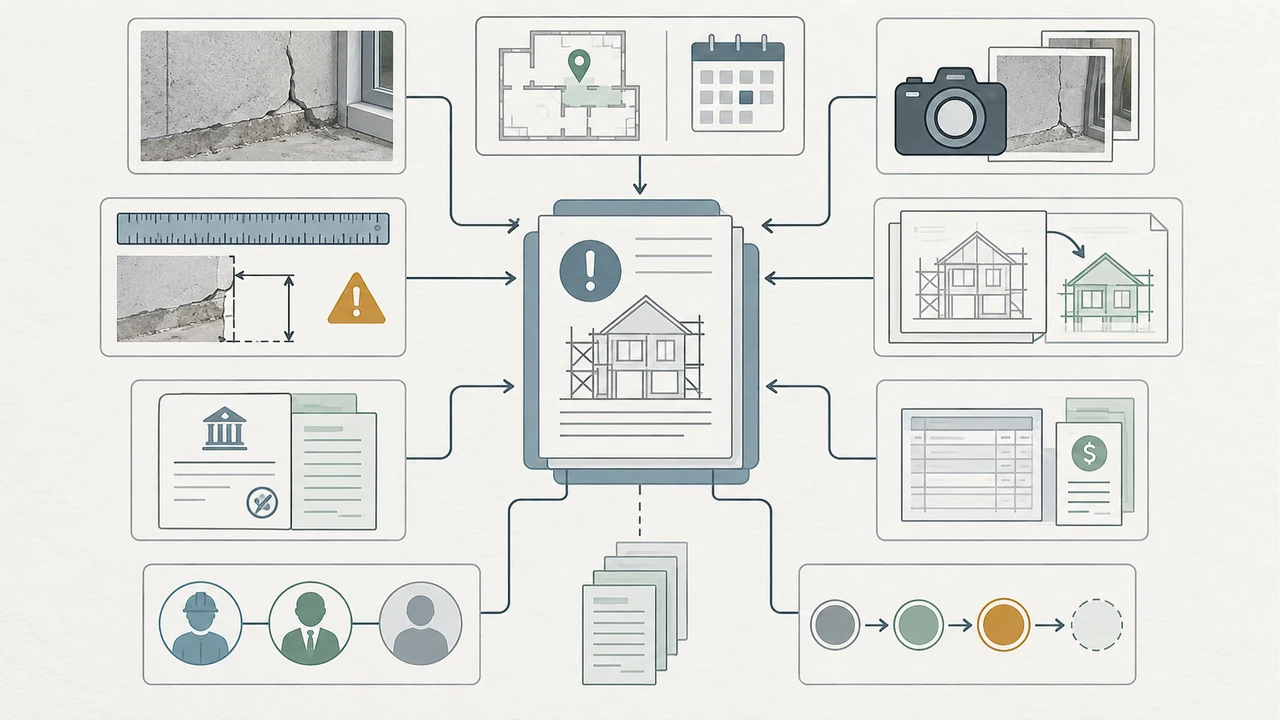
Before requesting a correction or deciding how a payment line should be treated, preserve enough evidence for another person to understand the condition without relying on your memory. Record the location, date, stage, measurements, contract reference, affected trade, and what has not yet been checked. The owner’s job is to make the condition legible; the owner is not required to make a remote diagnosis.
Start with an evidence packet
Create one folder or project log entry per concern. Use a stable identifier such as QC-014-kitchen-west-wall. Put the same identifier in the subject line of the notice, photo filenames, meeting notes, invoice response, and later verification record. Include:
- Observation. Write only what can be seen, measured, counted, or read. “Two conduit locations shown on E-2.1 are not visible at the north wall” is stronger than “the electrician did a bad job.”
- Location. Use room, elevation, grid, station, level, lot feature, or another reference a trade can find. Include a sketch if the drawing does not make the location obvious.
- Date and stage. Record the observation date, the work date if known, weather if relevant, and whether the item is open, partially covered, or fully covered.
- Photographs. Take an overall image showing context, a mid-range image showing the location, and a close image showing the condition. Put a ruler, tape, level, or other scale in the image only when it can be used safely and does not disturb the work. Do not move components just to make a photograph clearer.
- Measurements. Record units, instrument or method, start and end points, and any limitation. “Gap measured at 6 mm with steel rule at the lower left corner; surface was dusty and not cleaned” is reproducible. Do not turn one casual measurement into a tolerance conclusion.
- Contract mapping. Identify the contract section, drawing number and revision, specification section, schedule line, allowance, submittal, approved request, or manufacturer instruction that appears relevant. Copy the short phrase into your log and link or attach the complete document internally.
- Payment mapping. Record invoice number, payment application, draw number, milestone name, amount requested, prior payments, retainage if any, approved change orders included, and the exact amount or scope affected by the concern.
- People. Name the owner contact, contractor or superintendent, affected trade, designer or engineer, inspector or authority, lender draw contact, and proposed verifier. Do not assume the person who installed the item is authorized to approve a design departure.
- Status. Use one of: observed, contractor response pending, verifier assigned, correction proposed, correction in progress, ready for verification, verified, unresolved, or escalated.
The packet should also include the permit or inspection record when the concern touches permitted work. Brictale uses that record as a time-and-scope record of what the authority recorded for the inspection; this is a recordkeeping limitation of the worksheet, not a universal statement about the legal effect of every inspection. The worksheet therefore does not treat a pass or fail as a determination of hidden conditions or private contract conformity. For a California detached one- or two-family dwelling, accessory dwelling unit, or qualifying townhome, first identify whether the project falls under the current 2025 California Residential Code, Title 24, Part 2.5, and then confirm the local enforcing agency’s inspection requirements. California HCD identifies the 2025 California Building Standards Code, including Part 2.5, as effective January 1, 2026; the California Building Standards Commission describes Part 2.5’s residential scope. These sources identify the current code family and jurisdictional boundary; they do not resolve the private contract comparison or the project’s inspection result. California HCD’s current-code bulletin and CBSC’s Part 2.5 scope FAQ For another jurisdiction, check the applicable authority’s inspection and code rules.
Use a no-disturbance rule
If the issue may be covered by the next trade, write a no-cover request for the affected area, not an open-ended shutdown. State the location, the reason verification is needed, the person expected to respond, and the latest safe time for a decision. For example: “Please do not close the west kitchen wall between the two marked studs until the electrical rough-in locations shown on E-2.1, revision 4, are checked by the electrical contractor and the design contact. This request applies to the marked wall only. Please advise by 3:00 p.m. Wednesday whether access will remain open and who will verify.”
That wording preserves sequence. It does not tell a trade how to perform its work, and it does not imply that the homeowner has proved a violation. If the contractor must cover the area for weather or safety, request a safe alternative: a measurement record, as-built photograph before covering, inspection, test report, or written confirmation of the unresolved item. If the item is concealed before it can be checked, record who made that decision and what evidence was obtained; do not recreate the condition by destructive opening without authorization and a plan for cost responsibility.
Separate observation from interpretation
The following translation improves almost every notice:
| Weak statement | Evidence-first statement | What remains for a verifier |
|---|---|---|
| “The slab is bad.” | “At the northeast garage corner, the surface has a visible depression; a 1.2 m straightedge shows a maximum gap of 9 mm at the marked point.” | Whether the condition exceeds the contract, design, manufacturer, or applicable technical requirement; cause and remedy |
| “The framing is unsafe.” | “The opening at grid B-3 differs from the wall layout on A-3.2 revision 2; the temporary brace is not shown in the photo set.” | Structural significance, required protection, and professional direction |
| “The plumber failed inspection.” | “The inspection record dated May 12 lists item 4 as not approved and requests a reinspection.” | What correction is required and who can schedule or verify it |
| “We never approved that change.” | “The proposed substitution appears on Change Request 08, but the owner signature and price/time fields are blank in the project copy.” | Whether another signed instruction exists and whether the installed work was authorized |
Do not discard the weaker note if it captures your first reaction; keep it in a private note if useful, then use the precise version in the project record. The contractor needs facts that can be located and tested, not a conclusion that invites an argument about tone.
Measure without manufacturing certainty
A measurement is valuable when it has a defined purpose. For each measurement, write:
value = number + unit + method + location + date + limitation
For example: 9 mm gap, measured with a 1.2 m straightedge at the northeast garage slab mark, 2026-09-07, surface not cleaned and no elevation survey performed. This tells a qualified person both what you found and why the value cannot yet be used as a compliance conclusion.
If two people measure different values, preserve both records. Check whether they used different locations, tools, reference surfaces, or conditions before deciding that one person is wrong. Do not sand, shim, tighten, cut, reset, energize, or otherwise alter the work to make the measurement look better. The physical condition is part of the evidence.
Control drawing, specification, and payment versions
Construction records fail quietly when people compare the field to different revisions. Before you describe a mismatch, collect the current signed contract, every incorporated drawing or specification revision identified in the agreement, the approved submittals, issued requests for information, change orders, and the payment application. Record the date you received each document and the person or system that issued it. A file named A-3.2-final.pdf is not enough to establish that it was the governing version; the project register, transmittal, signature, or contract reference should do that work.
Create a small evidence index:
| Record ID | Document or photo | Revision/date | Issued or observed by | Relevance to QC | Original location |
|---|---|---|---|---|---|
| D-021 | Architectural plan A-3.2 | Rev. 2, June 4 | Design contact | Defines the opening location | Project document register |
| D-022 | Field photo IMG-014-03 | September 7, 10:40 a.m. | Owner | Shows the open wall | QC-014 folder |
| D-023 | Payment Application 07 | September 7 | Contractor | Identifies the electrical line | Invoice email |
| D-024 | Change Request 08 | Undated, unsigned | Contractor | May explain the difference | Change log |
The index is useful even when the answer is simple. It tells the verifier what was compared and exposes gaps before the discussion becomes a dispute. If two drawings both claim to be current, write that conflict as an open question and ask the design or contract administrator to identify the governing document. Do not silently choose the document that makes your preferred payment result more likely.
Do the same for photographs. Keep the original file, not only a compressed message attachment. Use filenames that preserve the concern ID, date, location, and sequence, such as QC-014_2026-09-07_west-kitchen_overall_01.jpg. If an image is cropped or annotated, retain the unedited original beside it. An annotation should identify a location or dimension, not draw a conclusion such as “unsafe” unless that is a quoted professional finding.
The payment ledger needs the same discipline. Record the invoice received date, the payment due date stated in the contract, the milestone or line, prior payment allocation, approved changes, credits, retainage, stored materials, and any lender or owner approval. If the contractor revises an invoice, keep both versions and record why the revision was issued. If a meeting changes an amount, ask for the updated payment application or written confirmation rather than relying on a remembered number.
Version control is especially important when the concern involves a substitution. A material may be permitted by a specification, proposed in a submittal, rejected by the designer, accepted with a condition, or installed before approval. The worksheet should identify each step. “The product is different” is an observation; “the product is unauthorized” requires a comparison to the approval record and contract procedure.
Prepare a short evidence index for every handoff
A verifier should receive a question that can be answered, not the entire project archive with no orientation. Make a one-page cover note containing the concern ID, the decision requested, the location, the governing document candidates, the evidence index, the safety limitation, and the desired response date. State what you are not asking the verifier to decide. For example: “Please confirm whether the installed opening matches the current design record. This request does not ask you to decide the payment dispute or assign legal responsibility.”
If the person says more information is needed, record exactly what is missing and who will provide it. Avoid sending a new archive every time a question arises; update the index and send the new record IDs. This makes the sequence of decisions visible and reduces the chance that a later reviewer mistakes an early draft for the final record.
3. Classify the concern against the contract and responsibility map #
Classify the concern before choosing a remedy: possible defect or nonconforming work, owner-requested change, code or permit question, incomplete prerequisite, or unknown. A single project can contain more than one class, but the same observed condition should not be sent down contradictory paths without explaining why.
The contract and its incorporated documents are the primary comparison set. A public Nevada owner-contractor form illustrates this pattern by listing the scope, proposal, drawings, specifications, addenda, and change orders as contract documents and stating that modification occurs through a written change order executed by the parties. That form is a Nevada public-contract example only; it is not a private-home rule. Nevada’s public owner-contractor agreement
The five-way classification matrix
Use the matrix as a triage tool, not as a legal decision. The “working classification” is a hypothesis to test with the responsible person.
| Working classification | Typical trigger | Evidence to compare | Usually responsible for first response | Safest next action | Payment treatment to document |
|---|---|---|---|---|---|
| Possible defect or nonconforming work | Installed work appears inconsistent with a signed scope, drawing, specification, approved submittal, or required manufacturer instruction | Marked contract document, as-built condition, photos, measurements, submittal, prior direction | Contractor or affected trade; design professional if design interpretation is involved | Ask for written response, proposed correction, and verification criteria | Identify affected line and undisputed work separately; do not label an amount legally withheld without local advice |
| Owner-requested change | Owner selected a different layout, finish, location, material, or performance from the signed scope | Original scope, owner request, proposal, change request, signed change order | Owner and contractor under contract change procedure | Price and schedule the change before work; if already done, ask for contract status and do not backdate approval | Treat as a change-order and authorization question, not automatic defect; preserve the original scope comparison |
| Code or permit question | Concern cites code, permit, inspection, license, unsafe condition, or required approval | Permit, inspection record, adopted code edition, approved plans, jurisdiction instructions | Authority having jurisdiction, licensed trade, architect, engineer, or other qualified professional as appropriate | Ask the responsible authority or professional to state the applicable requirement and next inspection | Do not use an unverified code opinion as the sole payment basis; record the payment issue separately |
| Incomplete prerequisite | Next trade or payment milestone appears to depend on work not finished, tested, cleaned, cured, documented, or accepted | Schedule, milestone definition, predecessor checklist, test or inspection record | Superintendent/project manager and responsible trade | Pause only the affected handoff long enough to define what is missing | Ask whether the payment line is milestone-based, value-based, or calendar-based and what portion is earned |
| Unknown | Facts are incomplete, documents conflict, or the condition is concealed or technically complex | Full evidence packet and independent review | Contractually designated verifier or qualified professional | Preserve, restrict unsafe access, and assign verification; do not guess | Mark amount as under review only according to contract, lender, and applicable law |
Defect versus owner change
The fastest way to inflame a dispute is to call an owner change a contractor defect. Suppose the signed scope calls for a 30-inch interior door, the owner later asks for a 36-inch door, and the rough opening is framed at 30 inches. The result may be undesirable to the owner, but the comparison starts with the change request, not a workmanship accusation. Conversely, if the signed drawing calls for a 36-inch opening and the framing is 30 inches without an approved revision, the same visible condition may be possible nonconforming work.
Ask three questions:
- What did the latest signed contract document require at the time the work was installed?
- Did the owner or design team issue a later written instruction that changed it?
- Was the change priced, scheduled, and approved under the contract before the work was performed?
California CSLB says that in California a price or scope change must be in a written change order signed by the customer and contractor before the change. Florida Bar consumer guidance similarly recommends that changes be written and signed before changed work is performed, with the work, price effect, and time effect identified. These are jurisdiction-specific or contract guidance points; neither source authorizes a homeowner to rewrite a different state’s contract procedure. California CSLB and The Florida Bar
If the contractor says a verbal conversation approved the change, do not answer with “that never happened” unless you are certain. Write: “I have not located a signed change order or written approval in the project record. Please identify the document or propose the current price and schedule treatment.” That preserves the question without making a factual claim you cannot support.
Code question versus private contract question
Building-code compliance and contract conformity overlap, but they are not identical. The contract may require a particular product, finish, location, or level of documentation that exceeds a minimum code requirement. A building official may confirm an inspection item without deciding whether the contractor delivered every private contract promise. A designer may identify a design conflict without having authority to approve a permit change. A contractor may propose a correction that appears practical but still needs design or authority approval.
Do not write “the inspector will reject this” unless you have a current direction from the inspector or adopted requirement that supports it. Instead write: “The installed condition appears different from the approved plan at detail S-4. The applicable code and inspection outcome have not been determined. Please identify the professional or authority who will verify whether a revision, correction, or reinspection is required.”
Oregon makes this routing distinction explicit. Its Building Codes Division says consumers should report missing permits to the local building department, code or unsafe-condition allegations to BCD where applicable, and licensure, breach-of-contract, negligence, or nonpayment complaints involving contractors to the Oregon Construction Contractors Board. That routing is for Oregon; it should not be copied as a national complaint map. Oregon BCD complaint routing
Responsibility map
Put a named person next to every open question. “Contractor” is often too broad for a live project. Use roles with authority:
- Owner: states the household decision, approves or rejects a documented change, keeps the record, and pays according to the contract and applicable process.
- General contractor or prime contractor: coordinates site work, subcontractors, sequence, access, notices, and the response promised in the contract.
- Affected trade: explains its installed work, materials, test results, and proposed correction within its scope.
- Architect, designer, or engineer: interprets or revises design documents within the professional’s scope; a homeowner should not use a contractor’s preference as a substitute for the design professional’s required decision.
- Authority having jurisdiction: handles the permit, inspection, code-administration, or certificate question within its authority.
- Lender or draw administrator: confirms financial draw documentation; it does not automatically decide workmanship or contract conformity.
- Mediator, licensing board, consumer agency, or attorney: handles the escalation channel defined by jurisdiction and issue type; each may have different powers and deadlines.
The first response can come from the superintendent, but the verifier may need to be someone else. Record both names. A person who can promise to “take care of it” may not be the person authorized to accept a design deviation, certify a test, sign a change order, or provide a statutory notice.
4. Send a notice that creates a fair, checkable handoff #
A useful notice states the condition, contract reference, requested response, affected handoff, and response date without declaring an unsupported legal conclusion. Send it through the communication method required by the contract, and preserve proof of delivery. For routine coordination, email may be practical; for a state-required pre-complaint notice or a contractual notice, use the required method and address.
The six-part notice
Use this structure for each quality concern:
Subject: QC-014 — West kitchen wall — hold cover pending rough-in verification — Payment Application 07
1. Identify the project and condition. Include the address or project number, location, date observed, and work stage.
2. State the observation. Describe what is visible or recorded, with units and references. Attach the photo index, sketch, measurement log, permit record, or inspection entry.
3. Cite the comparison document. Name the contract section, drawing and revision, specification, approved submittal, or change-order status. Quote only enough to identify it; attach the complete source.
4. State the uncertainty. Say what you have not determined: “I have not determined whether the observed difference is within an allowed tolerance or whether a later approved revision applies.”
5. Ask for a defined response. Request the responsible person, proposed correction or change treatment, evidence to be supplied, and date for verification. If the condition may be covered, request that only the affected area remain open until the handoff is defined.
6. Map payment without making a threat. Identify the invoice or milestone and say which line is under review. State that undisputed work will be reviewed separately under the contract. Ask the contractor to identify the value, approved changes, and documentation supporting the requested amount.
Example:
Project: 18 Cedar Lane, Payment Application 07, issued September 7, 2026.
Concern QC-014: At the west kitchen wall, the two electrical box locations shown on E-2.1, revision 4, are not visible in the current open-wall photographs. The wall was photographed at 10:40 a.m. on September 7; no component was moved. The photographs are IMG-014-01 through IMG-014-04. The condition is not yet classified as defective work; I have not confirmed whether a field revision or alternate location was approved.
Please identify by 3:00 p.m. September 8 who will verify the location against the current drawings and provide either (a) a correction plan, (b) the signed revision or change order that governs, or (c) a statement of the verification method and date. Please do not close the marked wall until that response is recorded, unless safety or weather requires another protection method. This request applies to the marked wall only.
Payment Application 07 includes the electrical rough-in line. Please identify the amount attributed to that line, any approved change-order amount, and the portion you consider earned independent of QC-014. I will review undisputed lines under the payment schedule and will record the resolution of QC-014 separately.
This notice does three things a vague complaint does not. It preserves the condition. It gives the contractor a fair opportunity to identify a later instruction or correct the work. It prevents an unresolved photo from silently becoming a payment refusal for unrelated work.
Ask for a response that can be verified
Avoid asking only “Can you fix this?” Ask for a response with fields:
| Response field | Good question | Why it matters |
|---|---|---|
| Classification | Is this a defect, owner change, design clarification, code question, incomplete prerequisite, or unknown? | Different categories use different people and documents |
| Contract basis | Which clause, drawing revision, specification, submittal, or change order governs? | Prevents a verbal preference from replacing the current record |
| Responsible person | Who will inspect, design, install, approve, or schedule the next step? | Creates an accountable handoff |
| Immediate protection | How will the area remain safe and verifiable until the decision? | Keeps the condition accessible without asking the owner to enter danger |
| Remedy | What will be corrected, replaced, tested, uncovered, or documented? | Makes “fix” measurable |
| Timing | When will the response, correction, and verification occur? | Protects the schedule and identifies a missed handoff |
| Payment treatment | Which payment line, amount, change order, or retainage is affected? | Separates the dispute from the entire project |
| Closeout evidence | What photo, test, inspection, signed change, or as-built record will close it? | Defines the end state |
If the contractor’s response is “we always do it that way,” ask which current contract document permits it. If the response is “the inspector passed it,” ask for the inspection record and separately compare the private scope. If the response is “we need payment to continue,” ask for the contract clause, earned-value breakdown, and the proposed protection for the unresolved item. Keep the tone factual; the record should remain useful if the parties later agree.
Written changes and contract patterns
AIA educational guidance uses a common contract pattern: nonconforming work is corrected at the contractor’s expense, and the associated agreement may assign costs such as additional testing, inspection, uncovering, and replacement. It also notes that an owner’s right to stop work depends on the agreement and that state right-to-cure procedures must be checked. Treat this as a drafting and contract-administration comparison, not as a universal homeowner remedy. Rejection & Correction of Work: A Construction Owner’s Guide
The useful transferable pattern is narrower than “AIA says I can stop payment”: define the contract documents, define nonconforming work, give a correction process, allocate verification costs, and state what happens if correction is not timely.
For an owner’s live project, ask the contract administrator or attorney whether the signed contract contains a notice, cure, suspension, termination, dispute-resolution, or payment procedure. Do not paste public-contract language into an existing agreement after the dispute starts and assume it controls.
Set the response deadline by the next irreversible event
The right deadline is driven by what will happen next, not by how quickly the owner wants an answer. If insulation, drywall, concrete placement, backfill, waterproofing, energization, or another irreversible step is scheduled for tomorrow, the notice should ask who will protect the condition today and who will verify it before covering. If the concern is a finish that will remain accessible for a week, the response can use the contract’s ordinary meeting cycle. Record both the response deadline and the physical deadline.
Use three separate dates:
| Date | Question | Example |
|---|---|---|
| Response date | When must the contractor identify the responsible person and proposed path? | September 8, 3:00 p.m. |
| Protection date | How long can the condition remain open or safely accessible? | Until the scheduled inspection on September 9 |
| Verification/decision date | When must the correction, change, or professional answer be complete? | Before insulation or the payment review on September 10 |
If the contractor cannot leave the condition open because of weather, safety, security, or another project dependency, ask for a written alternative. The alternative may be an as-built measurement, a pre-cover photograph with a fixed scale, a test record, a documented inspection, a design confirmation, or a controlled opening later. The record should state who selected the alternative and what uncertainty remains. Do not let “we had to cover it” become an unexamined conclusion that the concern disappeared.
If a response is late, send a short status notice rather than a new accusation: “The response requested for QC-014 was due at 3:00 p.m. today and has not been received. The wall is scheduled for insulation tomorrow at 8:00 a.m. Please confirm the protection plan and responsible verifier by 5:00 p.m. If the contract requires a different notice method, this email is a project-record copy and the required notice will follow.” Then follow the actual contract notice method. A reminder is not a substitute for a statutory notice or legal advice.
Do not set a deadline that the verifier cannot reasonably meet. A design professional may need the full drawing set; a building department may operate on its own inspection schedule; a lab or testing agency may need controlled conditions; and a contractor may need safe access or a trade crew. A fair deadline asks for an interim protection decision even when the final technical decision needs more time.
Use the right handoff for the affected trade
Different trades leave different evidence and different next decisions. The following is a planning map, not an inspection checklist or a substitute for the applicable contract, code, manufacturer instruction, or professional direction.
| Affected work | Safe homeowner record | Likely responsible verifier | Common next handoff |
|---|---|---|---|
| Site, excavation, foundation, or retaining work | Location, date, weather, visible condition, permit/inspection record, and contractor’s safe-access plan | Contractor’s competent person, geotechnical or structural professional, or authority as applicable | Stabilize access, preserve condition, then obtain qualified technical direction |
| Framing or structural connection | Drawing/detail revision, location, visible fasteners or geometry only if safely observable, and no-disturbance request | Structural designer/engineer and contractor | Resolve design or installation question before cover or load transfer |
| Roofing, flashing, windows, or waterproofing | Overall location, weather, sequence, product/submittal, photos before cover, and leak symptom if any | Contractor, envelope professional, designer, or manufacturer representative as appropriate | Protect from weather, identify water path or installation requirement, verify repair |
| Plumbing, gas, or pressure system | Fixture/line location, visible labels, test or inspection record, and symptom without manipulating valves or fittings | Licensed trade, designer, inspector, or utility/authority as appropriate | Isolate hazards, test under qualified control, record result and restoration |
| Electrical or low-voltage rough-in | Drawing/room reference, visible box or pathway location, inspection status, and photos from safe access | Licensed electrical contractor, design professional, and inspector where applicable | Keep access controlled, verify drawing and inspection path, then cover only after decision |
| Insulation, air sealing, or drywall | Product and location, open-wall photos, substrate condition, and sequence record | Contractor, designer, energy professional, or inspector as applicable | Correct substrate or installation before cover, document concealed work |
| Finish, cabinetry, tile, or trim | Product/model, approved sample, dimension, location, and finish-light photos | Contractor and owner/design contact under the finish schedule | Confirm tolerance or sample, correct or approve documented variation |
The map helps prevent a common handoff error: asking the owner to decide a technical question because the owner noticed it first. The owner can identify the condition and protect the record. The person with the relevant authority or qualification should decide the technical sufficiency.
5. Treat the payment as a scoped decision, not a pressure contest #
The payment decision should reconcile the contract’s milestone, the value of work performed, approved changes, prior payments, required documentation, and the specific unresolved scope. A homeowner should not infer a universal right to withhold all money from a concern, and a contractor should not treat a requested payment as proof that every visible condition is accepted.
Build a payment reconciliation
Use one row per payment line:
| Payment field | Record | Example, illustrative only |
|---|---|---|
| Contract line or milestone | Exact label from the agreement | Electrical rough-in |
| Contract value | Base amount for that line | $18,000 |
| Milestone definition | What must be complete or documented | Rough-in complete per scope and inspection path |
| Requested amount | Amount on current invoice | $6,000 |
| Prior payments applied | Payments already credited to this line | $9,000 |
| Approved change orders | Signed changes and amount earned now | $600, if complete and accepted under the agreement |
| Unapproved change requests | Proposed but not signed | $1,200, excluded from base arithmetic until status is resolved |
| Unresolved concern | QC identifier and affected work | QC-014, two locations under review |
| Undisputed support | Photos, delivery records, tests, inspection, schedule | Attach record IDs |
| Verification condition | Who must confirm what | Electrical trade plus design contact |
For an illustrative value-based calculation, define:
current contract balance for a line = verified earned base value + verified earned approved changes − prior payments allocated to that line
Suppose the signed payment schedule treats the electrical rough-in milestone as 80% of an $18,000 base line. The illustrative earned base value at that milestone is:
$18,000 × 0.80 = $14,400
If $9,000 has already been allocated to that line, the illustrative remaining base balance is:
$14,400 − $9,000 = $5,400
If a $600 change order is signed, complete, and payable at this stage under the contract, the illustrative total becomes:
$5,400 + $600 = $6,000
Those arithmetic results do not prove that the milestone is achieved, that the change order is earned, or that a homeowner has a legal right to pay that exact amount. The contract may use fixed draws, retainage, stored-material rules, lender forms, or a different allocation. The point of the calculation is to make the assumptions visible so the parties can correct them.
Show sensitivity instead of hiding assumptions
Change one input at a time:
| Scenario | Base milestone assumption | Prior payment | Approved change earned | Illustrative remaining balance |
|---|---|---|---|---|
| A: stated milestone | 80% of $18,000 = $14,400 | $9,000 | $600 | $6,000 |
| B: prior payment was higher | 80% of $18,000 = $14,400 | $10,500 | $600 | $4,500 |
| C: change is not yet approved | 80% of $18,000 = $14,400 | $9,000 | $0 | $5,400 |
| D: verifier finds milestone incomplete | Earned value not established | $9,000 | $0 | No payment conclusion from this worksheet |
Scenario D is the important one. Arithmetic cannot turn an unverified stage into earned value. If the contract requires completion, inspection, or a signed release before a draw, the owner should identify that prerequisite and ask the responsible person to verify it. If the contract instead permits payment for stored materials or partial progress, the record should describe what is stored, where, whose risk covers it, and what documentation the contract requires. Do not borrow a rule from a different contract form.
Separate undisputed and disputed scope
A quality concern in one wall does not automatically invalidate a concrete invoice for a completed and verified foundation milestone. It may, however, affect a payment line that expressly depends on the wall, concealment, inspection, or trade handoff. List the affected scope and unaffected scope separately:
- Undisputed and supported: completed work that matches the contract record and has the required documentation.
- Disputed classification: the observed condition and the contract reference are under review.
- Unapproved change: requested or performed extra work without a complete signed change record.
- Missing evidence: work may be complete, but required photos, tests, waivers, inspection records, or as-builts are not present.
- Safety or access hold: an unsafe condition requires controlled access or qualified review.
Then ask the contract administrator, lender, or attorney—depending on the issue—to confirm what the contract and local law permit. Do not relabel the entire draw as disputed just because a spreadsheet is easier that way. Conversely, do not silently pay an amount that the contractor’s invoice attributes to incomplete or unapproved work just because other work is satisfactory.
State examples: different rules, different precautions
California CSLB says a written contract is required for home improvement projects over $500, the payment schedule must be detailed, payments cannot exceed the value of work performed except for the allowed down payment, and scope or price changes must be signed change orders. A California homeowner can use CSLB’s official Check A License tool to look up a contractor record, but a license lookup does not decide whether this work conforms or what amount is due. California’s contract guidance
In Oregon, the CCB recommends that agreements and all changes be in writing. If a qualifying complaint later becomes necessary, CCB’s consumer tools say a homeowner generally must send a 30-day pre-complaint notice by certified mail to the address on record before filing, and its page lists project-specific complaint windows. Do not wait for a dispute to become urgent before checking the current notice method and category. Oregon CCB consumer tools
New York Attorney General guidance says progress-payment schedules must bear a reasonable relationship to work, materials, or project-related costs, and it describes protections for certain pre-substantial-completion payments through escrow or a bond. It advises withholding final payment until work and required inspections or certificates of occupancy are finalized. Those are New York-specific statements; the page also identifies local licensing requirements in New York City, Suffolk, Nassau, Westchester, Putnam, and Rockland counties. New York’s Home Improvement Fact Sheet
In Florida, The Florida Bar explains that unpaid contractors, subcontractors, suppliers, and laborers may have lien rights. It recommends structuring payments to match completed value, avoiding payment for unperformed work, obtaining lien waivers or releases with payments, and retaining final payment until completion and outstanding issues are resolved. It also advises obtaining a contractor’s final payment affidavit before final payment. This is Florida consumer guidance, not a national rule. The Florida Bar’s construction pamphlet
The common decision pattern is therefore narrower than “withhold the payment”: map the amount to the contract, identify the affected work, follow the jurisdiction’s documentation and notice requirements, protect lien and deadline records, and obtain legal advice when the payment decision could create a lien, default, termination, or litigation consequence.
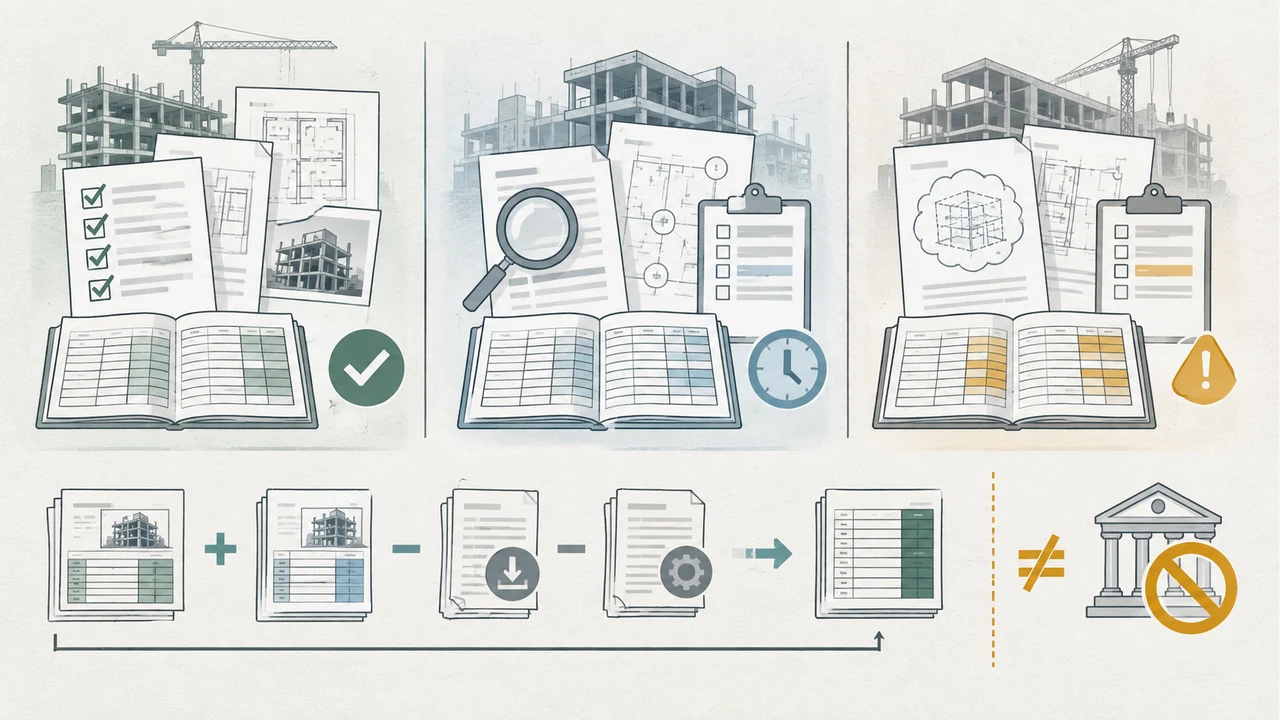
Run a payment-review meeting that can end in a decision
When the concern touches a payment application, hold a short review with an agenda rather than an unstructured site argument. Invite only the people needed for the affected scope: owner, contractor or superintendent, affected trade, design contact, and the payment or draw administrator if the contract requires one. A meeting is a coordination tool; it is not a substitute for a required notice, inspection, or legal process.
Use this sequence:
- Confirm the payment application number, contract milestone, and amount requested.
- Read the concern’s observation without adding conclusions.
- Identify the contract document and latest revision each person is using.
- Ask the contractor to classify the item and identify the person who can verify it.
- List the work that is complete and supported independent of the concern.
- List the work that is affected, unverified, changed, or missing documentation.
- Set the protection or access plan for the affected area.
- Set the response date, correction date, verification method, and next handoff.
- Record the payment treatment as a separate decision or open question.
- Read back the action log before closing the meeting.
The minutes should not say merely “owner and contractor discussed quality.” Record decisions and non-decisions:
| Item | Decision record |
|---|---|
| QC-014 classification | Remains possible nonconforming work or approved field revision; no final classification yet |
| Area control | West kitchen wall remains open under contractor site controls until trade/design comparison |
| Responsible response | Electrical superintendent to identify installed locations; design contact to confirm governing revision |
| Evidence due | Marked photograph, current drawing reference, and any signed change record by September 8 |
| Payment treatment | Electrical rough-in line separated from unrelated payment lines; amount remains subject to contract review |
| Next handoff | Owner and contract administrator review the evidence and payment application after verification |
Ask the contractor to state its position in the minutes. A contractor may say the work is complete, that a different revision governs, that the owner requested the change, or that the item cannot be evaluated until a professional review. Each response leads to a different next action. If the contractor does not agree with the minutes, add “contractor disputes this record” and request the contractor’s written correction rather than deleting the disputed entry.
If the meeting produces a price or time change, do not treat the minutes as a signed change order unless the contract expressly allows that method. Send a separate change document or approval record with the required signatures. If the meeting produces a technical direction, identify whether the designer, engineer, inspector, or authority must issue the formal instruction. This keeps a helpful conversation from becoming an accidental, undocumented modification.
Protect the payment ledger when the concern remains open
An open concern needs a ledger entry even if the parties agree that payment will proceed. Write the amount, scope, and conditions: “Payment released for the supported framing line; electrical rough-in line remains subject to verification of QC-014; no waiver of rights is intended unless the contract or signed agreement says otherwise.” Use this wording only as a record of what the parties agreed; do not insert a waiver disclaimer that conflicts with the contract or local law.
If payment is released for an affected line by agreement, record what the payment means and what it does not mean. It may mean the contractor receives a draw while correction remains open; it does not necessarily mean the owner accepted the work or waived a claim. A construction attorney should review the wording when the amount is material or the contract contains release, waiver, conditional-payment, retainage, or dispute clauses. Do not assume a notation in an email preserves a right that a signed release gives up.
If payment is not released, record the contract clause, notice method, amount, affected scope, and response date supporting that treatment. Avoid writing “withheld because the contractor did bad work” unless a qualified reviewer has established the relevant facts and the contract process supports the statement. Use “amount under review pending [specific verification]” when that is accurate, and have counsel review any formal notice or threatened default.
6. Verify correction, a change, or an affected handoff #
The concern is not resolved when someone says “fixed.” It is resolved when the agreed verifier confirms the defined end condition and the record identifies what changed, what was tested or inspected, what remains open, and how the payment or next trade handoff is treated.
Define the acceptance test before the correction
For each concern, write the verification question before the correction begins. Examples:
- “Does the installed opening match A-3.2 revision 2 at the marked wall, including the dimension and location shown?”
- “Has the affected pipe been tested using the method specified in the contract or applicable manufacturer instruction, with the result recorded?”
- “Did the authority having jurisdiction identify a correction, require a reinspection, or accept the permitted work?”
- “Does the owner-approved change order now state the revised material, price, and schedule effect, and has the installed work been compared with that order?”
- “Has the prerequisite work been completed and documented sufficiently for the next trade to proceed without covering an unresolved condition?”
Do not use “looks good” as the acceptance test for an issue that requires a measurement, test, design decision, permit record, or specialist opinion. A visual review may be all that is needed for a finish touch-up; it is not enough for concealed structural, electrical, gas, waterproofing, or code questions.
Match the verifier to the question
The installer can explain how work was installed and what materials were used. The superintendent can coordinate access and sequence. The designer or engineer can interpret design intent within their professional responsibility. The authority can address the permit or inspection issue within its jurisdiction. The owner can approve an aesthetic or scope choice that the contract reserves to the owner, but should not approve a technical departure that requires professional or authority review merely because the contractor proposes it.
For structural movement, load-bearing changes, foundation distress, roof framing, retaining conditions, or other matters where failure could injure people or damage the home, use the qualified design professional required by the project and local rules. Do not ask a remote article, photograph, or general contractor text message to provide structural sign-off. For electrical, gas, fire-protection, pressure, or hazardous-material concerns, use the licensed trade or qualified professional appropriate to the jurisdiction and system.
Correction path
The correction record should contain:
- The original concern ID and contract reference.
- The classification accepted for the correction, or a note that it remains disputed.
- The correction scope, including what will not be changed.
- The responsible party and access/safety controls.
- The planned date and any sequence consequence.
- Whether a written change order, design revision, permit revision, or inspection is required.
- The verification method and verifier.
- The payment line or credit/additional-cost treatment, subject to the contract and local law.
- The closeout evidence: photo, measurement, test, inspection, signed approval, or as-built record.
If correction requires uncovering or replacement, ask who bears the cost under the signed contract. AIA’s educational guidance describes correction clauses that may allocate testing, inspection, uncovering, replacement, and related necessary expenses to the contractor when work does not conform to contract documents, but it also cautions that the agreement and state right-to-cure rules control. Use that as a question to review in your contract, not as a predetermined result. AIA’s correction guidance
Verification records by result
The closeout evidence should match the result. A corrected finish may need a new photograph and owner/design review. A corrected dimension may need a measurement tied to a drawing. A substituted product may need the approved submittal and warranty record. A code or permit item may need an inspection record or authority direction. A concealed condition may need pre-cover photographs, test results, or a professional statement. The same word—“verified”—does not mean the same evidence for every trade.
Use one of these result labels:
- Verified as specified: the responsible verifier compared the observed or corrected work with the identified contract requirement and found it consistent within the stated scope.
- Corrected, recheck needed: work changed, but the final test, inspection, cure period, or design review has not happened.
- Accepted change: the original scope was replaced by a documented, approved change with price, time, design, permit, or warranty effects recorded.
- Accepted deviation: the contractually authorized person accepted a difference from the original requirement; keep the signed record and note any limits.
- Unresolved: evidence or responsibility remains disputed; identify the next person and date rather than closing the item.
- Escalated: the issue moved to an authority, mediator, licensing or consumer body, attorney, or court process; preserve the handoff and deadline.
Do not use “verified” to mean only that the contractor says the work is done. The contractor’s completion statement is a useful project record, but the verifier should be named according to the question. If the owner agrees to accept a cosmetic variation, write what was accepted and whether a credit, change, warranty, or future maintenance consequence was agreed. If no price or warranty consequence was discussed, do not invent one.
If the correction cannot be checked without destructive access, decide who authorizes the opening and who pays under the contract before work begins. Photograph the pre-opening condition, identify the exact opening location, and state how the area will be restored. If the opening reveals a different or larger condition, stop the correction sequence long enough to reclassify it and assign the appropriate professional. A larger discovery should not be forced into the original small repair record merely to keep the payment meeting on schedule.
When a payment discussion becomes a legal discussion
The boundary is crossed when the parties dispute a contractual right rather than a project fact: whether a notice was sufficient, whether a payment is due, whether a release waives a claim, whether a contractor may suspend or terminate, whether a lien is valid, whether a right-to-cure period applies, or whether replacing the contractor is permitted. A homeowner can still organize the evidence, but should ask local construction counsel for the actual legal conclusion.
Bring counsel a clean packet: signed contract and amendments, payment schedule, change-order log, concern worksheet, notice and delivery proof, photos with originals, drawings and revisions, inspection and permit records, invoices and payment ledger, meeting minutes, contractor responses, professional reports, and the exact decision needed. Explain what is undisputed. Counsel can work faster when the packet does not mix verified facts with theories or duplicate screenshots.
Change-order path
If the comparison shows that the owner wants something different from the signed scope, stop calling it a defect and prepare a change record. It should state:
- original requirement and document revision;
- requested replacement requirement;
- reason for the request;
- price increase or credit, with allowances identified;
- schedule or sequencing effect;
- permit, design, testing, or warranty effect;
- who supplies materials and who owns unused material;
- date by which the decision is needed;
- signatures or other approval method required by the contract.
Do not backdate a change order to make the project file look orderly. If the work is already installed, say so and record the unresolved authorization question. Ask counsel if the parties disagree about whether a verbal direction modified the agreement.
Closeout language
Use a status such as:
QC-014 verified on September 10, 2026 by [name and role]. Verification compared the open-wall installation with E-2.1 revision 4 and the signed Change Order 08. Photo set IMG-014-05 through IMG-014-08 and the inspection record dated September 10 are attached. The two locations now match the approved record. Payment Application 07 electrical line remains subject to the contract’s documentation requirements; no conclusion is made here about other lines.
Or, if unresolved:
QC-014 remains unresolved. The contractor supplied a proposed field revision, but the design contact has not approved it and the authority’s inspection status is unknown. The area is protected from disturbance under the contractor’s site controls. The payment record separates the affected electrical line from other lines. Next handoff: design contact to state whether a revision or correction is required by September 12; owner to review the payment consequence with contract counsel if no response is received.
That language keeps the unresolved item alive without declaring that every payment is forbidden. It also tells the next person exactly what has to happen.
Decide whether a second review is worth the cost
An independent review is most useful when the concern is technically consequential, the parties are using different documents, the original verifier has a conflict, or the cost of a wrong correction is high. It may be unnecessary for a clearly documented paint touch-up that the contractor agrees to correct. It is more important when the decision could affect structure, water entry, electrical safety, gas, fire protection, concealed work, expensive finishes, warranty eligibility, a permit revision, or a large payment.
Before hiring a reviewer, define the assignment. Ask for answers to the questions the contract and evidence support, such as:
- What condition was observed on the stated date?
- Which documents were reviewed and which revision governs?
- What additional access, test, measurement, or opening is necessary?
- Is the reviewer being asked to assess design conformity, workmanship, code, safety, or cost—and which of those are outside the assignment?
- What result would close the item, and what result would require a different professional?
- How will the reviewer preserve the condition and protect people during the assessment?
Confirm the reviewer’s license, role, insurance, independence, and authority for the jurisdiction and technical question when those qualifications matter. Do not ask an engineer to issue a building-department approval if the authority must act, and do not ask a building inspector to price a private repair dispute. Do not let an inexpensive but unqualified opinion create a second layer of confusion.
When the reviewer opens concealed work or performs a test, record the pre-test condition, the direction authorizing the work, the method, the result, and the restoration plan. If the result is negative or inconclusive, preserve that too. A failed attempt to establish a defect is not evidence that nothing happened; it may show that a different question or method is required.
7. Escalate through the correct channel when the handoff fails #
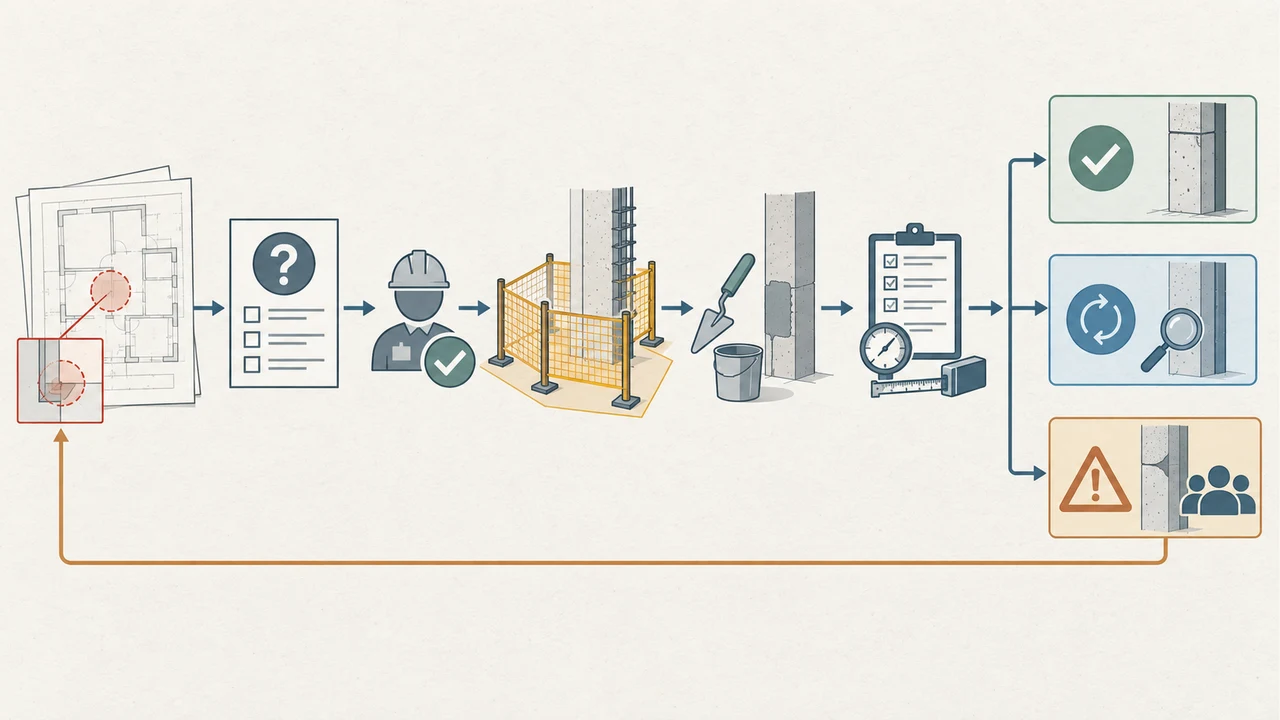
Escalate when the contractor does not respond within the contract or notice period, refuses safe access or correction, threatens to cover a material concern, invoices unsupported work, presents a lien or notice, or leaves a code, licensing, safety, or design question unresolved. Escalation should follow the issue and jurisdiction, not the homeowner’s level of frustration.
Escalation ladder
Use the lowest channel that can make the next decision while preserving deadlines:
- Project record and written notice. Send the concern to the contractually designated contact. Ask for a response date and keep proof of delivery.
- Contract administration meeting. Involve the owner, contractor, affected trade, designer, and verifier. Issue minutes with decisions, open items, responsible people, and dates.
- Design or technical review. Engage the architect, engineer, licensed trade, testing agency, or other qualified person required for the question. Ask for a bounded opinion and the evidence relied on.
- Authority or inspector. Use the permit office or authority having jurisdiction for a permit, inspection, code, or certificate question. Bring the permit, approved plans, inspection record, photographs, and exact question.
- Licensing, consumer, mediation, or bond process. Check the jurisdiction’s eligibility, notice, filing window, fee, and remedy limits before filing.
- Attorney or court. Seek local construction counsel when the issue involves a material payment, lien, default, termination, right to cure, threatened litigation, structural safety, injury, or deadline that a general guide cannot evaluate.
Do not skip directly to a public accusation or a replacement contractor while evidence is still being preserved unless safety or an urgent protective measure requires it. Replacing the original contractor can change the condition, cost, access, warranty, and mediation path. If emergency work is needed, document the reason, the condition before intervention, the professional directing the work, and the cost records.
Oregon: keep CCB, BCD, and local building department distinct
Oregon provides unusually clear examples of why routing matters. For a qualifying residential complaint, CCB says the owner must provide a 30-day pre-complaint notice by certified mail to the address on record. Its consumer tools list filing windows that vary: for example, a complaint about breach of contract, negligence, or improper work on a new structure may have a window tied to first occupancy or substantial completion, while an existing-structure complaint has another period. Confirm the category and current exceptions on the Oregon CCB consumer-tools page before relying on a date.
CCB also explains that, after jurisdiction and filing requirements are satisfied, a qualifying complaint may be assigned to mediation with a statutory processing fee. It says mediation is intended to help parties settle and is not a decision-making process that determines fault or forces payment. If mediation does not resolve the matter, court-filing steps may be required to keep the complaint open or pursue a bond remedy. Read the current Oregon CCB consumer-protection guidance and obtain Oregon advice for a live dispute.
Oregon BCD handles a different lane. Its complaint page accepts allegations such as unsafe building conditions, deficient materials or equipment, unlicensed work, and certain code violations. It directs permit failures to the local building department unless additional allegations justify a BCD complaint, and directs contract, negligence, licensure, and nonpayment matters involving contractors to CCB. Oregon BCD complaint routing
Do not file one generic complaint to all three entities and assume the first agency will transfer everything. Separate the records: code or permit question, contractor conduct or workmanship dispute, and payment or lien issue. A single event can create three records, but each record should state the issue that the recipient can actually address.
California: use CSLB information without treating it as adjudication
California homeowners can use CSLB’s contract guidance to compare the written scope, payment schedule, value of work, permits, completion date, and signed change orders. They can also use the official license lookup to verify a contractor record. The lookup is not a quality inspection and should not be presented to a contractor as proof that a payment dispute is resolved. California’s written-change-order and value-of-payment guidance applies within California’s home-improvement framework; ask California counsel about a live withholding, breach, lien, or termination decision.
New York: payment protection and local licensing limits
The New York Attorney General’s fact sheet states that New York home-improvement contracts must be in writing and describes payment protections, including escrow or a bond for certain payments received before substantial completion. It advises a payment schedule and says final payment should be withheld until the work, required inspections, and certificates of occupancy are finalized. It also notes that contractor licensing applies in New York City, Suffolk, Nassau, Westchester, Putnam, and Rockland counties. Those statements should be checked against the project type, county, contract, and current law; do not call them a rule for all US homeowners. New York Attorney General guidance
If a contractor threatens a lien or the homeowner receives a formal notice, preserve the envelope, date, sender, property description, contract, payment ledger, and all lien-related documents. Do not answer a legal notice with only a text message. Ask a New York construction attorney what response and deadline apply.
Florida: do not ignore lien documentation while resolving quality
Florida’s payment dispute can involve parties the homeowner did not hire directly. The Florida Bar explains that subcontractors and suppliers may have lien rights and recommends lien waivers or releases with payments, plus a contractor’s final payment affidavit before final payment. If a Notice to Owner, claim of lien, or other formal document appears, treat it as a separate legal track from the workmanship conversation. A quality correction agreement does not automatically discharge another party’s lien rights. Preserve all notices and seek Florida counsel promptly. Florida Bar consumer guidance
Nevada and AIA: compare language, do not import remedies
The Nevada State Public Works Board form is useful for spotting contract concepts: a defined set of contract documents, written change orders, a contractor’s coordination responsibility, and an acceptance/final-payment structure. It is a public form for Nevada state work, not a private residential statute. AIA’s owner education similarly shows how a contract may allocate correction, testing, uncovering, and replacement costs and may provide a correction period. Both are examples to compare against the actual signed agreement, not authorities that create a homeowner’s right to stop work or withhold payment. Nevada public-contract form and AIA owner guidance
8. Use the Quality Concern Resolution Worksheet and choose the next decision #
Use the Quality Concern Resolution Worksheet to carry one live concern from observed condition to classification, notice, responsible verification, payment treatment, and the next handoff; it keeps a disputed item scoped without pretending to decide code compliance or legal rights. The worksheet is the original contribution in this guide, paired with a classification matrix and a payment reconciliation.
Method: Complete one row per concern using the signed contract, current drawings and specifications, dated site evidence, payment line, change-order status, and the named verifier; then follow the classification and handoff branch shown in the article.
Limitations: This worksheet organizes evidence and communications; it cannot decide code compliance, establish legal rights, replace an inspection or engineering opinion, or tell a homeowner to withhold payment in a particular dispute.
Quality Concern Resolution Worksheet
Copy this worksheet once for each concern. Do not combine unrelated conditions into one row merely because they appear on the same invoice.
A. Identity and condition
| Field | Entry |
|---|---|
| Concern ID | |
| Project address or project number | |
| Date and time observed | |
| Observer and role | |
| Location, room, elevation, grid, level, or lot feature | |
| Affected trade and contractor contact | |
| Work stage: open, partially covered, covered, tested, inspected | |
| Immediate safety or access issue | |
| Safe observation method used | |
| Overall, mid-range, close photo IDs | |
| Measurement: value, unit, method, location, date, limitation | |
| What is directly observed | |
| What is not yet known |
B. Contract and design input
| Field | Entry |
|---|---|
| Signed contract section or scope line | |
| Drawing number and revision | |
| Specification section or manufacturer instruction | |
| Approved submittal or shop drawing | |
| Permit number and inspection record | |
| Relevant schedule or predecessor requirement | |
| Approved change orders that may affect the condition | |
| Owner request or verbal direction that may affect the condition | |
| Exact comparison statement | “The observed condition appears different from ___ because ___.” |
C. Classification gate
Check one working classification, then explain the evidence:
- Possible defect or nonconforming work.
- Owner-requested change.
- Code, permit, license, or inspection question.
- Incomplete prerequisite or missing closeout evidence.
- Unknown; qualified verification required.
Reason for classification: ____________________________________________________
Alternative classification still possible: ______________________________________
The classification is a working hypothesis, not a legal conclusion. If the contractor, designer, inspector, and owner use different classifications, record the disagreement rather than silently choosing the most favorable one.
D. Responsibility and response
| Field | Entry |
|---|---|
| Person who coordinates the response | |
| Person who will verify the technical or design question | |
| Authority having jurisdiction, if applicable | |
| Lender or draw administrator, if applicable | |
| Response requested by date and time | |
| Area to remain open or protected | |
| Safe access method or site control | |
| Correction, clarification, or change requested | |
| Evidence the response must include |
E. Payment reconciliation
| Field | Entry |
|---|---|
| Invoice, payment application, or draw number | |
| Payment line or milestone | |
| Base contract value | |
| Milestone definition or earned-value basis | |
| Amount requested | |
| Prior payments allocated to line | |
| Retainage or other contract adjustment | |
| Approved change-order value earned now | |
| Unapproved change request amount | |
| Work supported and undisputed | |
| Work affected by concern | |
| Documentation still missing | |
| Payment question for contract administrator or counsel |
If using a value-based formula, write it fully:
earned base value + earned approved changes − prior allocated payments − contract adjustments = illustrative balance
Then write assumptions and sensitivity. Example: $18,000 × 80% + $600 − $9,000 − $0 = $6,000, assuming the 80% milestone is actually achieved, the $600 change is signed and earned, and no retainage or other adjustment applies. If the change is not approved, the result becomes $18,000 × 80% − $9,000 = $5,400. If the milestone is not verified, the worksheet produces no payment conclusion. These figures are illustrative, not a quote, claim, or legal entitlement.
F. Verification and closeout
| Field | Entry |
|---|---|
| Verification question written before correction | |
| Verifier’s name, role, and authority | |
| Date and method of verification | |
| Documents compared | |
| Test, measurement, inspection, or photo record | |
| Result: verified, corrected and recheck needed, unresolved, or escalated | |
| Remaining limitation or open question | |
| Payment treatment recorded separately | |
| Next handoff and owner | |
| Closeout date and record location |
Worked example: an illustrative rough-in concern
The following is a modeled example created to show how the worksheet behaves. It is not a report from a real project, not a code determination, and not a measurement collected by Brictale.
Inputs. The signed contract has an electrical rough-in line valued at $18,000. The payment schedule describes an 80% rough-in milestone. The owner has already paid $9,000 allocated to the line. Payment Application 07 requests $6,000 and includes a $1,200 “field adjustment” that is not signed as a change order. The current open-wall photographs do not show two locations drawn on E-2.1 revision 4. The wall is scheduled for inspection and insulation the next day.
Observation. The owner photographs the overall west kitchen wall, marks the two drawing locations on a copy of the plan, and records that the locations are not visible in the current photographs. The owner does not remove a cover, move wiring, enter an unsafe area, or call the installation noncompliant. The record identifies the contractor’s superintendent, electrical trade contact, design contact, and inspection appointment.
Classification. The working classification is “possible nonconforming work or incomplete prerequisite,” with “approved field revision” as an alternative. The missing locations may be installed elsewhere, shown in an unlocated photo, or changed by an approved instruction. The owner requests the response rather than choosing among those explanations.
Notice. The owner asks that the marked wall remain open or be protected by a safe alternative until the electrical trade and design contact compare it with E-2.1 revision 4. The notice asks for the governing document, the location verification, and any correction or signed change record. It applies to the west kitchen wall, not the entire payment application.
Payment arithmetic. If the 80% milestone is verified and no contract adjustment applies, the illustrative base balance is $18,000 × 0.80 − $9,000 = $5,400. The $1,200 field adjustment is not included because it is unsigned. If the contract administrator confirms the $600 portion of a separate signed change order is earned now, the illustrative balance becomes $6,000. If the milestone depends on the two locations being verified and that prerequisite is not met, the arithmetic is not enough to determine the amount payable.
Sensitivity. If the prior payment allocation was $10,500 rather than $9,000, the same verified base milestone produces $14,400 − $10,500 = $3,900 before approved changes. If the unsigned $1,200 request becomes a signed change order, its price alone does not prove that the changed work is complete or earned at this draw. The record therefore keeps price approval and earned value as separate fields.
Verification. The electrical trade identifies the locations in a marked-up photograph. The design contact confirms whether the current drawing or a signed revision governs. The authority’s inspection record is attached if the work is inspected. If the locations match an approved revision, the item closes as a documentation/coordination concern. If they do not, the contractor proposes correction and the responsible professional confirms any required design or inspection step. The payment record states which line remains under review and which lines are separately supported.
What the example does not decide. It does not establish electrical code compliance, determine whether the contractor breached the agreement, set a legally permitted withholding amount, or allocate correction cost. Those decisions require the contract, jurisdiction, competent verifier, and potentially legal advice.
Failure branches to plan before they happen
The work is covered before the response. Record the covering date, the notice, the person who directed the sequence, and any pre-cover evidence. Ask for a safe, documented verification method. Do not perform destructive opening without authorization and a cost/safety plan.
The contractor says the concern is only cosmetic. Ask which document defines the finish, tolerance, or acceptance condition. If it is cosmetic and within the contract, close it with that comparison. If it is a performance, safety, moisture, structural, or concealed-work question, assign the appropriate verifier.
The contractor says the concern is an owner change. Ask for the original requirement, the later owner direction, the signed change status, and the price/time effect. Keep the classification open until those records are compared.
The contractor says the inspector approved it. Obtain the inspection record, identify the scope inspected, and compare the private contract separately. An inspection record may answer the authority’s inspection question without closing a finish, documentation, or private scope item.
The owner is told to sign a backdated or blank change order. Do not sign a document you do not understand. Request a completed version showing scope, price, schedule, permit/design effect, and status of work already performed. Seek local counsel if refusal threatens the project or payment.
The contractor stops work after the notice. Check the contract’s notice, suspension, cure, and dispute procedures. Protect the site and safety. Record the affected and unaffected scopes, costs, schedule effect, and any communication. Do not hire another contractor to alter the work until the preservation, emergency, warranty, and legal consequences have been considered.
A formal lien or payment notice arrives. Preserve it and its delivery date as a separate legal record. Do not assume a workmanship disagreement defeats a lien right or that paying the prime contractor automatically resolves every subcontractor or supplier claim. In Florida, The Florida Bar specifically warns that subcontractors and suppliers may have lien rights and recommends payment documentation and releases; seek counsel in the project jurisdiction. Florida Bar guidance
The condition presents immediate danger. Stop unsafe access, contact the site’s responsible safety person or emergency service as appropriate, and use qualified professionals. OSHA’s guidance is directed to construction employers and workers; it does not make the homeowner a competent person qualified to enter a trench, assess fall protection, or direct electrical or structural work. OSHA construction guidance
Compact originality brief
Current answers: State consumer pages explain written contracts, progress-payment relationships, signed changes, liens, license lookup, complaint deadlines, and mediation. AIA explains correction and rejection contract patterns, while a Nevada public form shows how contract documents and written change orders can be organized.
Missing decision: Those answers do not give a homeowner one live-project sequence for preserving a visible or partly concealed concern, mapping it to the contract, separating defect from owner change or code question, protecting the payment record, assigning a verifier, and choosing the next escalation handoff.
Original contribution: The Quality Concern Resolution Worksheet and five-way decision matrix carry one concern from observation through classification, notice, payment reconciliation, correction or change-order treatment, verification, and jurisdictional escalation. The worked example shows units, formulas, assumptions, and sensitivity.
How it can be checked: A reviewer can take any worksheet row and ask whether the observation has a date, location, evidence ID, contract reference, responsible verifier, response deadline, payment line, verification test, and next handoff. They can then compare each legal or safety statement with the linked primary source and confirm that California, Oregon, New York, Florida, AIA, Nevada, and OSHA scopes have not been presented as interchangeable.
The next decision
Complete the worksheet before the next irreversible handoff. If the evidence shows a contract mismatch, request a defined correction and verification. If it shows an owner preference, price and approve a change before continuing. If it raises code, permit, structural, electrical, gas, fire, or other technical risk, send the exact question to the authority or qualified professional. If payment, lien, cure, termination, or filing deadlines are at stake, get local legal advice while preserving the project record. The goal is not to win an argument at the invoice; it is to make the next responsible decision visible, limited, and verifiable.
Cite this guide
Brictale. “How to Handle a Home Construction Quality Concern Before a Progress Payment.” Published 2026-09-13; updated 2026-09-13.
https://brictale.com/build/contractors/manage-home-construction-quality-concern-before-progress-payment · Read the Markdown version
Original contribution: Quality Concern Resolution Worksheet. A reusable record and decision matrix that carries one construction-quality concern from observation through contract mapping, notice, verification, payment treatment, and escalation.
Sources and scope
Evidence behind this page
- California CSLB says home improvement projects over $500 require a written contract; the contract should include a detailed payment schedule, payments generally cannot exceed the value of work performed except for the permitted down payment, and a scope or price change must be in a written change order signed before the change.
Learn About Home Improvement Contracts
California home improvement contracts and California CSLB consumer guidance; not a national rule and not a conclusion about a particular contract.
Accessed · Link to this claim - California CSLB provides an official Check A License search that a homeowner can use to look up a contractor license record before relying on a contractor’s license representation.
California contractor license lookup service; availability of a record does not decide workmanship, payment, or legal rights.
Accessed · Link to this claim - Oregon CCB recommends putting all agreements and contract changes in writing, requires a 30-day pre-complaint notice by certified mail before a qualifying contractor complaint, and identifies filing windows that vary by project and complaint type.
Oregon Construction Contractors Board Consumer Tools
Oregon Construction Contractors Board consumer process; the page lists exceptions and project-specific deadlines, so a homeowner must confirm the applicable category.
Accessed · Link to this claim - Oregon CCB says a qualifying residential complaint may proceed to a $50 filing fee and mediation, but CCB mediation is intended to help the parties settle and CCB is not the decision-making entity that determines fault or awards payment; if mediation fails, court filing steps and deadlines can follow.
Oregon Construction Contractors Board Consumer Protection
Oregon CCB dispute-resolution information for qualifying complaints; not a substitute for Oregon legal advice.
Accessed · Link to this claim - Oregon Building Codes Division distinguishes alleged unsafe, deficient, unlicensed, or code-related work from contract, negligence, or nonpayment complaints: permit failures generally go to the local building department, while specified code allegations may go to BCD and contract or nonpayment issues go to CCB.
Building Codes Division: File a complaint
Oregon complaint routing only; other states and local authorities may use different channels.
Accessed · Link to this claim - New York Attorney General guidance says home improvement contracts must be written, progress-payment schedules must bear a reasonable relationship to work, materials, or project costs, and certain pre-substantial-completion payments must be protected through escrow or an alternative bond; it also advises withholding final payment until completion and required inspections or certificates are finalized.
New York home improvement consumer guidance; local licensing rules still apply in the counties identified by the Attorney General, and this is not a universal payment rule.
Accessed · Link to this claim - The Florida Bar consumer pamphlet explains that contractors, subcontractors, suppliers, and laborers may have lien rights; it recommends payments correspond to completed value, avoiding payment for unperformed work, collecting lien waivers or releases with payments, and retaining final payment until completion and outstanding issues are resolved.
Building or Remodeling a Home in Florida: What You Need to Know
Florida construction-lien and payment precautions described in a Florida Bar consumer pamphlet, updated June 2026; legal advice may be needed for a specific lien or payment dispute.
Accessed · Link to this claim - The Florida Bar says a construction contract should require changes to be in writing and signed by the owner and contractor before changed work is performed, with the change order stating the work, price effect, and schedule effect.
Building or Remodeling a Home in Florida: What You Need to Know
Florida consumer guidance and contract precaution; apply the signed contract and current Florida law to the actual project.
Accessed · Link to this claim - AIA Contract Documents describes a contract pattern in which work that does not conform to contract documents is corrected at the contractor’s expense, potentially including testing, inspection, uncovering, and replacement; it warns that any right to stop work depends on the agreement and that state right-to-cure rules must be checked.
Construction Basics for Owners: Rejection and Correction of Work
AIA educational explanation of contract-document patterns; not a state law or a promise that a homeowner may stop payment or work.
Accessed · Link to this claim - Nevada State Public Works Board’s small owner-contractor agreement is a public-contract example that incorporates drawings, specifications, scope, proposal, and change orders as contract documents and states that the agreement may be modified only by a written change order executed by the parties.
Owner-Contractor Agreement for Contract Amounts of $100,000 or Less
Nevada State Public Works Board public-contract form, offered only as a contract-pattern comparison; it is not a Nevada residential-law rule or a private-home contract.
Accessed · Link to this claim - The Nevada public owner-contractor agreement places construction procedures, methods, techniques, sequences, safety, and coordination of subcontracted work with the contractor as a contract responsibility in that form.
Owner-Contractor Agreement for Contract Amounts of $100,000 or Less
Nevada public-contract example only; responsibility in a homeowner’s project depends on its contract and applicable law.
Accessed · Link to this claim - OSHA identifies falls, electrical incidents, struck-by hazards, and trenching or excavation among serious construction hazards, and its trenching guidance says workers should not enter a trench unless it has been properly inspected by a competent person.
Construction eTool: Preventing Fatalities; Trenching and Excavation
US OSHA construction safety guidance for employers and workers; it does not make a homeowner a competent person or authorize a homeowner to enter a hazardous work area.
Accessed · Link to this claim - OSHA's construction confined-space standard requires an employer's competent person to identify confined spaces and permit spaces, and requires effective measures to prevent entry when the employer has not authorized its employees to enter a permit space; permit-space entry also requires a written program and related controls.
1926.1203 — General requirements: Confined Spaces in Construction
US OSHA construction standard for employers and employees; it is not a homeowner qualification or a universal private-home access rule.
Accessed · Link to this claim - EPA advises that a trained and accredited asbestos professional should take samples for analysis because incorrect sampling can release fibers and increase risk; it also says suspect asbestos material should be left alone when it is in good condition and will not be disturbed.
Protect Your Family from Exposures to Asbestos
EPA consumer guidance about suspected asbestos in homes; it does not identify every contaminant or replace state, local, health-department, or qualified environmental-professional direction.
Accessed · Link to this claim - California’s Department of Housing and Community Development identifies the 2025 California Building Standards Code, including Part 2.5 California Residential Code, as effective January 1, 2026; a California project should therefore be checked against the code cycle applicable to its permit and project date rather than a 2018 provision.
2025 California Building Standards Code, Effective January 1, 2026 (Information Bulletin 2025-03)
California HCD information bulletin identifying the 2025 code cycle and effective date; it does not determine a particular project’s permit transition, local amendments, inspection result, private contract conformity, or legal rights.
Accessed · Link to this claim - The California Building Standards Commission explains that California Residential Code Part 2.5 is the applicable Title 24 residential code for detached one- and two-family dwellings, accessory dwelling units, and townhomes not more than three stories above grade plane with a separate means of egress, subject to the code’s adoption and agency scope; local enforcement still must be checked.
California Building Standards Commission FAQ about Title 24 Part 2.5 scope and enforcement; it is California-specific and does not replace the applicable local enforcing agency’s inspection requirements or decide private contract conformity.
Accessed · Link to this claim