How to Manage a Home Construction Dispute Before Filing a Licensing Complaint
A jurisdiction-aware homeowner workflow for documenting quality concerns, requesting a cure, verifying the work, and choosing code, licensing, mediation, or legal next steps.
The short answer
Start by separating what you observed from what you conclude, then map it to the contract, identify the responsible party, preserve records, and send a specific cure request. Set a verification test and response date. Escalate only after checking the actual jurisdiction: code and safety routes are not the same as contractor licensing, mediation, a bond claim, court, or legal advice.How to Manage a Home Construction Dispute Before Filing a Licensing Complaint
Start by separating what you observed from what you conclude, then map it to the contract, identify the responsible party, preserve records, and send a specific cure request. Set a verification test and response date. Escalate only after checking the actual jurisdiction: code and safety routes are not the same as contractor licensing, mediation, a bond claim, court, or legal advice.
This guide is for a homeowner managing a live residential build or major renovation in the United States. It is a project-stage decision surface, not a legal opinion, engineering sign-off, official inspection, or promise that an agency will recover money. The examples are illustrative. They show how to organize a record without deciding that the contractor breached a contract, violated a code, or caused a compensable loss.
Decide the next gate before you call the problem a licensing violation #
The next step should be a scoped cure request unless there is an immediate safety or preservation problem, a clear permit or code-routing issue, a contract deadline that is about to expire, or evidence of fraud or abandonment that makes ordinary cure discussions unsafe or impractical.
“Bad work” is a useful alarm, but it is not yet a route. A homeowner may be looking at several different questions at once:
- What condition is actually present?
- What did the contract, plans, approved change order, manufacturer instruction, or permit require?
- Who had responsibility for the work or decision?
- Is the condition dangerous now, or merely incomplete, disputed, or disappointing?
- What remedy was promised, and how will it be tested?
- Does the next handoff belong to the contractor, designer, inspector, building department, licensing board, consumer office, mediator, insurer, court, or attorney?
The gate matters because a licensing complaint is usually not a substitute for finishing the project record. A licensing agency may investigate conduct, compliance, or public protection. It may not be the body that interprets your payment schedule, orders a particular repair, decides an engineering question, or pays your loss. A building-code office may care about an unsafe condition while having no role in a private price dispute. A mediator may help people reach a settlement without finding who was right. A lawyer may advise on rights and deadlines without inspecting the installation.
The Federal Trade Commission’s home-improvement guidance starts with the practical sequence: first try to resolve the problem with the contractor, document the communication, and seek outside help if that effort fails. That is useful as a federal consumer starting point, but it does not override a state notice clause or a local emergency process.
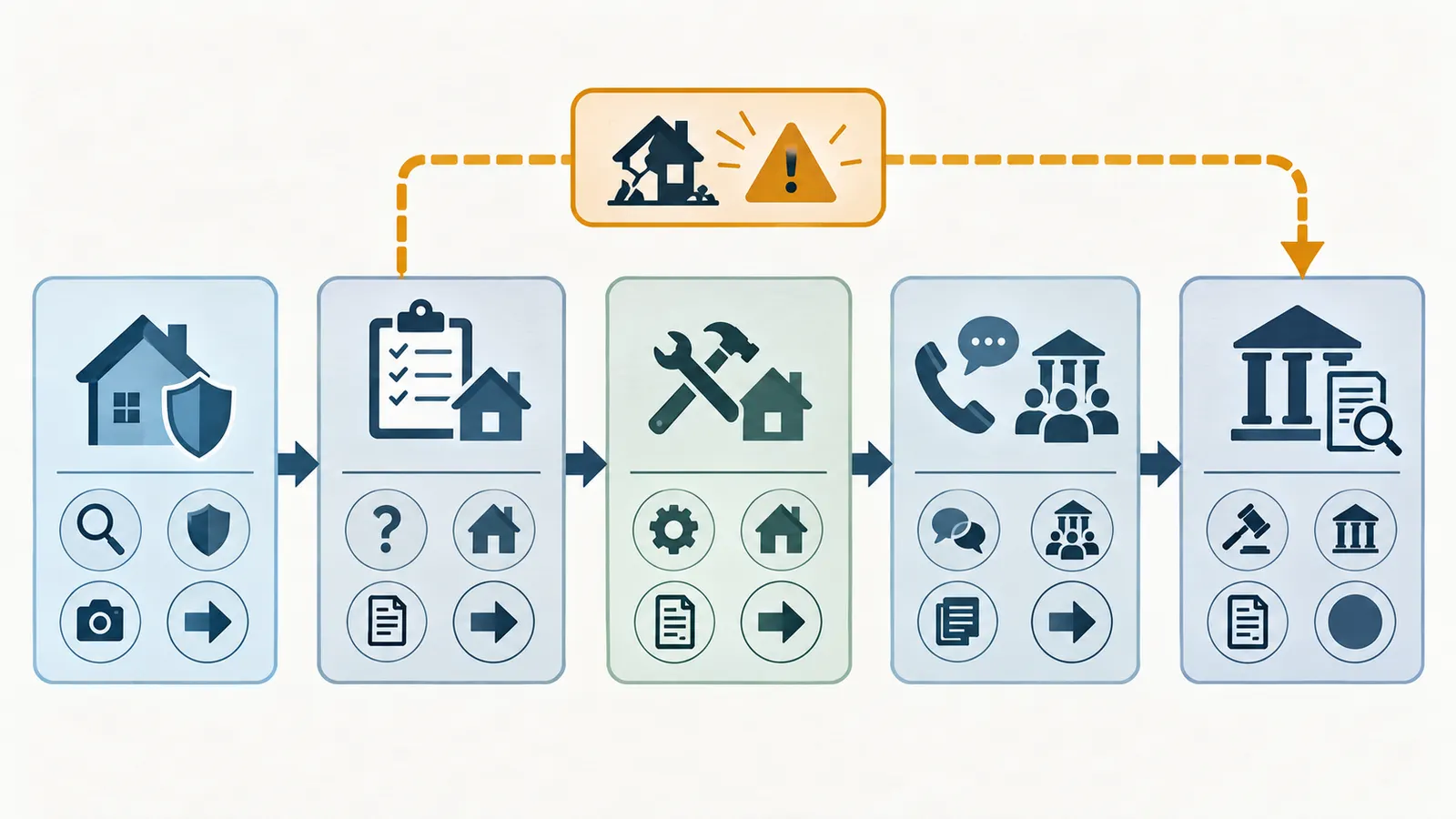
The five-gate decision
Use these gates in order, recording the answer and handoff for each one.
| Gate | Question to answer | Primary owner | Evidence that moves the gate | Next handoff |
|---|---|---|---|---|
| 1. Protect | Is anyone at immediate risk, or is evidence about to be covered or destroyed? | Homeowner and qualified emergency professional | Date-stamped observation, incident record, permit or inspection status, photos from a safe location | Emergency service, utility, local building official, insurer, or qualified professional as applicable |
| 2. Define | Can a neutral reader tell what was observed, where, when, and against which project document? | Homeowner with contract administrator or designer as needed | Contract clause, plan detail, change order, photo index, measurements, messages | Contractor or responsible design professional for a scoped response |
| 3. Cure | Has the responsible party received a specific requested correction, a reasonable response window, and a proposed verification test? | Contractor or other responsible party | Written request, delivery proof, response, cure plan | Site meeting, revised schedule, independent verification, or notice required by the contract or jurisdiction |
| 4. Route | Is the unresolved concern principally private performance, code or safety, license conduct, payment, insurance, or a mixed issue? | Homeowner, with local professionals where needed | License record, permit record, contract, independent report, cost evidence | Correct agency, mediator, insurer, or counsel; do not send the same undifferentiated packet everywhere |
| 5. Escalate | What remedy is still needed, what deadline applies, and what record must travel to the next forum? | Homeowner and chosen representative | Complete packet, chronology, requested outcome, preserved originals, jurisdiction check | Mediation, agency complaint, bond or insurer claim, court, or legal advice |
A concern can move through more than one gate. For example, a missing guardrail may require a safety response while a separate payment dispute remains a private contract issue. Keep the rows separate. Combining them into “the contractor is bad” makes the record less useful and can cause the wrong agency to receive the wrong question.
Stop first for an immediate hazard
Do not enter an unsafe area to collect better photographs. Stop work and keep people away from an open excavation, unsupported structure, exposed energized conductors, unstable scaffold, gas or combustion hazard, suspected asbestos or lead disturbance, contaminated water, or any other condition that could injure someone. Call emergency services or the relevant utility for an immediate emergency. For a building-safety question, contact the local building department or a qualified professional who can evaluate the condition in person. A remote article cannot determine structural capacity, electrical safety, fire risk, indoor-air exposure, or whether a temporary condition is safe.
For this Brictale guide, treat pressure as a separate safety boundary. Do not perform a pressure test, open a pressurized fitting, disconnect a component, bleed a line, or otherwise manipulate pressurized water, gas, hydronic, or air systems to investigate a dispute. Do not infer safety, leak-tightness, code compliance, or permission to proceed from a pressure reading supplied remotely or taken with an unknown instrument. Keep people away from the system and route the condition to the relevant utility, authority having jurisdiction, or qualified local professional before a cure, pressure change, opening, or concealment. Record the reading only if it was obtained safely by an authorized person and preserve the instrument, units, time, and system state as reported; it is evidence to hand off, not a remote diagnosis.
If the hazard is not immediate but work is about to cover it, ask the contractor in writing to pause that specific concealment until the responsible inspector, designer, engineer, or other qualified professional has recorded the condition. The homeowner should not direct a structural, electrical, gas, excavation, or other regulated repair unless qualified and authorized to do so. Record who made the pause decision, what area is affected, and how the project schedule will be protected.
What not to infer from the first observation
Do not infer any of the following solely from a photograph or symptom:
- A crack proves structural failure.
- A visible gap proves a code violation.
- A rough finish proves the work is outside the contract.
- A contractor’s license record proves the project is compliant.
- An agency’s acceptance of a complaint proves the contractor is liable.
- A consultant’s opinion automatically changes the contract price.
- A delayed response proves abandonment.
- A repair estimate is the amount a court, insurer, bond company, or licensing agency will award.
Instead, write “observed,” “document says,” “contractor stated,” and “professional to verify” as separate fields. This language is not timid. It prevents an early conclusion from contaminating the evidence you will need later.
Build the quality-dispute packet from observations, obligations, and responsibility #
The packet should let a new reviewer understand one concern in under five minutes: where it is, what happened, what document controls, who was responsible, what you asked for, how the cure will be tested, and what happens next.
The core record is one row per concern, supported by a chronological folder. Do not start with a long narrative or a list of every frustration on the project. Start with separable issues. “Kitchen is bad” is not a row. “The cabinet run at grid B-3 is 1 1/4 inches short of the approved elevation shown on detail A-402, observed on September 8, and the appliance cannot be installed without a revised decision” is a row that a contractor, designer, mediator, or reviewer can investigate.
The packet fields
Copy this structure into a working document or spreadsheet. Keep the original files in a read-only archive and give each file a stable name.
| Field | What to enter | Why it matters | Who supplies or verifies it |
|---|---|---|---|
| Concern ID | Q-001, Q-002, and so on | Prevents different people from discussing different problems | Homeowner |
| Location | Room, elevation, grid, lot area, equipment tag, or photo viewpoint | Makes the condition findable | Homeowner; confirm with plan or site lead |
| Observed condition | Concrete description with no diagnosis hidden inside it | Separates observation from conclusion | Homeowner; qualified professional if measurement or diagnosis is needed |
| First observed and rechecked | Date, time, weather if relevant, and whether the condition changed | Establishes sequence and possible coverage risk | Homeowner and site participants |
| Contract or design reference | Agreement section, exhibit, drawing/detail, specification, approved submittal, change order, or written promise | Identifies the obligation or decision to compare | Homeowner; contract administrator or designer |
| Responsible party | Prime contractor, subcontractor, designer, supplier, owner decision, inspector, or unknown | Prevents a complaint to the wrong party | Contractor and homeowner; verify through project records |
| Evidence index | Photo IDs, videos, messages, invoices, delivery records, inspection reports, and witness names | Makes the record auditable | Homeowner |
| Requested cure | One outcome stated in project terms | Gives the recipient something actionable | Homeowner, with professional input if needed |
| Response deadline | Date plus reason; distinguish response from completed cure | Creates a next decision without pretending a universal deadline | Homeowner; check contract and jurisdiction |
| Cure test | What must be observed, measured, approved, or documented to close the row | Prevents “fixed” from meaning “painted over” | Responsible professional or inspector as applicable |
| Safety or permit flag | None, monitor, pause-covering, urgent, or emergency | Separates public-safety routing from quality preference | Homeowner; local authority or qualified professional |
| Independent verification | Needed, not needed, or completed; identify scope, not desired conclusion | Makes the reviewer’s role neutral and bounded | Qualified local professional chosen for the issue |
| Cost evidence | Paid amount, remaining contract amount, quote for defined repair, delay consequence, and assumptions | Supports negotiation or later remedy without claiming entitlement | Homeowner, contractor, estimator, insurer, or counsel as applicable |
| Jurisdiction route | Local building department, licensing board, consumer office, CCB/BCD, mediation, insurer, bond, court, or counsel | Shows why the next recipient is appropriate | Homeowner after current local check |
| Handoff status | Date sent, recipient, delivery proof, response, next date, and preserved originals | Stops the process from losing the thread | Homeowner |
Use a neutral observation format
For each row, use four sentences:
- “On [date], at [location], I observed [condition].”
- “The condition is shown by [evidence IDs], and the project record says [document and short quote or paraphrase].”
- “I am asking [responsible party] to [specific cure or response] by [date].”
- “The row can be closed when [verification event], or it will be handed to [next route] with [records].”
If you cannot write sentence two because no project document addresses the issue, do not invent an obligation. Mark the row “scope unclear” and request the contractor’s or designer’s written explanation. If the problem might be a code matter, ask the local building department how to verify it rather than writing “code violation” as a fact.
Preserve originals and context
Save the full email thread, not only a screenshot of the last sentence. Retain the original photo file and note when it was taken; do not crop out context without keeping the original. Record who took a measurement, what tool or reference was used, and whether the surface was accessible. If a photo contains a scale, say what the scale is and whether the camera angle can distort the apparent dimension. A phone photograph can show location and sequence; it usually cannot establish level, plumb, slope, load, moisture content, electrical condition, air quality, or code compliance by itself.
Keep a payment ledger that identifies invoice date, amount, payee, payment method, scope stated on the invoice, retainage if any, and whether the payment was disputed. Do not unilaterally stop every payment just because one row is open. Check the contract, applicable law, lender requirements, and legal advice before withholding money, because a payment decision can create a second dispute or affect a statutory notice period. The FTC recommends written contracts and warns against paying the full amount up front, while also noting that payment rules vary by state; use that as consumer guidance, not as a substitute for the actual rule. FTC home-improvement guidance
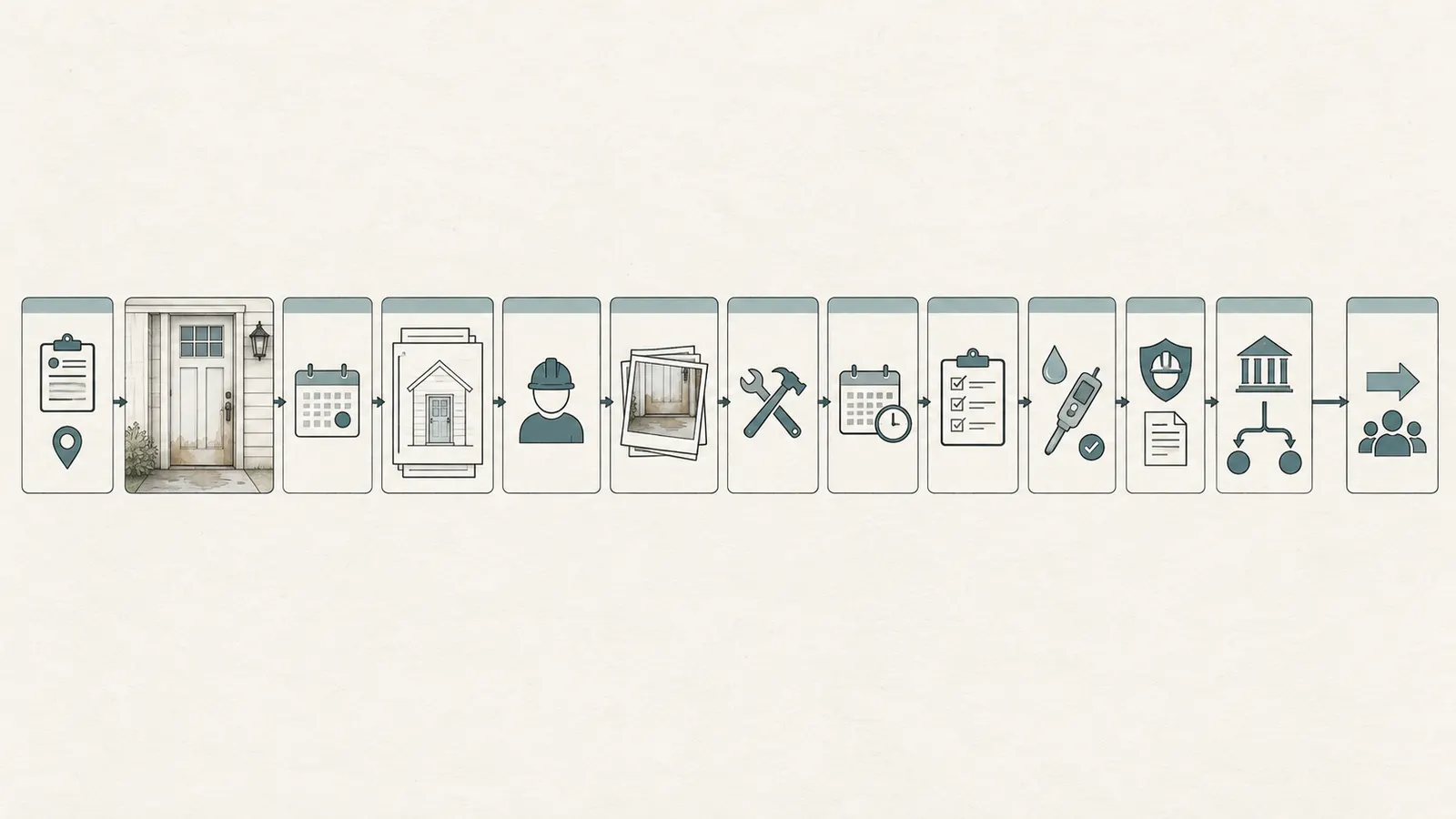
Keep a short chronology
The chronology is not a diary. It is a handoff tool. Use one line per event:
| Date | Event | Source | Decision or open question |
|---|---|---|---|
| 2026-08-21 | Subcontractor installed exterior door | Photo Q-001-01, delivery ticket D-14 | Was the approved flashing detail followed? |
| 2026-08-28 | Homeowner observed water staining after rain | Photo Q-001-05, weather record | Is the staining active, old, or from another source? |
| 2026-08-29 | Contractor said “we will seal it” by text | Message M-29 | What product, preparation, and cure test are proposed? |
| 2026-09-02 | Written cure request sent | Letter L-02, delivery proof | Await response by stated date; preserve access |
| 2026-09-08 | No written scope received | Message log | Independent verification or jurisdiction check? |
This chronology makes gaps visible. It also stops the common failure in which a homeowner remembers a conversation but cannot show when the contractor was told, what was requested, or whether access was offered.
Send a cure request that can be accepted, rejected, or verified #
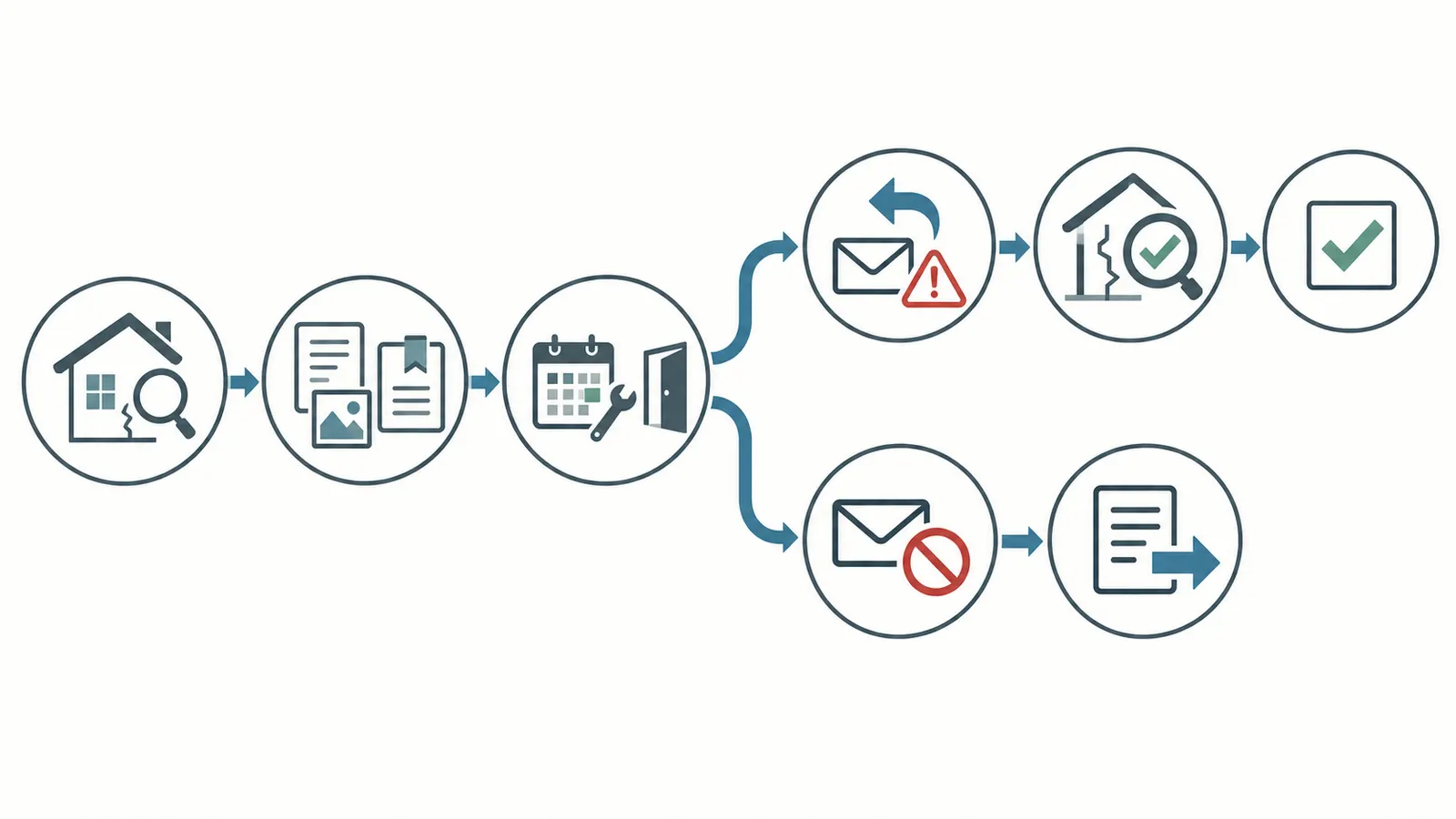
A cure request should identify one or more defined concerns, attach the evidence index, ask for a response that addresses responsibility and method, and state how the completed work will be checked; it should not demand that the contractor admit a legal conclusion.
The request is a project-control document. It is not necessarily a statutory notice. Label it accurately, and separately follow any contract notice clause, warranty procedure, lender requirement, insurance requirement, or state process that applies. A letter can be both professional and firm without threatening an agency, promising a lawsuit, or using words that the evidence cannot support.
The five parts of a strong request
- Project identity. State the property, contract date, project or permit number if known, and the recipient’s role.
- Defined concerns. List each concern by ID and location. Use observations and documents, not a global accusation.
- Requested response. Ask for a written position: accept and cure, dispute with reasons, propose investigation, identify another responsible party, or explain why the condition is within tolerance or scope.
- Access and deadline. Offer reasonable access and state a date for the response. Distinguish the date for a response, the date for a proposed plan, and the date for completed work if those are different.
- Verification and next handoff. State that completion will be recorded against the agreed test and that unresolved rows may be routed to the appropriate local authority, mediator, insurer, or counsel after checking the governing process.
A useful request is specific enough that a contractor can price or schedule it. “Fix the leak” is not enough if the source is unverified. “Investigate the staining at the west jamb, identify the source and proposed repair in writing, protect the opening from further water, and provide a date for a qualified person to verify the repair” is a process request. If the cause is already established by a qualified report, attach that report and ask for the defined correction while preserving the report’s assumptions.
Choose a response window without inventing a national rule
A response window should account for the risk of further damage, the work sequence, access, materials, weather, and the project’s existing contract schedule. Seven calendar days may be reasonable for a written response to a non-emergency observation, but that is an illustrative project-management choice, not a universal legal deadline. A request to make a dangerous condition safe may require immediate action. A request that needs a specialty part may need a plan first and completion later.
State the reason for the date: “Please provide a written investigation and temporary-protection plan by Friday because the opening will otherwise be covered on Monday,” or “Please confirm the proposed correction and schedule within seven calendar days so the appliance installation decision can be made.” Do not call a date a statutory deadline unless the actual rule says so and applies to your situation.
The FTC says to follow phone conversations with a letter sent by certified mail with a return receipt and to keep notes and copies. Read the FTC’s resolution and recordkeeping guidance. That is a sound record-preservation practice. Whether certified mail, a contract notice address, email, portal upload, or another method is legally sufficient depends on the actual contract and jurisdiction. Send the request through every method the contract requires, then keep proof of each delivery.
Avoid four counterproductive requests
Do not ask the contractor to “guarantee it will never happen again” when the cause is not known. Do not ask for a broad refund without explaining the scope and calculation. Do not require a subcontractor to change work if the prime contractor controls the contract and sequence unless the project structure supports that direct instruction. Do not threaten to publish accusations as a substitute for a documented remedy. These requests create noise, can undermine cooperation, and do not tell the next reviewer what outcome is needed.
If the contractor replies by phone, send a same-day confirmation: “My understanding is that you propose X, will do Y by Z, and believe the cause is Q. Please correct anything inaccurate.” If the contractor refuses to respond in writing, record the date, participants, exact words you remember, and your confirmation email. Mark memory as memory; do not turn it into a quotation.
When the cure request is the wrong first move
Move directly to professional or public-safety help when there is imminent danger, suspected criminal conduct, a serious health hazard, active uncontrolled water or gas damage, an unstable structure, or a condition that will be irreversibly concealed. Consider legal advice before sending a detailed demand when there is a looming limitation or notice deadline, a large disputed payment, a lien or bond issue, an arbitration clause, an insurer reservation, a threatened release or waiver, or a possible claim involving a designer, lender, or multiple parties. A request for cure does not automatically extend any deadline.
Verify the condition and the proposed cure without becoming your own inspector #
Independent verification should answer a defined question within the verifier’s qualifications, not be hired to produce a desired accusation or to replace the authority having jurisdiction.
Verification is often the difference between a useful dispute and an unbounded argument. It may be as simple as matching installed cabinet dimensions to an approved drawing, or it may require a licensed engineer, electrician, plumber, building envelope professional, industrial hygienist, or other qualified person. The right verifier depends on the question and the jurisdiction. A general home inspector may document conditions but may not be authorized to design a structural repair or certify regulated work.
Write the verification question first
Before hiring anyone, write one to three questions such as:
- “Does the installed door opening match the dimensions and flashing sequence shown in detail A-402 and the approved submittal?”
- “Is the observed staining active, and what additional inspection is needed to identify its source?”
- “Does the proposed repair address the failure mechanism described in the report, and what observable condition will indicate completion?”
- “Which part of this concern, if any, should be reported to the local building department or code authority?”
Avoid “Please inspect the entire house and tell me whether the contractor did everything wrong.” That scope invites a report that is expensive, hard to challenge, and poorly matched to the next decision. Ask the verifier to state exclusions, inaccessible areas, documents reviewed, instruments used, date, weather or operating conditions if relevant, and the limits of a visual or remote assessment.
Use an independent verifier carefully
Independence is not a magic label. Ask about current or prior work for the contractor, designer, insurer, lender, or homeowner. Ask whether the person is licensed or certified for the work in the actual jurisdiction, whether they carry appropriate insurance, and whether they can provide a written scope and fee. Do not misrepresent the desired conclusion. Give the verifier the contract and relevant drawing, but also ask for an opinion based on the condition and governing documents, not on your summary alone.
The homeowner may safely collect ordinary project records and photographs from accessible, safe areas. Hazardous inspection belongs to qualified professionals. Do not remove finishes, open electrical panels, enter confined spaces, climb unstable ladders, enter excavations, operate unfamiliar equipment, or perform destructive testing. If testing requires opening an assembly, agree in writing who authorizes it, who pays, how the opening will be protected, and whether the contractor, designer, insurer, or authority must observe before concealment.
Verify a cure by the failure mode, not the appearance
A cosmetic change may not be a cure. Build the test around the concern:
| Concern type | Weak closure test | Better bounded test | Responsible verifier |
|---|---|---|---|
| Finish mismatch | “Looks better” | Compare against agreed sample, approved finish schedule, and lighting conditions | Contractor and homeowner; designer if the finish is design-controlled |
| Door or window water entry | “Sealant applied” | Confirm source investigation, compatible repair, required flashing or drainage sequence, and post-repair observation or test defined by a qualified professional | Building-envelope professional or other qualified local professional |
| Floor or cabinet dimension | “Installed” | Measure the agreed reference points and compare with approved drawings, tolerances, appliance requirements, and any accepted field change | Contractor, designer, or independent verifier |
| Structural concern | “Crack filled” | Do not infer capacity from appearance; obtain an appropriate evaluation and repair design from a qualified professional | Engineer or other legally qualified professional |
| Electrical or gas concern | “Power is back” | Do not rely on operation alone; use the qualified trade and required inspection or testing path | Licensed electrician or gas professional and authority having jurisdiction |
| Missing permit or inspection | “The contractor says it is fine” | Verify permit status and inspection record with the local building department | Local building department or authorized professional |
This table is a decision aid, not a code checklist. Local codes, adopted standards, approved plans, and inspection protocols control. A remote reviewer cannot confirm concealed work, load paths, fire stopping, grounding, gas tightness, water intrusion source, or contamination.
Add a cost record without treating a quote as damages
Cost evidence supports decisions, but a quote is not automatically a legal measure of loss. Record:
- what work the quote includes and excludes;
- whether demolition, disposal, permits, design, testing, temporary protection, and reinstallation are included;
- whether the quote assumes the underlying condition is already known;
- whether the work is a repair, completion, replacement, or betterment;
- taxes, deposits, contingencies, and schedule assumptions;
- whether the contractor had a chance to inspect and cure;
- whether insurance, warranty, bond, or lender approval changes the path.
For an illustrative worksheet, suppose a homeowner receives three bounded estimates for a defined door-repair scope: $1,850, $2,400, and $3,100. The simple midpoint is:
($1,850 + $2,400 + $3,100) / 3 = $2,450
That midpoint is not “the damages.” It is a planning signal that the scope may be incomplete or that market conditions differ. Sensitivity matters: if the highest estimate includes $600 of unrelated trim replacement, the comparable set becomes $1,850, $2,400, and $2,500, with a midpoint of $2,250. If the lowest estimate excludes permit and testing costs, it should not be compared directly. Put assumptions beside each number.
The same logic applies to delay. If a defined correction is expected to take four working days and affects a $900-per-day temporary-housing cost, the modeled exposure is 4 × $900 = $3,600. It is illustrative only. Actual recoverability, causation, mitigation, insurance coverage, contract terms, and legal rules require the appropriate professional review.
Close a row only when the record says why it is closed
Use one of five closure states:
- Verified cured: the agreed test was completed and the evidence is attached.
- Accepted as-is: the homeowner knowingly accepts the condition, with any written credit, waiver, or future responsibility reviewed before signing.
- Re-scoped: the parties changed the work through a written change order or other contract mechanism.
- Unresolved and routed: the row was handed to a named authority, mediator, insurer, bond process, court, or counsel with delivery proof.
- Abandoned or inaccessible: the contractor did not respond, the site could not be accessed, or the evidence was compromised; the next decision records that limitation.
Do not mark a row closed because a contractor promised to return. Mark it “response received; cure pending” and set the next date.
Route the dispute to the right channel in the actual jurisdiction #
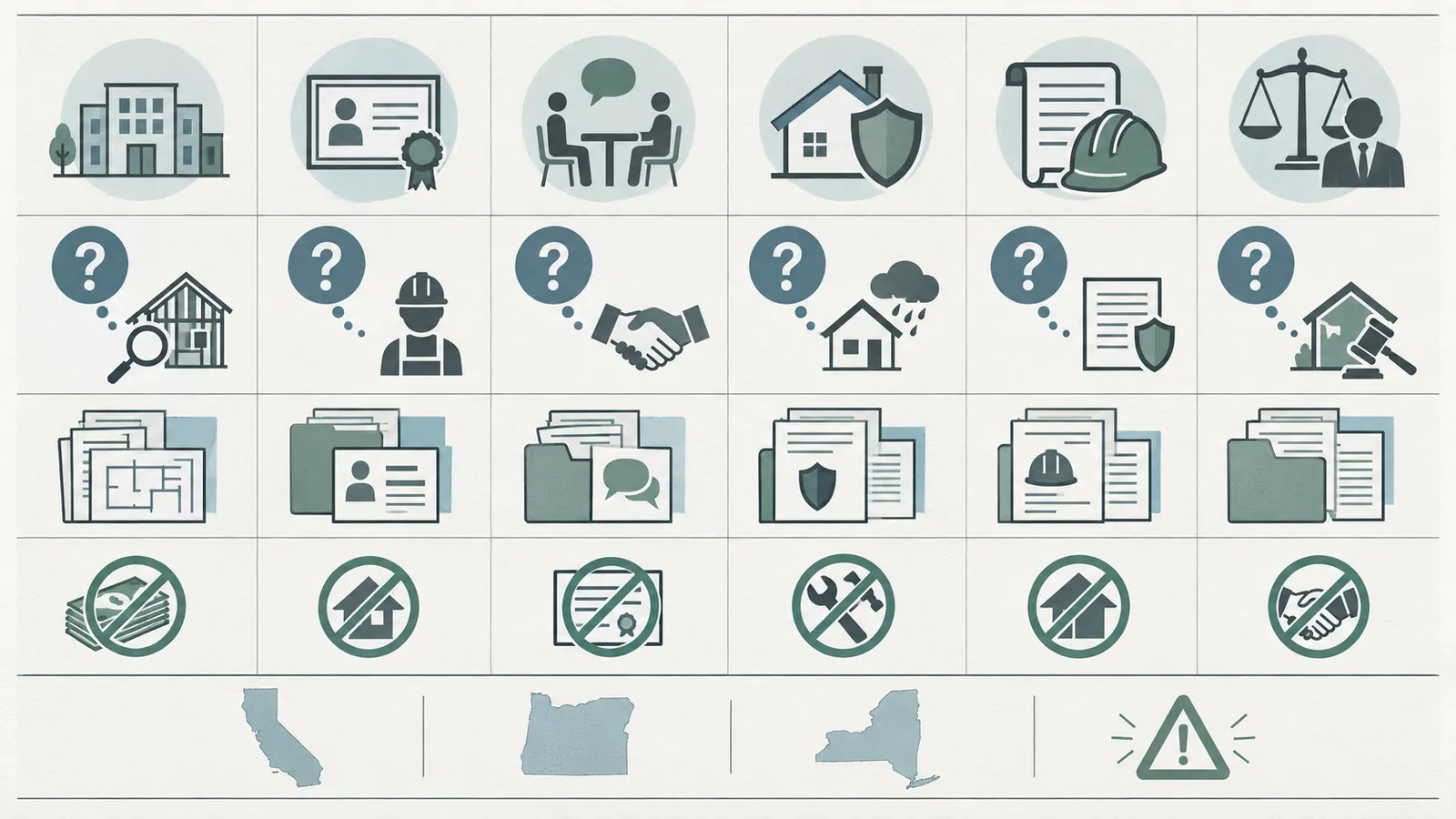
The correct route depends on the issue and location: a local building department for permit or code administration, a licensing body for covered contractor conduct, a consumer office for certain fraud or marketplace problems, mediation for a negotiated settlement, an insurer for covered damage, and counsel or court for rights and remedies.
The United States has no single national contractor-dispute process. State agencies differ, local building departments differ, and some states leave home-improvement licensing to counties or cities. The examples below are jurisdiction-labeled models for routing, not a national checklist.
Federal consumer starting point: records and first resolution
The FTC is a useful national consumer source for basic record discipline. It recommends considering licensed and insured contractors, getting a written estimate with work, materials, completion date, and price, reading the contract carefully, and not making the final payment until the work is done and satisfactory. It also says to first try to resolve a home-improvement problem with the contractor, document communications, and consider outside help if that effort fails. See the FTC’s current home-improvement guidance.
The FTC does not become the project’s building inspector or adjudicator because a homeowner sends a complaint. Treat its page as a record and consumer-protection starting point. For a local permit, inspection, license, or remedy question, identify the actual state, county, city, or agency whose rule applies.
California: CSLB complaint, mediation, license lookup, and bond are distinct
For a California contractor within Contractors State License Board jurisdiction, check the contractor record before drafting the route. The California CSLB license lookup allows a homeowner to check license or Home Improvement Salesperson registration information, including complaint disclosure. Save the result date and the exact business name and license number. A search is evidence about the record, not a finding about your project.
The California CSLB complaint process says every written complaint is reviewed for jurisdiction, CSLB sends written confirmation of receipt, and notice is sent to the contractor to encourage resolution. It prioritizes threats to public health and safety. If mediation is appropriate, CSLB may contact the parties and attempt mediation. That is different from a guaranteed repair or recovery; CSLB expressly says it cannot guarantee restitution.
Do not merge a license complaint with a bond claim. CSLB explains that a surety company investigates a bond claim while CSLB investigates a license complaint, and that CSLB does not process claims against surety companies. Review California’s explanation of complaint and bond separation before assuming that one filing preserves every remedy. Save the contractor’s license record, contract, change orders, photos, cure request, response, independent report, payment record, and any agency correspondence as separate packet sections.
For a California homeowner deciding whether to file now, ask:
- Is the issue within CSLB jurisdiction, or is it mainly a private contract, design, permit, insurance, or court issue?
- Is there a public-health or safety concern that changes urgency?
- Is the license active and is the contracting entity the same name on the contract and invoices?
- Are you considering a bond claim with a separate surety deadline?
- What exact action do you want CSLB, the contractor, the surety, mediator, or court to take?
The California page also describes potential small-claims and bond information in some circumstances and notes that arbitration programs have eligibility criteria. Do not turn those example thresholds into a recommendation without current review of the agency page, contract, and legal facts.
Oregon: separate CCB, Building Codes Division, and local building department routes
Oregon is a good example of why “file a licensing complaint” is too broad. The Oregon Construction Contractors Board consumer page covers contractor complaints, stated deadlines, pre-complaint notice, license checks, and dispute resolution. The Oregon Building Codes Division complaint page covers certain building-code, unsafe-condition, deficient-material, and unlicensed-work concerns, while directing contract, negligence, and contractor-licensing complaints to CCB and generally directing permit failures to the local building department unless other alleged violations are involved.
For Oregon CCB property-owner complaints, the current page states that a complaint about breach of contract, negligence, or improper work on a new structure must be received within one year from first occupancy or within two years of substantial completion, whichever is earlier. For an existing structure, it states a one-year period after substantial completion. It also says the homeowner must give the contractor 30 days’ pre-complaint notice by certified mail to the address on record. These are Oregon CCB statements, not national rules. Check the current form and facts before relying on them. Read the Oregon CCB deadlines and notice instructions.
That timing changes the gate. A homeowner should not spend months polishing a packet while assuming that an informal cure request pauses an agency deadline. Put the possible CCB deadline, substantial-completion date, occupancy date, and notice date in a calendar with the source and assumptions. If the date is uncertain or the claim is significant, obtain Oregon legal advice promptly.
Oregon CCB says its dispute-resolution staff will try to help reach a settlement when the matter is within jurisdiction, but its page says it can only help through that process if the contractor was licensed during construction. The license search can show an active license, bond, insurance, and complaints or discipline. Check Oregon CCB’s consumer tools and license information. Do not assume a contractor’s present status answers whether the contractor was licensed when the work occurred.
For an Oregon code or safety concern, BCD says a consumer can file regarding work without required licenses, unlicensed individuals, unsafe building conditions, or knowingly deficient materials or equipment. It also says permit failures should generally go to the local building department unless additional violations are alleged, while contractor licensure, breach of contract, negligence, and nonpayment complaints should go to CCB. Use Oregon BCD’s routing language and call the division if the category is unclear.
Oregon BCD’s submission requirements make the packet fields concrete: the complaint must be signed, describe the installation in detail, name the businesses or individuals involved, attach contracts, invoices, receipts, and other paperwork, and include witness information. BCD says an investigation generally requires 90 days but can vary. Read the Oregon BCD documentation requirements. A homeowner should not promise a witness that the agency will protect anonymity when the agency says the complainant is not anonymous and may need to answer questions or testify.
New York: licensing can be county or city specific
New York shows the danger of saying “the state licensing board” without checking the location. The New York Attorney General contractor guidance names licensing requirements for New York City, Suffolk, Nassau, Westchester, Putnam, and Rockland counties, and the City of Buffalo. It also says New York state law requires a written contract for home-improvement work over $500 with specified items such as scope, materials, approximate dates, price, cancellation notice, and payment language.
Treat that as a jurisdiction-labeled example. It does not mean every New York county or city uses the same license requirement, and it does not mean every state uses New York’s $500 threshold or contract language. Record the property’s county and municipality, ask the local consumer or licensing office which rule applies, and save the exact page or form consulted. If the contractor’s contract omits a required item, preserve the omission as evidence and ask counsel how it affects the project; do not write your own legal conclusion into the packet.
Route by problem type, not by anger level
Use this matrix before selecting an agency.
| Primary problem | First route to check | Records to send or preserve | What the route may not decide |
|---|---|---|---|
| Immediate danger | Emergency service, utility, local building authority, or qualified professional | Safe photos, incident date, permit and inspection information | Private damages or final contract allocation |
| Work may violate adopted code | Local building department or code authority | Permit number, inspection history, location, photos, plans, responsible trade | Whether the contractor owes a refund under the contract |
| Unlicensed or improperly licensed work | Actual state, county, or city licensing authority | Legal business name, license lookup, contract, invoices, scope | Engineering adequacy or all private remedies |
| Breach, negligence, poor workmanship | Contract cure process, insurer, mediator, counsel, or state contractor board where applicable | Contract, change orders, chronology, cure request, independent report, cost scope | A code determination if it lacks authority |
| Nonpayment or disputed invoice | Contract notice/payment process, lender, counsel, and applicable board | Invoice, payment ledger, lien notices, delivery records | Whether workmanship is compliant without technical evidence |
| Damage covered by insurance | Insurer and adjuster | Policy, loss date, mitigation receipts, photos before and after | Contractor discipline or code enforcement |
| Settlement choice | Contract mediation or arbitration clause, neutral mediator, counsel | Clean packet, requested outcomes, authority to settle | Public enforcement findings unless the agency is the forum |
One concern can have two routes, but the packet should state the distinct question for each. “Please determine whether the work complies with code” and “Please correct the contract nonconformance” are different requests to different recipients.
Use mediation, agency review, or legal advice as different handoffs #
Mediation is a negotiated process, agency review is an authority’s process, and legal advice is confidential professional guidance; choosing one does not automatically replace the others.
Mediation is for a negotiated outcome
Mediation is most useful when the parties can still exchange information, the desired outcome is concrete, and each person has authority to settle. Prepare a one-page settlement brief with the open rows, documents, disputed facts, proposed cure or payment options, verification test, schedule, and non-negotiables. Separate facts from positions: “the door leaks at the lower jamb after rain” is a fact to verify; “the contractor must replace the entire wall” is a proposed remedy.
Ask the mediator what information is confidential, whether the process is nonbinding until signed, who pays, how a settlement will be documented, and whether participating affects any deadline. Do not assume that making a mediation request pauses a licensing, bond, lien, warranty, or court deadline. If the contract requires arbitration, read the clause before choosing a different process.
In California, CSLB says it may attempt mediation when appropriate after its initial review and request for documentation, but it does not guarantee restitution. In Oregon, CCB says its dispute-resolution staff may try to help reach settlement for a complaint within its jurisdiction. Those agency processes are not identical to private mediation, and neither statement should be broadened into a national promise.
An agency complaint should be a jurisdiction packet, not a venting file
Before filing, make a copy of the packet tailored to the agency. Put the requested agency action on page one. A code authority may need the permit, installation description, and safety facts. A contractor board may need the license entity, contract, breach or negligence theory, notice proof, and deadline facts. A consumer office may need deceptive statements, payment records, and communications. Remove irrelevant accusations, confidential material not needed for the route, and unsupported diagnoses.
Use the agency’s current form and instructions. Capture the submission date, confirmation number, attachments, and any request for additional information. Keep a log of calls, but do not describe a staff member as having “ruled” on your claim unless the agency issued a written decision. An intake worker saying “this sounds like a contractor issue” is a routing clue, not an adjudication.
Legal advice becomes more valuable at a defined decision point
A lawyer is especially useful when the next move could waive rights, trigger a counterclaim, affect a lien or bond, involve an arbitration clause, require a statutory notice, dispute a large payment, or determine whether to alter or demolish work. Bring the packet, not a box of unorganized files. Ask the lawyer to identify:
- the parties and potentially responsible entities;
- governing contract and notice provisions;
- deadlines and which events start them;
- the difference between agency discipline and private remedies;
- whether a cure opportunity is required or strategically useful;
- whether an expert is needed and what question the expert should answer;
- how to preserve evidence before repair or demolition;
- what amount or remedy is actually being evaluated;
- what the homeowner should say or not say in future communications.
Do not ask a lawyer to certify a technical condition they have not inspected. Do not ask an engineer to decide a legal remedy. The handoff works when each professional receives a bounded question and returns a record that another decision-maker can understand.
Court or bond handoffs require their own timing check
The Oregon CCB publication Going to Court: CCB Complainants or Respondents explains that an unresolved CCB complaint may require court unless the contract requires arbitration or the complainant decides not to pursue it. It expressly says the publication is not legal advice. It also explains that a judgment may be needed to access a contractor’s bond and that a timely CCB complaint remains important.
That handoff illustrates a general principle: an agency complaint, court claim, bond claim, and mediation can be connected without being interchangeable. A homeowner may need to preserve each route separately. Record the contract’s forum clause, the court or agency’s jurisdiction, the amount and remedy sought, the filing or notice date, and whether the requested document is a judgment, administrative finding, settlement, or repair order.
Do not copy Oregon’s small-claims amount, venue, or bond language into another state. Do not assume a California license bond works like an Oregon CCB bond. Do not assume a favorable agency result pays every repair cost. Confirm current rules with the forum or counsel.
Apply the Brictale Quality-Dispute Packet and Escalation-Gate Worksheet #
The Brictale Quality-Dispute Packet and Escalation-Gate Worksheet turns a live disagreement into a row-by-row record that can be reviewed, corrected, and handed off without pretending that the worksheet is an inspection, legal notice, or agency form.
Method
The method is: build one row per concern from contemporaneous records, then apply the gate in order: safety or permit flag, contract and scope, responsible party, scoped cure, independent verification, jurisdiction route, and preserved handoff. This is a synthesis of the project-control sequence and the jurisdiction-specific source distinctions above. It is not a measured study and does not claim that the sequence guarantees settlement.
Worksheet
| Concern ID and location | Observation and date | Contract or approved record | Responsible party to contact | Requested cure or response | Response date and delivery proof | Cure test or verifier | Safety/permit flag | Route if unresolved | Next handoff and records |
|---|---|---|---|---|---|---|---|---|---|
| Q-___ / ___ | ___ | ___ | ___ | ___ | ___ | ___ | ___ | ___ | ___ |
| Q-___ / ___ | ___ | ___ | ___ | ___ | ___ | ___ | ___ | ___ | ___ |
| Q-___ / ___ | ___ | ___ | ___ | ___ | ___ | ___ | ___ | ___ | ___ |
Use a separate continuation page when the row becomes crowded. A compact row is better than a tiny font. Attach an evidence index:
| Evidence ID | File or record | Date created | What it proves or helps verify | Original preserved at | Shared with |
|---|---|---|---|---|---|
| P-001 | ___ | ___ | location and sequence | ___ | ___ |
| M-001 | ___ | ___ | statement or response | ___ | ___ |
| C-001 | ___ | ___ | contract or change order | ___ | ___ |
| R-001 | ___ | ___ | professional report or estimate | ___ | ___ |
Illustrative worked example
The following is an illustrative modeled example, not a legal or engineering determination. It shows how the worksheet can prevent a premature licensing accusation.
Suppose a homeowner is renovating a two-story house. The prime contract includes exterior-door installation, the approved detail shows a drainage and flashing sequence, and a change order adds trim but does not change the opening detail. On August 28, the homeowner sees staining at the lower interior jamb after rain. A photo shows the stain, but no photo proves the entry point. A text from the site superintendent says, “We can seal it next week.”
The first row should not say “contractor installed an illegal door.” It should say:
On August 28, at the west exterior door, the homeowner observed brown staining at the lower interior jamb after rain. Photos P-014 through P-017 show the location and nearby trim. The approved detail A-402 and door submittal S-06 are the records to compare. The water-entry source and compliance status are not yet determined.
The cure request can then ask the prime contractor to:
- protect the opening from further damage without concealing the relevant condition;
- identify the person who will investigate and the proposed scope;
- state whether the contractor believes the installation matches A-402 and S-06;
- provide a response by September 12 and a repair plan if the source is confirmed; and
- agree on a qualified verification step before the interior finish is restored.
If the contractor proposes only sealant, the homeowner should ask what source has been established and what the cure test is. If the contractor disputes the observation, the homeowner should preserve the condition and ask a qualified professional for a bounded assessment. If the condition suggests an immediate safety or substantial-damage risk, the response route changes before the ordinary deadline.
Now add cost evidence without inflating it. An illustrative repair estimate might list investigation at $450, temporary protection at $200, and defined repair at $1,750, for a modeled total of $450 + $200 + $1,750 = $2,400. A second estimate might list $2,900 but include unrelated trim replacement. The packet records both scopes instead of claiming the average is the loss. Sensitivity is the difference between a $1,750 repair if the opening is accessible and a $4,300 repair if concealed damage is found; that range changes the decision to seek early legal or insurance advice, but it does not prove either outcome.
The routing row might remain “contractor cure first; local code route to verify if permit or unsafe-condition evidence emerges; licensing route not yet selected.” That is a valid decision. The goal is not to file the fastest complaint. The goal is to know what the next recipient can actually decide.
Limitations
The limitations are: this is an illustrative homeowner workflow, not an official inspection, engineering opinion, legal notice, agency determination, deadline calculator, or substitute for advice from a qualified local professional. It cannot identify concealed defects remotely, determine whether a contract was breached, calculate recoverable damages, confirm current local licensing law outside the cited examples, or tell a homeowner whether withholding payment is permitted. It also cannot preserve a deadline merely because a row exists in a spreadsheet.
Review the worksheet before sending it. Remove conclusions that are not supported. Mark unknowns. Identify the actual property jurisdiction. Check the current agency form and contract notice clause. Ask the professional receiving the packet what additional record would change the decision.
Avoid failure cases that make escalation harder #
The most damaging process failures are usually preventable: mixing issues, destroying evidence, sending a vague demand, missing a local deadline, and choosing a forum before defining the requested decision.
Failure case: “Everything is defective”
Why it fails: The recipient cannot identify what to inspect, what was promised, or what outcome would close the dispute.
Repair: Split the allegation into rows. Start with the three concerns that affect safety, concealment, cost, or schedule. Link each row to a document and proposed test. Keep a separate pattern note if repeated conduct matters, but do not substitute it for issue-level facts.
Failure case: the homeowner repairs first and documents later
Why it fails: The repair may be necessary, but it can remove the condition, change the damage, or make responsibility harder to evaluate. A later photograph cannot recreate what was concealed.
Repair: For an emergency, make the area safe and document what can be safely documented before and during the work. For non-emergency work, notify the responsible party and relevant insurer or authority before destructive work. Ask a qualified professional what must be preserved. Keep invoices, removed materials when safe and appropriate, and the repair scope.
Failure case: the contractor’s “we will fix it” is treated as a cure plan
Why it fails: There is no scope, date, cause, responsible person, or test.
Repair: Confirm the statement in writing and ask for method, schedule, access needs, temporary protection, and closure test. Mark the row “response received; cure plan incomplete.”
Failure case: a photo is treated as a code ruling
Why it fails: Code compliance may depend on concealed assemblies, adopted local provisions, approved plans, measurements, inspection history, and the authority having jurisdiction.
Repair: Use the photo as evidence of location and condition. Ask the local building department or qualified professional the bounded code question. In Oregon, BCD specifically distinguishes certain code and safety complaints from contractor licensing and contract complaints; the correct destination is part of the evidence work. Oregon BCD routing
Failure case: a license lookup is treated as a quality inspection
Why it fails: A license record identifies a regulatory status and possibly disclosures; it does not inspect the installation or prove the contractor performed the work correctly.
Repair: Save the lookup as one packet exhibit, then separately document contract scope, observed condition, verification, and requested cure. California CSLB and Oregon CCB each provide license-search tools, but their agency roles and processes differ. California CSLB license search and Oregon CCB consumer tools.
Failure case: the homeowner waits for perfect evidence
Why it fails: Conditions change, work gets covered, weather passes, witnesses forget, and a jurisdictional deadline may approach.
Repair: Send a bounded preservation and cure request with what is known, label uncertainties, and update the packet. If a deadline may apply, ask counsel or the authority what preserves the route. Do not assume an informal email, mediation, or contractor promise stops the clock.
Failure case: one state’s procedure is copied nationally
Why it fails: Notice periods, licensing authority, county rules, bond procedures, arbitration, and court routes vary.
Repair: Put a bold jurisdiction field at the top of the packet: property state, county, municipality, agency checked, page or form URL, access date, and question asked. The Oregon 30-day pre-complaint notice and stated CCB deadlines, California CSLB process, and New York county-license examples belong only in their labeled branches. New York Attorney General jurisdiction examples.
Failure case: the homeowner demands money before defining the work
Why it fails: A payment demand that mixes unfinished work, alleged damage, delay, betterment, and emotional harm is difficult to verify and negotiate.
Repair: Break the amount into defined scopes and assumptions. Identify paid amounts, remaining contract amounts, repair estimates, temporary costs, and disputed categories. Ask counsel how the contract and local law treat each category. Keep settlement positions separate from factual records.
Failure case: the agency is asked to be the homeowner’s lawyer
Why it fails: An agency may investigate public compliance or license conduct but cannot represent the complainant or provide private legal advice. Oregon CCB’s court publication expressly warns that it is not legal advice and says the CCB cannot represent or advise a homeowner on a court case. Read the Oregon CCB court handoff publication.
Repair: Ask the agency what it can decide, what it needs, and what it cannot do. Ask a lawyer about private rights and deadlines. Ask a qualified technical professional about the condition. Keep the roles visible in the packet.
Make the next handoff explicit and keep the record current
The right next step is the one that answers the unresolved question with the least irreversible risk, while preserving any contract, agency, insurance, bond, or court route that may matter.
At the end of each packet review, write a five-line handoff:
- Decision made: cure request, verification, local code contact, licensing report, mediation, insurance notice, or legal advice.
- Reason: the evidence and jurisdiction fact that made this route appropriate.
- Responsible recipient: named person, office, contractor entity, mediator, insurer, or counsel.
- Required record: exact attachments, originals preserved, delivery method, and access conditions.
- Next date: response date, inspection date, deadline check, or review date; state what happens if there is no response.
Example:
Decision made: independent verification before agency escalation. Reason: the photos show staining, but the source and contract comparison are unresolved; no immediate hazard has been identified. Responsible recipient: qualified local building-envelope professional, limited to the west door opening and approved detail A-402. Required record: contract exhibit, submittal S-06, P-014 through P-017, chronology, and no destructive opening without written authorization. Next date: obtain scope and fee by September 15; if the condition is unsafe or will be covered sooner, contact the appropriate local authority immediately.
If the contractor cures the issue, record the test and close the row. If the contractor refuses, record the refusal without exaggeration, recheck the jurisdiction and deadlines, and select the next route. If the contractor disappears, secure the site, preserve evidence, notify the insurer or lender if relevant, and obtain prompt local advice before hiring replacement work that could change the record.
Originality brief
Current answers: Existing answers include general FTC consumer guidance, contractor license lookups, California CSLB complaint and mediation information, Oregon CCB complaint and court materials, Oregon BCD code routing, and New York Attorney General contract and county-license guidance. They are useful authorities, but they generally answer where to report, what a contract may contain, or what an agency process does.
Missing decision: A homeowner still needs to decide whether the next move is a scoped cure request, independent verification, a code or safety report, a licensing complaint, mediation, insurance notice, or legal advice—and what record must travel with that move—without turning one state’s deadline into national advice.
Original contribution: The Brictale Quality-Dispute Packet and Escalation-Gate Worksheet connects observation, contract obligation, responsibility, cure, verification, jurisdiction, and handoff in one auditable row. It includes a modeled example, formulas, sensitivity, failure branches, and explicit limits.
How it can be checked: A reviewer can take any row and ask whether the source observation is preserved, the cited project document exists, the responsible party is identified, the requested cure is testable, the jurisdiction is named, the current agency instructions were checked, and the next handoff has a date and delivery record. The article’s state examples can be checked directly against the linked FTC guidance, California CSLB process, Oregon CCB process, Oregon BCD routing, and New York Attorney General guidance.
The record is ready for the next person when that person can tell what is known, what is not known, what was promised, what was requested, what remains unsafe or unverified, which rule or contract route applies, and what decision is due next. For more homeowner planning and build-management subjects, continue through Brictale’s homeowner blog.
Cite this guide
Brictale. “How to Manage a Home Construction Dispute Before Filing a Licensing Complaint.” Published 2026-09-24; updated 2026-09-24.
https://brictale.com/build/contractors/manage-home-construction-dispute-before-licensing-complaint · Read the Markdown version
Original contribution: The Brictale Quality-Dispute Packet and Escalation-Gate Worksheet. A reusable record that connects an observed condition to the contract, responsible party, cure request, verification method, jurisdiction route, and next handoff.
Sources and scope
Evidence behind this page
- The Federal Trade Commission advises a homeowner with a home-improvement problem to first try to resolve it with the contractor, follow phone conversations with a letter sent by certified mail with a return receipt, and keep notes and copies of letters and documents.
How To Avoid a Home Improvement Scam
United States federal consumer guidance for home-improvement problems; it is general advice, not a state-specific notice rule or a legal conclusion.
Accessed · Link to this claim - The FTC recommends a written estimate or contract that identifies the work, materials, completion date, and price, and says homeowners should not pay the full project amount up front or make the final payment until the work is done and the homeowner is satisfied; state rules vary.
How To Avoid a Home Improvement Scam
United States federal consumer guidance; payment and contract requirements must be checked under the project contract and actual state or local law.
Accessed · Link to this claim - California Contractors State License Board says every written complaint is reviewed for jurisdiction, acknowledges receipt in writing, and sends notice to the contractor to encourage resolution; complaints involving a threat to public health and safety receive the highest priority.
Complaint Process Against Licensed Contractors - CSLB
California CSLB process for complaints involving contractors within CSLB jurisdiction; it does not establish a national complaint process.
Accessed · Link to this claim - California CSLB distinguishes a complaint against a contractor license from a claim against a surety bond: the surety company investigates bond claims, while CSLB investigates license complaints, and CSLB does not process claims against surety companies.
Complaint Process Against Licensed Contractors - CSLB
California CSLB explanation of license complaints and surety bond claims; deadlines and eligibility require case-specific checking.
Accessed · Link to this claim - California CSLB's license search lets a user check a contractor license or Home Improvement Salesperson registration and includes complaint disclosure among the information to verify.
Check a Contractor License or Home Improvement Salesperson (HIS) Registration
California contractor-license lookup; a search result is not a finding that a particular project is compliant or that a claim will succeed.
Accessed · Link to this claim - Oregon Construction Contractors Board says a property-owner complaint about breach of contract, negligence, or improper work on a new structure must be received within one year of first occupancy or two years of substantial completion, whichever is earlier, and generally requires 30 days' pre-complaint notice by certified mail; different Oregon situations have different deadlines.
Consumer Tools: How To File a Complaint
Oregon CCB property-owner complaint process and stated deadlines; not a national rule, not a substitute for checking the current form or legal advice, and not applicable to every project type.
Accessed · Link to this claim - Oregon CCB says its dispute-resolution staff can try to help reach a settlement when a complaint is within its jurisdiction, but it can only help with its complaint process if the contractor was licensed during the construction project; the CCB license search can show active license, bond, insurance, and complaint or disciplinary information.
Consumer Tools: How To File a Complaint
Oregon CCB licensing, complaint, and mediation guidance; it does not decide every contract or code question and does not apply outside Oregon.
Accessed · Link to this claim - Oregon Building Codes Division says consumers can report work without required licenses, unlicensed workers, unsafe building conditions, or knowingly deficient materials or equipment to BCD, while complaints about licensure, breach of contract, negligence, or nonpayment by contractors should go to the Oregon CCB; permit failures should generally be reported to the local building department unless additional violations are alleged.
Building Codes Division: File a complaint
Oregon BCD routing guidance for code, safety, licensing, contract, and permit complaints; local building departments and other states may use different channels.
Accessed · Link to this claim - Oregon BCD's complaint requirements include a signed complaint, a detailed installation description, names of businesses or individuals involved, copies of documentation and paperwork, and witness contact information; BCD says an investigation generally requires 90 days but may vary.
Building Codes Division: File a complaint
Oregon BCD complaint submission and stated general investigation timing; this is not a promise of a result or a universal agency timeline.
Accessed · Link to this claim - Oregon CCB's court handoff publication explains that an unresolved CCB complaint may require court unless the contract requires arbitration or the complainant stops pursuing it, warns that the publication is not legal advice, and explains that a judgment may be needed to access a contractor surety bond within the applicable time limit.
Going to Court: CCB Complainants or Respondents
Oregon CCB publication for residential-contractor complaints, revised June 9, 2023; amounts, venues, arbitration clauses, and deadlines require current case-specific review.
Accessed · Link to this claim - New York Attorney General guidance says home-improvement contractors must be licensed in specified jurisdictions including New York City, several named counties, and Buffalo, and says New York state law requires a written contract for home-improvement work over $500 with specified scope, materials, dates, price, cancellation, and payment language.
Contractors and home maintenance
New York Attorney General consumer guidance; the licensing examples are jurisdiction-specific and do not mean every New York location uses the same license rule.
Accessed · Link to this claim