How to Maintain a Contractor Proposal Revision Register Before Award
Keep changing custom-home bids comparable with a dated revision register for drawings, addenda, allowances, exclusions, price deltas, responsibility and award gates.
The short answer
Create one current bid-package baseline, assign every proposal and document a version ID, and log each revision as a row-level delta. Record what changed, who must confirm it, the price and schedule effect, and whether the old proposal is superseded. Re-price or pause when a material scope, allowance, exclusion, or responsibility is unresolved; proceed only when the selected proposal and its attachments are the package you intend to contract.How to Maintain a Contractor Proposal Revision Register Before Award
Maintain one dated baseline for the custom-home bid package, then log every proposal, drawing, specification, addendum, clarification, allowance, exclusion, price change and schedule change against it. Mark older versions superseded, assign a person to confirm each material delta, and stop treating bids as comparable when a material row is unresolved. Re-price, pause, or proceed only after the selected proposal and its attachments describe the same current scope.
This guide is for a US homeowner comparing custom-home builder proposals before signing an award or construction contract. It does not solicit bids, assess a contractor’s workmanship, review engineering, interpret a particular contract, or replace advice from a lawyer, architect, engineer, insurance professional, licensing agency or local building department. The core method is a Brictale synthesis: the sources below support the individual recordkeeping and comparison practices, while the register and decision gates organize them into an auditable homeowner workflow.
Use a live baseline, not a stack of bids #
The comparison is still valid only when each contractor has priced the same current documents, scope, assumptions and responsibility split. If a drawing revision, addendum, allowance, exclusion or clarification changes that common basis, freeze the old comparison, create a new baseline, and ask which proposals must be re-priced. California’s Contractors State License Board gives the clearest jurisdiction-labeled version of this principle: it advises California consumers to obtain written bids and compare them using identical plans, specifications and scope of work. That is a California consumer recommendation, not a national rule requiring three bids, but the comparability logic is useful throughout the United States. California CSLB explains the identical-plan comparison.
The key question is not “Which proposal has the lowest number?” It is “Which proposal is the lowest verified price for the same defined work, with the same known allowances, exclusions, responsibilities, schedule assumptions and document revision?” A proposal register exists to answer that second question without relying on memory, a contractor’s latest email, or a spreadsheet cell whose source has disappeared.
The need for a live baseline follows from how a construction package works. Plans show locations and dimensions; specifications describe materials, equipment, systems, standards and workmanship. A proposal may add qualifications, allowances, exclusions, alternates, unit prices, schedule assumptions and clarifications. An addendum may change the documents sent to every bidder. A later conversation may resolve an ambiguity for one contractor but not another. When those documents are not carried forward together, a nominal price comparison can silently become a comparison between different projects.
The American Bar Association’s public legal education guidance treats plans, bids, estimates and other project documents as part of the scope that should be attached to contract copies. It also says that change orders should be written, signed by both parties and attached when plans change or delays occur. That guidance concerns contract documentation, but it exposes the pre-award control point: if a document would matter after award, record it before award and decide whether every bidder has priced it. The ABA describes attaching plans, bids, estimates and signed change orders.
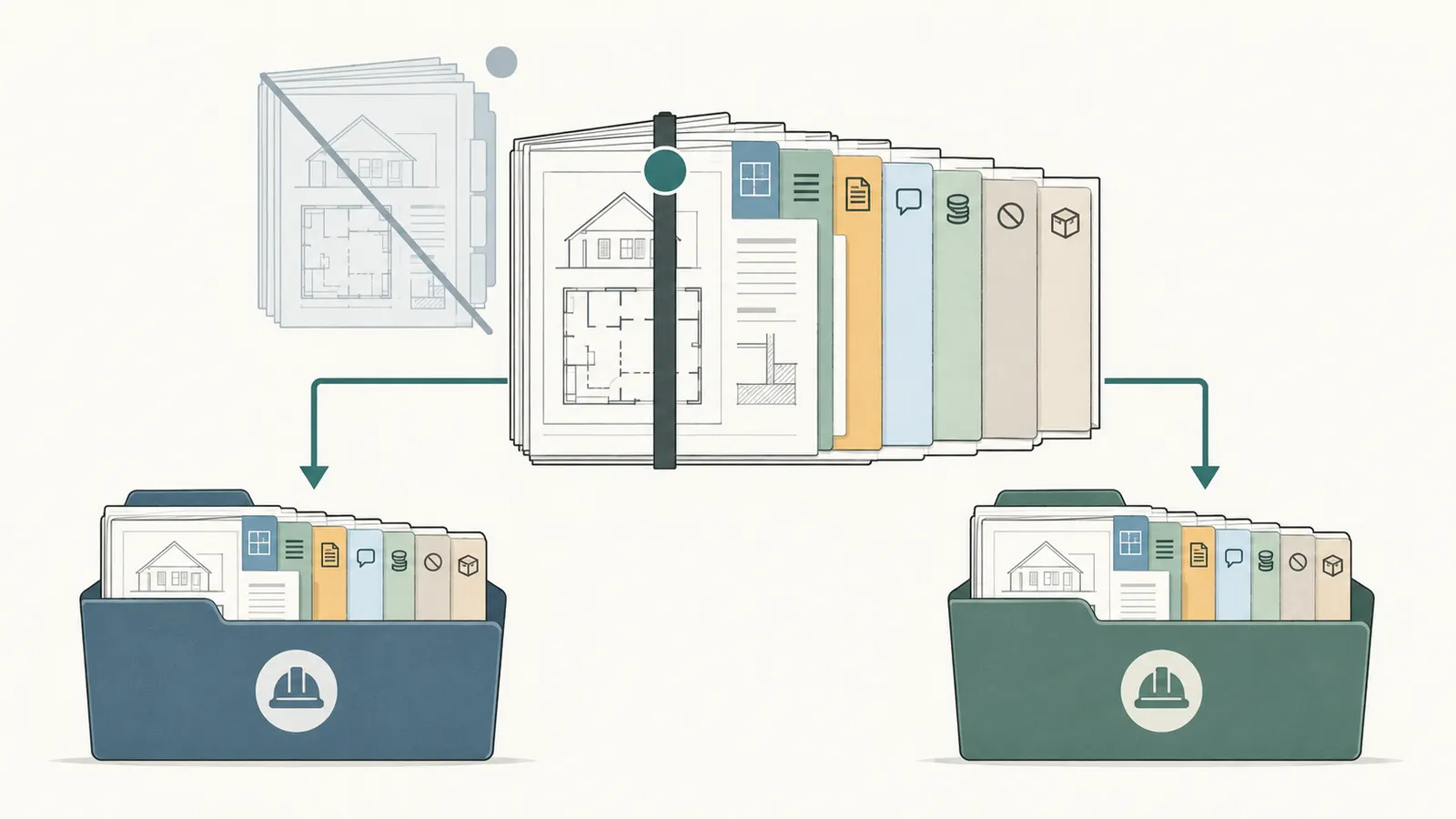
The decision the register must produce
At the end of each review cycle, the register should produce one of three owner decisions:
| Decision | Use it when | Required record before moving on | Next handoff |
|---|---|---|---|
| Re-price | The current baseline is clear, but one or more contractors have not priced a material change or are pricing a changed allowance, exclusion, quantity or responsibility differently. | New request date, affected rows, response deadline, requested document revision, and a rule that the old price is not current. | Send the same delta package to every affected contractor; architect or design professional confirms the document meaning where needed. |
| Pause | The scope, document precedence, responsibility, permit path, allowance basis, schedule effect or contract treatment is still ambiguous. | The unresolved question, decision owner, missing evidence, risk of proceeding and a hold status. | Obtain written clarification from the responsible design professional, contractor, lawyer or local authority. |
| Proceed | The selected proposal is tied to the current baseline, all material deltas are answered, the responsible people have confirmed their rows, and contract attachments are identified. | Final comparison date, selected proposal ID, superseded versions, open non-material items, and award-to-contract checklist. | Owner and selected contractor assemble the contract package; lawyer reviews legal terms if appropriate. |
Do not use “proceed” merely because a contractor says the change is “included.” “Included” is a conclusion, not a usable record. The register should identify the drawing or specification reference, the exact proposal language, the price treatment, the schedule treatment, the person who confirmed it, and the document that will govern after award. If that chain is missing, the safest decision is re-price or pause.
What counts as a material change
A change is material for bid comparison when a reasonable owner could select a different contractor, budget, contract type, payment plan or start date if the change were priced or assigned differently. Materiality is not limited to a large dollar amount. A small item can be material if it changes a permit responsibility, a life-safety system, a structural interface, a long-lead product, a warranty, a completion milestone, or who bears a risk.
Use these triggers as a review screen rather than as a legal definition:
- A revised plan changes area, dimensions, openings, grading, structural layout, mechanical equipment locations, utility routes or finish quantities.
- A specification changes a named product, performance requirement, installation standard, warranty, testing requirement or approval responsibility.
- An addendum adds, deletes or rewords a scope item, even when it says the price impact is “none.”
- A clarification converts an assumption into an exclusion, or an exclusion into a contractor obligation.
- An allowance changes amount, unit, included labor, tax treatment, markup, installation, delivery or owner-selection deadline.
- An alternate or substitution changes the basis on which contractors priced the work.
- A contractor’s proposal revision changes price, duration, payment terms, exclusions, qualifications, subcontractors, insurance evidence or permit assumptions.
- A response to one bidder’s question reveals information that every bidder needs in order to price the same work.
The trigger is not “the contractor sent a new PDF.” The trigger is whether the new PDF changes what the contractor is promising to furnish, what the owner must furnish, or the conditions under which the number is valid. A formatting correction can be logged as non-material. A one-sentence note that moves disposal, temporary utilities or permit fees to the owner is material even if the base price does not change.
Originality brief: what this guide adds
Current public answers generally advise homeowners to obtain multiple written bids, compare scope and price, check materials, warranties, references, licenses and insurance, and put changes in writing. The missing decision is what to do when the proposal package moves after that first comparison. The original contribution is a proposal-version-and-delta register that connects each document revision to an affected scope row, an inclusion or exclusion change, an allowance or price delta, a schedule effect, a responsible confirmer, superseded status and the owner’s next decision. You can check it by tracing any final price back to the exact baseline documents and by asking whether an unresolved row would change the award.
The register is not presented as collected data, a contractor survey, a field test or a legal form. It is a transparent worksheet derived from the evidence linked in this article. The method and limitations are stated explicitly in the next chapter so that another homeowner can reproduce the record structure, challenge an assumption, or adapt it to the project’s actual jurisdiction.
Set the document baseline before asking for another price #
Before requesting a re-price, create a named baseline that a person outside the conversation can reconstruct from the files. The baseline should identify the current drawings, specifications, addenda, clarifications, owner-furnished items, allowances, exclusions, alternates, schedule assumptions and responsibility matrix. If you cannot list the package, you cannot fairly tell a contractor what changed.
Start with prerequisites, not the spreadsheet
The register is useful only after the homeowner has enough design information to define the comparison. You do not need a fully finished building to start a proposal comparison, but you do need to know which documents are issued for pricing and which decisions remain open. Ask the architect, designer or design-build team for a transmittal that distinguishes issued-for-pricing documents from sketches, options and background information.
Collect these prerequisites:
- The project address or site identifier, jurisdiction, planned delivery method and target award date.
- A drawing index with sheet numbers, titles, revision letters or numbers, and issue dates.
- The specification index or written scope sections, including finish schedules and equipment schedules where used.
- Every addendum, bulletin, response to bidder question and written clarification distributed to contractors.
- A scope-of-work breakdown that is granular enough to identify who supplies and installs each major item.
- A list of owner-furnished, contractor-furnished and shared-responsibility items.
- An allowance schedule with amount, unit, included work, exclusions, selection deadline, tax and markup assumptions.
- A known-alternate schedule with the exact baseline option and the alternate option.
- Each contractor’s complete proposal, qualifications, exclusions, alternates, schedule and payment assumptions.
- License, registration, bond, insurance, reference and subcontractor records required by the project’s jurisdiction or your risk review.
Do not treat a contractor’s cover letter as the entire proposal when separate pages contain exclusions or allowances. Save the complete file, including attachments, and record the page or section where a material condition appears. If the file is an email body with an attached spreadsheet, preserve both. If a verbal meeting resolves a question, write a dated confirmation and ask the relevant parties to acknowledge it.
Washington Labor & Industries tells Washington homeowners to compare scope of work, warranties, references, completion dates and price, and to verify that permit fees, taxes and other costs are included in the bid. This is a Washington consumer checklist, but it is a practical reminder that a baseline is broader than drawings and a base price. Washington L&I lists the bid factors and cost inclusions to check.
Choose a version naming convention
Use IDs that communicate sequence without pretending that a higher number is automatically better. One workable convention is:
BP-2026-09-08-R02
where BP means bid package, the date is the release date, and R02 is the second issued baseline. A contractor proposal can be A-P03 for Contractor A proposal revision 3. A document can retain its designer-issued ID, such as A-101 Rev 2, while the register assigns a stable record ID such as DOC-014.
The stable record ID is useful because filenames change. A file might be downloaded as pricing_set_final_FINAL2.pdf, then renamed by the design team. The register should store both the stable ID and the exact file name or link. Never delete a superseded document from the project record simply because it is no longer current. Mark it superseded, preserve its received date, and make it impossible to mistake for the current baseline.
Use a small document-control table like this:
| Record ID | Document type | Issuer | Native revision | Date issued or received | Applies to baseline | Status | Notes |
|---|---|---|---|---|---|---|---|
| DOC-001 | Drawing index | Design team | R02 | 2026-09-08 | BP-2026-09-08-R02; carried into BP-2026-09-10-R03 | Current | Lists all issued sheets |
| DOC-002 | Specifications | Design team | R02 | 2026-09-08 | BP-2026-09-08-R02; carried into BP-2026-09-10-R03 | Current | Sections 01–33 included |
| DOC-003 | Addendum 01 | Owner or design team | 01 | 2026-09-10 | BP-2026-09-10-R03 | Current | Distributed to all bidders; creates the post-addendum baseline |
| DOC-004 | Contractor A proposal | Contractor A | P03 | 2026-09-12 | BP-2026-09-10-R03 | Current for A | Includes qualifications and exclusions |
| DOC-005 | Contractor A proposal | Contractor A | P02 | 2026-08-24 | BP-2026-08-20-R01 | Superseded | Retained for change tracing |
The table is not a substitute for the files. It is an index that lets you ask whether two numbers are attached to the same baseline. Record the time zone if a bid deadline is strict, and use the actual date received rather than the date someone says it was sent.
Define what is inside and outside the baseline
Write one sentence that states the comparison boundary. For example: “The 2026-09-08 baseline, BP-2026-09-08-R02, includes architectural sheets A-001 through A-610 at the listed revisions, structural sheets S-001 through S-402, specifications sections 01 through 33 as issued, and the owner-furnished appliance schedule dated 2026-09-07.” Addendum 01 is not part of R02. Then list what is not included: landscape design not yet issued, a pending geotechnical clarification, unresolved utility-company charges, or an owner decision between two finish levels. When Addendum 01 is issued on 2026-09-10, carry the unchanged R02 documents forward and issue BP-2026-09-10-R03 as the post-addendum baseline.
That boundary prevents two opposite mistakes. The first is false certainty: calling a price “complete” when the package expressly excludes design information that has not been issued. The second is endless churn: refusing to compare anything because a minor preference remains open. Open items can be carried as explicit allowances, alternates or decisions with an owner, but they should not be hidden in a generic “open amount” column.
When the baseline is incomplete, set the status to “comparison conditional.” State the unresolved inputs and whether every contractor received the same information. A conditional comparison can guide the next question; it cannot support a final proceed decision for an affected scope.
Record every change at row level #
Each material change should have one register row that identifies the old basis, the new basis, the affected scope, the price and schedule treatment, the responsible confirmer and the next action. A revision-level note such as “Addendum 02 incorporated” is too coarse because it does not reveal which bidder answered which part, which allowance moved, or whether a low bid remains comparable.
The proposal-version-and-delta register
This is the original contribution in full. Its title is Proposal-version-and-delta register. Its method is: Compare a fixed document baseline to each proposal revision, normalize only stated deltas, and route unresolved material changes to re-price or pause. Its limitations are: The register is an owner decision aid, not a bid estimate, contract, legal opinion, engineering review, license verification, insurance certificate, or substitute for state and local requirements.
Create one row for each changed scope item, not one row for each email. Use the following fields:
| Field | What to enter | Why it matters |
|---|---|---|
| Delta ID | Stable ID such as DELTA-007 | Lets emails, questions and approvals point to one change |
| Baseline before | Prior baseline ID and document IDs | Establishes what the earlier comparison meant |
| Baseline after | New baseline ID and document IDs | Establishes the current comparison target |
| Proposal ID | Contractor, proposal revision and received date | Prevents a contractor’s old price being mistaken for current |
| Change source | Drawing, specification, addendum, clarification or proposal page | Shows where the change came from |
| Exact reference | Sheet/detail/section/page/paragraph | Makes the change checkable by another person |
| Affected scope row | Plain-language work category | Makes the commercial effect visible |
| Old treatment | Included, excluded, allowance, alternate or unclear | Shows how the earlier price handled it |
| New treatment | Included, excluded, allowance, alternate or unclear | Shows what must be compared now |
| Price delta | Contractor-stated amount, credit, allowance movement or “not priced” | Separates fact from normalization or guess |
| Units and formula | Each, square foot, linear foot, lump sum, months or other stated basis | Prevents a quantity or unit mismatch |
| Schedule effect | Days, milestone, lead time, or “not stated” | A low price can be unusable if the date changes |
| Responsibility | Owner, designer, contractor, trade, utility or authority | Shows who must answer or perform the next step |
| Confirmer | Named person and date, or “unconfirmed” | Prevents silent assumptions |
| Status | Open, confirmed, re-price requested, superseded or closed | Shows whether the row can pass the award gate |
| Owner decision | Re-price, pause, proceed, accept allowance or carry alternate | Converts recordkeeping into an action |
| Evidence link | File name, email, meeting note or source URL | Allows a later audit of the conclusion |
The “price delta” field must distinguish three different numbers. First is the contractor-stated delta: a written revision such as “add $18,400.” Second is an owner normalization: a modeled number used to place two different allowances on a common comparison basis. Third is an unresolved amount: “not priced,” “included subject to clarification,” or “owner to supply.” Do not place all three in one numeric column. A blank numeric cell can mean zero, unknown or not applicable; use a text treatment field as well.
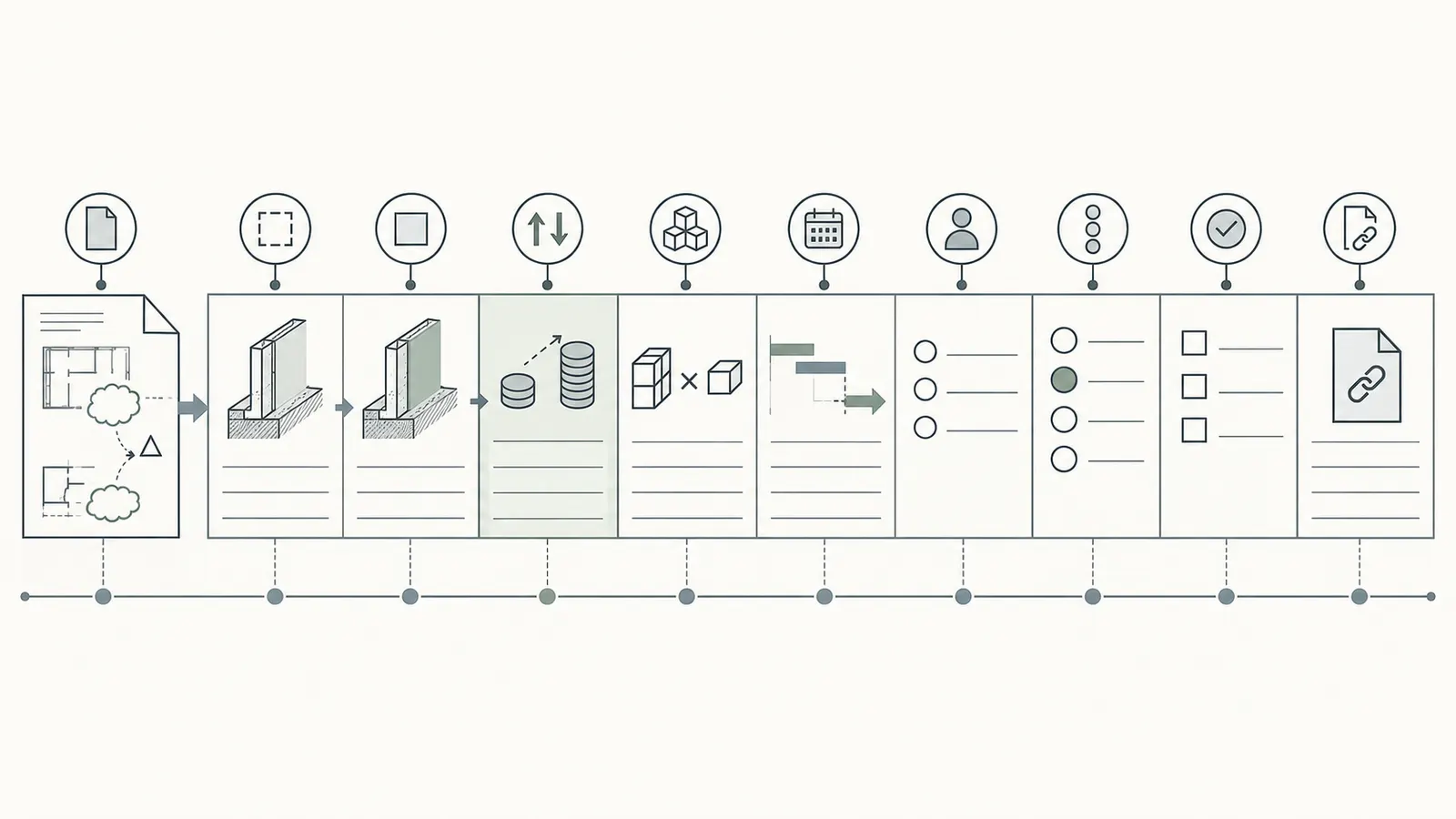
Keep proposal records separate from baseline changes
A design addendum changes the common package. A contractor proposal revision changes one contractor’s response to that package. A clarification may do either, depending on whether it was distributed to all bidders and incorporated into the issued documents. The register needs both levels:
- Baseline log: what the owner’s issued bid package contains.
- Proposal log: what each contractor priced and when.
- Delta log: how a change affects a scope row and what each contractor did about it.
If Contractor A sends Proposal P04 saying “per Addendum 02,” do not assume Contractor B’s P03 is based on Addendum 02 merely because B received the email. Record receipt and acknowledgment separately. The proposal should either list the addenda it includes or answer a checklist that names each one. If the contractor says an addendum has no cost impact, record that as a contractor-stated zero delta, not as proof that the overall scope is identical.
Use a delta classification that drives action
Classify each row using a short controlled vocabulary:
| Class | Meaning | Default next action |
|---|---|---|
| Document-only | Formatting, numbering or cross-reference correction with no scope meaning change confirmed | Confirm and close; preserve the record |
| Common-scope addition | New work all affected contractors must price | Issue the same request and re-price |
| Common-scope deletion | Work removed from the current package | Ask for a credit or revised price from all affected bidders |
| Allowance movement | Budget amount, quantity, included work or markup changed | Normalize for comparison, then obtain revised written treatment |
| Exclusion change | A party moves work or risk to another party | Pause until responsibility and price are written |
| Contractor qualification | One bidder adds a condition or limitation | Ask whether the condition is acceptable and whether other bidders need the same information |
| Alternate or substitution | Two different solutions are being priced | Keep as separate options; do not average them into the base bid |
| Schedule or commercial change | Start, completion, payment, warranty or escalation assumption changes | Re-price or pause because the proposal is no longer the same offer |
| Authority-dependent | Permit, utility, inspection or jurisdiction decision is unresolved | Ask the responsible authority or qualified professional; do not guess |
The classification does not decide legal effect. It decides what the owner must do next. For example, “contractor qualification” might be acceptable if the owner knowingly accepts it and every necessary responsibility is priced. Or it might make the proposal unsuitable. The register must show that decision rather than silently treating the qualification as boilerplate.
Preserve the superseded-version rule
Adopt one simple rule: a superseded proposal can explain history but cannot be used as the current price. If an old proposal contains a lower number, highlight it as historical. The current comparison should show either a written revision from that contractor or a clearly labeled normalization that does not pretend to be a quote.
A document becomes superseded when a later proposal expressly replaces it, when the contractor confirms that the later revision governs, or when the owner issues a new baseline and requires all bidders to respond. If none of those conditions is clear, mark the status “uncertain,” not “current.” Ask the contractor in writing which proposal governs and what documents it incorporates.
The owner should also prevent accidental mixing within a selected package. Do not select the price from P03, the exclusions from P04, and the schedule from an email that says “same as before” unless the final proposal explicitly incorporates those elements. A contract package assembled from fragments creates the same ambiguity the register was supposed to prevent.
Decide whether a revision requires re-pricing #
Re-price when a change affects the contractor’s cost, duration, responsibility, risk allocation or ability to perform, or when the owner cannot verify that the earlier price included the current requirement. Normalize only known differences for internal comparison; never convert a modeled normalization into a contractor commitment.
Use the materiality test in sequence
For each delta, ask the following questions in order:
- Is the current document identified? If not, pause. “The latest plan” is not an adequate reference.
- Does the current document change the described work, quantity, product, standard, interface or responsibility? If no, record why the change is document-only and close it.
- Did every affected contractor receive the same information? If no, issue the information equally before comparing responses.
- Does each proposal expressly state how it treats the change? “No change” can be a response, but it must be tied to the exact delta.
- Is the price treatment comparable? Compare included work to included work, allowance to allowance, and exclusion to exclusion. If not, request a common basis.
- Does the schedule or payment plan change? If yes, treat the offer as commercially changed even if the dollar price is unchanged.
- Has the responsible person confirmed the interpretation? A designer confirms design intent; a contractor confirms means, scope and price; the authority confirms permits or inspections; the owner confirms choices and owner-furnished items.
- Would the result change the award or budget decision? If yes or unknown, re-price or pause rather than proceed.
The sequence matters. Homeowners often jump from “the plan changed” to “add 180 square feet at the old rate.” That may be a useful sensitivity, but it is not evidence that a contractor will price the change that way. A quantity, detail, trade interface or schedule constraint may change the cost relationship. The register keeps the fact, assumption and request separate.
Treat allowances as incomplete prices
An allowance is not automatically comparable just because both proposals have a dollar amount beside the same label. Record at least the amount, unit or quantity basis, what the allowance buys, whether installation is included, whether labor is included, whether delivery and taxes are included, how contractor markup is applied, who selects the item, by what date, and what happens when the selected item is above or below the allowance.
Oregon CCB’s consumer guidance specifically lists allowance items and their budgeted amounts among useful written-contract components, alongside scope, specific materials, dates, price, payment schedule and permit responsibility. This is Oregon guidance, not a nationwide contract form, but it supports treating allowances as visible comparison rows rather than burying them inside a total. Oregon CCB lists allowances, scope, materials, permits and signed written changes.
For a comparison, distinguish:
Adjusted comparison amount = stated proposal total + common-basis allowance adjustment
If Proposal A carries a $12,000 lighting allowance and the common comparison basis is $20,000, the owner normalization is:
$620,000 + ($20,000 − $12,000) = $628,000
That $8,000 is not a contractor quote. It is a transparent adjustment showing what Proposal A would look like if both bids used the same stated allowance basis. If Proposal B already includes $20,000, its adjustment is zero for that row. If Proposal A’s $12,000 includes fixtures but not installation and Proposal B’s $20,000 includes fixtures, installation, delivery and tax, the simple subtraction is invalid. Mark the row unresolved and request a like-for-like breakdown.
Also record who controls the selection. An allowance can produce a later owner cost without any contractor error if the owner chooses a product above the allowance. That future exposure is a decision input, not proof that the current proposal is deficient. The register should show the allowance as a bounded unknown and identify the selection deadline that protects the schedule.
Treat exclusions as work that still has to go somewhere
An exclusion is a scope statement, not a saving, unless the owner has decided that the work is not needed or another responsible party has a written price and obligation. Convert each material exclusion into one of four dispositions:
- Included by this contractor in a revised proposal.
- Assigned to another contractor or supplier with a separate written price.
- Owner-furnished or owner-performed, with the owner accepting the time, coordination and warranty implications.
- Removed from the project scope by a documented design or owner decision.
If none of those dispositions exists, the exclusion is an unresolved gap. Do not compare a bid that excludes exterior stairs with a bid that includes them and call the difference “contractor price.” First record the scope gap; then obtain a price or an explicit decision to omit the work.
The California CSLB warns California consumers that an abnormally low bid may reflect omitted work or a contractor mistake. That warning does not prove that a particular low bidder omitted anything, but it is a strong reason to inspect the low proposal’s exclusions and qualifications before celebrating the difference. California CSLB’s low-bid warning explains why omitted work must be investigated.
Do not ignore zero-dollar changes
A zero-price response can still change the decision. A contractor may absorb a minor quantity change but move the completion date, substitute a product, exclude testing, add an owner-selection deadline or condition the price on a future engineering decision. Record zero as the stated price delta and separately record schedule, quality, warranty and responsibility effects.
Likewise, “included per plans” is not enough if the plan revision is not identified. Ask the contractor to confirm the exact sheet and revision, the relevant specification section, and whether its price includes labor, material, equipment, delivery, taxes, permits, inspections, cleanup and coordination that the scope row expects. The answer may be yes, but the register needs the yes attached to a document.
Separate fact, inference and request
Every delta row should make three statements visible:
| Layer | Example | How to label it |
|---|---|---|
| Fact | “A-203 Rev 2 adds a 180-square-foot covered porch shown between gridlines 3 and 5.” | Source document and page or sheet |
| Inference | “The porch may affect framing, slab, roofing, drainage and exterior finish quantities.” | Owner or design-team interpretation; confirm if material |
| Request | “Please price the porch and state whether permits, temporary protection, finish transitions and schedule effect are included.” | Sent to every affected contractor with deadline |
Mixing these layers causes a common failure: an owner’s inference becomes a spreadsheet number, then the number is later treated as a contractor commitment. Keep the request open until a written proposal or clarification answers it.
Work the comparison through an illustrative two-bid example #
In the illustrative example below, a low initial proposal stops being the apparent low bid after the owner brings both contractors to a current, stated scope basis. The numbers are modeled for demonstration only; they are not market prices, a forecast, a contractor quote or collected data. The example shows how to expose known deltas and sensitivity without inventing hidden costs.
The starting record
Assume a homeowner issued the same initial drawing and specification package to two custom-home contractors. The first comparison was:
| Item | Contractor A | Contractor B | Register treatment |
|---|---|---|---|
| Initial proposal total | $620,000 | $638,000 | Stated proposal amounts |
| Proposal version | A-P02 | B-P02 | Both tied to BP-2026-08-20-R01 |
| Concrete/site allowance | $18,000 | $25,000 | Not comparable without a common basis |
| Lighting and fixture allowance | $12,000 | $20,000 | Not comparable without scope detail |
| Exterior stairs | Excluded | Included | Scope gap, not a price advantage |
| Added porch shown later | Not in initial package | Not in initial package | New common-scope addition |
| Schedule | 14 months stated | 15 months stated | A difference to verify against the same milestones |
At this point, Contractor A is lower by $18,000 in stated price. That is a real difference between the written totals, but it is not yet a verified difference between equivalent projects. The owner should not “correct” A by casually adding numbers from a cost database or by assuming B’s allowance is the right market price. Instead, the owner should issue the changed documents and request specific responses.
The revised baseline and known changes
The design team later issues Addendum 01 on 2026-09-10, creating BP-2026-09-10-R03 from the carried-forward R02 documents. For this modeled example, the baseline log records:
- A covered porch is added, shown on a named drawing revision and described in the relevant specifications.
- The comparison allowance for site concrete is set at $25,000 for the same stated scope, subject to contractor confirmation of included work.
- The comparison allowance for lighting and fixtures is set at $20,000, with installation, delivery and tax treatment to be confirmed.
- Exterior stairs are part of the current scope, with the exact drawing and finish description identified.
- Both contractors must state schedule effect and whether the current proposal replaces the old proposal.
The delta log then records two written contractor responses:
| Delta | Contractor A response | Contractor B response | Status |
|---|---|---|---|
| Porch | Not priced in A-P02; A-P03 requested | B-P03 includes current porch scope at $656,000 total | A open; B stated current |
| Concrete allowance | A-P03 retains $18,000 allowance | B-P03 uses $25,000 allowance | A needs common-basis response |
| Lighting allowance | A-P03 retains $12,000 allowance, installation unclear | B-P03 uses $20,000 including installation per proposal | A needs breakdown |
| Exterior stairs | Excluded in A-P03 | Included in B-P03 | A scope gap |
| Schedule | A-P03 says “no change,” with no milestone table | B-P03 says 15 months from notice to proceed | Verify milestones and baseline |
The record does not silently make A-P03 equal to B-P03. It shows that B has given a current total and A has not. The next action for A is a re-price request, not an owner estimate.
Make only bounded normalizations
Suppose the owner wants an internal comparison before A answers. The register can calculate a known-basis normalization using only differences that are explicitly stated:
Internal normalized A = A stated total + allowance normalization + exclusion proxy + other stated current-scope delta
Using modeled inputs:
- A stated A-P03 base:
$620,000because A has not yet re-priced the porch. - Concrete allowance normalization:
$25,000 − $18,000 = $7,000. - Lighting allowance normalization:
$20,000 − $12,000 = $8,000, but only if the inclusions are confirmed equivalent. In this example, they are not yet equivalent, so show the calculation as provisional and keep the row open. - Exterior stairs proxy:
$14,000is an illustrative owner planning amount for a separate written price or bounded scenario, not an estimate of what A will charge. - Porch: not included in the known-basis total because no contractor price exists yet.
The provisional normalized total is therefore:
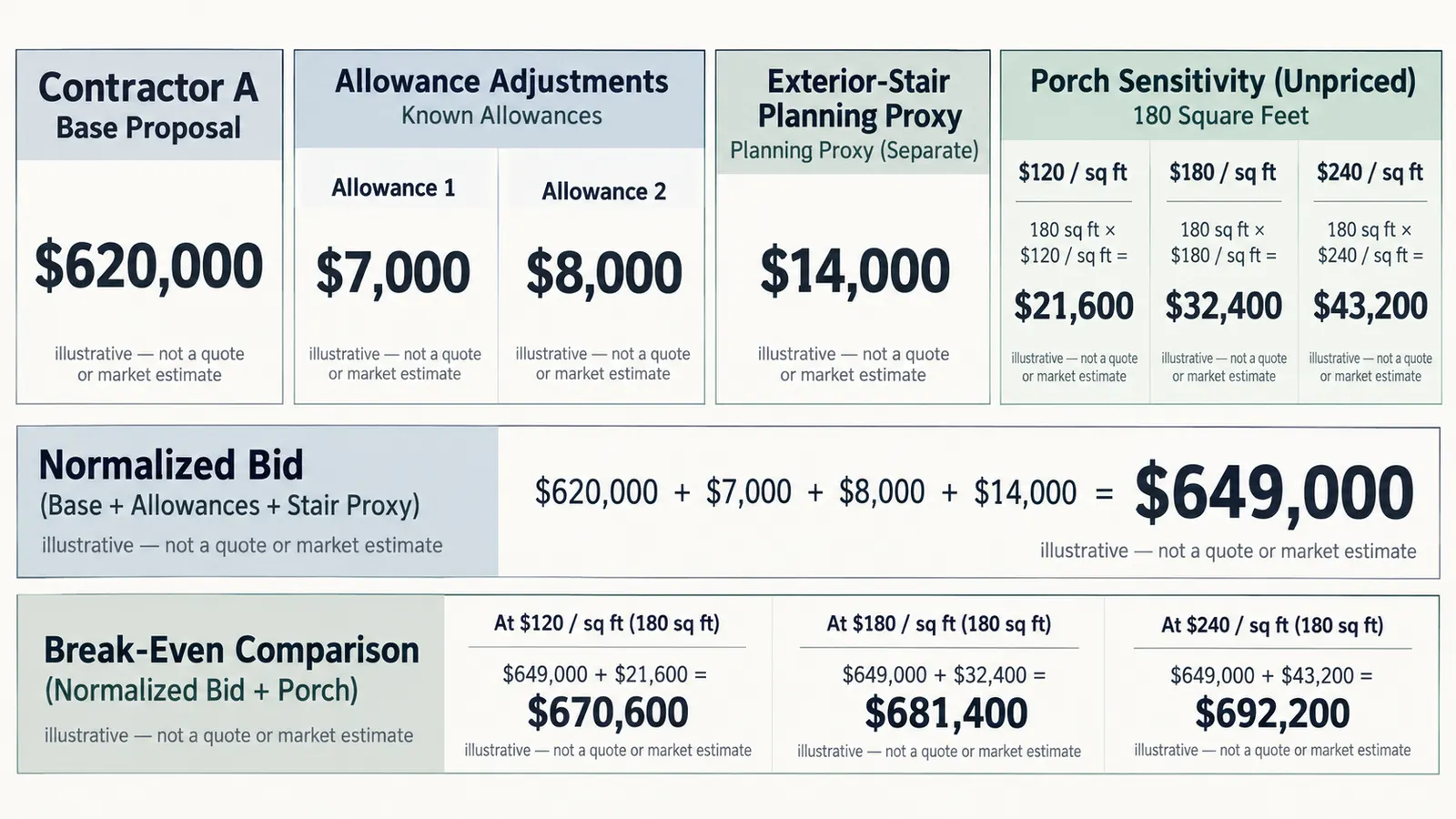
$620,000 + $7,000 + $8,000 + $14,000 = $649,000
The correct label is illustrative internal comparison, not a contractor offer. Against B-P03 at $656,000, A appears $7,000 lower on the known rows, but that result is not an award recommendation because the porch is unpriced, the lighting allowance treatment is unresolved, and the schedule basis is not matched.
The purpose of the arithmetic is to show the direction and size of known gaps. It prevents the owner from saying “A is $36,000 cheaper” when the visible baseline already identifies $29,000 of different allowances and excluded work. It does not forecast the final price.
Show sensitivity for the unpriced addition
If the owner wants to understand how much the unpriced porch could matter, use a sensitivity table with clearly labeled assumptions. In this modeled example, assume only for illustration that the porch is 180 square feet and test three planning rates. These rates are not sourced market data and should not be presented as a price range. A contractor must price the actual drawings, details, quantities, site conditions and schedule.
Formula:
Illustrative porch scenario = 180 square feet × assumed planning rate
| Assumed planning rate | Arithmetic | Illustrative porch scenario | Provisional A comparison after known adjustments |
|---|---|---|---|
| $120/sq ft | 180 × $120 | $21,600 | $670,600 |
| $180/sq ft | 180 × $180 | $32,400 | $681,400 |
| $240/sq ft | 180 × $240 | $43,200 | $692,200 |
At the low modeled rate, A’s provisional comparison is $670,600; at the middle rate it is $681,400; at the high rate it is $692,200. B’s $656,000 current proposal would be lower in all three scenarios, but the conclusion remains conditional because the assumptions are not bids and B’s own scope, schedule and allowances still require verification. If A returns a written porch price of $16,000, that written figure replaces the sensitivity assumption for A. If A says the porch is included in a revised $632,000 total, record the document and confirm what else changed before accepting the result.
Sensitivity is useful because it reveals decision leverage. The break-even porch cost against B in the illustrative known-basis comparison is:
B current total − A provisional known-basis total = $656,000 − $649,000 = $7,000
If A’s unpriced porch costs more than $7,000 on that internal basis, B’s stated current total is lower before considering schedule or unresolved allowance treatment. That does not prove B is better; it tells the owner that obtaining a real porch price is decision-critical. The threshold calculation also gives the homeowner a focused question for the design professional and contractors.
Record what the example cannot tell you
The example cannot tell the owner whether Contractor A or B will perform better, whether a proposed assembly complies with the local code, whether a schedule is achievable, whether an allowance is sufficient for the selected products, or whether a contract clause allocates risk fairly. It cannot estimate hidden site conditions, escalation, financing costs, taxes or utility charges. It cannot establish that an exclusion is permissible.
The example can tell the owner that the first comparison is stale, that certain rows are known to differ, that a modeled normalization is not a quote, and that the unpriced porch is an award-blocking question. That is the proper role of the worksheet: make the next decision more precise, not manufacture certainty.
Assign handoffs and verify the current package #
The homeowner owns the record and the decision, but does not own every answer. Assign each row to the person who has the authority, expertise or information to confirm it. A register that names only “team” or “contractor” is not a handoff; it is an unresolved queue.
Use a responsibility matrix
| Question or record | Homeowner | Architect or design professional | Contractor | Local authority | Lawyer or insurance professional |
|---|---|---|---|---|---|
| Which drawing revision is issued for pricing? | Receives and preserves | Issues and transmits | Acknowledges | Usually no | No |
| What does the drawing or specification mean? | States desired outcome | Interprets design intent within engagement | Explains constructability and price | May interpret adopted requirements | May advise contract effect |
| Is a scope row included in the price? | Asks and records | Helps define intended scope | Commits in proposal | No | Reviews language if engaged |
| Is the proposed product acceptable? | Makes owner preference | Checks design intent and required characteristics | Confirms supply and installation | May review approval/code aspects | No |
| Who obtains a permit or inspection? | Verifies written allocation | Advises design documents | States proposed responsibility | Confirms actual process | Reviews risk allocation |
| What is the schedule effect? | Confirms priority | Identifies design dependency | Provides schedule commitment or assumption | Provides authority timeline only if available | Reviews remedy or clause |
| Is the contract package complete? | Maintains final index | Confirms design attachments | Confirms proposal and qualifications | Confirms required submissions if asked | Reviews legal terms |
This matrix is a coordination aid, not a declaration that a particular person is legally responsible. The contract, professional engagement, state law, local rules and actual project delivery method control. In a design-build arrangement, the design and construction roles may sit within one company but still need separate internal confirmations. In an owner-managed project, the homeowner may need to hire distinct professionals for design, permitting, legal review or construction.
The sequence from change notice to decision
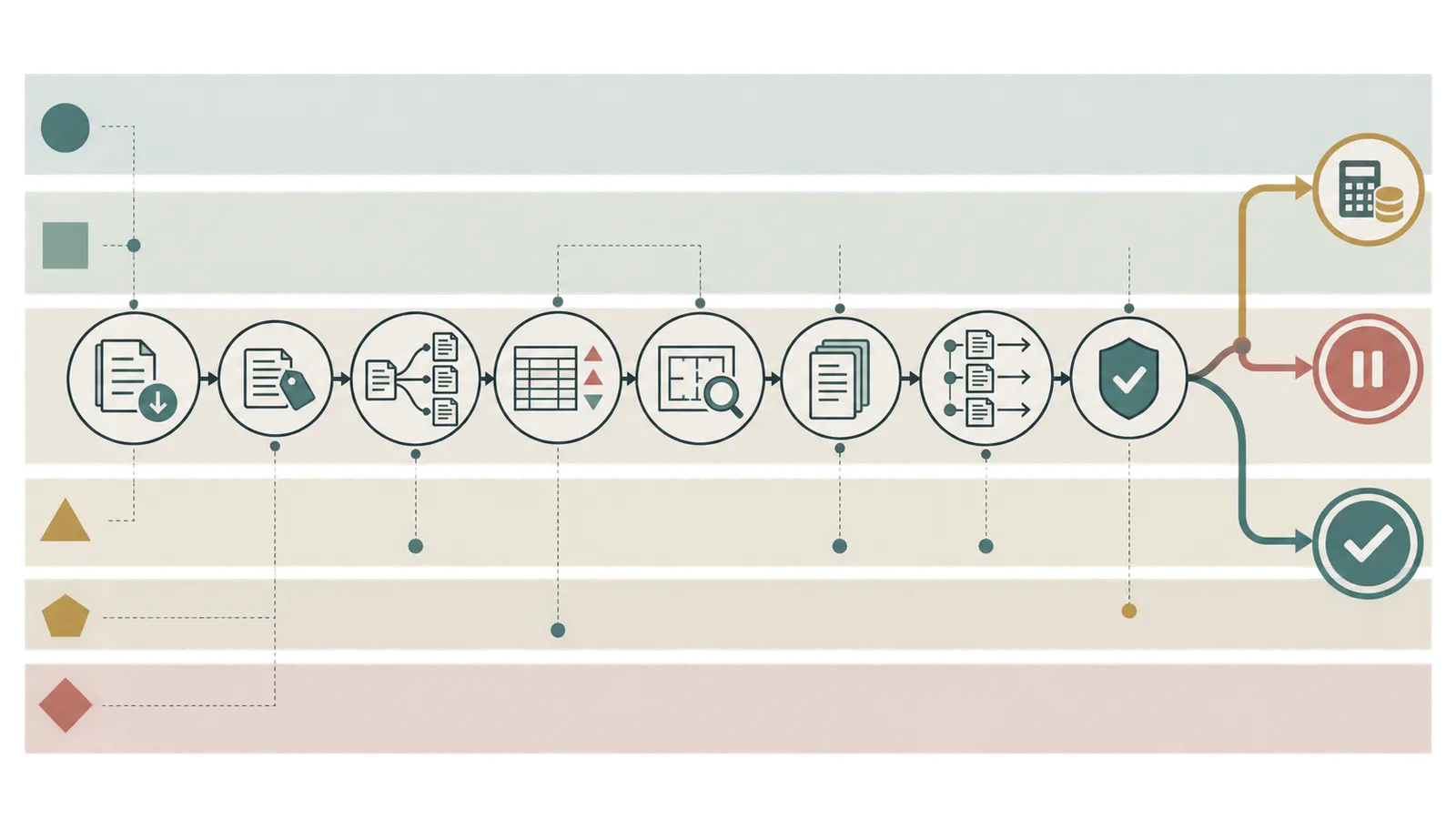
Run the same sequence every time a new document arrives:
- Receive and preserve. Save the original file, email, attachments and timestamp. Do not overwrite the prior document.
- Assign an ID. Add the document to the document log and identify the issuer, native revision and claimed effective date.
- Check distribution. Record which contractors received it and which acknowledged receipt. If a clarification could affect all bidders, distribute it consistently.
- Read for deltas. Compare the new document to the prior baseline. Identify every affected scope row, not only the headline change.
- Ask the design professional. Confirm design intent, quantities, interfaces, required details and whether the document supersedes another document.
- Update the baseline. Issue a new baseline ID only when the package is clear enough to identify the current comparison set.
- Request equal responses. Send a response schedule with the exact delta IDs, response format, price, units, schedule, inclusions, exclusions and assumptions requested.
- Log each response. Do not collapse “no cost,” “included,” “not applicable” and “not priced” into a single status.
- Verify responsibility. Route permit, utility, structural, insurance, product or legal questions to the responsible professional or authority.
- Run the award gate. Decide re-price, pause or proceed and record the next handoff.
Washington L&I advises homeowners to obtain a written contract with specific work, price and payment terms, permits, materials, suppliers or subcontractors, warranties and change-order processes, and later advises that changes to in-contract work be put in writing rather than left verbal. Those recommendations support this sequence’s emphasis on a written handoff from proposal to contract. Washington L&I’s written-contract and change-order guidance is Washington-specific; check the actual law and contract requirements where the home will be built.
Verify proposal acknowledgment, not just receipt
A sent email is evidence that information left the owner’s inbox. It is not evidence that a contractor incorporated the information into its price. Ask for an acknowledgment with a controlled response:
“We acknowledge receipt of BP-2026-09-10-R03, including Addendum 01 and the listed carried-forward drawing/specification revisions. Our proposal P03 includes these documents except for the following stated exclusions or qualifications: ____. The price impact for each DELTA-ID is ____. The schedule impact is ____. This response supersedes proposal P02 as to the listed scope.”
That language is an example of a record request, not a legal clause. Have the project lawyer adapt any final contract language. The practical benefit is that it makes the contractor state what is included and what remains excluded. If the contractor will not identify the governing package, mark the proposal uncertain and do not use it as the current low bid.
Verification that the owner can do safely
The homeowner can safely verify the administrative chain: filenames, revision dates, distribution, response status, arithmetic, document references, missing rows and whether the selected proposal is the one attached to the award. The homeowner can also ask for license, registration, insurance, bond, references and subcontractor information, then verify those records through the appropriate jurisdiction or insurer.
The homeowner should not independently approve structural changes, electrical design, gas work, life-safety systems, hazardous materials, excavation methods, code compliance or permit requirements solely from a remote document comparison. Ask the licensed design professional, qualified contractor, engineer, inspector or authority with responsibility for that issue. Do not enter excavations, climb unfinished structures, open energized equipment, disturb suspected asbestos or lead, or perform construction verification in a way that creates a fall, electrical, contamination or confined-space hazard.
California CSLB tells homeowners to check license status and insurance information, and it explains California-specific workers’ compensation and commercial general liability considerations. The California Department of Insurance also recommends requesting a certificate of insurance showing the insurer, policy number and limits, and keeping a job file containing contracts, change orders, plans, specifications, invoices, insurance certificates and lien releases. These are California sources; insurance certificates do not prove coverage for every claim, and the insurer or qualified professional should answer coverage questions. California CSLB’s licensing and insurance guidance and California Department of Insurance’s recordkeeping and COI guidance in its “Don’t Get Scammed” PDF show the kind of record to preserve.
Verify the contract handoff before award
Before signing an award or construction contract, create a final attachment index from the register. Include the selected proposal revision, current drawing index, drawings, specifications, addenda, written clarifications, accepted alternates, allowance schedule, exclusions, schedule, payment schedule, owner-furnished list, permit responsibility, insurance or bond exhibits, warranty language and change-order procedure as applicable to the contract.
The exact list depends on the form of contract and jurisdiction. The point is to ensure the documents that determined the price are identified as contract documents or otherwise handled deliberately. If an email is important to the price, ask the lawyer and contractor how it will be incorporated. If a contractor says “all prior documents apply,” the final package should still identify which prior documents and revisions govern.
The ABA advises attaching plans, bids, estimates and related project documents to contract copies and attaching signed change orders when plans change or delays occur. Use the ABA guidance as a documentation prompt, then have the contract reviewed for the project’s law.
Apply the four jurisdiction examples without turning them into national rules #
The United States has no single homeowner contractor-contract checklist that overrides state, county, city, tribal, utility, licensing and project-specific requirements. Use the following as four labeled examples from the research brief. For the project’s actual state, county, city and special district, verify current rules before award. A custom-home new-construction contract may not be classified the same way as a repair or home-improvement contract.
California: same documents, license and insurance checks
In California, CSLB consumer guidance says to compare written bids based on identical plans, specifications and scope, and warns against automatically accepting a substantially lower bid because it may omit work or reflect a mistake. Use that guidance as a trigger for the low-bid branch: open the exclusions, qualifications, allowances and document acknowledgment rows before selecting the apparent low price. California CSLB’s contractor-selection page is the relevant official starting point.
The same CSLB page says to check license status and ask for insurance information. It describes California-specific workers’ compensation requirements when a contractor has employees and notes that commercial general liability insurance is not required by CSLB, although it covers property damage. Do not copy those California statements into a different state. For a California project, record the license number, the date and result of the CSLB lookup, the certificate of insurance request, and any question sent to the insurer. A license number printed on a proposal is not itself proof that the license is current.
If a California bidder’s price is far below the others, use the register to compare actual scope rows. Check site work, temporary utilities, excavation and disposal, permits, design coordination, utility connections, finish allowances, cleanup, testing, warranties, subcontractor scope and schedule. This is not a presumption of wrongdoing; it is a verification response to a material price variance.
Washington: compare bid factors and locate permit responsibility
Washington L&I advises homeowners to compare scope, warranties, references, completion dates and price, and to verify permit fees, taxes and other costs. In Washington, record those items as explicit fields rather than treating the price total as self-explanatory. Washington L&I’s Hire Smart guidance also links the comparison to written-contract terms and contractor verification.
Washington L&I describes building and plumbing permits as issued by the county or city where the project is located and explains that electrical permitting responsibility differs by area. Therefore, for a Washington project, add an authority row with the exact city or county building department, the electrical authority if different, the permit type, the applicant responsibility and the date checked. Do not write “Washington permits” as though a state-level answer resolves the local process. Washington L&I’s permit explanation is a jurisdiction-specific prompt to contact the project’s local department.
Washington L&I also says a contractor’s registration verification can help a homeowner check bonding, liability insurance and infractions, and discusses workers’ compensation account status when employees are on site. Record the lookup date and the precise result. A registration check does not evaluate the contractor’s proposed scope or guarantee performance.
Oregon: written scope, allowances, permit responsibility and license history
Oregon CCB’s consumer material says a well-written construction contract often includes the contractor’s full name and CCB license number, owner and job information, detailed scope, specific materials, start and completion dates, total price, payment schedule, allowances, required permits and responsibility for obtaining them, and a written change-order process signed by the contractor and homeowner. For an Oregon project, make each of those items a final-package check, while confirming whether the cited CCB guidance applies to the specific new-home arrangement. Oregon CCB’s contract guidance is the source for this Oregon example.
Oregon CCB also says its license lookup can show active license status, surety bond, liability-insurance proof, workers’ compensation information and complaints or disciplinary actions from the past 10 years. Use the lookup to verify the business identity and review history, then separately assess project-specific skills and references. A clean license lookup is not a design review, price validation or promise that every subcontractor is properly covered.
Oregon CCB states that construction agreements over $2,000 must be in writing under its consumer guidance and recommends putting all agreements, including changes, in writing. Because thresholds, notices, exceptions and legal effects can depend on the contract and project facts, treat this as an Oregon rule to verify, not as a US-wide threshold. Do not use the Oregon threshold to decide whether a different state permits an unwritten change.
New York: written-contract and local-licensing example
The New York Attorney General’s home-improvement fact sheet says New York law requires a written contract for covered home-improvement work and identifies timeline, payment schedule, specific work and materials, price, contractor information and a cancellation notice among contract contents. It also says local licensing laws continue to apply. The New York Attorney General’s fact sheet is a New York example, not a universal new-home rule.
For a New York homeowner comparing custom-home proposals, use the fact sheet to ask which statutory classification applies to the project, whether the work falls within the described home-improvement coverage, which local licensing authority applies, and whether the proposed contract includes the required notices and payment protections. Ask a New York construction lawyer for the project-specific answer, particularly for new construction, design-build delivery, owner-builder arrangements, or work crossing county and municipal boundaries.
Do not copy New York’s written-contract, payment, escrow, cancellation or local-license statements into California, Washington or Oregon. Conversely, do not assume that a contract element absent from the New York page is optional. The register’s jurisdiction field should name the project location and authority, and the unresolved status should remain visible until the correct source or professional confirms it.
Federal consumer guidance: useful floor, not state-law substitute
The Federal Trade Commission advises consumers to get multiple estimates, use written estimates describing work, materials, completion date and price, avoid automatically choosing the lowest bidder, read the contract carefully and avoid paying the full amount up front. It expressly notes that contract requirements vary by state. The FTC’s home-improvement scam guidance is a useful consumer-protection floor for recordkeeping, not a complete construction-contract checklist.
The FTC also recommends keeping notes and copies of letters and documents when a problem occurs. That is consistent with a register that preserves the proposal history, though a pre-award register is not a dispute file by itself. If a dispute begins, follow the contract’s notice procedure and obtain legal advice rather than assuming that a spreadsheet or email proves the legal result.
Choose re-price, pause or proceed before award #
Proceed only when the selected contractor’s current proposal is tied to the current baseline, every material delta has a written treatment, responsibility and schedule are understood, and the contract attachment index is ready. Otherwise, choose re-price or pause and record why.
Re-price when the baseline is clear but the offer is stale
Choose re-price when the owner can describe the current scope and the missing item is a contractor response. Examples include a new drawing issued to all bidders, a changed finish schedule, a revised allowance amount, an exclusion that must now be included, or a proposal that does not acknowledge the latest addendum.
The re-price request should be equal and bounded. Send the same baseline documents and delta schedule to every affected bidder. Ask for:
- revised total price and each delta amount;
- units, quantities and formula where a unit basis applies;
- included labor, materials, equipment, delivery, taxes, permits, testing and cleanup;
- exclusions, qualifications, assumptions and owner-furnished items;
- schedule impact, lead time and milestone changes;
- proposal expiration, escalation and validity assumptions;
- allowance treatment, markup and owner-selection deadlines;
- the proposal revision that supersedes the prior version; and
- the name and role of the person authorized to submit the response.
Give the same response deadline where practical, but do not imply that a deadline changes the contractor’s legal rights or proposal terms. If one contractor needs a clarification, distribute the material answer to the others. If the requested response reveals a design ambiguity, pause the price comparison until the design professional answers it.
Pause when the change affects authority, safety or legal meaning
Choose pause when a correct answer requires an authority or professional and proceeding would lock in an assumption. Pause for unresolved structural interfaces, excavation or retaining conditions, utility-company requirements, permit responsibility, fire or life-safety scope, hazardous-material work, insurance coverage, conflicting contract documents, unclear order of precedence, unknown allowance inclusions, missing schedule milestones, or a disputed verbal promise.
The pause record should state:
- the exact unresolved row and source document;
- what each contractor currently says;
- the consequence of selecting before resolution;
- the person or authority assigned to answer;
- the question in a form that can receive a written answer;
- the documents or calculations needed;
- the date the answer is needed for the project decision; and
- the condition that will release the hold.
Do not ask an unlicensed or unqualified person to confirm code, structural adequacy, electrical safety, hazardous-material handling or insurance coverage merely because that person is available. The register can route the question; it cannot confer authority.
Proceed when the final package is traceable
Choose proceed only after completing this minimum gate:
- The project address, state, county, city and relevant special authorities are identified.
- The current baseline has a unique ID, issue date and document index.
- Each selected proposal page, attachment, qualification, allowance, exclusion and alternate is identified.
- Every addendum and material clarification is acknowledged or explicitly excluded with an owner decision.
- Every material delta is closed, accepted as an allowance or alternate, assigned to another party with a written price, or removed from scope by decision.
- The selected price includes a stated treatment of permits, taxes, fees, temporary services, site work, cleanup, testing, warranties and owner-furnished items as applicable to the project.
- Start, completion, milestones, long-lead items and schedule assumptions are identified.
- The payment schedule and change-order process are visible in the proposed contract and reviewed for jurisdiction-specific requirements.
- License, registration, bond, insurance, references and subcontractor records have been checked to the extent appropriate for the project and location.
- Open items are listed with an owner decision; they are not hidden in a generic “to be determined” note.
- The selected proposal will be attached or incorporated into the final contract package in a way the lawyer and contractor accept.
- The owner has a copy of the pre-award record and understands which documents are superseded.
The decision should be written as a sentence, not only a color code. For example: “Proceed with Contractor B P03 for BP-2026-09-10-R03 because Addendum 01, the carried-forward R02 documents, the allowance schedule, current porch scope, exterior stairs, 15-month schedule and proposal qualifications are identified; DELTA-006 remains an owner finish selection allowance and is not a contractor scope gap.” If the sentence cannot be written without “probably,” “same as before,” or “included somewhere,” do not pass the gate.
Common failure cases and the recovery move
The latest file has “final” in its name. File names are not revision control. Recovery: compare the native revision, issue date and transmittal to the baseline log; ask the issuer which document governs.
One contractor prices an addendum and another says it received it. Receipt is not incorporation. Recovery: send a delta schedule to each contractor and require a written proposal treatment.
A low bid has fewer pages. Page count is not scope completeness. Recovery: compare exclusions, qualifications, allowance notes, alternates and attachments row by row.
The proposals use the same allowance label but different contents. A shared label does not prove shared basis. Recovery: record amount, unit, inclusions, installation, tax, markup and selection rule; normalize only after the contents match.
A contractor says a change is included but will not revise the proposal. Recovery: ask for a written acknowledgment that identifies the baseline and delta IDs, or mark the row unconfirmed and pause or re-price.
The owner uses one contractor’s detailed proposal to fill gaps in another’s vague proposal. That imports one bidder’s assumptions into another bidder’s price. Recovery: use the detailed proposal to formulate questions, not to rewrite the other proposal; request equal written scope.
A design clarification is answered privately. Recovery: have the design professional issue the answer to all affected bidders, record distribution and reset the baseline if the answer changes scope.
The owner chooses a contractor and plans to “clean up the paperwork later.” Recovery: stop award, create the final attachment index and have the selected contractor confirm the governing proposal and documents before signature.
A proposed schedule is compared by duration only. Fourteen months and fifteen months may use different start events, owner-selection assumptions, permit timing or completion definitions. Recovery: compare milestones, start trigger, exclusions, dependencies, float and owner decisions.
The owner treats a license lookup as a quality guarantee. Recovery: separate license, insurance, bond, references, current workload, scope comprehension and contract review into distinct evidence rows.
A jurisdiction example is copied into the wrong state. Recovery: label every rule by state and local authority, verify the actual jurisdiction, and ask project counsel when classification is unclear.
A spreadsheet has a total but no source links. Recovery: add evidence links to the exact file, page, email or written confirmation; if the source cannot be found, mark the number unverified.
The next decision after award
Award is not the end of document control. The final pre-award register becomes the starting baseline for contract changes, submittals, selections, payment review and closeout. Freeze the award package, preserve the superseded comparison and create a new change log for post-award changes so that a proposal delta is not confused with a contract change order.
The next handoff is usually from the owner and design professional to the selected contractor: confirm contract documents, schedule, permit path, submittal list, owner decisions, allowances and communication protocol. The next verification is that the contractor’s construction schedule and procurement actions reflect the awarded scope. If a later change affects price or time, use the contract’s written change procedure and update the record before authorizing work, subject to the project lawyer’s advice and applicable law.
The homeowner should retain the register with the signed contract, drawings, specifications, addenda, clarifications, proposal revisions, payment records, insurance documents, permits, inspection records, warranties and closeout documents. California Department of Insurance guidance lists a similar category of records for a California disaster-repair context; its exact legal context is different, but the recordkeeping lesson is portable. Keep a complete job file as described by the California Department of Insurance in its “Don’t Get Scammed” guide (PDF).
A compact owner review checklist
Use this at the end of every proposal revision cycle:
- I can name the current baseline ID and list every drawing, specification, addendum and clarification it contains.
- I preserved the prior baseline and marked it superseded instead of overwriting it.
- Each contractor’s current proposal states which baseline documents it includes.
- Every material change has a row with a source reference, affected scope, price treatment and schedule treatment.
- Allowances state amount, unit, included work, selection responsibility, markup and tax or delivery assumptions where relevant.
- Exclusions have been included, separately priced, assigned to another party, accepted as owner work or removed from scope.
- I separated contractor-stated numbers from my own illustrative normalization and labeled any modeled sensitivity.
- A named person has confirmed every design, construction, permit, insurance or legal question within that person’s role.
- The selected proposal is not a mixture of pages from superseded revisions and informal promises.
- The next action is explicitly re-price, pause or proceed, with a responsible person and date.
If any box is unchecked, the answer is not “pick the cheapest and ask later.” The answer is to identify the missing evidence and choose the gate that matches it. A moving proposal package is manageable when its changes are dated, attributed, compared on a common basis and handed to the person who can confirm them. That record does not eliminate construction uncertainty, but it prevents a stale low number from masquerading as a current, complete proposal.
This article was reviewed as an automated evidence-backed homeowner guide, not as a lawyer’s, architect’s, engineer’s, contractor’s or insurer’s review. Read Brictale’s editorial method for how source scope, original contribution and limitations are handled, and return to the Brictale blog for the broader build journey. Verify all local rules and the final contract for the home’s actual jurisdiction before award.
Cite this guide
Brictale. “How to Maintain a Contractor Proposal Revision Register Before Award.” Published 2026-10-06; updated 2026-10-06.
https://brictale.com/build/contractors/maintain-contractor-proposal-revision-register-before-award · Read the Markdown version
Original contribution: Proposal-version-and-delta register. A reusable register that keeps competing custom-home proposals tied to the same drawing, specification, addendum, clarification, allowance, exclusion, price and schedule baseline before award.
Sources and scope
Evidence behind this page
- California CSLB advises homeowners to obtain at least three written bids and compare them using identical plans, specifications and scope of work.
How do I find the right licensed contractor?
California CSLB consumer guidance; used here as a California example of a same-baseline comparison rule, not a national bid-count mandate.
Accessed · Link to this claim - California CSLB warns that a substantially lower bid may reflect a contractor mistake or omitted work and says homeowners should not automatically accept the lowest bid.
How do I find the right licensed contractor?
California CSLB consumer guidance on unusually low bids; not proof that any particular contractor omitted work.
Accessed · Link to this claim - California CSLB says homeowners should verify license status and ask for insurance information; it explains that California contractors with employees must carry workers’ compensation insurance and that commercial general liability insurance is not required by CSLB but covers property damage.
How do I find the right licensed contractor?
California-specific licensing and insurance guidance; requirements and coverage consequences vary by jurisdiction and facts.
Accessed · Link to this claim - Washington L&I tells homeowners to compare bid scope, warranties, references, completion dates and price, and to verify permit fees, taxes and other costs are included.
Washington L&I consumer guidance; a Washington comparison example rather than a nationwide statutory checklist.
Accessed · Link to this claim - Washington L&I lists price including sales tax, payment terms, permit fees, specific work, materials, suppliers or subcontractors, warranties and change-order processes among minimum contract subjects, and advises homeowners to put changes in writing.
Washington L&I consumer guidance; contract requirements can differ by project, city, county and state.
Accessed · Link to this claim - Washington L&I says building and plumbing permits are issued by the county or city where the project is located, while electrical permitting responsibility differs by area, so the homeowner should contact the local building department.
Washington permitting description; not a statement about every US jurisdiction.
Accessed · Link to this claim - Oregon CCB says its license lookup can show active license status, surety bond, liability insurance proof, workers’ compensation information and complaints or disciplinary actions from the past 10 years.
Oregon CCB consumer license-history guidance; the lookup is not a substitute for project-specific qualification or contract review.
Accessed · Link to this claim - Oregon CCB lists detailed scope, specific materials, dates, total price and payment schedule, allowances, permit responsibility, and written change orders signed by contractor and homeowner as useful written-contract components.
Oregon CCB contract guidance, including the agency’s discussion of residential construction agreements; do not generalize Oregon thresholds or notices to other states.
Accessed · Link to this claim - Oregon CCB recommends putting all contract agreements and changes in writing and states that construction agreements over $2,000 must be in writing under Oregon guidance.
Oregon-specific rule and recommendation; the threshold and legal effect must be checked against the current Oregon statute and project facts.
Accessed · Link to this claim - The FTC advises consumers to get multiple estimates, use written estimates that describe the work, materials, completion date and price, read the contract carefully, avoid automatically choosing the lowest bidder and avoid paying the full amount up front.
How To Avoid a Home Improvement Scam
Federal consumer advice for home-improvement transactions; it expressly notes that contract requirements vary by state.
Accessed · Link to this claim - The American Bar Association’s consumer guidance says plans, bids, estimates and other project documents should be attached to contract copies, and that change orders should be written, signed by both parties and attached when plans change or delays occur.
Remodeling and the Law: What should the contract include?
ABA public legal education guidance; not a substitute for an attorney’s advice on a specific construction contract or state law.
Accessed · Link to this claim - California Department of Insurance guidance recommends a certificate of insurance showing the insurer, policy number and limits, keeping a job file with contracts, change orders, plans, specifications, invoices, insurance certificates and lien releases, and acknowledging contract modifications in writing.
Don’t Get Scammed After a Disaster
California Department of Insurance consumer guidance in a disaster-repair context; the recordkeeping method is portable, while legal duties and insurance terms are not.
Accessed · Link to this claim - The New York Attorney General says New York law requires a written contract for home-improvement work and identifies timeline, payment schedule, specific work and materials, price, contractor information and a cancellation notice among contract contents; it also notes local licensing laws continue to apply.
New York Attorney General example for covered home-improvement work; classifications, thresholds and local licensing must be checked for a particular new-home project.
Accessed · Link to this claim