How to Compare Contractor License, Performance and Payment Bonds Before Signing
Compare a contractor license bond with performance and payment bonds before a custom-home award, using jurisdiction, trigger, cap, term and claim-route checks.
The short answer
A contractor license bond is not automatically a project completion or subcontractor-payment guarantee. Before signing, record the jurisdiction, project type, principal, obligee, bond number, trigger, penal sum, project or aggregate cap, dates, claim route and exclusions. Verify the actual bond with the state record and surety, then have the contract and unresolved gaps reviewed locally. California and Nevada rules below are labeled examples, not nationwide rules.How to Compare Contractor License, Performance and Payment Bonds Before Signing
A contractor license bond is not automatically a project completion or subcontractor-payment guarantee. Before signing, record the jurisdiction, project type, principal, obligee, bond number, trigger, penal sum, project or aggregate cap, dates, claim route and exclusions. Verify the actual bond with the state record and surety, then have the contract and unresolved gaps reviewed locally. California and Nevada rules below are labeled examples, not nationwide rules.
This guide is for a United States homeowner comparing a proposed builder before awarding a custom-home contract. “Bonded” is a starting question, not a conclusion. The same word can describe a commercial or license bond required to hold a contractor license, a consumer-protection bond for a defined class of residential work, a performance bond written around one contract, a payment bond for labor and material claimants, or a cash deposit accepted instead of a surety bond. Those instruments can have different protected parties, triggers, amounts, deadlines and claim routes.
The decision at the end is deliberately narrow and practical: can you document what protection exists, who can claim, what event activates it, how much is exposed, how long the protection lasts, and who must verify the unresolved point before you sign? If the answer is no, the proposed award is not ready for signature. That does not prove the contractor is unsuitable; it means the risk has not been made legible enough to accept.
What protection does the contractor's bond actually provide? #
A contractor's bond provides only the protection described by that bond and the law governing it; the word “bonded” does not identify the protected party, covered event, amount, or remedy. Start by classifying the document as a license/commercial bond, consumer-protection bond, performance bond, payment bond, bid bond, or cash alternative, then compare its exact wording with the contract you are about to sign.
For a custom home, the first error is treating a license record as though it were a project-risk transfer. The second is treating a performance bond as though it pays every unpaid supplier. The third is assuming that a payment bond repairs defective work. The fourth is treating a certificate or sales statement as stronger than the bond itself. Your worksheet should force each of those assumptions into a separate row.
The U.S. Small Business Administration describes contract bonds as instruments that ensure the terms of a specific contract are fulfilled. Within that category, it describes payment bonds as protecting payment to suppliers and subcontractors and performance bonds as protecting full completion of a contract. That is useful vocabulary, but it is not a promise that every privately negotiated home contract contains those bonds or that every claim succeeds. The governing bond form, incorporated contract, applicable law and claim procedure still control. See the SBA explanation of contract, payment and performance bonds.
By contrast, a license or commercial bond is normally connected to the contractor's authority to operate or to compliance with a class of legal obligations. The SBA separates commercial bonds, which help ensure laws and regulations are followed, from contract bonds, which ensure the terms of a specific contract are fulfilled. That distinction is the reason a state board's “bond on file” indicator does not answer whether your custom-home contract has completion or labor-and-material protection. The state board record may establish that a licensing condition is present; it does not, by itself, prove a project-specific bond exists.
California makes the distinction unusually visible in its consumer guidance. The California Contractors State License Board says a licensed contractor must have a $25,000 contractor license bond, and it warns that the bond covers any project the contractor agrees to perform but may not be enough to cover multiple complaints or a project worth more than the bond. On the same page, CSLB describes contract bonds as guaranteeing completion and payment for labor and materials, generally up to the face amount of the bond. Read those as two different rows in your comparison, not as two names for one product. CSLB's contractor-bond comparison is California consumer guidance, not a national requirement.
The same CSLB page warns that bonds do not assure the financial or professional integrity or competency of a contractor. Therefore, a bond check cannot replace references, financial-capacity questions, license classification, insurance review, schedule and scope comparison, or a contract review. A builder can have a current license bond and still be a poor fit for a complex home; a builder may have a project bond and still submit an incomplete scope. The bond answers one risk question only.
Your first screen should therefore produce one of three states:
| Screen result | What it means | Safe next action |
|---|---|---|
| Documented license/commercial bond only | You have evidence of a licensing or legal-compliance instrument, not automatic proof of completion or payment protection. | Ask whether project performance and payment bonds are required, offered, or deliberately omitted; document the answer in the contract review. |
| Separate project bonds documented | The builder has supplied performance and/or payment bond evidence tied to a named contract or project. | Verify the principal, obligee, contract reference, amount, dates, claim provisions, surety and incorporation into the final signature set. |
| Bond label or certificate is incomplete | You cannot tell what is protected or whether the document matches the legal entity and work. | Pause the award and route the gap to the contractor, surety/agent and a qualified local construction adviser. |
Do not turn the table into a score. “Separate project bonds documented” is not a green light if the obligee is wrong, the amount is capped below the agreed protection, the term ends before the work, or the bond is conditioned on a contract that is not the signature version. It is simply a better starting fact pattern.
The word “bond” also says nothing by itself about insurance. AIA–MBA bidding guidance recommends that bidding information separately identify performance and payment bonds, general liability insurance, builder's risk insurance and other insurance. That separation is a useful document-control rule for a homeowner: keep bond rows and insurance rows distinct, with different issuer, policy or bond number, insured or protected party, limits, exclusions, dates and claim contact. AIA–MBA's bidding information guidance is professional guidance rather than a private-home statute, but it gives a clear handoff model.

The safest interpretation of an unqualified “we are bonded” statement is therefore: “The builder may have a bond of some kind; identify it before relying on it.” Your next decision is whether the builder will provide the actual documents and whether the jurisdiction's rules make any particular protection mandatory, optional or irrelevant to this project type.
Why is a license bond different from a performance or payment bond? #
A license bond is connected to the contractor's license or legal obligations, while a performance bond is ordinarily tied to the contractor's faithful performance of a specified contract and a payment bond is ordinarily tied to payment claims from labor and material participants. The differences are the protected party, trigger, scope and cap—not the adjective used in a proposal.
The four parties and the question each document answers
On a project-bond row, identify the principal, surety and obligee or beneficiaries. The principal is usually the contractor whose obligation is bonded. The surety is the company issuing the bond. The obligee is the party to whom the bond's promise is made, often the owner for a performance bond or the party named in the bond for a payment obligation. A claimant can be a different person from the obligee depending on the form and governing law. Do not infer those roles from an insurance certificate or a contractor's email.
Ask these separate questions:
- Who is protected? Is it the licensing authority, an owner, subcontractors, suppliers, employees, or another named beneficiary?
- What activates a claim? Is it a license-law violation, defective work under a contract, failure to complete, failure to pay, or another defined default?
- What work is covered? Is it any work performed by the licensee, one project, a defined home-improvement class, or a special trade such as residential pool and spa work?
- What is the maximum stated obligation? Is the amount the face or penal sum, a percentage of contract price, an aggregate across contracts, or a separate cap by claimant or category?
- Where and when is a claim made? Is the route the surety, the state board, a court, a notice recipient, or a combination, and what deadlines or notice conditions apply?
The SBA's categories support the core comparison: payment and performance are not interchangeable. A payment bond is aimed at suppliers and subcontractors; a performance bond is aimed at completion of the bonded contract. SBA's bond-category explanation uses those categories for its federal program and educational guidance. A private residential bond may use different language, so copy the actual condition rather than replacing it with a shorthand label.
What a license bond can show—and what it cannot show
A current license bond can show that a contractor has satisfied a licensing condition in the named jurisdiction, subject to the public record's scope and timing. In California, CSLB says the contractor bond is filed for the benefit of consumers damaged by defective construction or other license-law violations and for employees owed wages; CSLB lists the amount as $25,000. The same page requires the business name and license number on the bond to correspond with CSLB records. California's bond requirements are the source for that California-specific check.
That does not tell you that the bond equals the value of the home, that it is project-specific, or that the surety will pay the cost to finish the home. California CSLB explicitly says the $25,000 contractor license bond covers any project the contractor agrees to perform and may be insufficient for multiple complaints or a project worth more than the bond. A $25,000 face amount next to a $600,000 contract is a visible mismatch in scale, but the ratio is not a recovery estimate and cannot predict a claim outcome.
Nor does a license bond prove that the contractor's liability insurance, workers' compensation coverage, builder's risk arrangement, umbrella coverage, or professional design coverage exists. In California, CSLB separately describes workers' compensation proof or exemption and continuous coverage for licensees; CSLB's workers' compensation requirements support keeping that record separate from the contractor bond. AIA–MBA's bid guidance likewise lists bonds and insurance as separate bid-information requirements. Ask for each document on its own line.
What a performance bond can show—and what it cannot show
A performance bond can provide a contract-specific remedy structure when the bond names the owner or another intended obligee and covers the final contract documents. The exact remedy may be completion by a replacement contractor, financing, a tender, a negotiated cure or another option in the bond; do not promise yourself a particular remedy without reading the form. The presence of the phrase “performance bond” does not mean the surety will immediately pay your entire cost overrun.
Check whether the bonded contract includes the plans, specifications, general conditions, addenda, accepted alternates and signed change orders that define the obligation. Confirm who may declare or report default, what notice must be given, whether the owner must first comply with contract procedures, how the surety investigates, and whether the bond includes a consent-to-change or notice condition. Have a local construction attorney read the actual language when the bond is a condition of award or a major reason you are accepting a builder.
What a payment bond can show—and what it cannot show
A payment bond is ordinarily discussed as a route for covered labor and material claimants, but the actual bond wording controls and it is not automatically an owner warranty. The SBA's bond-category explanation supplies the general payment-bond distinction. Local-review instruction: ask the surety and local counsel to identify notice deadlines, the definition of covered claimant, the required notice address, any claim period after last furnishing, exclusions for disputed or indirect costs, and the payment or title controls that still apply. The contractor's promise to “pay subs” is not the same document as an issued payment bond whose terms cover the work.
For an owner, payment-bond evidence belongs in the payment-control packet. Local-review instruction: do not assume that a payment bond replaces lien waivers, payment applications, notices, title checks or lender controls; ask the builder, lender, title company and local counsel which records the actual state, contract and financing arrangement require. This is a handoff question, not a nationwide statement that one payment procedure applies to every custom home.
Why a cash deposit is not the same verification path
Some jurisdictions accept a cash deposit instead of a surety bond. That can change who holds the money, how a claim is initiated, whether a court order is needed, what administrative fees apply, and when the deposit can be released. California CSLB says some contractors use a cashier's check in lieu of a surety bond, and that a consumer seeking payment from that cash alternative must file a civil action for the bond to be released; CSLB can pay from the cashier's check only under a court order. CSLB's bond basics is the source for that California process.
Therefore, a line reading “bond or cash deposit” cannot be treated as an interchangeable customer experience. Record whether the evidence is a surety bond, cashier's check, bank-certified check, letter of credit or another approved security. Identify the holder and claim procedure. If the builder gives you only a certificate saying “bonded,” ask whether the state record shows a cash alternative and what that means for the intended claimant.
Your next decision is now clearer: if the protection you need is completion of a $600,000 home, a license bond row should not be marked “sufficient” merely because the amount is nonzero. You need the contract's project-bond decision, the exact obligee and the local review handoff.
How does jurisdiction change the answer for a custom home? #
Jurisdiction changes the answer because bond requirements can attach to a license, a project type, a contract category or a special trade, and the same state can treat ground-up construction differently from work on an existing owner-occupied home. California and Nevada below are examples for comparison, not a substitute for identifying the state, county, city and contract structure of your actual project.
California: separate the active-license bond from contract-bond evidence
For California, begin with the CSLB license record and bond history, then ask separately whether the proposed custom-home contract requires or includes project performance and payment bonds. CSLB says the contractor bond must be in place for an active license and lists a $25,000 amount. It also says the business name and license number on the bond must correspond exactly with CSLB records and the bond must be written by a surety company licensed through the California Department of Insurance. California CSLB's current bond requirements supports those checks.
California CSLB's consumer page distinguishes the contractor license bond from contract bonds. It says the license bond covers any project the contractor agrees to perform, while contract bonds guarantee completion and payment for labor and materials, generally up to the face amount. Use that distinction for the worksheet, but do not turn CSLB's general consumer explanation into an automatic requirement that every private ground-up custom-home contract carry a performance and payment bond.
The California blanket performance and payment bond is a particularly important trap. CSLB describes it in connection with an exception to home-improvement down-payment rules, and California's law book includes a form that refers to owners or tenants entering into a home-improvement contract and to aggregate contract prices across open contracts. The California source therefore does not establish that a builder's blanket bond is the ordinary protection for a ground-up new home. Read the California CSLB law book and blanket-bond form with the actual contract classification and have a California construction attorney decide applicability.
The distinction between “home improvement” and “new construction” is not cosmetic. A rule designed for an existing residence may regulate deposits, disclosures or blanket bonds in a way that does not control a new home built on a vacant parcel. Conversely, a new-home contract may contain its own bond requirement, lender condition, completion security, retainage, warranty or payment controls. Ask the contractor to identify the legal and contractual basis for any bond statement instead of assuming the most consumer-friendly category applies.
California's claim route also affects your records. CSLB says the consumer files a surety bond claim with the surety company within applicable time frames; CSLB does not process claims against surety companies, although it investigates complaints against the license. CSLB says a license bond is canceled 30 days from the date CSLB receives a cancellation notice. It separately says that if CSLB does not receive a bond reinstatement notice or replacement bond before the end of that 30-day period, the license is suspended. The reinstatement or replacement condition therefore describes license status; it should not be summarized as necessarily preventing cancellation of the original bond. That makes the bond history and the contract date important. Save a dated copy of the license detail, bond history, bond document, contract and communications. CSLB's bond-claim guidance supports this handoff, but it does not tell you whether your facts satisfy a claim.
For California, the pre-signing result should be one of these:
- License bond verified; project bonds not offered: record that the license condition is documented but completion and labor/material protection remain a contract decision. Ask the owner-side attorney and lender whether the gap changes the award, payment structure or security package.
- Project bonds promised but not supplied: pause signature. Request the bond forms, principal, obligee, surety, amount, effective date, contract reference and claim instructions. A proposal line is not the final evidence.
- Blanket bond asserted: check CSLB's license detail and bond record, then ask California counsel whether the home contract is within the described home-improvement scope. Do not infer that the blanket bond is a full-value guarantee for a ground-up home.
The next handoff in California is from contractor documents to CSLB record verification and then to a California-qualified construction attorney or other qualified adviser who can interpret the exact contract and bond. The homeowner can collect and compare; the homeowner should not issue a legal conclusion from a public record.
Nevada: do not merge the license bond, residential-improvement consumer bond and pool/spa bonds
For Nevada, start with the Nevada State Contractors Board license record and the actual bond evidence. The Board says each Nevada contractor license requires a license bond, that the Board determines the amount at license approval, and that the amount can vary from $1,000 to $500,000 based on license type, monetary limit, financial responsibility, experience and character. It also says the requirement may be satisfied with a surety bond or cash deposit. Nevada's Board bond page is the source for this range and verification starting point.
The Nevada license-bond amount is not automatically the amount of a project performance or payment bond. If a builder proposes a $50,000 Nevada license bond for a $500,000 custom home, record the $50,000 as the license-bond amount and ask whether separate project bonds are required or offered. Do not label the license-bond row “50% completion protection” or “payment protection” because the number happens to be larger than another state's license-bond amount.
Nevada's residential-improvement provisions are another scope boundary. The Board describes the provisions as applying to contracts for construction, remodeling, repair or improvements to existing, completed single-family residences occupied by their owners. It says the down payment cannot exceed $1,000 or 10% of the contract price, whichever is less, unless the contractor posts a $100,000 consumer-protection bond with the Board or has another specified relief. Nevada's explanation of the residential-improvement consumer bond is useful precisely because it names the existing, owner-occupied setting.
Do not apply that $100,000 consumer-protection-bond exception automatically to a ground-up custom home on a new lot. If the project is a new residence that will not yet be occupied, the homeowner should classify it with Nevada counsel and the Board before relying on a residential-improvement rule. If the project is an addition or improvement to an existing owner-occupied single-family residence, record that fact and ask whether NRS 624.970 and related regulations apply to the proposed contract.
Nevada's statute also gives an owner in the specified residential-improvement scope a right to request a payment and performance bond when one is not otherwise required under the cited law. NRS 624.970 requires the contract to state that right. The statute also ties payment schedules and contract disclosures to the residential-improvement category. Read the current Nevada Revised Statutes, NRS 624.970 rather than importing a rule from a contractor's sales sheet.
Nevada separately addresses residential pool and spa contractors. The Board says that under certain conditions it may require a performance bond of at least 50% of the contract for the protection of the property owner and a payment bond of at least 50% for people supplying labor or materials to the contractor or subcontractors. It also notes that equivalent security may be accepted. Nevada's pool and spa bond provisions are limited to that special work and do not turn the entire custom-home contract into a 50%-bonded project.
That special rule illustrates why a homeowner must record the covered work, not only the contractor's name. If a builder's proposal includes a pool as part of the home, ask whether the pool contract is separate, which license classification is performing it, whether the Board has required additional bonds, whether the bond covers only the pool contract, and whether the main home contract has its own payment and performance protection. A pool bond cannot safely be described as a bond for the home unless the actual document says so and a qualified local adviser agrees.
For Nevada, the next handoff is from the homeowner's project-classification record to the Nevada Board's license search and then to a Nevada construction attorney, lender or other qualified local adviser. The Board can explain its licensing records and forms; it does not decide the legal meaning of every private contract for you. The homeowner's record should include the project address, occupancy status, contract type, trade scopes and each bond's separate purpose.
What the comparison does not say about the other 48 states
This article does not create a nationwide bond rule. State licensing systems differ in whether a license bond exists, who may claim, whether a cash deposit is allowed, how a claim is noticed, how a project bond is required, and whether residential-improvement protections exclude ground-up construction. Local rules can also arise from a city license, county permit condition, public funding, lender requirement or special trade.
For the state where the house will be built, identify the actual authority having jurisdiction for permits and the contractor licensing authority. AIA–MBA guidance recommends that bidding information identify the authority having jurisdiction for permits alongside bid security, performance and payment bonds and insurance. That is a useful ownership rule even where the guidance is not mandatory. The AIA–MBA bidders-information checklist gives the document categories to ask for.
Do not use the California $25,000 figure, the Nevada $1,000-to-$500,000 range, Nevada's $100,000 residential-improvement bond, or Nevada's pool/spa 50% provisions as benchmarks for another state. They are examples of why the worksheet begins with jurisdiction and project classification. Your next decision is whether your own state source and contract identify an applicable protection; if they do not, pause local interpretation rather than filling the gap with a neighboring state's number.
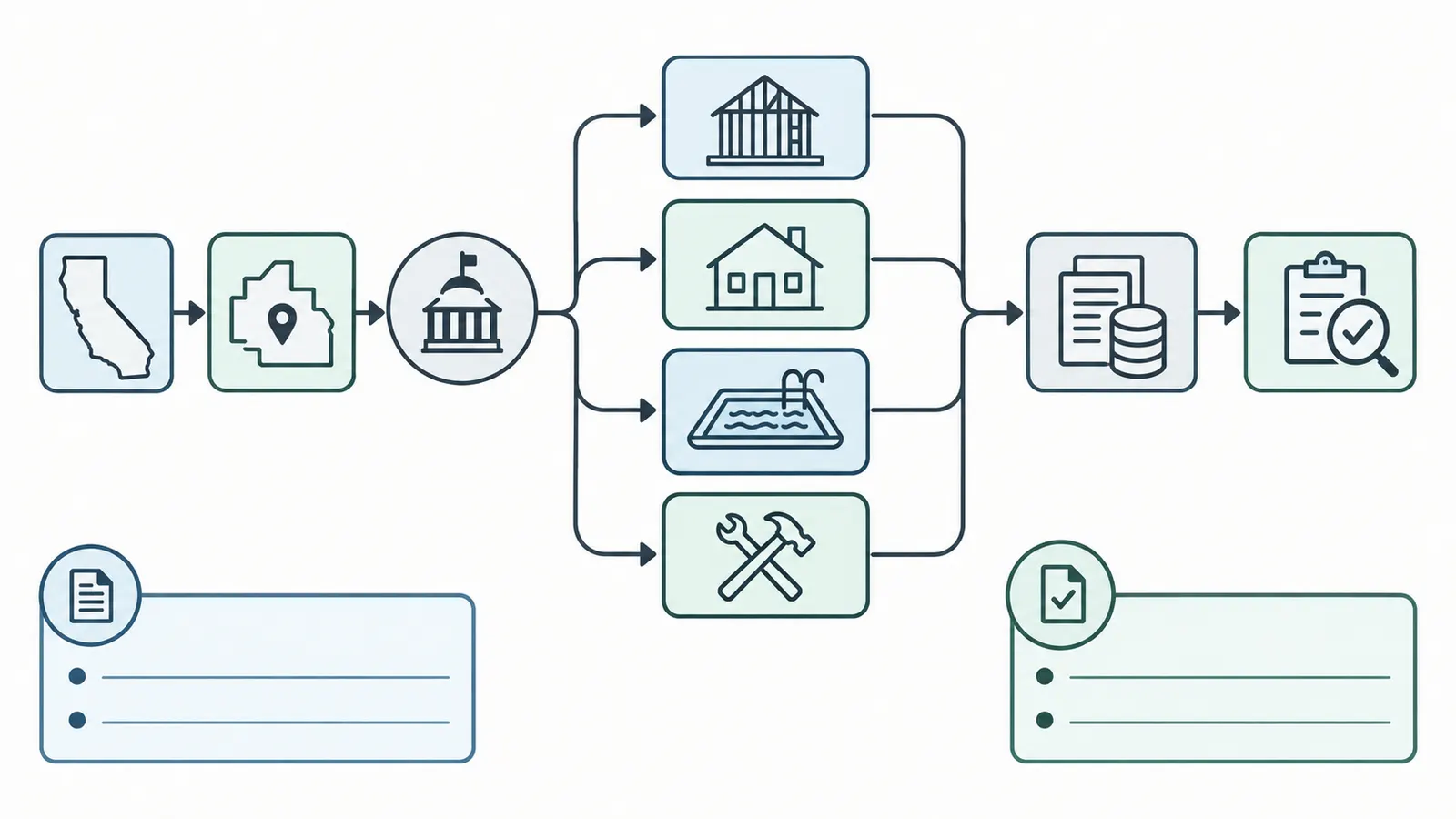
Who should collect and verify each bond record? #
The homeowner should own the decision log, the contractor should supply complete and accurate bond and insurance documents, the state board should be used for licensing-record verification, the surety or authorized agent should confirm the bond's identity and status, and a qualified local attorney or adviser should interpret applicability and claim rights. No single participant can safely replace the others.
The responsibility map
| Task | Homeowner | Contractor or builder | State board or regulator | Surety or bond agent | Local attorney, lender or design professional |
|---|---|---|---|---|---|
| Classify state, county/city and project type | Collect address, occupancy, new-build or improvement facts and contract structure | Confirm the proposed license classification and scope | Explain licensing categories and published forms | Identify whether the bond is written for the jurisdiction | Interpret legal applicability; lender may impose additional conditions |
| Identify each instrument | Request a separate row for every bond, insurance policy and cash alternative | Provide bond form/certificate, number, principal, obligee, amount, dates and attachments | Display or confirm available license/bond record | Confirm the issued bond and required power of attorney | Check consistency with contract and financing requirements |
| Verify identity | Match legal entity, license number, project address and contract name | Correct any mismatch before signature | Provide public status and record limits | Confirm surety name, authority, agent and bond number | Decide whether mismatch prevents reliance |
| Verify limits and scope | Compare amount to the contract only as a face-amount comparison | Explain what was priced and what is omitted | Explain only the scope of the public record | Explain wording, aggregate limits and claim procedure | Interpret the legal effect and negotiate protection |
| Decide whether to sign | Mark sign, correct or pause; preserve dated evidence | Supply corrected documents and signature set | Do not approve a private contract | Answer bond-status questions within its role | Give local legal, lending or design review as appropriate |
The homeowner's role is not to underwrite the builder or investigate every fact personally. It is to make the handoffs explicit. If the builder says “our broker has the bond,” the homeowner should record a due date and the exact missing items. If the surety says “the bond is current,” the homeowner should ask whether that statement refers to the license bond or the project bond and whether the surety has reviewed the final contract. If the lender requires a payment bond, the lender's requirement should be placed in the same packet as the contract, not left in an email thread.
The document packet to request before award
Request one dated packet for the entity that will sign the contract. It should include:
- the contractor's legal name, trade name, license number and business address;
- the proposed contract, plans, specifications, addenda, accepted alternates and change-order form;
- the license detail or state-register record and any bond-history page available;
- each license, disciplinary, consumer-protection, performance, payment or bid bond that the contractor says is relevant;
- the bond number, surety, principal, obligee, penal sum, effective date, expiration or continuation terms and cancellation provisions;
- the surety's authorized-agent or attorney-in-fact evidence where the form requires it;
- a written explanation of whether the bond is project-specific or applies across contracts, and if aggregate, how the aggregate is measured;
- the claim notice address, contact, deadline language and required supporting records;
- certificates or policies for general liability, workers' compensation and builder's risk where relevant to the bid or contract;
- the proposed payment schedule, draw conditions, retainage, lien-release process and lender instructions; and
- the contractor's written answer to any item it says is not applicable.
The list is intentionally longer than a certificate. Local-review instruction: treat an insurance certificate or broker communication as intake evidence, then ask the broker, lender or local adviser to compare it with the actual policy and endorsements before relying on exclusions, additional-insured status, cancellation terms or claim conditions. California's Department of Insurance says the actual policy terms and applicable law prevail over its informational guides and that the policy is the controlling document. California's insurance information-guide notice supports the document-control principle; it does not decide coverage for this project. The same document-control caution applies to a bond certificate: request the actual bond or a certified copy and the record that confirms it.
State-record verification is a snapshot, not a warranty
A public license record is valuable because it anchors the legal entity, status and bond history to a date. It is not a warranty that the database has every recent change, that the bond will answer your claim, that the contract fits the bond, or that the contractor's work will be competent. California CSLB provides a license-detail route, contractor bond history and a current-bond-information process; its Forms and Applications page describes those verification routes, and CSLB says consumers should not assume license and bond renewals occur on the same cycle. CSLB's bond basics and verification guidance supports saving a dated snapshot and checking dates independently.
Nevada's Board provides a license search and publishes bond forms and explanatory material. Its bond page says the Board determines the license-bond amount at approval and that a surety bond or cash deposit may be required. Use the Nevada contractor license search to match the builder's license number and legal name, then compare the result with the bond packet. The search page says its information is provided as a courtesy, may not reflect recent changes or updates, and is not guaranteed complete or accurate. The Nevada license-search notice supports treating the result as a dated evidence point rather than an irrevocable guarantee.
For a California project, the Department of Insurance's company-profile search can identify the company's license status, company type, lines of insurance and complaint history, including surety. California's insurance-company profile search is a verifier for the surety's regulatory identity; it does not decide whether the bond responds to your contract. For another state, use that state's insurance regulator or the surety's authorized licensing record, with local advice where the amount is material.
A practical verification sequence
Use this sequence before selecting the winning builder and repeat it immediately before signature:
- Freeze the project description. Write the property address, state, county, city, new construction or improvement status, owner occupancy status, contract price, scopes and planned start date. If a pool, solar system, excavation package or owner-builder structure is separate, list it separately.
- Ask the same bond question of every finalist. “Which bond on your license record is required for your license, which is project-specific, who can claim, what is the penal sum, and where is the actual form?” Give all finalists the same deadline and requested fields.
- Match the entity. Compare the legal name and license number on the proposal, contract, license record, bond, insurance certificate and surety document. A trade name alone is not enough if the contracting entity is different.
- Match the project. Check the property, contract reference, owner, scope, plans and dates. If a project bond names an owner or obligee that is not you, ask for correction before award.
- Read the scope and trigger. Highlight the event that permits a claim, the person who may claim, notice deadlines, proof requirements, exclusions and remedies. Do not summarize these as “covers the project” until the highlighted text supports it.
- Check cap structure. Record the penal sum, whether it is per project or aggregate, whether payment and performance limits are separate, and whether the bond is reduced by prior claims or has a total aggregate across years or contracts.
- Check status twice. Save the state-register or board record at proposal comparison and again at signature. Ask the surety or agent to confirm the exact bond number and effective dates in writing.
- Route unresolved points. Send the packet to the lender, design professional and qualified local attorney as appropriate. Put the answer, not just the question, in the decision log.
- Put the decision in the final contract. State whether bonds are required, who supplies and pays for them, the amount and form, when they must be delivered, how changes affect them, and what happens if the required protection is not delivered.
- Do not release a signing deposit while a material gap remains. If the contract makes the deposit due before the bond or insurance packet, ask counsel and the lender whether the payment sequence should be changed or held.
This sequence creates a handoff chain: homeowner classification → contractor packet → state-board verification → surety confirmation → local review → final contract → signature record. If a participant says the next participant will handle it, name that participant and the due date. “Someone checked it” is not a reusable project record.
How do you use the Bond Protection Comparison Worksheet? #
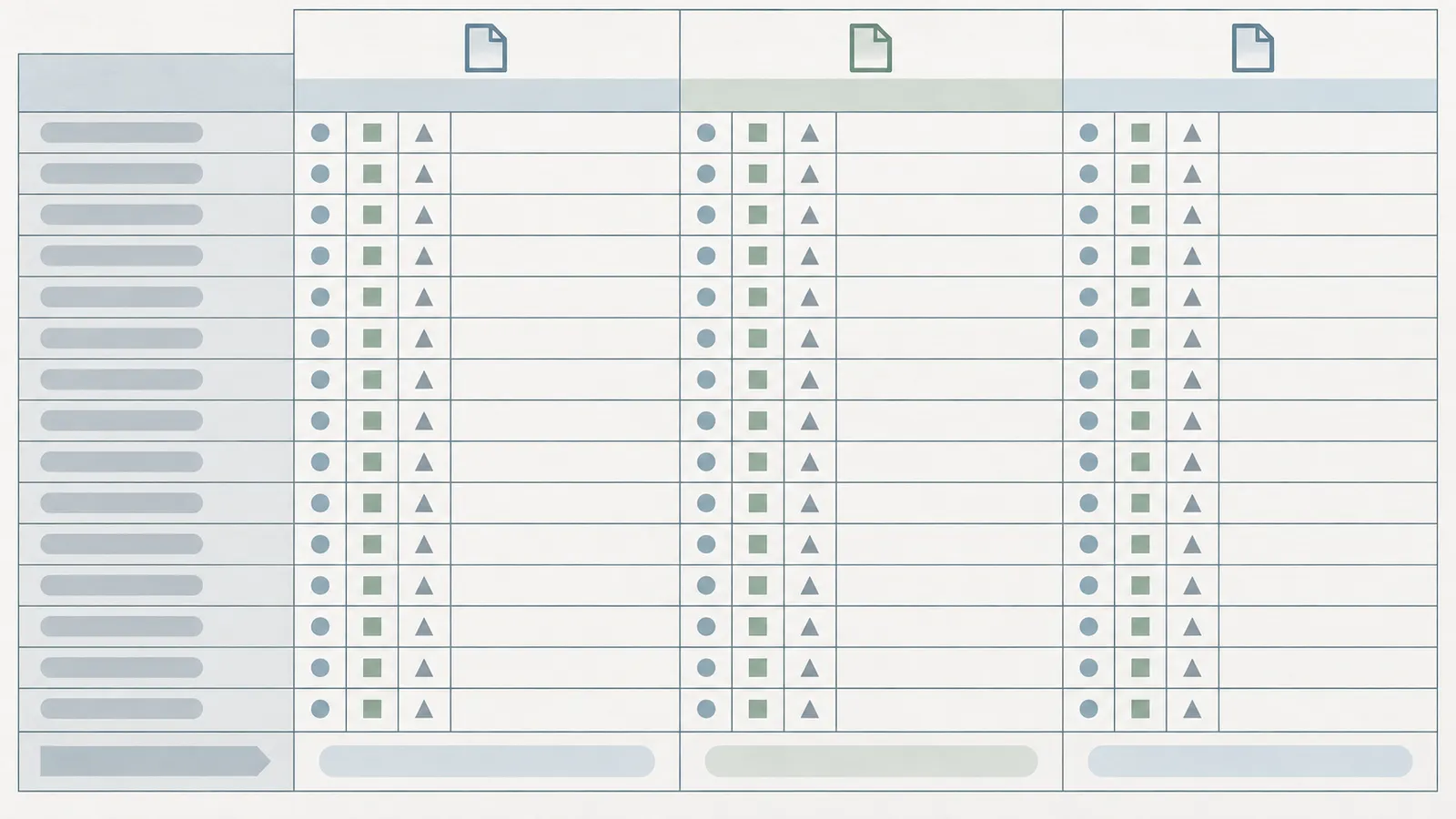
Use one row per instrument and one column per decision question; mark any unknown as “not supplied,” not “not applicable.” The worksheet is complete only when the document verifier and next handoff are named, the public record is dated, and the final contract says what protection will exist at signing and during the work.
Original contribution: Bond Protection Comparison Worksheet
The Bond Protection Comparison Worksheet is Brictale's original contribution for this decision.
Summary. It separates a license bond, consumer-protection bond, performance bond, payment bond, insurance and cash alternative by protected party, trigger, cap, term, claim route and verifier. It is intended to prevent a homeowner from treating every “bonded” statement as a project completion guarantee.
Method. Classify the jurisdiction and project type first, then transcribe each proposed bond from the actual document and state record. Compare the named principal, obligee, covered trigger, stated penal sum, project or aggregate cap, effective dates, cancellation rules, claim route and exclusions. Calculate only the numeric cap as min(stated penal sum, known applicable aggregate remainder), keeping unknown values unknown; test covered work and claimant/category scope separately as qualitative pass, partial or unknown gates. Run an explicitly illustrative face-amount comparison without treating it as a recovery forecast.
Limitations. This is a research aid, not a legal opinion, surety underwriting decision, contract form, construction inspection or guarantee of completion, quality, solvency or recovery. California and Nevada examples remain jurisdiction-specific; the executed bond, contract, current state record and qualified local adviser control. A blank row is a decision signal, not proof that no protection exists.
Copy this table into your project record. Add rows rather than combining instruments.
| Field | What to record | Why it changes the decision |
|---|---|---|
| Jurisdiction and project classification | State, county/city, authority having jurisdiction, ground-up new home, addition, repair, owner-occupied improvement, pool/spa or separate trade | A local rule may apply to one project category and not another. |
| Bond name and type | License/commercial, disciplinary, consumer-protection, performance, payment, bid, maintenance or cash alternative | The name points to the legal purpose but is not enough without the form. |
| Principal | Exact contracting legal entity, trade name and license number | A mismatch can leave the proposed contract outside the document you verified. |
| Surety or holder | Surety legal name, authorized agent, state authority, or public body holding cash | The claim route and regulatory check depend on who issued or holds it. |
| Obligee or protected party | Licensing authority, homeowner, lender, subcontractors, suppliers, employees or named beneficiaries | A bond may protect someone other than the homeowner. |
| Bond number and form date | Number, form edition, attached power of attorney or endorsements | The certificate and claim contact must point to an identifiable instrument. |
| Covered trigger | License-law violation, failure to complete, failure to pay, consumer damage, pool/spa condition or another defined default | A claim depends on a defined event, not a general feeling that the project went badly. |
| Covered work and contract | Project address, contract number, plans, specifications, addenda, alternates and changes | Project bonds depend on what the bonded contract actually includes. |
| Penal sum or face amount | Dollar amount or percentage and currency | This is a stated cap or scale input, not an expected recovery amount. |
| Cap structure | Project-specific, per claimant, per bond, aggregate across contracts, or unclear | An aggregate cap can be shared across claims or projects; do not count it twice. |
| Effective date | Start date and any condition before the bond becomes operative | A bond that starts after mobilization may not answer an earlier exposure. |
| Cancellation, expiry and continuation | Notice period, cancellation recipient, renewal, continuation and post-completion claim period | A current license does not necessarily mean the same bond remained in force for the contract date. |
| Claim route | Surety, state board, court, lender, notice recipient, or combination | The wrong recipient or late notice can change the practical remedy. |
| Proof and notice | Required default notice, claimant status, invoices, releases, contract, correspondence and deadlines | Preserve the records while the event is current. |
| Exclusions and conditions | Contract changes, owner default, disputed work, indirect losses, attorney fees, delay, design responsibility and other wording | A broad marketing description cannot erase a stated exclusion. |
| Labor/material exposure | Whether payment claims are included, who can claim and the notice route | Payment protection is not the same as completion protection. |
| Completion exposure | Whether the owner is protected, remedy options and cost cap | A payment bond does not automatically fund completion. |
| Insurance row | Policy type, insureds, additional insured status, limit, deductible, dates and claim contact | Insurance and bonds are separate evidence categories. |
| Public record verifier | Board or regulator page, record date, search criteria and saved copy | A later status change should be detectable in the project record. |
| Document verifier | Contractor, surety agent, board, attorney, lender or other responsible person | Every material assertion needs an accountable source. |
| Next handoff | The named recipient, question, date and required decision | An unresolved row must move to a person who can decide it. |
Mark the result without pretending to be the surety
Use four statuses for each row:
- Verified for identity: the name, number, issuer or holder, date and public record match.
- Verified for stated scope: the actual text supports the protected party, trigger, work and amount you recorded.
- Needs local interpretation: the facts are present, but applicability, claim rights, exclusions or contract meaning require a qualified adviser.
- Pause: a material field is missing, inconsistent or contradicted by the final contract.
Do not use “verified” to mean “guaranteed.” A homeowner can verify that a document exists and that the state record shows a bond. Only a later claim process, contract interpretation and applicable law determine whether a particular loss is covered. This distinction matters if a builder asks you to sign because a certificate has been supplied but the obligee, scope or aggregate cap remains unknown.
The minimum comparison for a proposal meeting
If you have only 15 minutes with a proposal, ask the builder to answer these questions in writing:
- What exact bond are you referring to when you say “bonded”?
- Is it required for your license, required for this project, or voluntarily offered?
- Who is the principal and who is the protected party or obligee?
- What event triggers a claim, and who receives the claim?
- What is the penal sum, and is it project-specific or aggregate?
- Does it cover completion, labor/material payment, license-law violations, consumer losses, or a different obligation?
- What are the effective, cancellation and claim deadlines?
- Which document verifies each answer, and which state or regulator record can I check?
- What protection exists if the bond is replaced, canceled, paid down or the contract changes?
- Which unresolved question should go to my local attorney or lender before award?
The builder's willingness to answer is useful qualification evidence, but willingness is not proof. A clear “the project is not bonded for performance; here is the contract payment structure and the reason” is safer than a vague “we are fully bonded.” The comparison is about visibility and fit, not about punishing a builder for declining optional security.
How much does the stated bond amount protect relative to a custom home? #
Compare a bond amount with the contract price only as a labeled face-amount scale check; never present the ratio as the percentage of money you will recover. Then test whether the amount is project-specific, aggregate, reduced by prior claims, split between performance and payment, or limited to a special trade or claimant class.
Illustrative California-versus-Nevada example
The following is an illustrative modeled comparison, not a quote, legal conclusion or prediction of recovery.
California example. Assume a proposed $600,000 ground-up custom-home contract in California. The CSLB record shows a $25,000 contractor license bond. California CSLB describes that bond as covering any project the contractor agrees to perform and separately describes contract bonds for completion and labor/material payment. The simple face-amount scale is:
$25,000 license-bond face amount ÷ $600,000 contract price = 0.0416667
Rounded for communication, the license-bond face amount is about 4.17% of the contract price. The calculation does not say the homeowner would recover 4.17%, that the bond is payable for a construction-cost overrun, or that the builder is unsuitable. It says only that a $25,000 license-bond limit is small relative to a $600,000 build. The separate question—whether a performance bond, payment bond or other completion security should be required—must be answered from the proposed contract and California-specific review.
Nevada example. Assume a $180,000 contract to improve an existing, completed, owner-occupied single-family residence in Nevada. The Nevada Board says a license bond amount is determined for the license and may range from $1,000 to $500,000; it also describes a $100,000 consumer-protection bond for the specified residential-improvement down-payment exception. If the Board record showed an illustrative $50,000 license bond and the contractor also supplied the applicable $100,000 consumer-protection bond, the arithmetic would be:
$50,000 ÷ $180,000 = 0.2777778, or about 27.78% for the license-bond face amount; and
$100,000 ÷ $180,000 = 0.5555556, or about 55.56% for the separate consumer-protection bond face amount.
Those numbers do not combine into 83.34% protection, do not prove that the contract qualifies for the residential-improvement rule, and do not create completion or payment rights beyond each bond's actual wording. The project classification is doing the work: the Nevada Board describes the consumer-protection provision for an existing, completed single-family residence occupied by its owner, not automatically for a ground-up home. The $50,000 amount in this example is also illustrative; Nevada sets the actual license-bond amount at license approval.
The example deliberately avoids comparing the states as though their numbers were competing products. California's $25,000 license-bond amount and Nevada's variable license-bond range arise from different licensing systems. Nevada's $100,000 consumer-protection bond is a separate residential-improvement concept, not a general new-home completion bond. A fair comparison asks whether the proposed contract has a project-specific performance and payment package, not which state displays the larger licensing number.
Sensitivity: what happens when the home price changes?
For a fixed $25,000 license-bond face amount, the face-to-contract ratio changes as the project price changes:
| Illustrative contract price | Fixed $25,000 face amount ÷ price | What the result does not mean |
|---|---|---|
| $300,000 | 8.33% | It is not an expected payment percentage. |
| $600,000 | 4.17% | It does not prove the bond is inadequate under local law. |
| $900,000 | 2.78% | It does not prove a project bond is required. |
| $1,200,000 | 2.08% | It does not measure quality, solvency or completion probability. |
The sensitivity test is useful because it prevents a homeowner from treating a fixed license-bond amount as though it scales with the home. If the contract price rises through change orders, the ratio falls while the license bond may remain fixed. If the license bond is canceled and replaced, the number may change, but the claim relationship to the original contract date can be more complicated. Record the date and ask the surety or local attorney about which bond was in place when the contract was signed.
For a project-specific bond expressed as a percentage, use a different calculation:
illustrative bond amount = stated contract price × stated bond percentage
For example, if a contract expressly requires a performance bond equal to 100% of a $600,000 contract, the stated amount is:
$600,000 × 1.00 = $600,000
If a Nevada pool/spa provision under specified Board conditions required a performance bond of at least 50% of a $120,000 pool contract, the statutory floor described by the Board would be:
$120,000 × 0.50 = $60,000
That last calculation is only for the pool/spa work and only under the conditions described by Nevada's Board. It is not a $60,000 performance bond for the home, and it does not say the owner can claim $60,000 without satisfying the bond and law.
A conservative cap test for the worksheet
Use a two-stage research-control test, not a legal claims formula. First calculate only the numeric cap inputs:
numeric cap available = min(stated penal sum, applicable aggregate remainder)
Then apply separate scope gates:
documented usable protection = numeric cap available only if covered work and claimant/category scope are confirmed; otherwise status = not determinable
The first line is reproducible because both inputs are dollar amounts or explicitly unknown. The second line is deliberately not arithmetic: covered work and claimant/category scope are document-reading tests, not dollar inputs. Record each as confirmed, partial or unknown, with the supporting clause or a named local reviewer.
For an illustrative record, assume:
- Stated penal sum: $600,000.
- Applicable aggregate remainder: unknown.
- Numeric cap available:
min($600,000, unknown) = unknown. - Covered work gate: partial — the bond appears to cover the base contract but not owner-directed landscaping.
- Claimant/category scope gate: unknown — performance protection for the owner is described, but payment-protection wording is not supplied.
The worksheet output is not determinable. The $600,000 line cannot be treated as full project protection until the aggregate remainder, covered work and claimant/category scope are verified. If the aggregate remainder were instead documented as $450,000, the numeric calculation would be min($600,000, $450,000) = $450,000; the result would still be not determinable if either scope gate stayed partial or unknown. This preserves units, formulas and sensitivity without pretending that qualitative scope can be multiplied or minimized.
For a split bond package, do not add performance and payment limits unless the documents clearly state that they are separate limits and the contract permits that interpretation. Record them side by side:
| Instrument | Stated amount | Intended protected party | Can it be added to the other row? |
|---|---|---|---|
| Performance bond | $600,000 | Owner | Not as payment protection; test its own scope and remedies. |
| Payment bond | $600,000 | Covered labor/material claimants | Not as completion protection; test claimant and notice rules. |
| License bond | $25,000 | Defined license-law or statutory beneficiaries | No; it is a different purpose and cap structure. |
The next decision is not “which number is largest?” It is “which risk remains without a documented instrument, and is the owner willing to accept that risk after the contract, lender and local review?”
What common failure cases should make you pause? #
Pause when the bond label, legal entity, protected party, trigger, cap, dates, claim route or project scope is missing or inconsistent; each failure points to a different corrective action. Do not solve every failure by demanding a larger bond, because the actual problem may be a wrong obligee, a wrong project category, an expired document or an insurance-versus-bond misunderstanding.
“We are bonded” but no bond type is named
What to observe: The proposal contains “licensed and bonded,” a logo, a dollar amount or a certificate but no bond type.
What you may infer: Only that the contractor is making a general statement.
What you may not infer: That completion, payment, consumer protection or quality is covered.
Next action: Ask the builder to list every bond by type, number, principal, surety, obligee, amount, effective date and project scope. If the answer identifies only a license bond, mark “license bond only documented” and ask whether a project performance and payment package is required, offered or omitted. Do not let the proposal's adjective fill the worksheet's blank cells.
The license record is current but the project bond is absent
What to observe: The state record shows an active contractor and a bond on file, but no project bond appears in the contract or packet.
What you may infer: The licensing condition may be current as of the record date.
What you may not infer: That the project is protected for completion or unpaid labor/material claims.
Next action: Compare the planned payment structure, retainage, lender requirements, personal or corporate guarantees, escrow, completion controls and insurance with the risk you are accepting. Ask local counsel whether the jurisdiction mandates a project bond for this contract and whether the lender requires one. If your decision depends on completion security, pause award until the missing protection is resolved or consciously accepted in writing.
The certificate names the wrong legal entity
What to observe: The bond names a parent company, trade name, affiliate, qualifying individual or old entity while the contract names a different limited liability company or corporation.
What you may infer: There may be an organizational relationship.
What you may not infer: That the bond automatically covers the contracting entity.
Next action: Ask the contractor and surety agent for a corrected bond or written confirmation that the exact principal is covered. California CSLB requires the business name and license number on the contractor bond to correspond with CSLB records. CSLB's bond-requirement details illustrate why identity matching belongs before signature. Have local counsel decide whether an amendment or new bond is needed.
The bond names the lender or public entity, not the homeowner
What to observe: The obligee is a lender, public owner, developer, general contractor or another entity, while the homeowner is the contracting owner.
What you may infer: The bond may serve another party's risk allocation.
What you may not infer: That you can make a direct claim or receive the same remedy.
Next action: Ask who may claim under the form and whether the homeowner is an obligee, beneficiary or neither. If your protection is indirect, document how a default notice reaches the surety and who controls the claim. Do not rely on a bond solely because the lender has accepted it; the lender's protection and your protection can differ.
The amount is high but the cap is aggregate
What to observe: The bond shows a large face amount, but the document or agent refers to a blanket or aggregate limit across open contracts, claimants or years.
What you may infer: The amount is a stated maximum within a defined pool or structure.
What you may not infer: That the entire amount is available to this contract.
Next action: Ask for the current aggregate exposure or a written confirmation of the amount available for your project. For California's blanket performance and payment bond concept, CSLB describes coverage sufficient for all outstanding contracts open at one time, and the California law-book form refers to aggregate contract prices. That is why the worksheet has both “penal sum” and “aggregate remainder.” California's blanket-bond material should be treated as jurisdiction-specific legal material for local review.
The builder offers a bond only after signing
What to observe: The proposal says a bond can be obtained later, after the contract is awarded, after the deposit, or after lender approval.
What you may infer: The builder may be pricing a conditional security package.
What you may not infer: That a bond will be issued on the terms you need or that it will cover the pre-bond deposit and early work.
Next action: Put the condition into the contract: who must obtain the bond, the required form and amount, delivery date, effective date, cost allocation, consequences of non-issuance and whether work or payment can begin before delivery. Ask the lender and local counsel whether the deposit should be held until the condition is satisfied.
The bond is for a different project type
What to observe: The builder points to a pool/spa consumer bond, home-improvement bond, solar bond, public-works bond or another trade-specific instrument while proposing a whole-home contract.
What you may infer: A separate rule may apply to the defined scope.
What you may not infer: That the bond covers the entire custom home.
Next action: Split the scope into contracts or exhibits and name the bond that covers each. Nevada's pool/spa performance and payment provisions are a clear example: the Board describes them for residential pool and spa work under specified conditions, with separate owner and labor/material protection. They do not automatically cover the home's foundation, framing, envelope or mechanical systems. Nevada's Board explanation supports this scope separation.
The state record and bond document disagree
What to observe: The public record shows a different surety, amount, bond number, cancellation date or principal than the builder's packet.
What you may infer: A change, filing delay, replacement, cash alternative or document error may exist.
What you may not infer: Which document controls your contract date.
Next action: Do not sign based on the more favorable version. Save both records with access dates, ask the board and surety agent targeted questions, and route the discrepancy to local counsel. In California, CSLB says consumers can use contractor bond history to identify the surety that wrote the bond in place at the time of the contract. That historical point can matter more than a current certificate. CSLB's bond-history guidance is the relevant state example.
A payment bond is offered as a substitute for retainage or lien controls
What to observe: The builder says the payment bond means you do not need lien releases, payment applications, stored-material evidence or lender controls.
What you may infer: The bond may be one part of the payment-protection package.
What you may not infer: That all other payment and title procedures are waived.
Next action: Ask the lender, title company and local counsel what payment records and releases remain required. Check the bond's claimant and notice terms. Keep the payment-bond row separate from the draw-control row; one is a surety protection and the other is a project-administration control.
The builder says the bond guarantees quality
What to observe: A salesperson describes the bond as proof that workmanship, financial strength or professional competence is guaranteed.
What you may infer: The builder is making a marketing claim that needs qualification.
What you may not infer: That the state or surety has certified the builder's quality.
Next action: Ask for the exact bond condition and assess quality through plans, specifications, inspection, independent verification, references and contract remedies. California CSLB expressly warns that bonds do not assure financial or professional integrity or competency. CSLB's consumer bond guidance supports rejecting that inference.
What should the bid and contract say before you sign? #
The bid and contract should state whether performance and payment bonds are required, offered or omitted; name the required form, amount, principal, obligee, surety and delivery date; separate bonds from insurance; assign verification; and explain what happens if the promised protection is not delivered. If the document is silent while the sales discussion is reassuring, the decision is not complete.
Put the bond decision in the bid instructions
AIA–MBA guidance recommends a complete and concise bidding information document. Its checklist includes the amount and acceptable format of bid security, notice of performance and payment bonds, general liability and builder's risk insurance, and the authority having jurisdiction for permits. That guidance is not a blanket private-residential mandate, but it is a useful structure for a homeowner comparing builders because it turns hidden assumptions into comparable bid inputs. Read the AIA–MBA bidders-information section.
For a custom-home bid, write a short bond instruction that answers:
- whether the owner requires a bid bond, performance bond, payment bond or none;
- whether the required bond is a condition of bidding, award, contract execution or first payment;
- the amount or percentage and whether performance and payment amounts are separate;
- the acceptable surety and jurisdictional authorization;
- the name to appear as principal and obligee;
- the documents each bidder must submit with the proposal;
- whether the bond cost belongs in the base bid or an alternate;
- whether the bond must cover change orders, accepted alternates and the final contract price;
- who verifies the surety and bond before award; and
- the consequence if a selected bidder cannot provide the required bond.
The point is not to copy a public-works specification into a private home. The point is to make the proposed builders bid on the same risk allocation. If one builder includes a performance/payment package and another prices only a license bond, their totals are not directly comparable until the difference is disclosed.
Put the bond decision in the contract exhibits
The final contract should include the bond requirement or the acknowledged absence of one. At minimum, attach or identify:
- the bond form or a condition requiring delivery of the exact form;
- the principal, surety and obligee;
- the penal sum or formula and whether it is project-specific or aggregate;
- the contract documents incorporated into the bond;
- the effective date and duration;
- the cancellation, renewal, replacement and change-order process;
- the claim notice address and document-retention responsibility;
- the cost and timing of obtaining the bond;
- the payment-bond process for subcontractor and supplier information, releases and notices; and
- the owner's remedy or pause right if the required bond is missing, canceled, replaced or materially changed.
Do not insert a generic statement that the contractor “will remain bonded.” That statement does not specify bond type, amount, protected party, contract, claim route or remedy. Use the worksheet fields to draft a precise exhibit, then let local counsel adapt it to the jurisdiction and chosen form.
Separate the contract from the insurance schedule
AIA–MBA's guidance places performance and payment bonds beside general liability, builder's risk and other insurance, not inside one undifferentiated “protection” label. Your contract packet should do the same. For insurance, record the insurer, policy number, named insured, additional insured status, policy term, limits, deductibles, exclusions and certificate contact. For bonds, record principal, surety, obligee, penal sum, trigger, claim route and bond term.
Insurance and bonds can also have different practical claim paths. Local-review instruction: an insurance certificate or bond record is a document to reconcile with the actual policy or bond; ask the broker or surety for document-level confirmation and route interpretation to a qualified local professional. California's insurance regulator states that the actual policy and applicable law control its insurance guidance, so do not treat a certificate or summary as a substitute for the governing document. California's insurance information-guide notice supports that review boundary.
Add the handoff and pause language
A good contract packet says who is responsible for what happens next. For example:
| Decision point | Responsible person | Required record | Pause condition |
|---|---|---|---|
| Confirm whether a project bond is required | Owner's local attorney and lender, with builder input | Written applicability note or lender condition | No one accepts responsibility for the answer. |
| Obtain the bond | Builder and surety agent | Executed bond, power of attorney and endorsements | Only a proposal or certificate is supplied. |
| Verify state status | Homeowner or owner's representative | Dated license/bond-history record | Entity, amount or dates do not match. |
| Confirm final contract coverage | Owner's attorney and builder | Signature set and bond references agree | Plans, addenda or change-order terms are missing. |
| Release first payment | Owner, lender and title/payment administrator | Contract condition, bond evidence and payment packet | Required protection is promised for later. |
| Respond to a default or nonpayment event | Owner, attorney, surety and lender as applicable | Notices, contract, invoices, records and timeline | Claim deadline or recipient is unknown. |
This table is not an official form and does not create legal rights. It is a project-control pattern. If you modify it, preserve the distinction between “person who collects evidence,” “person who verifies a record” and “person who decides legal applicability.” Those roles are often different.
When to pause the award
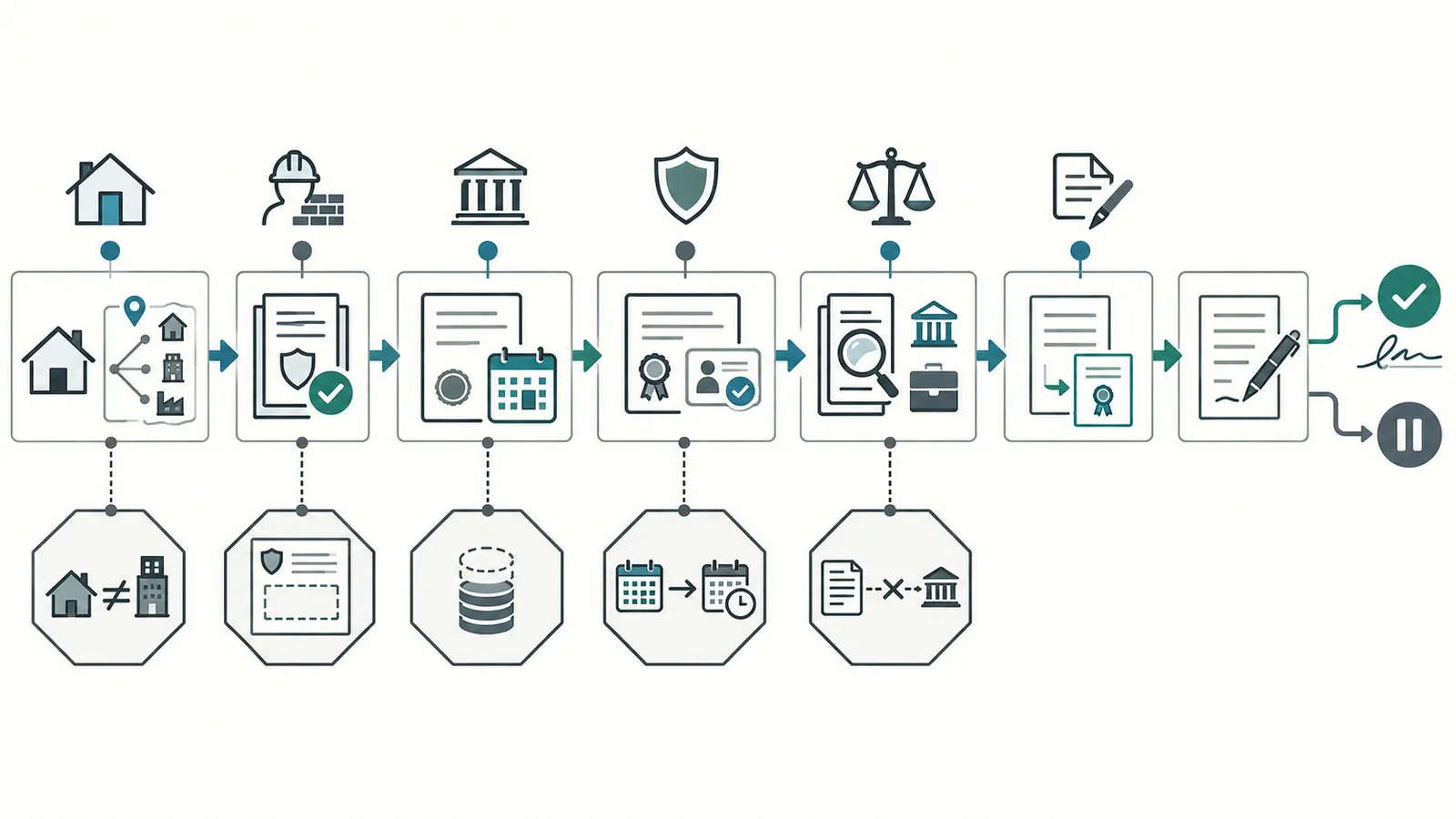
Pause the award if any of the following is true:
- the builder will not state what “bonded” means;
- the exact principal does not match the contract entity;
- the project bond names a different owner, lender or public entity;
- the bond amount or percentage is missing;
- the cap is aggregate and no available amount is documented;
- the bond's effective date begins after the proposed deposit or start of work;
- the bond is limited to a pool, spa, solar, home-improvement or other scope that does not cover the whole home;
- the claim route or time limit is not supplied;
- the state record and actual bond disagree;
- a cash alternative is being described as a surety bond; or
- the lender or local adviser has a bond condition that the contract does not satisfy.
Pausing is a document decision, not a finding of wrongdoing. The contractor may correct a clerical mismatch or explain that the proposed home is outside a special residential-improvement rule. The important thing is that the correction occurs before signature and the final evidence is saved.
What is the final decision path before signing?
Sign only when the bond protection you are relying on is identified, matched to the correct project and entity, verified against the relevant state record and surety, written into the final contract, and reviewed for jurisdiction-specific applicability; otherwise mark the award “pause” or consciously accept the documented gap after qualified local review.
The five-minute decision card
Before signing, write these answers in one place:
Project. What state, county, city and authority having jurisdiction govern the work? Is this ground-up construction, an addition, repair, work on an existing owner-occupied home, pool/spa work or a combined scope?
Protection. Is the documented instrument a license/commercial bond, consumer-protection bond, performance bond, payment bond, insurance policy, cash deposit or something else? What does its text say it protects?
People. Who is the exact principal, surety or holder, obligee, beneficiary and claim recipient? Is the homeowner directly protected?
Money. What is the penal sum? Is it a percentage, project-specific amount or aggregate? What does the face-amount comparison show, and what does it expressly not show?
Time. When does it begin, when can it be canceled or replaced, and what are the claim notice and filing windows?
Documents. Which actual bond, endorsement, state record, contract exhibit and surety confirmation support each answer? Who verified each one and when?
Decision. Does the contract require this protection, offer it, or omit it? If omitted, what other controls address completion, payment and deposit risk? Has a qualified local adviser reviewed the gap?
If any answer is “I think so,” leave the status as “needs local interpretation” or “pause.” That language is more honest than a green check with an unverified assumption.
Remote-assessment and safety limits
This guide can help you organize records and ask better questions remotely. It cannot determine whether a particular builder is financially solvent, whether work is defective, whether a contract is enforceable, whether a lien is valid, whether a bond claim will succeed, or what remedy a surety must provide. It also cannot inspect the construction site, verify concealed work, evaluate structural conditions, assess electrical or gas work, or replace a permit inspection.
The immediate hazard in this decision is financial and legal: signing a large contract, paying a deposit or waiving a protection based on an incomplete document. Do not enter an active construction area to inspect a bond-related fact; a site visit does not verify a surety obligation. Stay out of excavations, off ladders and away from energized systems, heavy equipment and confined spaces unless a qualified professional is controlling the work. Ask a licensed or otherwise qualified local professional to perform any physical, structural, electrical, gas, excavation or code review that the decision requires.
Remote records, photographs and descriptions also cannot diagnose pressure hazards or contamination. Do not test, open, disturb, sample or enter a potentially pressurized system or contaminated area to answer a contract question; isolate it only if that can be done without exposure, then hand the project and safety decision to a qualified local professional or the applicable emergency, utility, environmental or public-health authority. Keep the worksheet marked “needs local interpretation” or “pause” until that handoff is complete.
For a high-value custom home, the responsible local review may include a construction attorney, lender, title company, architect, owner's representative, independent inspector and insurance or surety professional. Each answers a different question. A contractor's own explanation can identify the document; it should not be the only interpretation of the protection you are being asked to rely on.
Originality brief: what this page adds
Current answers. Licensing pages and search results commonly say that contractors are bonded, while many summaries collapse license bonds, consumer-protection bonds and project performance/payment bonds into one reassuring label.
Missing decision. A homeowner still needs to know who the bond protects, what event triggers a claim, whether the cap is project-specific or aggregate, how the term and claim route work, and which state record and document verifier must be checked before award.
Original contribution. The Bond Protection Comparison Worksheet and the California-versus-Nevada illustrative comparison make those fields explicit and keep new construction, owner-occupied residential improvement and pool/spa rules separate.
How it can be checked. Reproduce each worksheet row from the linked CSLB, Nevada Board, Nevada statute, California insurance-regulator, SBA and AIA–MBA sources; then compare the row with the builder's actual bond, dated state record and final contract. The illustrative ratios can be recomputed from the displayed inputs. The result should be checked by the applicable state authority and a qualified local adviser before reliance.
The next handoff
Once the worksheet is complete, send it with the proposed contract to the person responsible for the next decision: the owner's local construction attorney for legal applicability, the lender for loan and draw conditions, the title company for lien and payment controls, the design professional or owner's representative for scope and sequencing, and the contractor/surety agent for document correction. Ask each recipient to answer only the rows within their role and to identify any remaining unknown.
Then record one of three final outcomes:
- Proceed to signature: the required protection is documented, applicable, matched, incorporated and locally reviewed.
- Correct and return: the issue is a clerical or document gap that the contractor or surety can fix before signature.
- Pause or renegotiate: the project has only a license bond or another limited protection, the scope is uncertain, or the contract's risk allocation is unacceptable after review.
If the outcome is “pause or renegotiate,” the next decision is not whether to search for a more reassuring bond label. It is whether to change the contract, payment structure, completion security, builder selection or local review path. For the broader builder-selection and scope process, continue with the contractor-selection record for this project; for sequencing and payment handoffs, keep the construction schedule and budget record with the same decision log. The single Blog feed is at /blog.
The useful finish line is a dated, reproducible record: the exact project, exact entity, exact instrument, exact protected party, exact trigger, exact cap, exact dates, exact claim route, exact exclusions, exact verifier and exact next handoff. Until those facts are visible, “bonded” is a question still waiting for an answer.
Cite this guide
Brictale. “How to Compare Contractor License, Performance and Payment Bonds Before Signing.” Published 2026-09-19; updated 2026-09-19.
https://brictale.com/build/contractors/compare-contractor-license-vs-performance-payment-bonds-custom-home · Read the Markdown version
Original contribution: Bond Protection Comparison Worksheet. A contract-stage worksheet that separates a license bond, consumer-protection bond, performance bond, payment bond, insurance and cash alternative by protected party, trigger, cap, term, claim route and verifier.
Sources and scope
Evidence behind this page
- California CSLB says an active contractor must maintain a contractor bond, and describes the contractor bond as filed for consumers damaged by defective construction or other license-law violations and for employees owed wages; the listed amount is $25,000.
Bond Requirements — Contractors State License Board
California contractor licensing; the page describes the state license bond and its requirements, not a nationwide rule or a project-specific completion bond.
Accessed · Link to this claim - California CSLB requires the contractor license bond to be written by a surety company licensed through the California Department of Insurance, and requires the business name and license number on the bond to correspond exactly with CSLB records.
Bond Requirements — Contractors State License Board
California contractor-license bond identity and surety requirements; this exact-match rule is not a nationwide requirement and does not establish that a project-specific bond covers a custom-home contract.
Accessed · Link to this claim - California CSLB distinguishes a $25,000 contractor license bond that covers any project the contractor agrees to perform from contract bonds that guarantee completion and payment for labor and materials, generally up to the bond face amount.
How do I find the right licensed contractor? — Contractors State License Board
California consumer guidance; the contract-bond description is general CSLB guidance and does not establish that a bond is required for every private custom-home contract.
Accessed · Link to this claim - California CSLB warns that bonds do not assure the financial or professional integrity or competency of a contractor.
How do I find the right licensed contractor? — Contractors State License Board
California consumer guidance; used here as a warning against inferring competency or solvency from the word bonded.
Accessed · Link to this claim - California CSLB says a surety bond claim is filed with the surety company within applicable time frames, CSLB does not process claims against surety companies, and a license bond is canceled 30 days from the date CSLB receives a cancellation notice. CSLB separately says that if a bond reinstatement notice or replacement bond is not received before the end of that 30-day period, the license is suspended; that condition describes license status and does not say that the original bond cancellation is prevented.
Bond Basics: A Brief Discussion — Contractors State License Board
California license-bond administration and claim routing; exact claim deadlines and the bond wording must be confirmed for the actual claim.
Accessed · Link to this claim - California CSLB describes a blanket performance and payment bond as an exception tied to home-improvement down-payment rules and says the bond amount is sufficient to cover all outstanding contracts open at one time; the California regulation form identifies home-improvement contracts and an aggregate contract-price condition.
CA Contractors 26E PDF — California Contractors State License Board Law Book
California law and regulation materials for a blanket performance and payment bond; not a statement that every ground-up custom-home contract is a home-improvement contract.
Accessed · Link to this claim - California CSLB provides contractor bond-history and current-bond-information routes for checking a license's bond records and requesting additional bond information.
Forms and Applications — Contractors State License Board
California verification workflow; a public record does not replace review of the actual bond, contract, current dates, claim provisions or surety confirmation.
Accessed · Link to this claim - The California Department of Insurance company-profile search identifies an insurance company's license status and the lines of insurance it is authorized to transact, including surety.
Insurance Company Profiles — California Department of Insurance
California insurer-regulator search; it verifies regulatory identity and authorized lines, not whether a specific bond responds to a homeowner's contract.
Accessed · Link to this claim - California CSLB states that active licensees must provide valid workers' compensation insurance, self-insurance certification or an allowed exemption, and that workers' compensation coverage must be continuous; this is a separate licensing record from the contractor bond.
Workers' Compensation Requirements — Contractors State License Board
California contractor licensing and workers' compensation maintenance; it does not establish workers' compensation requirements in another jurisdiction or coverage for a particular worker or claim.
Accessed · Link to this claim - California Department of Insurance says the actual insurance policy terms and applicable law prevail over its informational guides and that the policy is the controlling document describing what the insurer will pay.
Information Guides — California Department of Insurance
California insurance consumer guidance; used for document-control caution, not to decide coverage under a contractor's specific policy or certificate.
Accessed · Link to this claim - The Nevada State Contractors Board license-search page says the information is provided as a courtesy, may not reflect recent changes or updates, and is not guaranteed complete or accurate.
License Search — Nevada State Contractors Board
Nevada public contractor-license search notice; it supports dating and corroborating a search result, not a conclusion about bond validity, contract applicability or claim recovery.
Accessed · Link to this claim - Nevada State Contractors Board says every Nevada contractor license requires a license bond, determines the amount at license approval, and may set it from $1,000 to $500,000 based on factors including license type, monetary limit, financial responsibility, experience and character; the bond may be a surety bond or cash deposit.
Bonds — Nevada State Contractors Board
Nevada contractor licensing; the range is a Nevada Board statement, not a project-specific performance or payment limit and not a nationwide rule.
Accessed · Link to this claim - Nevada State Contractors Board says its residential-improvement provisions apply to construction, remodeling, repair or improvements to existing, completed single-family residences occupied by their owners; the initial down payment limit is $1,000 or 10%, whichever is less, unless a $100,000 consumer-protection bond is posted or another specified relief applies.
Bonds — Nevada State Contractors Board
Nevada residential-improvement rules as described by the Board; do not extend the rule automatically to a ground-up custom-home contract or another project type.
Accessed · Link to this claim - Nevada's Board says that under certain conditions it may require a residential pool or spa contractor to obtain a performance bond for at least 50% of the contract for the owner's protection and a payment bond for at least 50% for persons supplying labor or materials; equivalent security may be permitted.
Bonds — Nevada State Contractors Board
Nevada residential pool and spa work under specified Board conditions; it is not a rule for an entire custom-home contract.
Accessed · Link to this claim - Nevada Revised Statutes section 624.970 requires a residential-improvement contract to state that the owner has the right to request a payment and performance bond when one is not otherwise required under the cited Nevada law, subject to the statute's project scope.
NRS Chapter 624 — Contractors, NRS 624.970
Nevada statutory residential-improvement contract requirements for an owner-occupied single-family residence; not a nationwide owner right.
Accessed · Link to this claim - The U.S. Small Business Administration describes contract bonds as ensuring the terms of a specific contract are fulfilled and identifies payment bonds as ensuring payment to suppliers and subcontractors and performance bonds as ensuring full completion of a contract.
Surety bonds — U.S. Small Business Administration
Federal SBA educational guidance about surety-bond categories; actual rights depend on the bond form, contract, law and claim procedure.
Accessed · Link to this claim - The SBA distinguishes commercial bonds that help ensure compliance with laws and regulations from contract bonds that ensure terms of a specific contract are fulfilled.
Surety bonds — U.S. Small Business Administration
Federal SBA educational categories; used to explain why a licensing/commercial bond should not be treated as the same instrument as a project contract bond.
Accessed · Link to this claim - AIA–MBA Joint Committee bidding guidance recommends that bidding information identify bid security and separately give notice of performance and payment bonds, general liability insurance, builder's risk insurance and other insurance, along with the authority having jurisdiction for permits.
Bidding — AIA-MBA Joint Committee Best Practices Guide
Professional bidding guidance, not a statute and not a mandate for private residential contracts; used for document-assembly and responsibility recommendations.
Accessed · Link to this claim