How to Compare Contractor Delay and Time-Extension Clauses Before Signing a Custom Home Contract
Compare delay clauses before signing a custom home contract: assign responsibility, notice, evidence, critical-path impact, extensions and next approvals.
The short answer
Before signing, turn every delay clause into a row with a trigger, responsible party, notice deadline and delivery method, required evidence, critical-path test, extension formula and next approval. Compare owner, contractor, designer, permit, material, lender and extraordinary-event delays separately. Utah and California examples are labeled by jurisdiction; have local counsel review the actual contract before you rely on any entitlement or remedy.How to Compare Contractor Delay and Time-Extension Clauses Before Signing a Custom Home Contract
Before signing, turn every delay clause into a row with a trigger, responsible party, notice deadline and delivery method, required evidence, critical-path test, extension formula and next approval. Compare owner, contractor, designer, permit, material, lender and extraordinary-event delays separately. Utah and California examples are labeled by jurisdiction; have local counsel review the actual contract before you rely on any entitlement or remedy.
This guide is for a United States homeowner planning a custom single-family new home before the owner-contractor agreement is signed. It is a contract-comparison and project-planning method, not legal advice, a determination of breach, or a strategy for an active dispute. A delay clause can change payment exposure, move-in planning, lender timing, storage, temporary housing and the sequence of every later handoff, so it deserves the same attention as price and scope.
It belongs in Brictale's contractor decision guides within the homeowner blog, where the same build journey continues from choosing the team to managing the work and handover.
The answer: compare a delay clause as a chain, not a sentence #
The useful comparison is not “Which contract has the fairest force-majeure paragraph?” It is “For each event that could move completion, can the contract answer who acts, by when, with what record, against which schedule activity, for how many days, and with whose written approval?” A clause that names weather but omits notice, evidence or extension math is not yet a usable schedule control.
Compact originality brief
Current search answers usually explain force majeure, excusable delay or construction delays at a high level. They rarely separate owner decisions, contractor performance, designer information, permitting, materials, lender dependencies and extraordinary events into different responsibility paths. They also often present one state's contract guidance as if it were a national rule.
The missing decision is the homeowner's pre-signing choice among three actions: accept the clause as written, ask the parties to clarify it in the contract and schedule, or send the issue to a qualified local attorney before signing. The original contribution here is the Delay-allocation and extension worksheet: a source-backed matrix with trigger, responsible party, notice clock, evidence, critical-path effect, extension math and next handoff, followed by illustrative sensitivity scenarios.
Method: Extract the schedule and notice controls from the proposed contract, classify each trigger, then run illustrative weather, selection, permit and lender scenarios using calendar-day inputs and an explicit critical-path formula. In practice, that means copying each relevant clause into a row; naming its event and contracting party; identifying the notice clock and delivery method; attaching the record that would prove occurrence and effect; testing whether the affected activity is on the current critical path; calculating a transparent net extension; and recording the next approval.
Limitations: This is a planning synthesis, not legal advice, a project schedule, a determination of entitlement, or a prediction of a site's actual critical path; Utah and California examples remain jurisdiction-specific. The worksheet also does not decide causation or concurrency, create a critical path for a particular site, or replace local counsel, the architect's schedule review, the contractor's means-and-methods judgment or the lender's written requirements.
The best starting comparison has seven columns:
| Delay question | What a complete answer looks like before signing |
|---|---|
| Trigger | “Owner selection of exterior door hardware is due 42 calendar days after notice to proceed; a late selection is an owner decision delay” rather than “owner-caused delays.” |
| Responsible party | The named contracting party or the party responsible for the handoff, with a separate question for designer, lender, permit authority and supplier dependencies. |
| Notice | Who sends it, to whom, by what method, within how many days, and whether an updated notice is needed when the effect becomes clearer. |
| Evidence | A dated selection request, permit receipt, schedule update, delivery notice, weather record, meeting record or approved design revision. |
| Schedule test | The activity, predecessor, successor, available float and critical-path effect—not just elapsed calendar time. |
| Extension | Time-only, time-and-cost, no extension, or unresolved until counsel reviews the actual clause; include the formula and approval record. |
| Next handoff | A revised date, responsible person, decision deadline, document to sign and next verification checkpoint. |
If a proposed contract cannot support these seven answers, mark the row clarify before signing. Do not fill the gap with an assumption that “the builder will be reasonable.” Reasonableness may be a useful negotiating goal, but it is not a schedule record, a notice method or a stated completion-date mechanism.
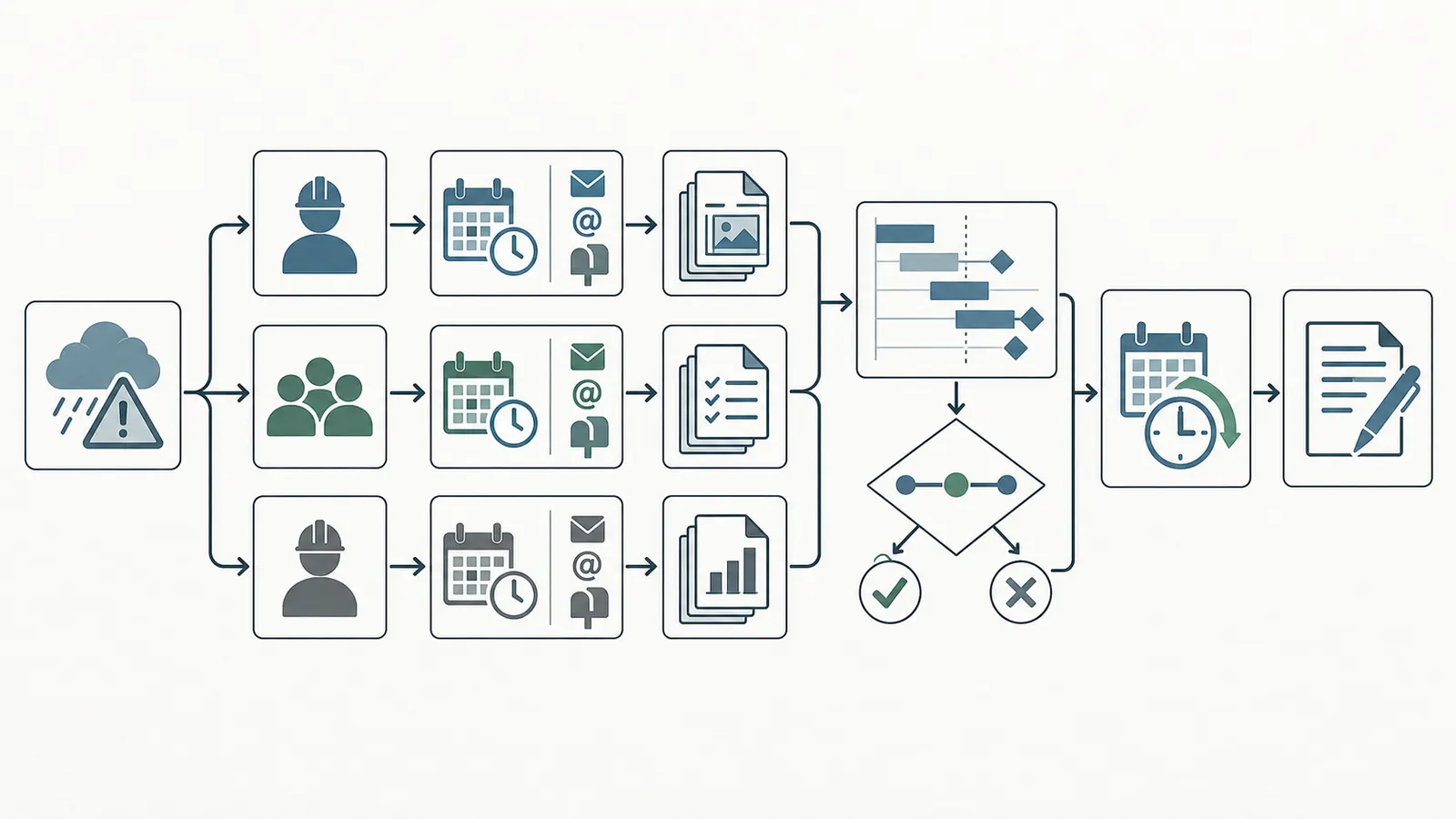
1. Build the schedule baseline before comparing clauses #
Compare delay clauses against one agreed baseline schedule with a defined start trigger, completion milestone, calendar convention, dependencies and owner-decision dates. A completion date without its starting event and predecessor assumptions is a label, not a testable schedule promise.
The baseline is the smallest schedule that lets the homeowner and contractor answer whether an event changed the promised completion path. It does not need to be a perfect production schedule before signing, and the homeowner should not attempt to direct construction means and methods. It does need enough structure to expose the decisions and external approvals that the price and completion language assumes.
Collect the inputs
Ask the contractor to identify, in the proposed contract or an incorporated schedule, the following inputs. Ask the architect or designer to confirm the design and approval dependencies. Ask the lender to confirm draw prerequisites and inspection timing in writing. Ask the permitting authority or permit expediter for the applicable process and local time estimates, without treating an estimate as a guaranteed date.
| Input | Unit or record | Who supplies it | Why it matters to the delay comparison | Verification before signing |
|---|---|---|---|---|
| Agreement date | Date | Owner and contractor | Some forms measure contract time from execution unless another start method is selected. | Both parties initial the selected commencement rule. |
| Notice to proceed | Date and named sender | Owner, contractor or both | A notice-to-proceed date can differ from the agreement date and can control the day count. | Keep the form and delivery receipt in the contract file. |
| Permit and approval gate | Date per approval, permit number and issuing authority | Contractor, owner, designer and permit expediter | A permit dependency may shift start, but its treatment must be stated rather than assumed. | Match the contract responsibility to the permit log. |
| Substantial completion | Fixed date or calendar-day duration | Contractor and owner | It is the milestone that commonly controls move-in, financing and later closeout. | Define what “substantial” means and what remains afterward. |
| Final completion | Date or duration after punch list | Contractor and owner | The homeowner may be able to occupy before every correction is complete, but the contract should distinguish milestones. | Match payment, occupancy and punch-list language. |
| Owner decisions | Decision name, due date, responsible decision-maker | Owner, designer and contractor | Late selections and unanswered requests can affect procurement and installation. | Put every allowance and selection deadline in the schedule. |
| Design information | Drawing/specification revision and due date | Designer and contractor | Missing or conflicting information may stop affected work or create a change. | Identify who resolves discrepancies and how the decision is recorded. |
| Material release | Item, approved submittal, lead-time assumption and delivery milestone | Contractor, supplier and owner | “Material delay” is too broad unless the order, approval and delivery chain is visible. | Attach supplier confirmation or label the lead time as an assumption. |
| Inspection and testing | Inspection type, responsible requester and prerequisite | Contractor, designer, authority and owner | A failed inspection, unavailable inspector or missing test can affect successor work. | Record the authority and local process; do not promise an inspector's date. |
| Funding and draw | Draw request, inspection, approval and funding date | Owner and lender | The lender may not be a party to the construction contract. | Put owner funding duties and lender assumptions in writing. |
| Weather and site condition assumption | Activity, season, threshold or documented condition | Contractor and owner | A generic “weather delay” label does not identify whether the affected work was critical or foreseeable. | Ask for the schedule assumption and record the actual event later. |
The Utah Division of Professional Licensing's optional Residential Construction Agreement is a useful example of this level of visibility. It describes a stated start date or commencement within 15 calendar days after necessary permits and approvals, an estimated substantial-completion date, and a written schedule listing subcontractor activities, material-delivery milestones and deadlines for the owner's decisions. That is a Utah form, not a national requirement, but it shows the inputs a homeowner should ask to see. Utah's 2025 Residential Construction Agreement
Compare the clock mechanisms
Most proposed schedules use one of four clock mechanisms, or an awkward combination of them:
- Fixed completion date. The contract names a calendar date. Compare it with the actual start trigger, assumed permit date, owner selection deadlines, material lead times and the list of events that can move it.
- Duration after commencement. The contract says, for example, “substantial completion within 240 calendar days after commencement.” Compare the definition of commencement with the date the owner can actually control.
- Notice-to-proceed clock. The contractor starts the contract period after the owner issues a written notice to proceed. Compare who can issue it, what prerequisites must be satisfied and whether the owner can delay it without a remedy or extension rule.
- Estimated or approximate date. The date is described as an estimate, target or expectation. Ask what is binding, what records must support a change and how the contract treats a missed target.
AIA's public instructions for its A101 stipulated-sum agreement illustrate why this distinction matters: the commencement date may be the agreement date, an owner-issued notice to proceed or another agreed method, while substantial completion may be stated as a calendar date or a number of days from commencement. AIA's description helps with document comparison; it does not mean an AIA form governs your project. AIA A101 instructions on commencement and substantial completion
For each mechanism, ask the contractor to write a one-line example using your project: “If the permit is issued on June 10, the notice to proceed is sent on June 12, 2026, and the duration is 240 calendar days, with the notice-to-proceed date excluded and June 13 counted as calendar day 1, the stated substantial-completion date is February 7, 2027.” An inclusive convention that counts June 12 as day 1 would produce February 6, 2027, so the contract should state its counting rule. Then ask what happens if the permit is issued on June 22, an exterior-window selection is seven days late, or a required design clarification arrives after framing begins. If the answer changes from a fixed date to “we will see,” the clause needs clarification.
Distinguish contract time from a working schedule
The contract time is the agreed measurement that controls the completion obligation under that contract. The working schedule is the contractor's operational plan for sequencing trades, deliveries and inspections. A weekly schedule update can reveal a problem without itself changing the contract completion date. A signed change order, written extension, or other mechanism named by the contract may be needed to record a change.
That distinction prevents two opposite errors. The first is treating an unapproved schedule forecast as a permanent extension. The second is treating a revised forecast as irrelevant until the final day has already been missed. Require a short written update when a trigger is first known, then a verified extension record when the effect is sufficiently understood. A clause should say whether the first notice preserves a request while the final number is calculated later.
Define substantial completion and the handoff after it
“Completion” can mean several milestones: ready for legal occupancy, usable for the intended purpose, substantially complete with minor corrections remaining, final completion, or closeout after releases and manuals. A delay clause tied only to “completion” can create a second dispute about which milestone moved.
Write the milestone and the next handoff together. For example: “Substantial completion means the home is available for legal occupancy and the work identified in the contract for that milestone is complete, subject only to listed minor corrections; within five days the parties will inspect, create a dated punch list and record the expected final-completion date.” The wording must be reviewed for local legal effect, but the planning goal is clear: the schedule should not hide the transition from construction to inspection, lender closeout, occupancy and ownership.
2. Classify every delay trigger by responsibility #
Do not compare one broad “excusable delay” bucket with another. Classify each trigger by the handoff that failed, the party with the contractual duty to act, and the schedule activity that moved. The same event—such as a late permit or a missing drawing—can have different treatment depending on the contract's assignments, notice language and actual critical-path effect.
The matrix below is the core comparison tool. It is a planning synthesis, not a statement that any row automatically creates an extension or excuses performance.
| Trigger family | Typical trigger to name | First responsible person to identify | Evidence to require | Critical-path question | Likely next handoff to record |
|---|---|---|---|---|---|
| Owner decision | Selection, access, payment, site information or approval arrives after the agreed date | Owner decision-maker, unless the contractor failed to make a complete request | Dated request, complete options, owner response, allowance and schedule update | Did the missing decision stop an activity with no usable successor path? | Owner approves selection; contractor confirms release and revised delivery/install dates. |
| Contractor performance | Labor, supervision, procurement, coordination or sequencing falls behind the contractor's own plan | Contractor | Baseline update, daily or weekly records, purchase orders, delivery status and recovery plan | Is the slip on the controlling path, or is float available? | Contractor issues recovery plan and owner verifies the next milestone. |
| Designer or consultant information | Incomplete, conflicting or late drawing, specification, response or delegated design | Party assigned to produce or coordinate that information; check whether the contractor had a review duty | RFI, drawing revision, response date, affected work notice and coordination record | Which work was blocked and could other work continue? | Designer resolves, contractor prices/time-impacts any change, owner approves where required. |
| Permit or authority | Plan review comment, permit issuance, inspection availability, failed inspection or required public approval | Contractually assigned permit coordinator; authority is not usually the contractor's contractual counterparty | Application receipt, comments, approval, inspection request/result and authority communication | Was the activity waiting only on the authority, or were other prerequisites missing? | Contractor or expediter updates permit log; designer answers comments; owner receives revised date. |
| Material or supplier | Long lead, substitution, damaged delivery, unavailable product or late owner approval | Party assigned to select, approve, order and manage the item; do not assume “supplier delay” ends the analysis | Submittal approval, purchase order, promised date, carrier record, damage report and substitution request | Could an approved substitute or resequence protect the completion path? | Contractor proposes options; owner/designer approves substitution; change record states time and cost. |
| Lender or funding | Draw inspection, approval, wire, loan condition or owner cash timing | The party that promised funding or payment under the construction contract; lender is separately checked because it may not be a party | Draw request, inspection result, approval, funding confirmation and payment receipt | Did a contract payment condition stop work, or did the contractor have another funded activity? | Owner and lender resolve draw; contractor confirms restart and revised forecast. |
| Extraordinary event | Fire, earthquake, emergency, war, government restriction or other defined event beyond reasonable control | Contract definition and notice procedure control; do not rely on the label alone | Official notice, site record, affected activity, mitigation steps and recovery estimate | What work was actually unavailable and for how long after mitigation? | Contractor gives notice; owner and counsel assess the clause; schedule is updated. |
| Concurrent or unclear causes | Owner decision and contractor slippage overlap; two paths reach the same milestone | Both parties preserve records; attorney may need to analyze the contract | Overlapping updates, requests, responses, resource records and predecessor logic | Can the delay be separated by activity and day, or is the effect inseparable? | Pause any assumption of entitlement; obtain contract administration and legal review. |
Identify the contracting party, not just the person who caused the event
The homeowner may interact with an architect, civil engineer, permit expediter, lender, cabinet supplier and subcontractor, but many of those people are not parties to the owner-contractor agreement. The contract should say who is responsible for passing information, making a request, paying a fee, ordering an item, obtaining an approval or warning of a risk. “The architect was late” is not enough; ask whether the contractor had a duty to coordinate, whether the owner had a separate design agreement, and which contract contains the remedy or extension rule.
AIA's public description of A201 is helpful as a document-structure reminder: it sets out rights, responsibilities and relationships among owner, contractor and architect; it also explains that the architect may perform document-preparation and construction-phase duties without being a direct party to the owner-contractor agreement. That distinction is why the homeowner should map connected agreements before assuming one schedule clause reaches everyone. AIA's public A201 document instructions
Make a simple contract-party map:
| Relationship | Ask before signing |
|---|---|
| Owner–contractor | Which party controls each notice, selection, payment, permit and schedule update? |
| Owner–architect/designer | Does the design agreement have response times, additional services and delay language that must align with the build contract? |
| Contractor–subcontractor | Does the contractor remain responsible to the owner for coordination, or is there an owner-direct contract that changes the path? |
| Owner–lender | What draw or inspection dates are assumptions, and what does the build contract say if funding is late? |
| Owner/contractor–authority | Which party submits, responds, attends inspections and pays fees, and what part of the process is outside the contract parties' control? |
| Contractor–supplier | Who chooses the product, approves the submittal, places the order, checks the delivery and proposes a substitute? |
Do not use this map to assign legal fault. Use it to identify where two agreements must be consistent and where a missing handoff could turn into a schedule surprise.
Classify the remedy separately from the cause
A proposed clause can treat a trigger as: no time extension; time extension only; time plus documented cost; a change order; a suspension; termination rights; or an issue requiring agreement before the parties proceed. These are not interchangeable. A contract may permit additional time without permitting additional payment, or may require the owner to approve a cost while the contractor must continue unaffected work.
Put the proposed treatment in a separate column from the cause. If the clause says “contractor is entitled to an extension for delays beyond its control,” ask five follow-up questions:
- Does “beyond its control” include supplier failure, subcontractor failure, permit review, labor shortage, design information and owner selections?
- Must the event affect the critical path, or does any calendar-day interruption qualify?
- Is notice required, and when does the clock begin: when the event occurs, when the contractor knows, or when the effect is known?
- Is the extension measured by the event's duration, the affected activity's delay, or the net movement of the completion milestone?
- Does the clause change the contract sum, and what records must support that amount?
Those questions make ambiguity visible without deciding what a court or arbitrator would do. If the answer is material to your move-in date, financing or temporary housing, put the actual contract before a local attorney before signing.
3. Compare the five clause controls that change the outcome #
A strong delay clause controls five things: the trigger, the notice clock and delivery method, the evidence and causation test, the extension calculation, and the money or termination consequences. Compare each control line by line across the proposed contract, the schedule, change-order form and any incorporated general conditions.
Control 1: the trigger must be observable
“Unavoidable delay,” “unforeseeable event” and “material delay” can be meaningful legal language, but they are weak project instructions when the homeowner cannot tell what event starts the clock. Rewrite the comparison in observable terms:
| Weak comparison | Better pre-signing question |
|---|---|
| Weather delay | Which weather event, on which activity, under what workability assumption, and with what record? |
| Material delay | Was the material selected and approved on time, ordered on time, promised for a date, delivered damaged, or changed after approval? |
| Permit delay | Which permit or approval, who submitted it, when was the complete application accepted, and what did the authority request? |
| Owner delay | Which owner action was due, when was a complete request made, and did the contractor give the owner enough information to decide? |
| Design delay | Which document or response was missing, who owed it, what affected work was blocked and could work continue elsewhere? |
| Force majeure | Which listed event occurred, what part of performance was prevented, and what notice and mitigation steps apply? |
Utah's optional agreement illustrates a narrow force-majeure approach by listing events beyond reasonable control such as fire, earthquake, war or emergencies in section 16.7, while sections 4.4–4.5 separately address owner-caused delay, contractor notice and change-order extensions. It is a Utah example, not a definition to copy into a different jurisdiction. Utah DOPL's 2025 agreement, sections 4.4–4.5 and 16.7
Control 2: the notice clock must be usable on a bad day
Compare four notice details: the event that starts the clock; the person who must send the notice; the required recipient and method; and the content needed to preserve the request. “Prompt,” “immediately” and “as soon as practicable” may need a specific outer limit and a later-update rule. A notice procedure should also say whether an initial notice may state that the duration is still being evaluated.
Utah's optional form gives a concrete example: when the contractor becomes aware of a delay, it is to notify the owner within a reasonable time and no later than seven days, identify the necessary extension, and document the extension in a change order. The seven-day period belongs to that Utah form; it is not a national rule. Utah's delay and extension provisions
For any proposed contract, write the notice procedure as a small test:
- The contractor sees a permit comment on Tuesday.
- The contractor sends a written notice Tuesday or Wednesday to the exact email or portal listed in the agreement.
- The notice names the permit, the affected activity, the current known days, the assumptions still being checked and the next update date.
- The owner acknowledges receipt without treating acknowledgment as agreement to entitlement.
- The contractor updates the schedule when the authority answers.
- The parties sign the change or extension record if the contract requires one.
If the contract requires certified mail only, has no usable address, or says notice is ineffective unless the final delay number is known on day one, ask counsel and the contractor to fix the procedure. A notice that cannot be sent and traced is a failure-prone control.
Also compare effective time. Utah's public agreement summary says notices may be delivered in person, by email to the contract address or by certified mail, with effectiveness tied to delivery, successful transmission or the postal rule stated there. The exact delivery and effective-time provisions must be read in the agreement you sign. Utah's notice provisions
Control 3: evidence must show both the event and the effect
An event record proves that something happened. A schedule record shows whether it changed completion. You need both. A rainfall total does not by itself prove that the home finished later; a late selection email does not by itself prove that the installation was on the critical path.
Use an evidence bundle with six parts:
- Request: the original complete request, drawing, selection, submittal, permit application or funding request.
- Due date: the contractual or schedule date and the date the party actually responded.
- Event: the dated authority notice, delivery record, weather observation, inspection result, site condition report or approved revision.
- Affected activity: the schedule ID, predecessor, successor, planned dates and actual dates.
- Mitigation: resequencing, alternate material, additional crew, revised inspection request or other proposed response. Do not direct means and methods; record the contractor's plan and ask the responsible professional to evaluate it.
- Effect: baseline completion, current forecast, available float, days recovered and the requested net extension.
This is also where you should separate an allowance from a selection. If the owner selects an item above the allowance, the contract may have a cost rule that differs from the time rule. Utah's optional form, for example, addresses a selection that exceeds an allowance separately from its general change procedure. That makes it a prompt to read the actual selection and delay provisions together, not a reason to assume a time extension is automatic. Utah's selections and changes provisions
Control 4: the extension must use critical-path logic
The simplest defensible planning formula is:
net extension days = max(0, delay to controlling completion path − usable float − accepted recovery days)
This is not a legal entitlement formula. It is a transparent way to keep the conversation from equating every lost workday with a lost completion day. It requires a baseline and an updated schedule.
Use calendar days or working days consistently. If the contract says calendar days, show calendar days in the worksheet. If the contractor's schedule uses working days, show the calendar conversion and any holiday or weather assumptions. Do not silently mix a seven-day contract period with a five-day workweek forecast.
Record three dates for the affected activity:
| Date | Meaning |
|---|---|
| Baseline finish | Where the activity was expected to finish before the event. |
| Forecast finish without recovery | Where it would finish if the event occurred and the original sequence continued. |
| Forecast finish with accepted recovery | Where the controlling path lands after a documented resequence or other recovery plan. |
Then identify whether the completion milestone actually moved. If the affected activity had four days of float and the event consumed only two, the project forecast may not move even though the activity did. If a successor cannot start until that activity finishes, the same event may consume all float and move completion. Only the project-specific schedule can establish that relationship; this article cannot.
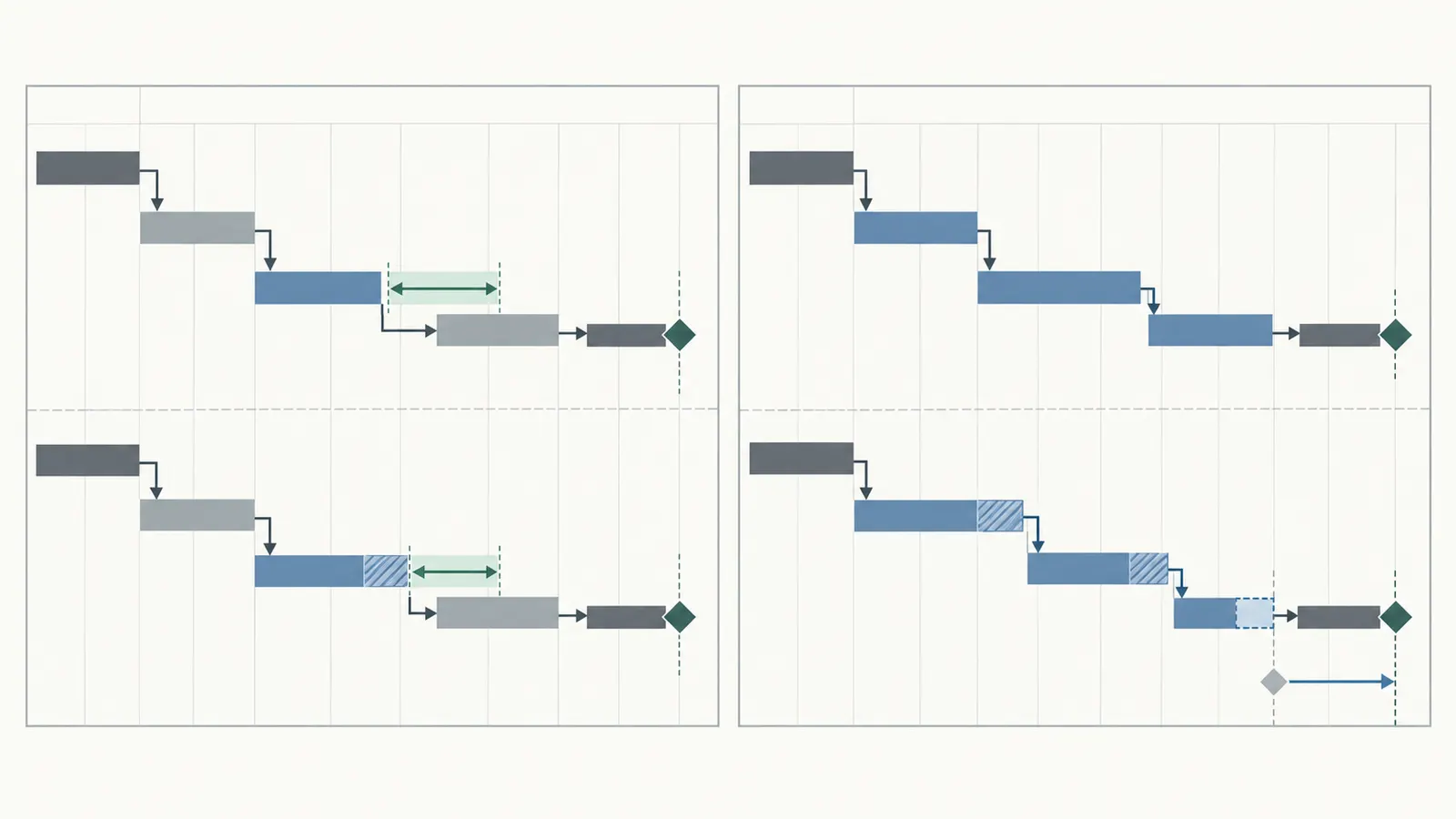
Control 5: money, liquidated damages and termination need separate review
Compare schedule relief with financial consequences. A clause may grant an extension but still allocate temporary housing, storage, loan-extension interest, insurance, supervision or other costs in a different section. A liquidated-damages provision may depend on the contract completion date and approved extensions. A termination-for-convenience provision may use a separate fee. Do not infer the result from the delay paragraph alone.
AIA's A101 public instructions show this separation: they discuss the commencement and substantial-completion fields, liquidated damages and bonuses or incentives as separate contract inputs, and advise attorney drafting for liquidated-damages provisions. The page is a document-completion guide, not legal advice for your project. AIA A101 instructions on time and liquidated damages
Ask a local attorney to review any clause that combines a fixed completion date with daily damages, bonus dates, owner financing commitments, rent exposure, acceleration rights, suspension rights, termination, waiver or a broad release. The homeowner's comparison worksheet should flag those provisions; it should not calculate a legal remedy.
4. Run the matrix on permits, selections, weather and lender handoffs #
Run at least four illustrative scenarios before signing: one owner decision, one authority dependency, one extraordinary event and one funding or external-party handoff. The point is to expose missing inputs and show how the same number of elapsed days can produce different schedule effects.
The examples below are modeled illustrations, not predictions, measurements or records from a real project. Each uses calendar days for simplicity. Replace every input with the contractor's baseline, the actual permit log, the actual selection request and the actual lender requirements before relying on the arithmetic.
Scenario A: late owner selection
Inputs
- Selection request for exterior door hardware issued complete on Day 42.
- Contract and schedule require the owner decision by Day 49.
- Owner responds on Day 56, seven calendar days late.
- The item has a 28-day fabrication and delivery period.
- Installation is on the controlling path to weather-tightness.
- Contractor documents a three-day resequence opportunity.
Illustrative calculation
gross selection slip = 7 calendar days
net extension = max(0, 7 − 0 float − 3 accepted recovery days) = 4 calendar days
The matrix should not stop at “owner delay: four days.” It should record the request, the dates, the item and approved submittal, the supplier's promised date, the activity ID, the resequence plan and the next handoff: the owner approves the hardware; the contractor confirms release and delivery; the schedule is updated with the revised weather-tightness milestone.
Sensitivity
| Owner response | Gross slip | Accepted recovery | Illustrative net extension if no float |
|---|---|---|---|
| Day 49 | 0 days | 0 days | 0 days |
| Day 53 | 4 days | 2 days | 2 days |
| Day 56 | 7 days | 3 days | 4 days |
| Day 60 | 11 days | 3 days | 8 days |
The sensitivity shows why a clause that says only “owner selections must be timely” is incomplete. The decision deadline, complete request, lead-time assumption, recovery record and critical-path test all matter. If the owner is waiting for a designer's unresolved option or for a lender allowance decision, classify that upstream handoff rather than automatically calling it an owner delay.
Scenario B: permit or inspection dependency
Inputs
- Baseline assumes a complete permit approval on Day 0 and site start on Day 15.
- The authority issues a correction request on Day 4.
- The designer answers on Day 10.
- The permit is issued on Day 22.
- The contractor's next available mobilization is Day 28.
- The initial schedule has two days of float before the foundation activity controls the path.
The arithmetic is:
permit issuance movement = 22 − 0 = 22 calendar days
For this illustration, the baseline site start is Day 15. If the permit is issued after that date, the contractor's next available mobilization is six calendar days after issuance; otherwise the baseline start remains Day 15. In formula form, next available mobilization = max(Day 15, permit issue day + 6 calendar days). Thus the Day 22 permit produces Day 28 mobilization, consistent with the input above.
mobilization movement against the baseline start = 28 − 15 = 13 calendar days
illustrative net completion movement before other mitigation = max(0, 13 − 2) = 11 calendar days
But that number is only a scenario output. The matrix must first identify the contract's permit duty, whether the application was complete, whether the correction belonged to the designer or contractor, whether the contractor could perform non-permit-dependent work, and whether the contract sets the start clock after permit issuance. In Utah's optional agreement, the contractor obtains required approvals and permits, the owner pays the stated costs, and commencement is set by a date or within 15 calendar days after necessary permits and approvals. That Utah allocation does not automatically apply in California or any other state. Utah's permit and commencement provisions
Sensitivity using the same mobilization assumption
The table applies that rule to every row: next available mobilization = max(Day 15, permit issue day + 6), then net movement = max(0, next available mobilization − Day 15 baseline start − 2 days of float). The six-day post-issuance availability is an illustrative contractor-scheduling input, not a legal rule or a prediction of an authority's process.
| Permit issue date | Next available mobilization | Movement against Day 15 baseline | Float | Illustrative net movement before recovery |
|---|---|---|---|---|
| Day 0 | Day 15 | 0 days | 2 days | 0 days |
| Day 15 | Day 21 | 6 days | 2 days | 4 days |
| Day 20 | Day 26 | 11 days | 2 days | 9 days |
| Day 22 | Day 28 | 13 days | 2 days | 11 days |
| Day 28 | Day 34 | 19 days | 2 days | 17 days |
The next decision is not “grant an extension” in the abstract. It is “which permit response, by which party, is needed now, and what non-permit work can be verified without creating rework?” The designer or permit professional should answer technical approval questions; the contractor should give the affected schedule and recovery path; the owner should preserve the authority records and have counsel review any legal allocation.
Scenario C: extraordinary weather event
Inputs
- Earthwork is scheduled for Days 70–78.
- A documented event makes the site unavailable for five calendar days.
- Two days of float exist before the foundation successor.
- The contractor can recover one day through a documented resequence.
- No other cause overlaps in this simplified example.
gross unavailable period = 5 days
net extension = max(0, 5 − 2 float − 1 recovery day) = 2 days
This is not a conclusion that the event qualifies for force-majeure treatment. The clause may define events, foreseeability, mitigation, notice, site conditions, seasonal assumptions and the difference between time and cost. The evidence bundle should include the event record, the affected activity, the contractor's safe work decision, the schedule update and the recovery proposal. Do not ask a homeowner to enter unsafe excavation, inspect unstable ground or direct work after a severe event; leave site safety and means-and-methods decisions to qualified professionals.
Sensitivity
| Unavailable days | Float | Recovery | Illustrative net movement |
|---|---|---|---|
| 3 | 2 | 1 | 0 days |
| 5 | 2 | 1 | 2 days |
| 7 | 2 | 1 | 4 days |
| 7 | 0 | 1 | 6 days |
The comparison question is whether the contract says what happens when the event affects one activity but not project completion. If the proposed clause automatically adds every weather day to the completion date, ask for the schedule test. If it excludes every weather day even when the contract assumes a particular season and the event closes a critical activity, ask counsel and the contractor to clarify the allocation.
Scenario D: lender or draw handoff
Inputs
- The contractor's next funded activity requires a draw inspection and owner payment.
- The draw request is complete on Day 100.
- The inspection occurs on Day 104.
- Funding is available on Day 106.
- The contractor stops the affected activity on Day 101 because the contract makes payment a prerequisite.
- Two days of other work can continue but no other critical-path work is ready.
gross stop on controlling activity = 5 calendar days, Days 101–105
net extension before recovery = max(0, 5 − 0 usable float) = 5 days
The issue is not simply “the lender caused five days.” A lender may not be a party to the construction contract, and the homeowner may have duties to submit documents or fund payments. Utah's optional agreement explicitly says its performance dates are not binding on lenders and other non-parties unless the non-party separately agrees in writing. That is a Utah form provision; the broader planning lesson is to trace the lender dependency and avoid promising a date the lender has not accepted. Utah's external-party date provision
The next handoff is a written funding status, not a verbal promise. The owner confirms the lender's requirement and payment date; the lender confirms any missing item; the contractor updates the sequence and identifies work that can proceed safely; the schedule record states whether the completion milestone moved. Ask counsel to review any clause that tries to make the owner guarantee a lender's performance or that treats all funding interruptions as a contractor entitlement.
Scenario E: the same delay number, different path effect
Consider two events that each last four calendar days:
- Event 1: a countertop template is late, but the contractor completes painting, trim and exterior cleanup in the same period. The countertop has six days of float. The activity moves four days; the project completion forecast does not move.
- Event 2: a required structural clarification stops framing, and every weather-tightness successor depends on framing. There is no float. The project forecast moves four days unless an approved recovery plan changes the path.
The elapsed-time number is the same. The extension question is not. This is why “four days of delay” should always be paired with the affected schedule activity, float and successor logic. Remote article guidance cannot inspect the actual schedule or establish the critical path; ask the contractor for the schedule update and, when the financial or legal consequences are material, have the architect, owner's representative, scheduler or attorney review it.
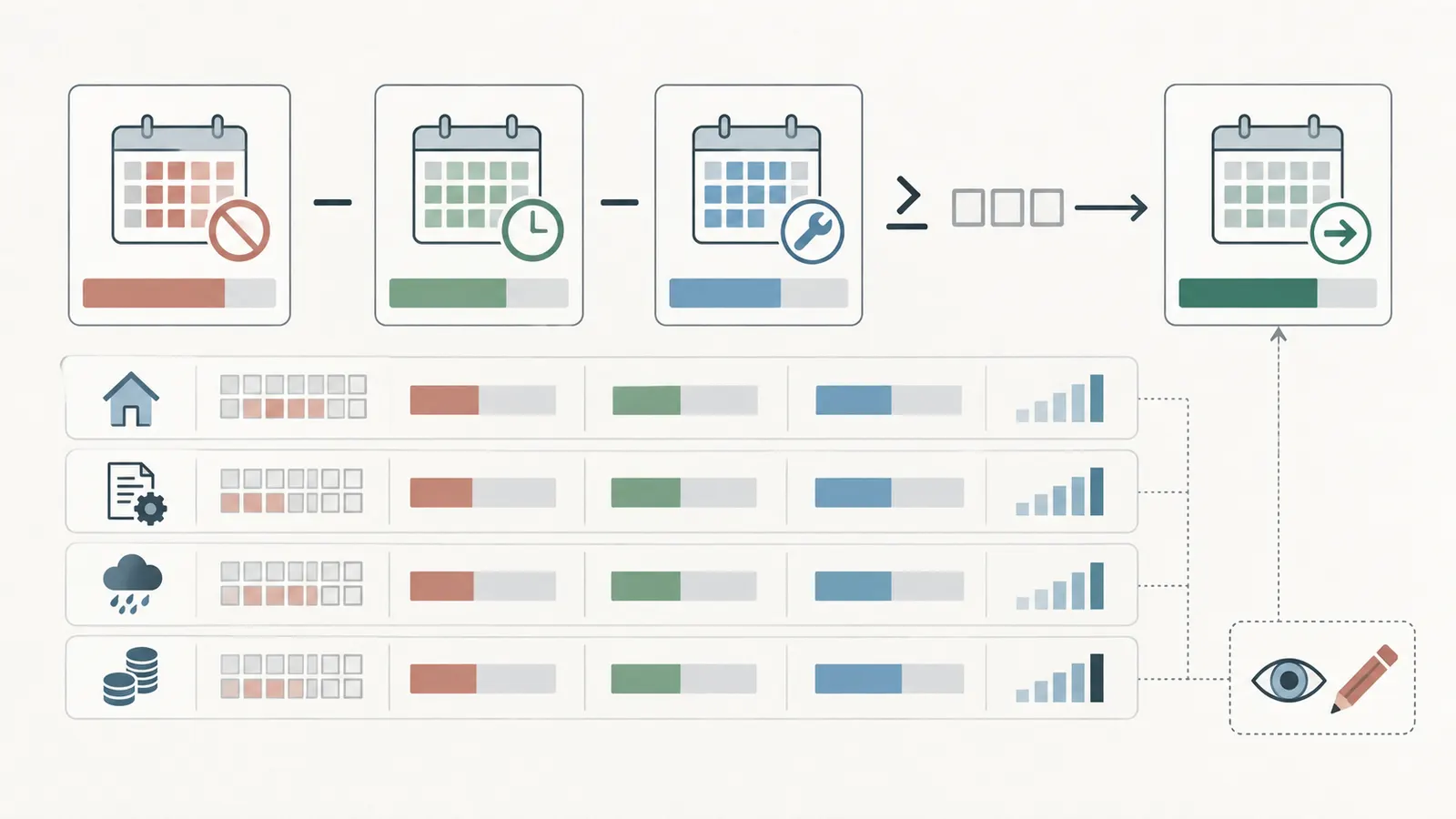
5. Verify Utah and California limits before signing #
Treat Utah and California as labeled examples, not a national contract law. In Utah, the public DOPL form is an optional starting point with concrete notice and extension language. In California, CSLB consumer guidance describes written home-improvement contract and change-order requirements within its scope. For a ground-up custom home in either state, confirm the actual agreement, project classification and current local rules with a qualified attorney.
Utah: use the DOPL form as a comparison source, not a substitute for counsel
The Utah Department of Commerce Division of Professional Licensing says its Residential Construction Agreement is intended for Utah residential construction projects, is optional, may be customized, and is not legal or professional advice. It also says questions about the agreement or its effect should go to an attorney. Utah DOPL's description and limits
For this decision, the Utah example is valuable because it places related controls next to one another:
- a schedule with subcontractor activities, material milestones and deadlines for owner decisions;
- a start date or start within 15 calendar days after required permits and approvals;
- an estimated substantial-completion date;
- an owner-caused delay provision tied to the duration of the delay;
- contractor notice within a reasonable time and no later than seven days after becoming aware of a delay;
- written change descriptions and a written cost-and-time estimate before proceeding, except for a safety or property-damage emergency;
- a signed change order documenting the change, additional cost and completion-date extension; and
- written notice methods and a stated rule for when notice is effective.
The point is not that every owner should adopt those words. The point is that a homeowner can compare a proposed contract against a checklist that names who acts, what is written and how time changes. If the contractor proposes a different allocation, record it clearly and ask why it fits the project.
Utah's form also assigns permit and approval tasks and costs in a particular way, addresses inspections and tests, and separates owner selections from broader changes. Those provisions should be compared with the contractor's proposal, the permit expediter's scope and the owner's design agreement. If the project uses an architect, lender, HOA approval, utility provider or special district, list those dependencies even if they are not parties to the form.
California: distinguish CSLB home-improvement guidance from ground-up construction
California's Contractors State License Board says its home-improvement consumer guidance requires a written contract for home-improvement projects over $500 within that guidance's scope. It says the contract should identify who obtains necessary building permits and when the job will be finished, and that changes should be written. California CSLB contract guidance
CSLB's broader contract checklist says the contract should detail the work, price, payment timing, permit responsibility and finish date, and says a change to work, materials or the completion date should be recorded in a written change order with price changes. It also says a good contract includes warnings and notices about allowable delays. California CSLB's contract and binding-agreement checklist
The 2025 CSLB sample home-improvement contract shows the kind of record to compare: written authorization before changed work begins; a description of the change; the amount added or subtracted; and the effect on progress payments or the completion date. The sample is informational and carries its own limits. California CSLB's 2025 sample contract
Do not silently turn those pages into a statement that every ground-up custom single-family contract in California has identical requirements. The terms “home improvement,” “new construction,” “owner-builder,” “developer,” “residential property” and the contracting parties' roles can matter. Before signing a California custom-home contract, ask California counsel to confirm which CSLB guidance and statutes apply to the project and whether the proposed form satisfies the project's actual classification. The homeowner worksheet should label the source scope in the row rather than writing “California requires” without qualification.
AIA: use public guidance to map documents and roles, not to copy proprietary terms
AIA Contract Documents' public pages provide useful orientation for comparing a proposal that incorporates A101, A201 or related documents. AIA's public A201 instructions describe the general conditions as setting rights, responsibilities and relationships among owner, contractor and architect, and say the architect performs document-preparation and construction-phase duties even though the architect is not a direct party to the owner-contractor contract. AIA A201 public instructions
AIA's A101 instructions say the contract should enumerate the contract documents in detail, including optional documents incorporated by reference and additional documents. Use that as a document-control question: does the proposed contract identify every general condition, exhibit, schedule, drawing, specification, allowance, addendum, owner directive, insurance exhibit and change-order form that will govern the date? AIA A101 instructions on contract documents
AIA also warns that its documents may need modification for licensing laws, building codes, taxes, monetary terms, arbitration, indemnification and other state or local requirements, and encourages attorney review before completion or modification. That warning is relevant to a homeowner comparing standard forms: a recognizable form name does not prove local fit. AIA's warning about local modifications
Do not reproduce or alter copyrighted standard terms from a public summary. Record the document title, edition, incorporated sections and proposed modifications, then send the complete proposed contract to counsel and the project professionals who must administer it.
For every other state: use a local verification box
If the project is outside Utah or California, leave the jurisdiction row blank until verified. Record:
- state and local authority;
- project classification and property type;
- contractor licensing and consumer-contract guidance;
- required written contract fields, if any;
- change-order, completion-date, notice or allowable-delay rules that actually apply;
- permit and inspection responsibilities under the local process;
- lien, payment, arbitration, mediation, termination and liquidated-damages implications; and
- the name and date of the official source or attorney review.
Never use the Utah seven-day notice period as a national default. Never use California's home-improvement guidance to decide a ground-up custom-home issue without checking scope. A national article can provide a comparison method; it cannot fill a jurisdictional blank.
6. Turn the comparison into notice and record procedures #
The clause becomes useful only when the homeowner, contractor, designer and other participants can follow the same event procedure. Before signing, agree on the baseline file, the notice route, the schedule-update rhythm, the decision owner and the form that records a final extension.
The pre-signing packet
Assemble one controlled packet with version dates. It should include:
- Contract and incorporated documents. Save the complete proposed agreement, general conditions, exhibits, drawings, specifications, allowances, addenda, insurance requirements, schedule and change-order form. AIA's public instructions specifically emphasize enumerating contract documents; use that principle to find missing attachments. AIA A101's contract-document instructions
- Responsibility register. For each permit, selection, submittal, inspection, payment, design response and delivery, name the responsible person, the contracting party, the due date and the evidence of completion.
- Baseline schedule. Include the start trigger, calendar convention, substantial-completion milestone, final completion, critical activities, owner decisions, design responses, material milestones and permit assumptions.
- Notice register. State the required email or portal, backup recipient, method, response expectation, initial-notice deadline, update deadline and effective-time rule. Match the actual contract; do not invent a shortcut.
- Extension worksheet. Keep one row per potential trigger. Leave entitlement and remedy columns marked “counsel review” when the clause does not answer them.
- Decision log. Record each owner selection or approval with the request date, complete information date, due date, response date, cost allowance, schedule effect and next action.
- Jurisdiction note. Identify the actual state and local authority for permits, licensing and consumer-contract rules. Put Utah or California examples in a separate comparison column, never in the project-rule column.
The six-step event procedure
When a delay risk appears, use this sequence. It is an administrative workflow, not an instruction for the homeowner to direct construction operations.
Step 1: detect and preserve. Save the dated request, notice, authority message, delivery record, site report, schedule update or meeting record. Do not rewrite the original after the fact. Add a short factual note: what was expected, what occurred and what is not yet known.
Step 2: send the contract notice. Use the exact person and method in the contract. Name the trigger, affected activity, current known dates, potential completion effect, mitigation status and next update date. If the duration is uncertain, say so and ask whether the contract permits an initial notice followed by substantiation.
Step 3: verify the dependency. The contractor identifies the schedule activity and predecessor/successor logic. The designer verifies any design or code question. The permit professional verifies authority status. The owner verifies the decision or payment it owes. The lender verifies its document or funding requirement. No one should use the worksheet to sign off an engineering, code, safety or legal conclusion outside that person's role.
Step 4: update the forecast. Compare baseline finish, forecast finish without recovery and forecast finish with the proposed recovery. Show float, calendar convention and any overlapping cause. If the contractor's schedule is not detailed enough to test the path, mark “critical-path effect not verified” rather than guessing.
Step 5: agree the record. If the contract requires a change order or written extension, identify the revised milestone, number of days, cost effect, assumptions, affected documents and signatures. A schedule update can be attached; it should not silently replace the contract.
Step 6: hand off and recheck. Assign the next decision and date. Recheck the milestone at the next schedule update. Close the row only when the event, effect, response and revised date are recorded or counsel has directed another treatment.
The handoff table
| Participant | Safe information they can confirm | Information they should not invent | Next record |
|---|---|---|---|
| Homeowner | Decision date, payment submission, receipt of notice, preferred option, access or owner-provided information | Legal entitlement, code compliance, structural adequacy, safe means and methods or a contractor's critical path without schedule support | Dated decision, receipt, approval or question to counsel. |
| Contractor | Current schedule, affected activity, procurement status, recovery options, notice and cost/time estimate | A permit approval, legal conclusion, engineer's design or guaranteed authority date | Delay notice, schedule update, change proposal or recovery plan. |
| Architect/designer | Drawing status, response date, design coordination, permit-comment response and professional scope | Contractor's entitlement, lender decision or local legal interpretation outside the engagement | RFI response, revised drawing, design directive or confirmation of scope. |
| Permit expediter/authority | Application status, accepted date, comments, inspection status and official communication | Guaranteed approval date or a contractor's contractual remedy | Permit log, official notice or inspection record. |
| Lender | Draw requirements, inspection status, approval and funding confirmation | Completion-date promise unless it has agreed in writing | Draw checklist, approval, funding receipt or missing-item notice. |
| Attorney | Contract interpretation, local law, notice preservation, risk allocation and proposed redline | Site inspection, project schedule certification or engineering judgment without that scope | Written review comments and a decision record. |
The handoff is complete only when the recipient is named, the input is dated, and the next decision is clear. “Sent to the team” is not a reliable record if no one is assigned to answer.
Use a neutral file naming convention
Use names such as 2026-10-14-delay-notice-permit-correction.pdf, 2026-10-15-schedule-update-v03.pdf and 2026-10-16-owner-selection-exterior-hardware.pdf. Keep the original email or portal export, attachment and delivery record together. Preserve versions rather than overwriting them. This is ordinary project administration, not a claim that a file proves legal entitlement.
Common failure cases and repairs
“Force majeure covers everything unexpected.”
Why it fails: it hides whether the event is listed, whether it actually prevented performance, whether notice is timely, whether mitigation is required, and whether the remedy is time, money or both.
Repair: list the event families, notice clock, evidence, affected activity, mitigation and extension treatment. Have counsel review definitions and remedy language.
“The contract says the builder gets a reasonable extension.”
Why it fails: neither party knows whether reasonable means event duration, critical-path movement, a revised estimate or a negotiated number.
Repair: require a schedule update with baseline, forecast, float, recovery and proposed net days, plus a written approval mechanism.
“The owner signed the selection late, so every late day is automatically owner delay.”
Why it fails: the request may have been incomplete, the contractor may have missed procurement, the item may have float, or the designer may have delayed the option.
Repair: record request completeness, due date, response date, procurement chain and critical-path effect.
“The permit was late, so the contractor is responsible” or “the city caused it, so nobody is.”
Why it fails: permit responsibility may be allocated in the contract; a correction may be caused by design; the application may not have been complete; and the parties may have had work available elsewhere.
Repair: preserve the permit log, identify the assigned coordinator, separate authority timing from party performance and update the sequence.
“The supplier is late, so the clause ends the analysis.”
Why it fails: the contractor may have ordered late, the owner may have approved late, the product may be an owner-selected long-lead item, or a permitted substitute may exist.
Repair: compare submittal approval, purchase date, promised delivery, actual delivery, damage or substitution record and available recovery.
“A lender promised the date.”
Why it fails: the lender may not be a party, and its draw process can depend on a third-party inspection, lien waiver or document condition.
Repair: list lender assumptions separately, make the owner responsible for the documents the owner controls, and do not make a completion date depend on an unaccepted third-party promise.
“A weekly schedule changed, so the contract changed.”
Why it fails: forecasts and contractual amendments are different records.
Repair: require the schedule update and the contract's named extension or change-order mechanism to agree.
“Everyone agreed in a meeting.”
Why it fails: later participants may not know the date, scope, price or time effect, and some jurisdictions or contracts require writing.
Repair: send minutes that identify open items, then use the required written change or extension record. California CSLB guidance specifically emphasizes putting changes in writing within its home-improvement guidance. California CSLB on written changes
“The completion date is fixed, but the start date is flexible.”
Why it fails: the contract may create an impossible duration if permits, notice to proceed or owner prerequisites move.
Repair: coordinate start trigger, duration, completion date and extension events in one example calculation before signing.
“The delay notice is just an email.”
Why it fails: the contract may require a particular recipient, method, content or delivery proof.
Repair: test the actual notice route with a non-substantive draft and confirm receipt. Do not treat the test as a notice of a real event.
“The homeowner can inspect the site to decide whether work is safe.”
Why it fails: construction sites can involve excavation, unstable ground, falls, electrical hazards, moving equipment, structural work, pressure, contaminants and confined spaces.
Repair: collect records from a safe location and assign site safety, engineering, code and means-and-methods decisions to qualified professionals. The contract-comparison worksheet cannot make a site safe or approve work.
7. Decide what to clarify, accept or send for review #
Sign only after each material delay row has a visible owner, notice path, evidence rule, schedule test and next decision—or after a qualified local attorney has told you what uncertainty remains and you have consciously accepted it. A clear risk allocation is not the same as a favorable one; the homeowner needs to understand both the cost and the control that the clause creates.
Green: the clause is administratively usable
Mark a row green when all of these are true:
- The trigger is observable and scoped.
- The responsible party and contracting agreement are identified.
- The notice clock, recipient, method and effective time are stated.
- The required evidence is practical to create.
- The schedule activity and critical-path test are named.
- The extension rule distinguishes activity delay from project-completion movement.
- Time-only, cost, acceleration, suspension, termination and liquidated-damages consequences are addressed elsewhere or clearly marked for counsel.
- The next handoff and approval record are named.
Green does not mean the clause is legally valid or economically favorable. It means the project team can administer the question without guessing.
Amber: clarify in the contract and schedule
Mark a row amber when the concept is understandable but one operational control is missing:
- “Prompt notice” has no outer limit.
- The contract says “completion” but does not distinguish substantial and final completion.
- Weather is listed without the affected activity, season assumption or critical-path test.
- Owner selections have no complete-request date or decision deadline.
- The contractor must obtain permits but the owner pays them, with no rule for corrections, authority delays or incomplete applications.
- Materials have lead times but no approval, ordering or substitution path.
- Lender draws appear in the schedule but the lender is not a party and has not accepted the dates.
- The notice method names an email address that is not monitored or an individual who may leave the project.
- A change-order form captures price but not the completion-date effect.
Ask for a redline, a schedule revision and a worked example. Do not agree to “we will handle it in practice” when the issue affects temporary housing, a rate lock, a sale of another home, a school move, a storage contract or a lender commitment.
Red: pause and obtain professional review
Stop the signing decision and obtain legal review when any of the following is true:
- The contract has a fixed date and daily damages but no usable extension process.
- A broad force-majeure clause can change price, time or termination without notice or evidence.
- The contractor can extend time unilaterally, or the owner can demand acceleration without price and safety review.
- The contract waives all claims for late notice, even when the event could not reasonably be quantified immediately.
- The proposed form incorporates documents you have not received.
- The schedule conflicts with the payment, inspection, permit or owner-decision provisions.
- The contract makes the owner responsible for a designer, lender, authority or supplier without explaining the handoff and remedy.
- The proposed standard form has been modified for local licensing, code, arbitration, indemnity or payment terms but no local attorney has reviewed it.
- The project has unusual site conditions, complex financing, a strict move-in commitment, a large liquidated-damages exposure or an owner-builder structure.
AIA's public guidance itself warns that standard documents may need modification for state and local requirements and encourages attorney review before completing or modifying them. That is a useful red flag for any standard-form comparison, not a claim about your state's law. AIA on local modifications and attorney review
The final pre-signing worksheet
Copy this table into your review file and complete one row per trigger. A blank cell is a decision to make, not a neutral result.
| Trigger and contract section | Party and agreement | Notice clock, recipient and method | Evidence | Affected activity and float | Gross days | Recovery days | Net completion effect | Time/cost treatment | Next decision and date | Status |
|---|---|---|---|---|---|---|---|---|---|---|
| Owner selection | ||||||||||
| Permit or inspection | ||||||||||
| Design information | ||||||||||
| Material or supplier | ||||||||||
| Contractor performance | ||||||||||
| Weather or extraordinary event | ||||||||||
| Lender or funding | ||||||||||
| Concurrent or unclear cause |
For each row, write the formula in plain language. For example: “The activity forecast moves from Day 90 to Day 97; two days of float and one accepted recovery day remain; illustrative net movement is four days.” If the calculation cannot be made because the schedule, notice, or responsibility is missing, write not verified and send that gap to the contractor, designer or attorney who owns the answer.
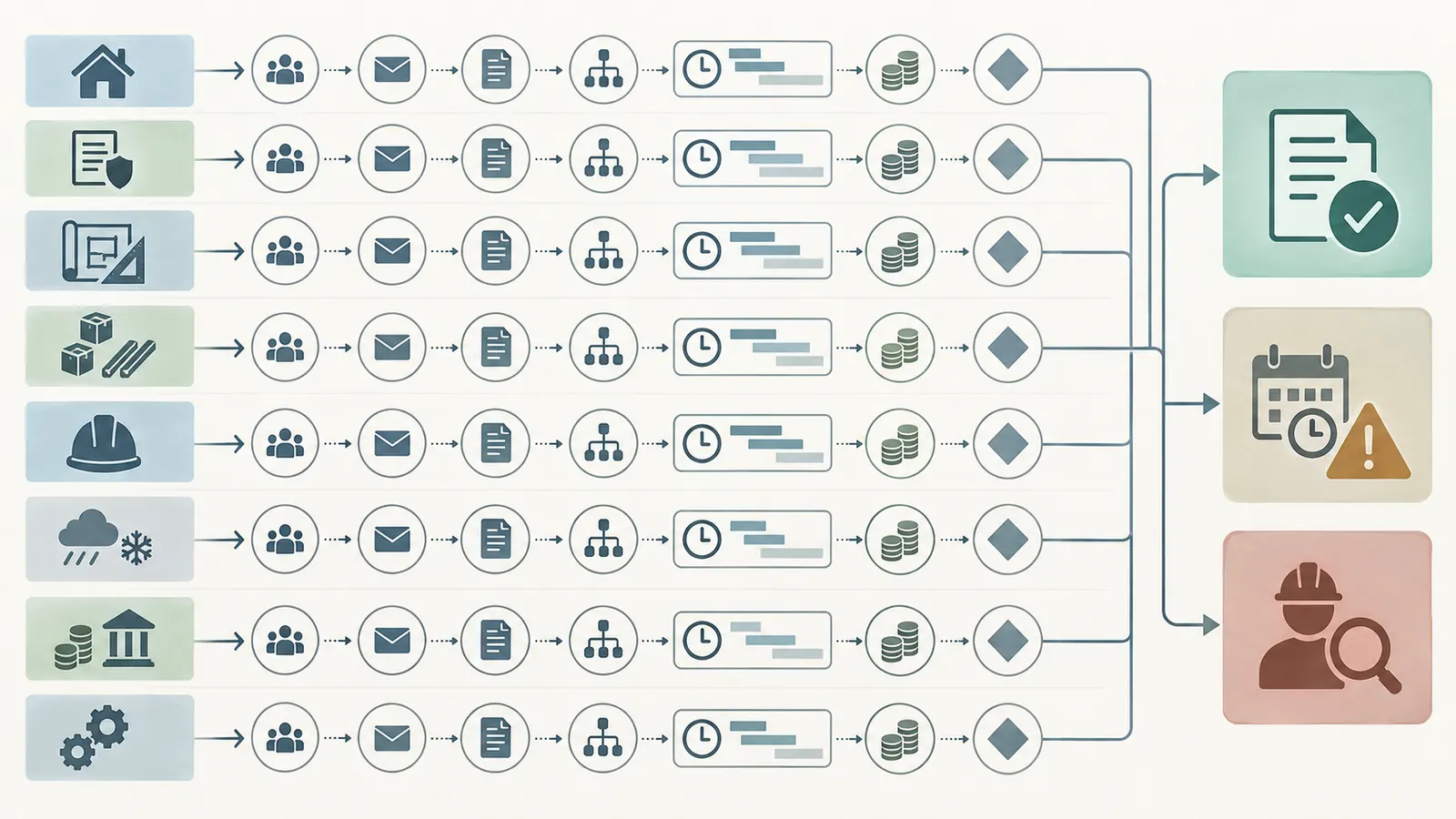
What to bring to a professional
Bring the complete proposed contract, every incorporated exhibit, the baseline schedule, the change-order form, the permit log, the design agreement, the lender draw requirements, the allowance and selection schedule, and your filled matrix. Mark the clauses that control your actual risk: completion date, notice, allowable delays, force majeure, changes, payment, suspension, termination, damages, dispute resolution and document precedence.
Ask the attorney for a jurisdiction-specific answer to these questions:
- Which contract and consumer-protection rules apply to this project classification and location?
- Does the proposed completion-date and extension language work together?
- What notice failures could waive a claim or defense, and can the contract preserve an initial notice while facts are still developing?
- Does the proposed allocation distinguish time, cost, acceleration, suspension and termination?
- How should designer, lender, permit and supplier dependencies be coordinated across separate agreements?
- Are any liquidated-damages, arbitration, indemnity, lien, insurance or payment provisions inconsistent with local requirements?
Ask the architect, owner's representative or scheduler a different set of questions:
- What activities control the current substantial-completion milestone?
- Which owner decisions, permits, design responses and materials are predecessors to those activities?
- What float exists, and how was it measured?
- Which recovery options are feasible without directing unsafe work or compromising quality?
- Which date is verified, which is an estimate and which depends on a third party that has not accepted the schedule?
Ask the contractor to answer operational questions:
- Who sends each notice and who receives it while the project team changes?
- What record will be created when a late selection, permit comment, delivery problem or weather event first appears?
- How does the contractor distinguish an activity delay from a project-completion delay?
- Which changes require a signed change order before work proceeds, and what happens in an emergency involving safety or property damage?
- How will the schedule and the contract record stay synchronized?
The next decision is then concrete: sign the clarified contract and baseline schedule, hold the signature while a specified redline is resolved, or obtain local professional review before choosing. That is the value of the matrix. It does not tell you that a contractor will win or lose a future delay issue. It tells you exactly which unanswered dependency would make signing premature.
Safety and remote-assessment boundary
This is a moderate-safety decision because schedule pressure can encourage unsafe site access, rushed excavation, structural changes, electrical work, work at height, equipment movement, exposure to contaminants or entry into confined spaces. A homeowner can safely organize documents, record dates from a safe location, ask for professional reports and compare contract language. A homeowner should not enter a restricted site, direct a contractor's means and methods, approve structural or electrical changes, decide that ground or weather conditions are safe, or treat a remote schedule review as an inspection or engineering sign-off.
For local permitting and construction rules, verify the state, municipality and other authority where the project is located; that is not necessarily the homeowner's residence, contractor headquarters or lender location. Contract choice-of-law, venue, licensing, lien, arbitration and other legal issues can differ from the project's local permitting rules and require review by counsel qualified for the relevant jurisdiction. Utah provisions cited here are Utah examples. California CSLB provisions cited here are California consumer guidance with a stated home-improvement scope. Other states and local authorities may use different rules. Verify the current rule and have the actual contract reviewed before signing when the consequence is material.
The decision in one page
The clause is ready for a practical signing decision when the schedule has a real start trigger and completion milestone; every owner, contractor, designer, permit, material, lender and extraordinary-event dependency has a responsible party; notices can be sent and proved; evidence shows both the event and the schedule effect; extensions use transparent critical-path logic; and time, cost, payment, acceleration, suspension, termination and damages are separately visible.
If any material row is blank, do not fill it with a generic force-majeure label or an optimistic verbal promise. Mark it amber for contract clarification or red for local professional review. Then record the next handoff and date. A homeowner who can answer “what happens next, who owns it, and what document proves it?” is in a much stronger position to choose a contract before construction starts.
Cite this guide
Brictale. “How to Compare Contractor Delay and Time-Extension Clauses Before Signing a Custom Home Contract.” Published 2026-09-25; updated 2026-09-25.
https://brictale.com/build/contractors/compare-contractor-delay-time-extension-clauses-custom-home-contract · Read the Markdown version
Original contribution: Delay-allocation and extension worksheet. A pre-signing matrix that connects each delay trigger to the responsible party, notice clock, evidence, critical-path effect, extension math and next handoff.
Sources and scope
Evidence behind this page
- Utah DOPL describes its Residential Construction Agreement as an optional, customizable starting point for Utah residential construction projects and says it is not legal or professional advice.
Residential Construction Agreement — Utah Division of Professional Licensing
Utah; the agency's optional form and its stated limits, not a national rule or a conclusion about a particular custom-home contract.
Accessed · Link to this claim - The Utah optional agreement provides for a stated start date or commencement within 15 calendar days after required permits and approvals, an estimated substantial-completion date, and a written schedule that includes subcontractor activities, material-delivery milestones and owner-decision deadlines.
Residential Construction Agreement 2025-05-29, sections 4.1–4.3
Utah optional form; use only as an example of how a contract can expose schedule inputs and dependencies.
Accessed · Link to this claim - Under the Utah optional agreement, if the contractor becomes aware of a delay, the contractor is to notify the owner within a reasonable time and no later than seven days, identifying the necessary extension; an owner-caused delay extends substantial completion by the delay duration under that form.
Residential Construction Agreement 2025-05-29, sections 4.4–4.5
Utah optional form; not a general seven-day rule for all United States contracts.
Accessed · Link to this claim - The Utah optional agreement calls for a written description of a change, a written estimate of cost and time impact before proceeding except for a safety or property-damage emergency, and a signed change order documenting the change, added cost and substantial-completion extension.
Residential Construction Agreement 2025-05-29, section 5.2
Utah optional form; a useful comparison structure, not a universal statutory procedure.
Accessed · Link to this claim - The Utah optional agreement assigns the contractor responsibility for obtaining required governmental, community or association approvals and permits, while assigning permit and approval costs to the owner and generally assigning required inspections and tests to the contractor with costs and fees paid by the owner.
Residential Construction Agreement 2025-05-29, sections 2.4.3–2.4.4
Utah optional form; parties can negotiate other written allocations and local permitting practice still must be verified.
Accessed · Link to this claim - The Utah optional agreement identifies written notice methods including personal delivery, email to the contract address, or certified mail, and specifies when those notices become effective.
Construction Contract — Utah Division of Professional Licensing
Utah optional agreement summary; do not assume another state or contract uses the same delivery method or effective-time rule.
Accessed · Link to this claim - Section 16.7 of Utah's optional Residential Construction Agreement identifies fire, earthquake, storm, flood, explosion, riot, war, terrorism, a legally declared emergency, or a similar event beyond reasonable control as Force Majeure Events; the affected party must notify the other party as soon as practicable of the event and its impact and use diligent efforts to resolve resulting issues and perform to the extent reasonable. Sections 4.4–4.5 separately address owner-caused delay, contractor delay notice and documenting a completion-date extension by change order.
Residential Construction Agreement 2025-05-29, sections 4.4–4.5 and 16.7
Utah Division of Professional Licensing optional generic residential agreement; this is an example of that form's wording, not a national force-majeure definition or a conclusion about entitlement under another contract.
Accessed · Link to this claim - Section 5.1 of Utah's optional Residential Construction Agreement separately addresses an owner selection of an item listed in the plans that exceeds its allowance or estimated price, requiring the owner to pay the additional cost without a change order; section 5.2 separately requires a written description, a written cost-and-time estimate before proceeding except for a safety or property-damage emergency, and a signed change order for an agreed change.
Residential Construction Agreement 2025-05-29, sections 5.1–5.2
Utah Division of Professional Licensing optional generic residential agreement; it illustrates separate allowance and change procedures and does not make a time extension automatic or establish a rule for another jurisdiction.
Accessed · Link to this claim - The Utah optional agreement states that performance dates are not binding on inspectors, lenders and other non-parties unless separately agreed in writing by the non-party.
Residential Construction Agreement 2025-05-29, section 16.1
Utah optional form; used here to expose a handoff risk, not to decide responsibility in another contract.
Accessed · Link to this claim - California CSLB consumer guidance says a written contract is required for home-improvement projects over $500 within the guidance's scope, and says the contract should state who obtains necessary building permits and when the job will be finished.
California CSLB home-improvement consumer guidance; confirm with California counsel whether and how these requirements apply to a ground-up custom single-family contract.
Accessed · Link to this claim - California CSLB says that, within its home-improvement guidance, a written contract is required for all home-improvement projects over $500; the contract should give written direction about who will obtain necessary permits and provide a completion date; and changes to the contract must be in writing, with price or scope changes made by a written change order signed before the change.
What is a Contract? — California Contractors State License Board
California CSLB home-improvement consumer guidance; the page's $500 threshold and written-contract requirements are scope-limited and do not by themselves determine the rules for a ground-up custom single-family contract. Confirm project classification and application with California counsel.
Accessed · Link to this claim - California CSLB guidance says that if work, materials or the completion date changes, the change should be written in a change order with price changes, and its 2025 sample contract describes written, signed authorization before changed work begins and requires the scope, price effect and completion-date or progress-payment effect.
Sample Home Improvement Contract — California Contractors State License Board
California CSLB sample home-improvement contract; informational and not a substitute for counsel or a custom-home form.
Accessed · Link to this claim - California CSLB consumer guidance says a good contract should include warnings and notices about allowable delays and should be specific about the work, price, permit responsibility and finish timing.
California CSLB consumer guidance; it does not establish a national definition of allowable delay.
Accessed · Link to this claim - AIA describes A201 as setting rights, responsibilities and relationships between owner, contractor and architect, with the architect involved in document preparation and construction-phase duties even though the architect is not a direct party to the owner-contractor contract.
AIA's public description of its A201 family; it is a standard-document orientation, not a free contract or legal rule.
Accessed · Link to this claim - AIA's public instructions for A101 identify commencement as potentially tied to the agreement, an owner-issued notice to proceed or another agreed method, and describe substantial completion as a specified date or a number of days from commencement.
AIA A101 public instructions; use as a comparison of date mechanisms, not as a statement that an AIA form governs a project.
Accessed · Link to this claim - AIA's A101 instructions say the contract documents should be enumerated in detail, including optional incorporated documents and additional documents that form part of the contract.
Instructions: A101–2017, Article 9 — AIA Contract Documents
AIA A101 public instructions; supports a document-control check, not a state-law conclusion.
Accessed · Link to this claim - AIA cautions that its documents may require modification for professional or contractor licensing laws, building codes, taxes, monetary terms, arbitration, indemnification and other state or local requirements, and encourages attorney review before completion or modification.
Instructions: A201–2017, Important—Modifications — AIA Contract Documents
AIA public warning; used to reinforce local legal review rather than to supply a legal rule.
Accessed · Link to this claim