How to Verify a Construction Loan Payment Disclosure Against the Draw Schedule
Reconcile construction-loan advances, interest, reserves, maximum payment, permanent conversion and lender documents before signing.
The short answer
Build one dated draw schedule from the lender’s commitment, plans, budget and agreement; identify whether interest is charged on actual advances or the full commitment; then recalculate the disclosed construction payment, maximum payment, reserve and permanent-phase assumptions. Compare the results with the Loan Estimate, Closing Disclosure and conversion terms. Any unexplained mismatch is a written lender question before signing, not a number to silently adjust.How to Verify a Construction Loan Payment Disclosure Against the Draw Schedule
Before signing, build one dated draw schedule from the lender’s commitment, budget and construction-loan agreement; identify whether interest is charged on actual advances or the full commitment; then recalculate the construction payment, reserve and permanent-phase assumptions. Compare those results with the Loan Estimate, Closing Disclosure and conversion terms. Any unexplained mismatch is a written lender question before signing, not a number to silently adjust.
This guide is for a homeowner in the United States evaluating a multiple-advance construction loan or construction-to-permanent loan before consummation. It is a document-review method, not personalized borrowing, refinancing, investment or tax advice. The federal disclosure references below are U.S. Regulation Z and CFPB guidance. Fannie Mae and Freddie Mac rules are investor-program requirements, not national law. No state, county or municipal rule is stated here. For the property’s actual state and local jurisdiction, ask the lender, settlement agent, title professional and, when needed, a qualified attorney how recording, lien, permit, occupancy and conversion requirements apply.
1. Define the audit decision before you compare numbers #
You are ready to compare a disclosure only when you can state which funds are committed, when each advance is expected, what balance earns interest, what payment is due in each phase, what could make that payment rise, and what must happen before permanent amortization begins. A construction loan is not a normal mortgage with one payment date: the lender may release money in stages, and the balance can change while the house is being built. The Consumer Financial Protection Bureau’s construction-loan explanation describes advances as typically occurring as construction progresses and notes that payment timing depends on the product.
The decision is not “Does the disclosed payment look reasonable?” It is:
“Can I trace every amount and date in the proposed payment disclosure to a term in the legal documents, a planned advance, a stated federal disclosure method, or an identified lender assumption—and do I know the next written question for every item I cannot trace?”
That wording matters because a disclosure can be accurate under an estimation method without being a forecast of your actual interest bill. Conversely, a number can look plausible while concealing a different interest basis, an interest reserve, a balloon payment, a draw fee, a maximum balance or a permanent rate that is not locked. Your task is to make the assumptions visible and ask the lender to confirm which ones apply to your transaction.
What the audit covers
The audit covers four linked surfaces:
- The project commitment. This is the total credit available, including the lot or land payoff, construction costs, lender fees financed, contingency and any reserve. The commitment is not automatically the amount that will be advanced or the balance on which interest will be charged.
- The construction cash-flow plan. This is the dated sequence of advances, the work or invoice each advance supports, any borrower cash contribution, inspection or approval gate, and the expected unadvanced remainder.
- The disclosure surface. This includes the Loan Estimate, Closing Disclosure, any addendum, the Loan Terms Table, Projected Payments Table, Adjustable Payment table, Loan Costs table and any separate construction-phase disclosure. The CFPB guide identifies the Loan Terms Table and Projected Payments Table as key places where loan amount, rate, payment, balloon and payment-change information appears. Read the CFPB’s construction disclosure guide for the field descriptions.
- The handoff to permanent financing. This is the construction period, conversion or modification date, permanent balance, permanent rate, amortization term, escrow or mortgage insurance assumptions, completion evidence and any requalification condition.
The compact originality brief
Current answers: Consumer explanations usually describe construction-loan types, interest-only periods, advances or conversion. CFPB material explains the disclosure mechanics, and Fannie Mae material explains investor delivery and completion requirements. Those sources are valuable, but they are not organized as a homeowner’s field-by-field reconciliation path.
Missing decision: The homeowner needs to know whether the proposed draw timing and project budget reconcile with both phases of payment disclosure, including the interest basis, interest reserve, maximum payment, fees and conversion conditions.
Original contribution: This page contributes a Draw-to-payment audit worksheet. It maps each input to a document, responsible party, verification record, failure branch, lender question and next handoff. It also shows an illustrative balance-times-rate-divided-by-12 calculation and sensitivity for a delayed draw, early full funding and a changed rate.
How it can be checked: A reader can reproduce every worksheet row from the signed or proposed documents, date each advance, use the contract’s day-count rule, compare the calculated result with the disclosure assumption, and retain the lender’s written explanation for each difference. The worksheet is a synthesis, not a measured study or firsthand lender test.
Method: Map each field to the Loan Estimate, Closing Disclosure, note, construction-loan agreement, draw procedures and completion requirements; then recompute illustrative balances and interest from dated advances using the contract rate basis and compare the result with the lender's disclosed assumptions.
Limitations: The worksheet is an illustrative review aid, not a lender quote, underwriting decision, legal interpretation, appraisal, tax opinion or prediction of a particular borrower's payment. The signed loan documents, applicable federal rules, lender procedures, investor requirements and the law of the property jurisdiction control.
Who is responsible for which fact
For the federal TRID disclosures discussed here, the creditor—not an undifferentiated “lender or broker”—is responsible for issuing the applicable Loan Estimate and Closing Disclosure under the transaction’s disclosure structure; the CFPB guide assigns those disclosure choices and timing duties to the creditor. See the CFPB’s construction-loan disclosure guide for the creditor’s disclosure options and timing. A mortgage broker may require or arrange services for consummation and may help gather or explain transaction information, but the guide’s separate reference to services required by a creditor or mortgage broker does not make every broker the disclosure issuer. See the guide’s Loan Costs discussion of services the creditor or mortgage broker may require. The creditor or lender should explain the interest basis, reserve treatment, payment assumptions and legal-document locations. The borrower is responsible for checking that the project the borrower intends to build is the project represented in the loan file and for raising questions before signing. The builder, general contractor or construction manager should provide a coherent cost-loaded schedule and identify what each draw pays. The settlement agent handles closing documents and funds according to the transaction instructions, but is not a substitute for the creditor’s explanation of underwriting or payment assumptions. The appraiser or completion professional supplies valuation or completion evidence when required by the loan program; the appraiser does not certify that the borrower’s entire financing plan is affordable.
Do not assign one person responsibility for everything. A builder can explain why framing is scheduled before drywall, but usually cannot explain the legal meaning of an Adjustable Payment table. A lender can explain its interest basis, but should not be asked to certify that a draw is sufficient to finish a foundation or that a change order complies with a local building code. A homeowner can compare documents, but should not remotely approve structural work, electrical work, excavation or an occupancy decision.
Prerequisites and the document packet
Collect the following before attempting the arithmetic. Use the most recent version of each document and save the date received.
| Packet item | What to capture | Who can confirm it | Why it matters |
|---|---|---|---|
| Loan Estimate | Loan amount, rate, projected payments, closing costs, cash to close and any payment-change language | Lender or broker | Establishes the early disclosure baseline |
| Closing Disclosure, if issued | Final loan amount, payment table, costs, reserves, credits, cash to close and contract-detail references | Lender and settlement agent | Shows the pre-consummation final disclosure surface |
| Promissory note and riders | Rate, payment, interest-only period, maturity, late charges, balloon, rate changes and permanent terms | Lender; attorney for legal interpretation | The legal obligation outranks a worksheet assumption |
| Construction-loan agreement | Draw conditions, inspection, retainage, eligible costs, deadlines, interest basis, reserve and default provisions | Lender; attorney for contract questions | Defines how funds actually become available |
| Budget and cost breakdown | Lot, site work, permits, design, builder contract, allowances, contingency, owner purchases and taxes | Borrower, builder and lender | Tests whether commitment and draws cover the scope |
| Planned draw schedule | Advance date or stage, amount, payee or category, evidence and cumulative total | Builder and lender | Connects work sequencing to balance timing |
| Conversion conditions | Completion, occupancy, appraisal update, inspection, requalification, modification and date rules | Lender; local professionals for local requirements | Determines when and how construction becomes permanent |
| Program or investor addendum | Any Fannie Mae, Freddie Mac, FHA, VA, bank or credit-union conditions | Lender | Prevents an investor rule from being mistaken for a universal rule |
If you do not have the construction-loan agreement or note, stop at a preliminary comparison. Do not infer a rate basis from a marketing sheet. If you have only a Loan Estimate, mark the worksheet “preliminary” and ask what legal document will govern each unresolved term.
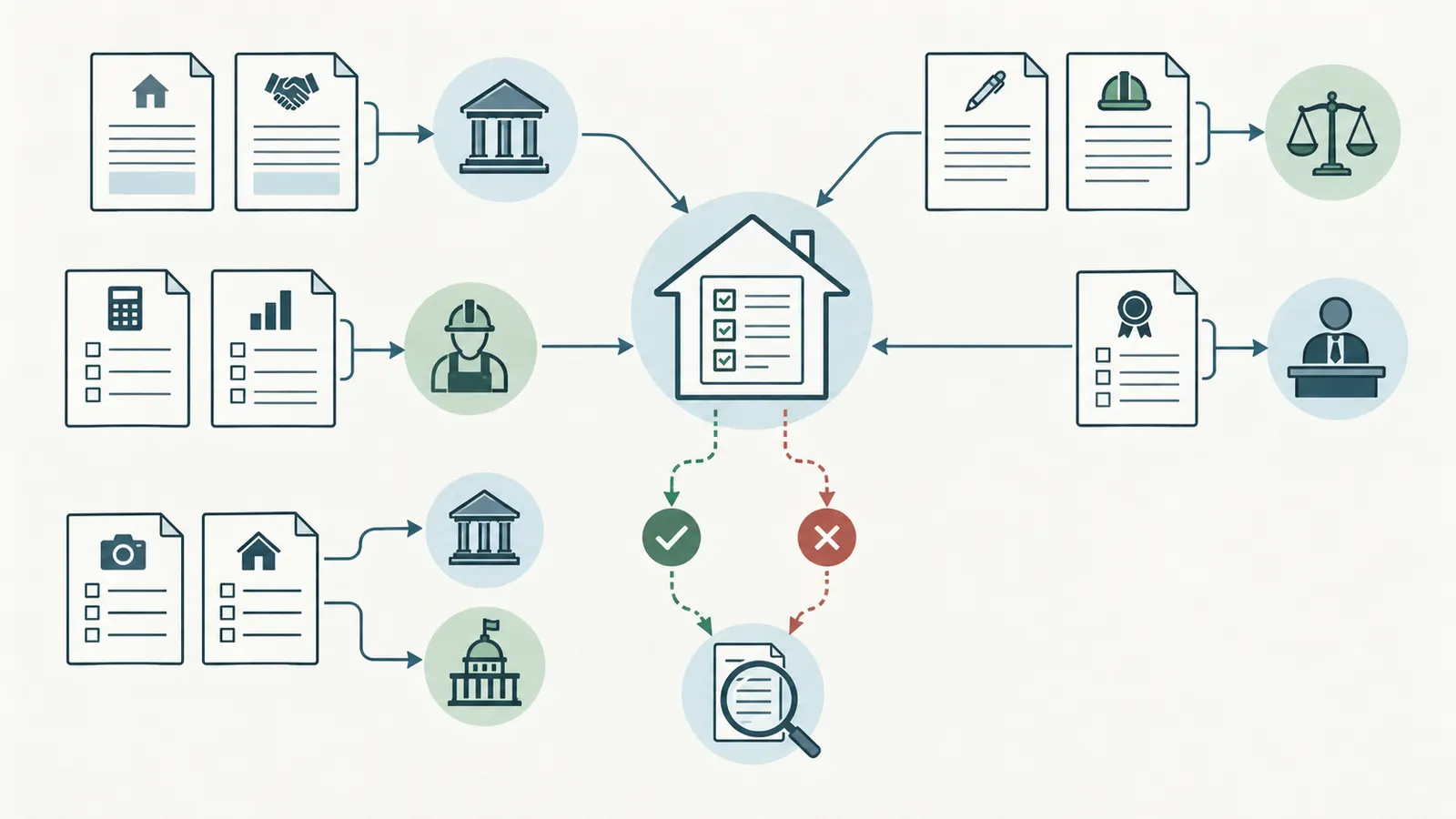
The next decision after this chapter is simple: either the packet is complete enough to map, or it is not. If it is not, send a short request: “Please provide the current construction-loan agreement, note and draw procedures, identify whether the construction and permanent phases are disclosed together or separately, and identify the interest basis and reserve treatment used for the payment figures.”
2. Build a dated draw schedule that can be audited line by line #
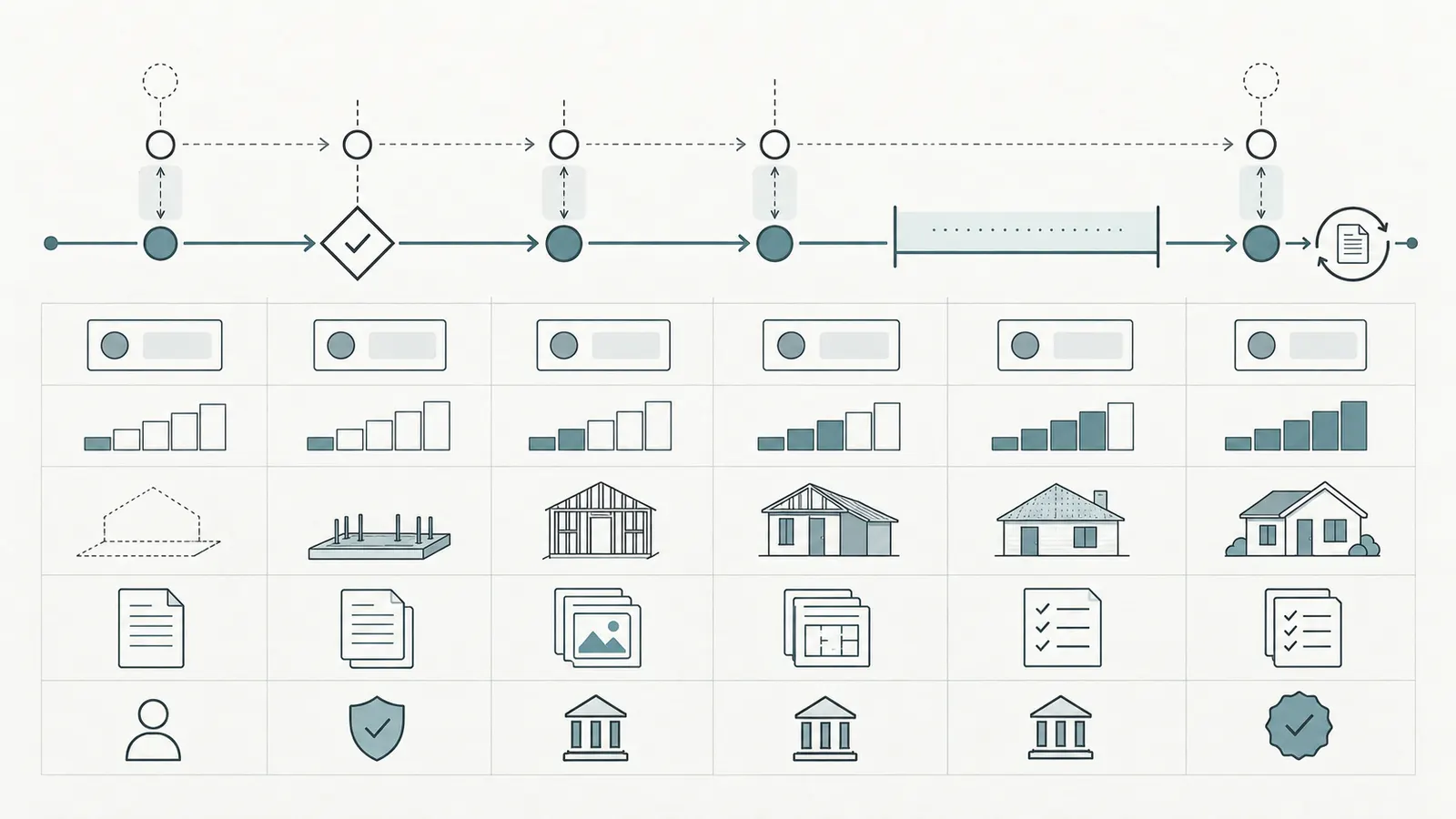
The draw schedule is the bridge between the project budget and the payment disclosure. It should show the amount expected to be advanced, the date or stage of the advance, the cumulative balance, the expected days outstanding, the work or cost supported, the required evidence and the person who approves the release. A list of construction stages without amounts and dates is not enough to audit interest. A list of dollar amounts without the work or approval gate is not enough to manage cash flow.
Start with the commitment, not the payment
Record the commitment as a set of components rather than one headline number:
| Commitment component | Illustrative input | Confirm from |
|---|---|---|
| Lot purchase or lot payoff | $120,000 | Purchase contract, payoff statement, Closing Disclosure |
| Site work and utilities | $58,000 | Builder/site contracts and allowances |
| Vertical construction | $282,000 | Executed builder contract and plans |
| Permits, design and inspections | $12,000 | Fee schedules, contracts and lender budget |
| Contingency or unallocated balance | $8,000 | Construction-loan agreement and budget |
| Interest reserve, if included | $0 or stated amount | Note, agreement and lender explanation |
| Financed lender or draw fees | $0 or stated amount | Loan Costs table, agreement and fee schedule |
| Total commitment | $480,000 illustrative | Lender’s commitment and closing documents |
Do not add these rows blindly. Some amounts are included in the commitment, some are paid in cash, some are financed, and some are held in a reserve account. A cost can therefore appear in the project budget without appearing as an advance, or appear in a disclosure category without being a construction draw. Ask the lender to identify whether each row is in the commitment, payable from proceeds, payable from borrower cash, or excluded.
The CFPB’s current Appendix D commentary says that, for certain construction transactions, construction costs are disclosed in the Closing Disclosure’s summaries of transactions and that proceeds placed in a reserve or other account may be disclosed separately or included with construction costs, subject to the disclosure options. Check the current Appendix D language before treating a reserve label as a second source of funds. The practical audit rule is to prevent double counting: every commitment dollar should have one status, and every planned cost should have one funding source.
Convert stages into events
Use an event row for each planned advance. A stage such as “rough-in” may require several payments, so split it when the lender’s procedures or the project cash flow split it. The row should include:
- event number and planned date or date window;
- construction milestone or invoice group;
- amount requested and amount actually expected to be released;
- cumulative amount advanced after the event;
- borrower cash paid before or alongside the event;
- interest-basis balance after the event;
- inspection, invoice, lien waiver, permit or other evidence required;
- responsible requester, reviewer, lender funder and person receiving the money;
- whether the amount is a draw, a reserve transfer, a fee, a retainage release or a change-order advance.
Here is an illustrative schedule designed to expose timing. It is not a quote, a typical project or a recommendation.
| Event | Planned timing | Purpose | Advance | Cumulative advances | Expected balance after advance | Evidence gate |
|---|---|---|---|---|---|---|
| 1 | Closing | Lot and permitted preconstruction costs | $60,000 | $60,000 | $60,000 | Settlement statement and lender funding confirmation |
| 2 | Month 3 | Foundation and below-grade work | $110,000 | $170,000 | $170,000 | Inspection, invoices and required waivers |
| 3 | Month 5 | Framing and roof dry-in | $140,000 | $310,000 | $310,000 | Progress inspection and builder documentation |
| 4 | Month 8 | Windows, exterior enclosure and rough systems | $90,000 | $400,000 | $400,000 | Inspection, invoices and change-order reconciliation |
| 5 | Month 10 | Interior completion and closeout | $62,000 | $462,000 | $462,000 | Completion package and remaining eligible costs |
| — | — | Unadvanced remainder or contingency | $18,000 | $462,000 | Not an advance until lender approves and funds it |
The schedule has two deliberate features. First, the $480,000 commitment is not the same as the $462,000 planned advances. Second, the timing leaves a large balance outstanding late in the build. Those facts change interest even if the final project cost does not change. A payment disclosure based on an assumed average or half commitment must be compared with the stated estimation method, not presented as the exact outcome of this schedule.
Use two balance columns when the reserve is unclear
Create separate columns for principal advanced for construction and amount held or used for an interest reserve. If the reserve is part of the commitment but not initially advanced for construction, do not silently place it in the same balance column. If reserve deductions are made from proceeds, note when the deduction occurs and whether the deducted interest itself increases the balance.
This is not a semantic exercise. The current Regulation Z Appendix D interest-reserve interpretation distinguishes between a creditor allowing the consumer to pay interest as it comes due and a creditor automatically deducting interest from a reserve. The latter treatment requires the disclosure calculation to reflect interest accruing on those interest payments as well as other proceeds. Your worksheet should therefore ask:
- Is the reserve part of the stated commitment?
- Is it funded at closing, funded through later advances, or only a bookkeeping limit?
- Who owns the reserve balance if the project finishes early?
- Does unused reserve money reduce the principal or become cash due at conversion?
- If interest is deducted automatically, does the deduction reduce the reserve only, or does it increase the loan balance?
- What happens if the reserve is exhausted before completion?
Get each answer in writing. A label such as “interest reserve,” “finance reserve,” “payment reserve” or “construction interest account” does not tell you the accounting treatment by itself.
Reconcile the schedule at each handoff
At the budget-to-lender handoff, the borrower and builder should agree that the draw schedule represents the current scope, including allowances and exclusions. At the builder-to-lender handoff, the builder should submit the documentation the agreement requires. At the lender-to-settlement handoff, the lender should state the amount approved, the date funded and the resulting balance. At the construction-to-permanent handoff, the lender should state which balance converts, what costs remain unpaid, and which completion documents are still missing.
For each handoff, save the before-and-after version. A later change order should not overwrite the original schedule. Add a new row, identify the funding source, record the approval date and show whether the change affects the maximum possible balance or completion date. This gives you a record of why a later payment can differ from the first disclosure without treating every change as an error.
The next decision is whether the schedule is known enough to use as the calculation basis or whether the lender is using an estimation method because timing or amounts are unknown. The CFPB guide explains that some construction loans require disclosures based on known disbursement timing and amounts while others require estimates when the schedule is unknown. Use the guide’s discussion of known and unknown advances as a question prompt for the lender.
3. Recalculate construction-phase interest using the stated basis #
Recalculate the construction phase only after the lender identifies the balance, rate and day-count basis. A simple monthly check is balance × annual rate ÷ 12, but it is an illustrative comparison unless the note actually uses monthly periods and that rate basis. The contract may use daily accrual, a 360- or 365-day convention, interest on the actual outstanding amount, interest on the full commitment, or a different treatment for fees and reserves.
The basic worksheet formulas
Write the formula next to the result so another person can reproduce it:
Monthly illustrative interest
monthly interest = interest-bearing balance × annual interest rate ÷ 12
Daily illustrative interest
daily interest = interest-bearing balance × annual interest rate × days outstanding ÷ day-count denominator
The denominator might be 360 or 365, but do not choose one because it is familiar. Copy the denominator and accrual convention from the note or construction agreement. If the rate changes, divide the period at the effective change date. If a draw occurs mid-month, use the lender’s stated posting and accrual rule rather than assuming the full month or no month.
For a reproducible daily-accrual check, use the actual date fields rather than only a month label. Record the planned or requested date, the date the lender funded the advance, the date it posted to the loan balance, the period-end date, the resulting days outstanding, the annual rate and the day-count denominator. In this illustrative check, assume a January 1, 2027 closing, advances posting on the dates shown, actual/365, and a period end at the next posting date. The dates and day counts are modeled inputs, not a lender statement.
| Accrual period | Funded / posting date | Period-end date | Days outstanding | Day-count denominator | Interest-bearing balance after posting | Illustrative daily formula | Illustrative interest |
|---|---|---|---|---|---|---|---|
| 1 | Jan 1, 2027 | Apr 1, 2027 | 90 | 365 | $60,000 | $60,000 × 8.25% × 90 ÷ 365 | $1,220.55 |
| 2 | Apr 1, 2027 | Jun 1, 2027 | 61 | 365 | $170,000 | $170,000 × 8.25% × 61 ÷ 365 | $2,343.90 |
| 3 | Jun 1, 2027 | Sep 1, 2027 | 92 | 365 | $310,000 | $310,000 × 8.25% × 92 ÷ 365 | $6,446.30 |
| 4 | Sep 1, 2027 | Nov 1, 2027 | 61 | 365 | $400,000 | $400,000 × 8.25% × 61 ÷ 365 | $5,515.07 |
| 5 | Nov 1, 2027 | Jan 1, 2028 | 61 | 365 | $462,000 | $462,000 × 8.25% × 61 ÷ 365 | $6,369.90 |
| Total | 365 | $21,895.73 |
The daily check differs slightly from the month-based illustration below because it uses actual day counts and a 365-day denominator. That difference is expected in a modeled example. Replace every date, posting rule, rate and denominator with the terms in the note. If the lender uses a 360-day basis, a fixed monthly accrual, or a different rule for the posting day, do not blend that rule with actual/365; rerun the rows consistently and ask the lender to explain any remaining difference.
Track at least these columns, and make every period endpoint explicit:
| Period | Explicit interval | Opening interest-bearing balance | New advance at interval start | Principal reduction or reversal | Rate | Months | Formula | Illustrative interest |
|---|---|---|---|---|---|---|---|---|
| 1 | Closing (Month 0) → Month 3 | $0 | $60,000 at Closing | $0 | 8.25% | 3 | $60,000 × 8.25% ÷ 12 | $412.50/month |
| 2 | Month 3 → Month 5 | $60,000 | $110,000 at Month 3 | $0 | 8.25% | 2 | $170,000 × 8.25% ÷ 12 | $1,168.75/month |
| 3 | Month 5 → Month 8 | $170,000 | $140,000 at Month 5 | $0 | 8.25% | 3 | $310,000 × 8.25% ÷ 12 | $2,131.25/month |
| 4 | Month 8 → Month 10 | $310,000 | $90,000 at Month 8 | $0 | 8.25% | 2 | $400,000 × 8.25% ÷ 12 | $2,750.00/month |
| 5 | Month 10 → Month 12 | $400,000 | $62,000 at Month 10 | $0 | 8.25% | 2 | $462,000 × 8.25% ÷ 12 | $3,176.25/month |
The table uses the balance immediately after each stated draw for the interval that follows it. The endpoints are Closing, Month 3, Month 5, Month 8, Month 10 and Month 12, so the periods are 3 + 2 + 3 + 2 + 2 = 12 months. A real audit should use the actual posting date and the contract’s accrual convention. For this illustrative schedule, the 12-month interest is:
3 × $412.50 + 2 × $1,168.75 + 3 × $2,131.25 + 2 × $2,750 + 2 × $3,176.25 = $21,821.25
The weighted average balance in this simplified example is $264,500, calculated as ($60,000 × 3 + $170,000 × 2 + $310,000 × 3 + $400,000 × 2 + $462,000 × 2) ÷ 12. The same result is therefore $264,500 × 8.25% × 12/12 = $21,821.25. This is a worked example, not a lender quote. It excludes taxes, insurance, mortgage insurance, loan costs, draw fees and any interest compounding or reserve treatment.
Compare the result with the federal estimation method, not with a promise
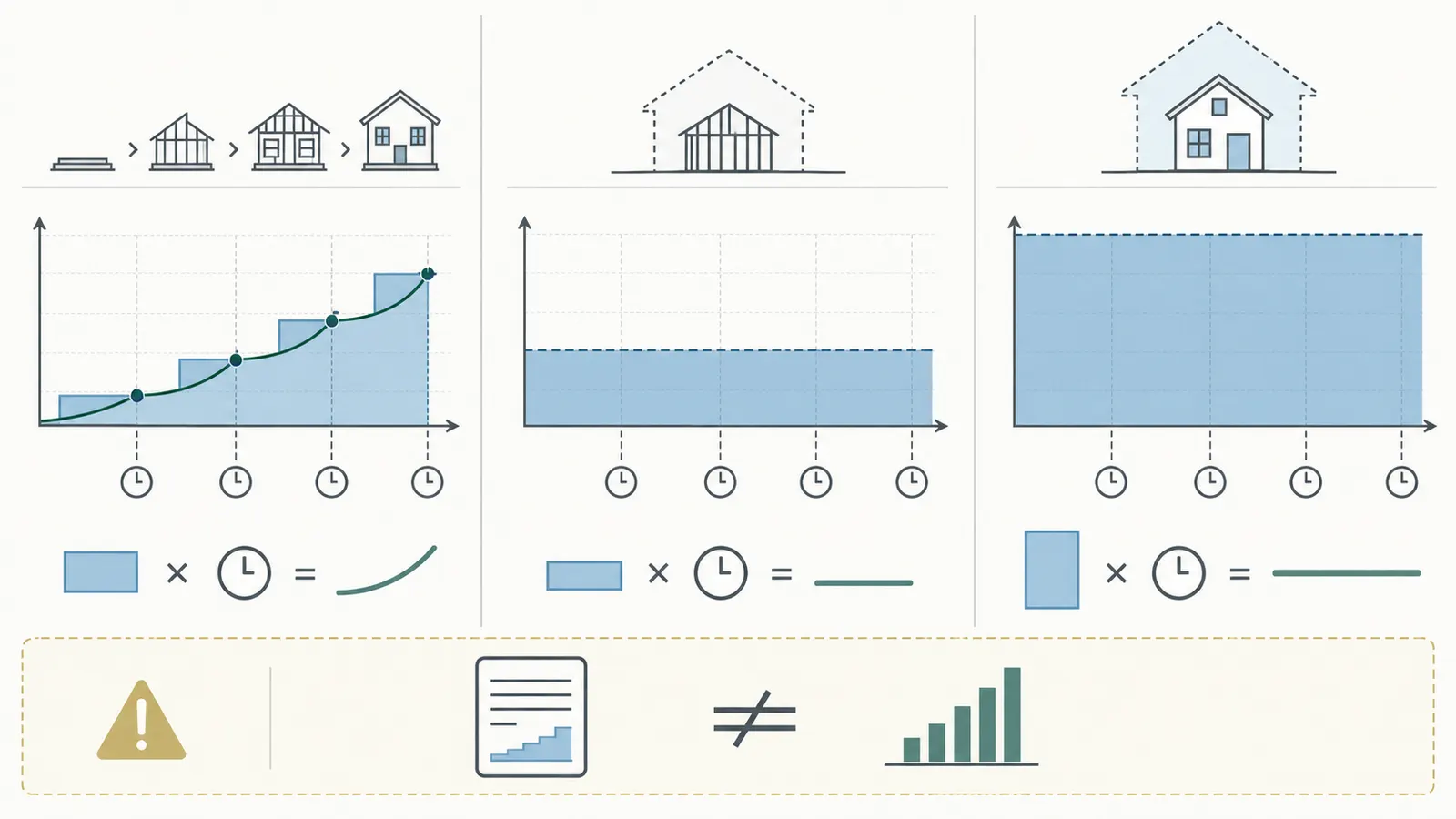
If the lender uses current Regulation Z Appendix D for an actual-advance construction loan whose timing is unknown, the construction interest estimate assumes one-half of the commitment is outstanding for the entire construction period. For the illustrative $480,000 commitment at 8.25% for 12 months:
$480,000 ÷ 2 × 8.25% × 12/12 = $19,800
That estimate is lower than the $21,821.25 produced by the illustrative staged schedule because the schedule’s weighted average balance is $264,500 rather than $240,000. The difference is $2,021.25. It does not mean the lender’s disclosure is wrong. It means you must ask whether the disclosure uses the one-half-commitment assumption, a known schedule, or another permitted method. The current Appendix D text expressly distinguishes the estimate for interest payable only on actual advances from the estimate for interest payable on the entire commitment.
If the lender charges interest on the entire commitment regardless of when money is disbursed, the same illustrative commitment produces:
$480,000 × 8.25% × 12/12 = $39,600
That is $17,778.75 higher than the staged schedule’s simplified interest. Again, the point is not to select the cheapest scenario. The point is to detect which economic rule the contract and disclosure use. Ask the lender to complete this sentence: “During construction, interest accrues on ______, beginning on ______, at ______, using ______ day-count, and advances or reserve deductions post on ______.”
Interest reserve: distinguish payment source from debt balance
An interest reserve can change what leaves your checking account without eliminating the financing cost. It may be a portion of the commitment designated to pay accruing interest. Under the current CFPB Appendix D interpretation, a reserve is not treated as a prepaid finance charge for disclosure purposes. When the creditor automatically deducts interest from the reserve, the calculation must reflect interest on those interest payments as well as on other loan proceeds.
For an illustrative reserve scenario, assume the $480,000 commitment contains an $18,000 interest reserve and $462,000 of non-reserve construction commitment. A simplified Appendix D-style base estimate at 8.25% for 12 months would be:
($462,000 ÷ 2) × 8.25% × 12/12 = $19,057.50
Do not treat this as the reserve amount or exact disclosed interest. It only demonstrates why “half the commitment” may need clarification when a reserve is carved out. If the lender’s written method separately models reserve-funded interest and interest on that deducted interest, its result may be higher. The current Appendix D commentary describes an additional compounding treatment based on first calculating interest exclusive of the reserve and then adding an amount based on half that interest being outstanding for the construction period. Ask the lender to identify the exact reserve formula rather than copying this simplified illustration.
Use three statuses in the worksheet:
- Borrower-paid interest: the borrower pays periodic interest from cash; the reserve is ignored in the Appendix D calculation when the creditor permits those payments as they come due.
- Reserve-paid interest: the lender deducts interest from a designated reserve; record the reserve balance after each deduction and ask whether the loan balance itself increases.
- Unclear: the documents use a reserve label without stating whether it is a commitment component, an advance, a payment source or a balance adjustment. This is a stop-and-ask condition.
Sensitivity 1: a delayed draw
Assume the $110,000 foundation-and-below-grade advance shown in Event 2 is delayed by three months while the lender continues to charge interest only on actual advances. For an isolated tranche comparison, the simple interest difference is:
$110,000 × 8.25% × 3/12 = $2,268.75
In this isolated sensitivity, delaying that $110,000 funding event reduces the time that tranche is interest-bearing by three months, so its simplified construction-interest contribution is lower by about $2,268.75. This is not a rescheduled-project total: if the delay moves framing or any later draw, shift those rows and recalculate the full schedule. A delay can also trigger standby costs, winter work, expired permits or price commitments, and a later concentrated draw can raise the payment near completion. If the contract charges on the full commitment, the delay may not change interest at all. If the lender treats the advance as approved on one date but funded on another, the posting rule controls.
The lender question is: “For interest accrual, is the draw date the date requested, approved, wired, posted to the loan balance or paid to a third party?” The builder question is: “What cost or schedule consequence follows if this draw is not available on the planned date?”
Sensitivity 2: early full funding
Assume the full $480,000 commitment becomes interest-bearing in month 1 at 8.25% for 12 months. The simplified interest is:
$480,000 × 8.25% × 12/12 = $39,600
Compared with the one-half-commitment estimate of $19,800, early full funding adds $19,800. Compared with the staged schedule’s $21,821.25, it adds $17,778.75. This is a deliberately visible upper-timing scenario, not a forecast. Ask whether the construction agreement permits or requires a large initial advance, whether funds are placed in an account before costs are incurred, and whether an undisbursed commitment can still accrue interest.
Sensitivity 3: a changed construction rate
Using the illustrative staged schedule’s $264,500 weighted average balance, a one-percentage-point increase from 8.25% to 9.25% changes the simplified 12-month interest by:
$264,500 × 1.00% × 12/12 = $2,645
If the construction rate is fixed, this sensitivity is not a prediction that it will change. If it is adjustable, identify the index, margin, first-change date, caps, floor and whether the permanent rate also changes. The current CFPB construction-loan guide explains that the Loan Terms Table includes the initial rate and whether the rate may increase, with additional adjustment details when applicable. Use that field map when checking the Loan Estimate and Closing Disclosure.
The next decision is whether the construction payment shown in the disclosure is a direct result of your known schedule, a federal estimation method, an adjustable-rate range, a reserve model or an unexplained lender calculation. Record the answer beside the number before moving to the permanent phase.
4. Reconcile the Loan Estimate and Closing Disclosure field by field #
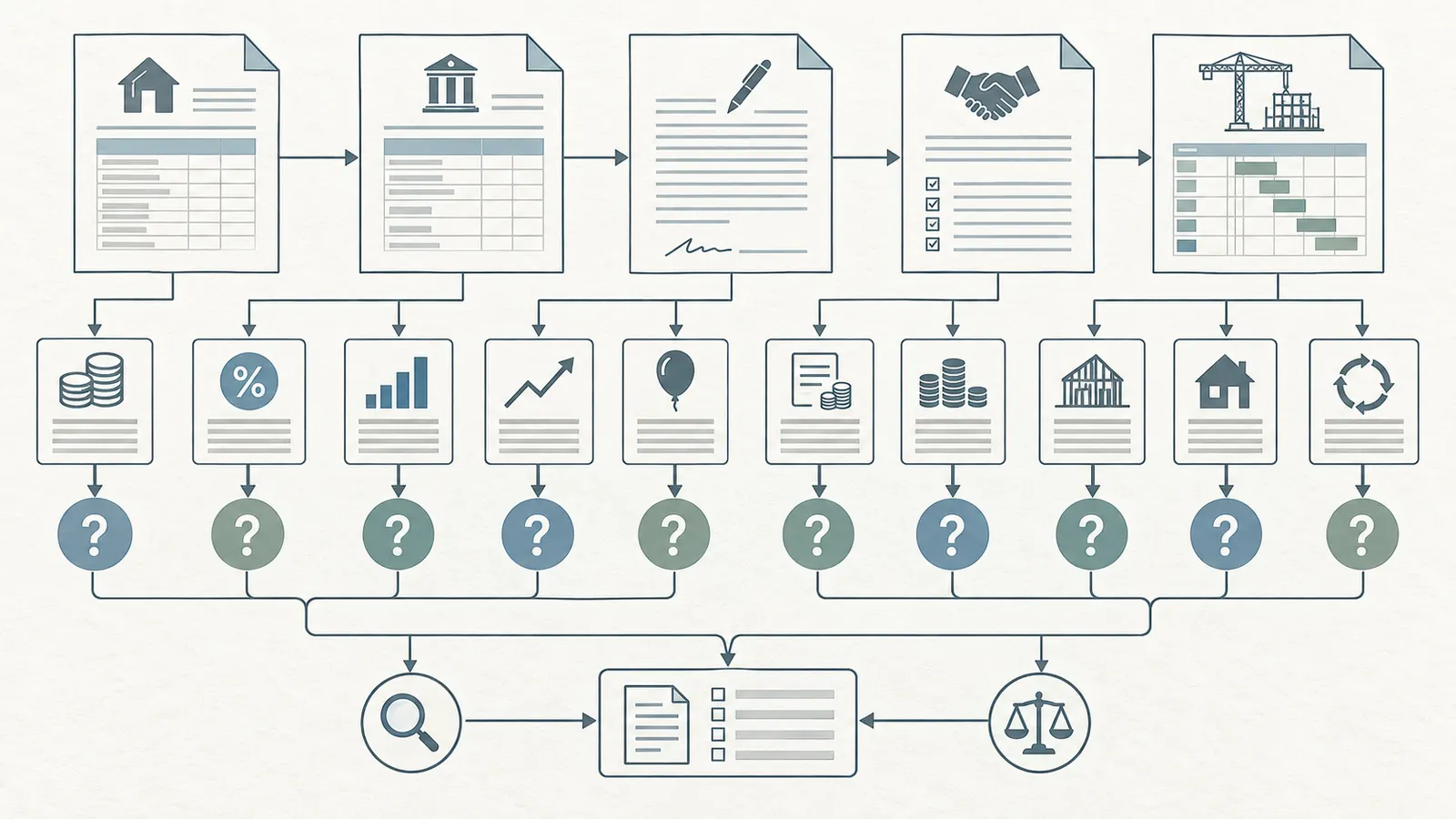
The Loan Estimate and Closing Disclosure should be read beside the note and construction agreement, not as substitutes for them. A disclosure tells you what the lender is required to present under the applicable disclosure framework; the note and agreement tell you the legal and operational terms. For construction-to-permanent financing, first determine whether the lender is presenting one combined transaction or separate construction and permanent transactions. Regulation Z permits those alternatives in applicable multiple-advance construction-permanent transactions. The CFPB guide explains the separate-versus-combined choice and its effect on the document set.
Start with the disclosure architecture
Write one of these labels at the top of the audit:
- Combined: one disclosure presents both construction and permanent phases.
- Separate phases: one set of disclosures presents construction and another presents permanent financing.
- Separate advances or other structure: the lender has chosen a more granular structure or supplied additional documents.
- Unknown: the documents do not make the structure clear.
Do not compare a construction-only payment from one document with a permanent principal-and-interest payment from another and call the difference an error. First identify the phase, number of payments included, payment start date and whether the table contains a balloon or a future conversion.
The CFPB’s TRID guide describes the Loan Terms Table as including the loan amount, interest rate, periodic principal-and-interest payment, prepayment penalty and balloon payment. It also explains that the Projected Payments Table includes principal and interest and may use multiple columns when payment changes or balloon payments trigger additional disclosures. These are the fields to capture, even if your lender’s layout or addenda differ.
Audit the loan amount and funds-to-project bridge
Compare these amounts in order:
- Total project cost in the lender’s budget.
- Lot price or lot payoff.
- Construction costs funded from the loan.
- Financed closing costs and construction inspection or handling fees.
- Interest reserve or other reserve account.
- Contingency and unallocated balance.
- Borrower cash contribution.
- Loan amount or commitment on the Loan Estimate.
- Loan amount and construction-cost line on the Closing Disclosure.
- Loan amount and maximum balance in the note and agreement.
Then write the bridge as an equation:
total project uses = loan-funded uses + borrower cash uses + other verified funds
and separately:
loan commitment = planned construction advances + financed fees + reserve or unallocated amount, subject to the agreement’s definitions
These equations are not legal formulas. They are a double-counting check. If the project budget includes $18,000 of contingency, the loan commitment includes $18,000 of contingency, and the draw schedule also adds $18,000 as a separate advance, ask which row is duplicated. If a reserve is disclosed separately from construction costs, verify that the construction-cost figure excludes the reserve where the applicable disclosure method requires that treatment. Current Appendix D commentary addresses this separate-label and no-double-counting issue. Review the reserve and construction-cost paragraphs directly.
Audit the construction payment
For the construction phase, record:
- first payment due date;
- payment frequency;
- interest-only or principal-and-interest status;
- initial disclosed rate;
- whether the rate can increase;
- balance assumed for the payment;
- whether the balance is actual advances, one-half commitment, full commitment or another method;
- reserve or automatic deduction treatment;
- escrow, mortgage insurance, taxes or insurance included or excluded;
- draw and inspection fees;
- final construction payment, balloon or conversion treatment.
If the construction payment is interest-only, do not use a fully amortizing mortgage calculator to “correct” it. If it is a range, do not replace the range with its midpoint. If the first payment is shown as $0 or omitted, ask whether interest is deferred, paid from a reserve, due at conversion or shown elsewhere. The current CFPB guide says that when a construction payment amount is unknown, the creditor may estimate it using the best information reasonably available or Appendix D. That is an instruction to identify the method, not permission to assume the lowest result.
Audit “Can this amount increase after closing?”
If the answer is “Yes,” copy every related bullet, timing statement and maximum amount into the worksheet. Do not record only the word “Yes.” Determine whether the possible increase comes from:
- more of the commitment being advanced;
- an adjustable construction interest rate;
- an adjustable permanent rate;
- a change from interest-only to amortizing payments;
- a reserve being exhausted;
- escrow or mortgage insurance beginning in a later phase;
- an extension, late draw or changed conversion date;
- a changed loan amount or other modified term.
The current Appendix D commentary states that when advance amounts or timing are unknown and the actual-advance assumption is used, the creditor discloses “Yes” to whether the amount can increase after closing and bases the maximum possible periodic principal-and-interest payment on the maximum principal balance that could be outstanding during construction. Use the current federal text for this specific maximum-payment check.
Your worksheet should therefore have two different numbers:
- Schedule payment: what the dated illustrative schedule produces under the stated rate basis.
- Maximum disclosed payment: what the lender says could occur under the legal obligation and applicable disclosure method.
They are not supposed to be identical. A schedule payment can be lower because draws are delayed or never fully used. A maximum payment can be higher because the commitment could be fully advanced or the rate could rise. The important question is whether the maximum is traceable to the contract and disclosure rule.
Audit balloon and conversion language
If construction-phase payments do not repay principal, identify whether the construction balance is due as a balloon, converted automatically, modified by agreement, or refinanced through a new application. A construction loan that does not automatically convert may require a new loan, depending on the lender and the borrower’s circumstances; the CFPB consumer explanation warns that choices depend on the lender and credit history. Treat conversion as a condition to verify, not a default assumption.
Ask the lender:
- Is the permanent financing a binding feature of this legal obligation or merely an option to apply?
- What date starts permanent interest and amortization?
- What balance converts if there is unused commitment, an unpaid change order or a reserve remainder?
- Is the permanent rate fixed now, fixed by a formula later, or adjustable after conversion?
- Can the construction period be extended, and what fee or rate applies?
- What happens if completion is earlier or later than the original date?
- Does the permanent phase require updated income, employment, assets, credit, appraisal or requalification?
- What event causes a failed conversion, and what payment becomes due then?
The next decision is either “all fields reconcile” or “return the disclosure for written correction or explanation.” A verbal assurance at a closing table is not a durable audit record.
5. Test the permanent payment and the conversion handoff #
The permanent payment must be checked against the balance, rate, amortization term and phase-start date that the legal documents actually establish. A construction payment based on interest-only advances cannot validate a permanent payment, and a permanent payment shown on a combined disclosure cannot tell you whether every completion condition has been satisfied. Treat the conversion as a new handoff with its own inputs and evidence.
Rebuild the permanent principal-and-interest payment
For a fixed-rate, fully amortizing illustrative payment, use:
P&I = L × [r(1+r)^n] ÷ [(1+r)^n − 1]
where L is the principal balance, r is the monthly rate, and n is the number of monthly payments. This formula does not include taxes, insurance, mortgage insurance, HOA charges, lender fees, reserves or other payment components.
Illustrative inputs:
- permanent balance
L = $480,000; - annual fixed rate
= 8.00%; - monthly rate
r = 0.08 ÷ 12 = 0.0066667; - term
n = 360monthly payments; - no taxes, insurance, mortgage insurance or escrow in this calculation.
The resulting illustrative principal-and-interest payment is approximately $3,522.07 per month. It is not a quote, and it is not evidence that the lender must use a $480,000 permanent balance. If the construction schedule leaves only $462,000 advanced, the permanent balance could differ. If financed fees or reserve-funded interest are added to principal, it could differ. If the permanent rate is not known, the displayed payment may be an estimate or a range under the disclosure method.
Run at least four balance cases:
| Permanent balance case | Why to test it | What to ask |
|---|---|---|
| Full commitment, $480,000 illustrative | Tests maximum planned principal | Does unused commitment cancel or convert? |
| Planned advances, $462,000 illustrative | Tests the current draw plan | Are all planned advances eligible and expected to fund? |
| Planned advances plus financed fees | Tests the actual note balance | Which fees are added to principal? |
| Planned advances less unused reserve | Tests early completion | Who receives unused reserve and how is balance recomputed? |
Do not present the highest case as the likely case or the lowest case as the affordable case. Put the assumptions beside each result and ask the lender which balance the payment disclosure uses.
Verify the rate path, not just the rate today
Copy the construction rate and permanent rate separately. Then mark each as fixed, adjustable, formula-based at conversion or unknown at consummation. For a formula-based rate, record the index, margin, adjustment date, caps, floor, rounding rule and any lock or float-down provision exactly as stated. If the permanent rate may adjust at conversion, it is not equivalent to a fixed rate shown elsewhere merely because the lender expects a similar market rate.
Current Appendix D commentary explains that if the permanent rate is unknown at consummation, certain construction-permanent disclosures describe the product as adjustable rate, even if the permanent phase will be fixed once the rate is set, when the legal obligation allows the rate to increase from the disclosure. Use the actual legal obligation and current federal rule when asking why a product is labeled adjustable.
The lender question should be precise: “Is the permanent rate in the note a number, a formula or a future lender option? What is the earliest date it can be set, what is the latest date, and what is the maximum rate and payment that the legal obligation allows?” If the answer depends on an investor guideline, ask which investor and whether the lender is obligated to sell or merely expects to sell the loan.
Check as-completed value separately from payment
An appraisal’s “as completed” value is not a payment disclosure, and a payment that fits your monthly budget does not prove that the collateral value supports the loan. For investor programs, the lender may need to verify both the project’s completion and the value or loan-to-value calculation. Fannie Mae’s single-closing guidance describes loan-to-value calculations using the purchase price or the “as completed” appraised value, depending on the transaction and applicable terms. Review the Fannie Mae rule only if your lender identifies a Fannie Mae delivery path.
Do not infer from that program-specific rule that every lender uses the same value formula. Instead, record:
- appraisal date and effective date;
- whether the appraisal is based on plans and specifications;
- as-completed value;
- purchase price or lot-plus-construction cost used by the lender;
- maximum LTV, CLTV or other ratio the lender applies;
- whether a value decline triggers a new appraisal or re-underwriting;
- who pays for an update and when it must be delivered.
Check completion evidence and local occupancy separately
The completion handoff has at least three different questions:
- Has the contracted scope been completed? This is supported by the builder, borrower, inspection or appraisal evidence required by the loan program.
- Has the lender received the evidence it needs to convert or deliver the loan? This is a lender and investor file question.
- Has the property satisfied the applicable local jurisdiction’s permit and occupancy requirements? This is a question for the authority having jurisdiction and the relevant local professionals; it is not answered by a payment disclosure or an investor guide.
Fannie Mae’s current completion guidance says that improvements ordinarily must be complete when the loan is sold to Fannie Mae and describes Form 1004D and permitted alternatives with visually verifiable exhibits. It also describes verification against plans and specifications for new or proposed construction. See the Fannie Mae completion requirements for the program-specific evidence path.
Freddie Mac’s current construction-to-permanent guidance likewise describes a file containing plans, specifications, receipts, invoices, lien waivers, a cost calculation and settlement disclosures for interim and permanent financing. This is an investor file requirement, not proof that a particular lender uses Freddie Mac. Use the Freddie Mac guide as a prompt to ask what cost and closeout records your lender requires.
The homeowner’s safe task is to collect records: the final approved plans, change orders, paid invoices, draw ledger, lien releases or waivers when required, inspection records, warranties, certificates and lender correspondence. Do not enter an active excavation, climb a structure, operate electrical equipment or perform a structural inspection to create evidence for the lender. A qualified local professional should perform hazardous work and any inspection or certification that the contract or jurisdiction requires.
Test whether an early or late finish changes the payment
Put the original conversion date and the contract’s date-adjustment language beside the planned completion date. If construction finishes two months early, ask whether permanent amortization begins two months early, whether the construction payment stops immediately, whether unused funds are canceled, and whether the permanent payment is recalculated. If construction finishes late, ask about an extension fee, construction-rate continuation, reserve exhaustion, a maturity date, a balloon risk and an updated completion submission.
Fannie Mae’s single-closing guidance says that when construction finishes sooner or later than anticipated, the lender may need to amend the construction rider and uniform instrument to show new permanent amortization dates and record the amendments before sale. This is a Fannie Mae program condition, not a universal statement about every loan. Check the applicable Fannie Mae conversion-document section.
The next decision is whether conversion is a predictable handoff or a conditional second underwriting event. For a loan intended for sale to Fannie Mae, the Fannie Mae single-closing guidance says the permanent-financing terms are the underwriting basis and that re-underwriting may be required when modifications no longer reflect that basis, subject to its stated tolerances and conditions. A lender may therefore identify updated credit, income, employment, appraisal or reserves as conditions for its applicable path; those are not universal requirements. Write the lender’s exact condition into the risk register and ask what happens if you no longer qualify. Never interpret a projected permanent payment as a guarantee of conversion.
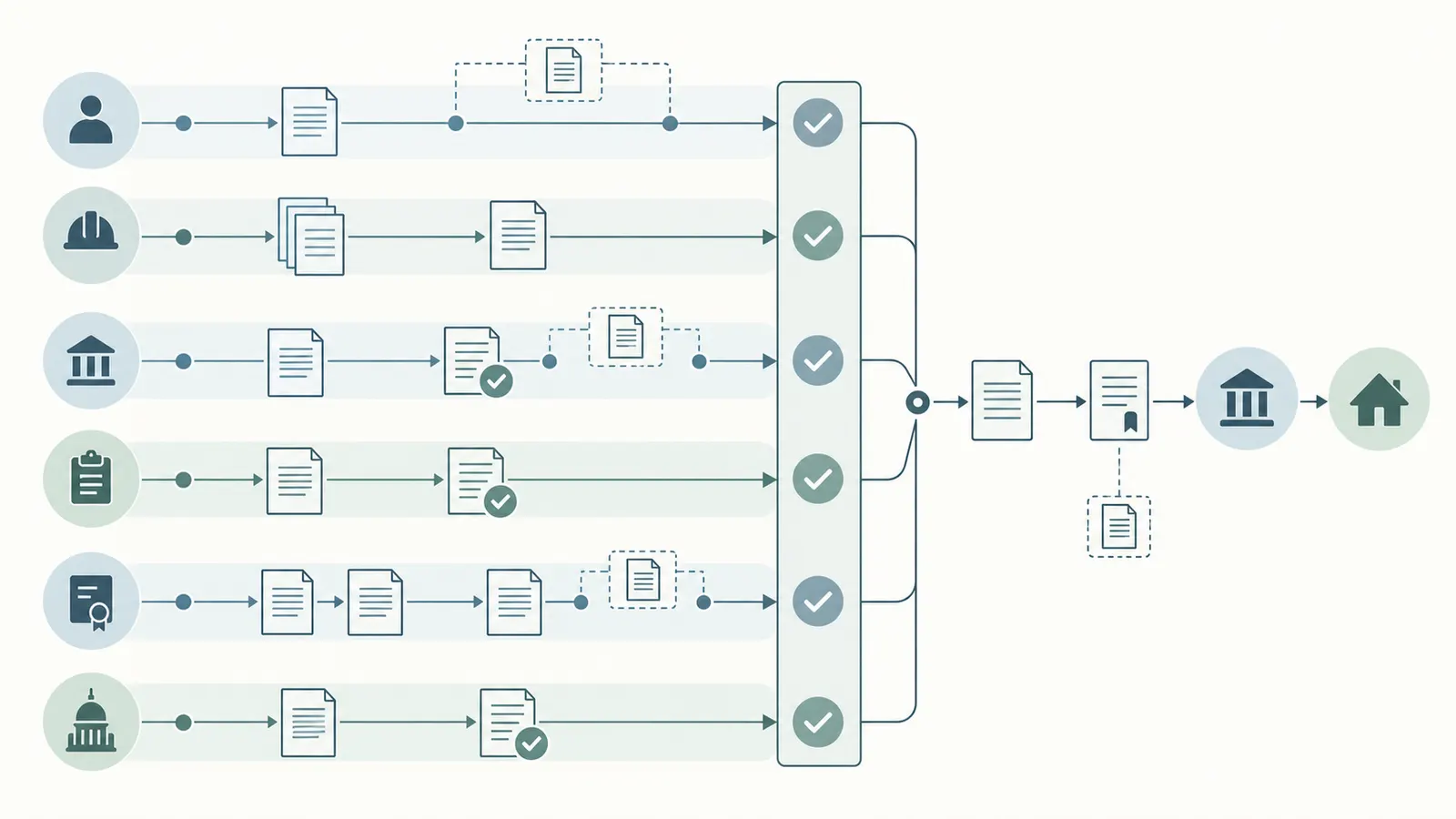
6. Diagnose mismatches and route each one to the right question #
A mismatch is material when it changes the amount you may owe, the date you must pay, the balance that earns interest, the maximum payment, the availability of funds, the cost of conversion or your ability to complete the project. Route the mismatch to the lender, builder, settlement agent, appraiser, local authority or attorney based on who controls the fact. Do not ask one professional to answer a question outside that person’s role.
Mismatch matrix
| What you observe | What it may mean | Evidence to request | Responsible party | Safest next action |
|---|---|---|---|---|
| Draw total is less than commitment | Unused contingency, reserve or canceled availability | Written status for each remainder | Lender and builder | Do not count the remainder as available cash until confirmed |
| Draw total exceeds commitment | Budget double-counting, financed fees or an unapproved change | Revised sources-and-uses and approval | Lender, builder and borrower | Stop and reconcile before signing a change or funding request |
| Disclosure payment is near half-commitment interest but plan is front-loaded | Appendix D estimate rather than schedule forecast | Calculation method and assumption | Lender | Label as estimate and model cash flow separately |
| Payment uses full commitment | Interest may apply regardless of actual draws | Contract clause and example statement | Lender | Compare full-commitment and actual-advance outcomes |
| Reserve label has no balance ledger | Payment source and debt treatment unclear | Reserve opening balance, deductions, remainder and balance effect | Lender | Treat as unresolved; obtain written accounting |
| Draw fee appears nowhere | Fee may be in an addendum or not applicable | Fee schedule, Loan Costs table or addendum | Lender and settlement agent | Ask where collected-after-closing fees are disclosed |
| Permanent payment is shown but rate is “to be determined” | Payment is an estimate or formula outcome | Rate formula, cap, lock and conversion date | Lender | Do not use it as a fixed affordability number |
| Permanent payment begins before expected completion | Date or phase definition differs | Note, rider and construction period definition | Lender | Ask which event starts permanent amortization |
| Appraisal value differs from project cost | LTV, contribution or loan amount may change | Appraisal, cost calculation and lender threshold | Lender and appraiser | Do not change scope to fit value without written approval |
| Lender requests a completion report after builder says finished | Investor or lender file condition remains open | Exact acceptable completion evidence | Lender and qualified completion professional | Keep funds and conversion status open until confirmed |
| Local certificate of occupancy is missing | Local jurisdiction requirement may be incomplete | Authority’s written status and lender condition list | Local authority and lender | Do not equate investor completion with lawful occupancy |
| Late draw changes the final balance | Timing, eligibility or reserve rule changed | Updated ledger and revised disclosure if applicable | Lender and builder | Re-run the schedule and request the next decision in writing |
The matrix is a routing tool, not a legal conclusion. For example, a draw fee can be missing because no fee is charged, because it is collected later in an addendum, or because the lender has not yet produced the final disclosure. Current CFPB guidance says inspection and handling fees, including draw fees, are loan costs and describes different disclosure placement depending on collection timing. Ask the lender which of those cases applies.
The five-question mismatch protocol
For every mismatch, send the same five-part note:
- Observed: quote the field name, document date, page or section and number.
- Expected: state the draw schedule row, contract clause or calculation that led you to a different number.
- Impact: explain whether the difference changes cash to close, construction cash flow, interest, maximum payment, completion timing or permanent payment.
- Question: ask one precise question that can be answered with a number, clause, date or document.
- Handoff: ask who must approve the correction and request the revised document or written confirmation.
Example:
“The construction agreement lists a $480,000 commitment, but the planned draw schedule totals $462,000 and leaves $18,000 as contingency. The Loan Estimate’s construction payment appears to use $240,000, which is one-half of the commitment. Please confirm whether the payment was estimated using Regulation Z Appendix D’s one-half-commitment assumption, whether the $18,000 contingency may be advanced, whether interest accrues on actual advances or the full commitment, and whether the Closing Disclosure will show the reserve or unadvanced amount separately. Please identify the controlling sections of the agreement and return any corrected disclosure.”
This format protects the conversation from drifting into “That is how construction loans work.” There are multiple construction-loan structures. The question must identify yours.
When a lender answer still does not resolve the issue
Escalate in a defined order:
- Loan officer or processor: first explanation and document location.
- Construction-loan department or closing disclosure specialist: calculation method, draw procedures, reserve and fee treatment.
- Settlement agent: closing figures, cash to close, credits, recorded documents and addenda.
- Builder or construction manager: project scope, draw amount, invoice timing, retainage and change order.
- Appraiser or completion professional: valuation or completion evidence within that professional’s scope.
- Attorney licensed in the property’s state: legal interpretation of the note, rider, lien, recording, default, conversion or state-law effect.
- Authority having jurisdiction: permit, inspection and occupancy status for the actual city, county or other local jurisdiction.
If the lender refuses to identify the basis or will not correct a material error, you can decide not to sign until the issue is resolved, compare another product or seek independent legal and financial advice. This guide cannot determine whether a lender has violated a rule or whether a contract is enforceable. A consumer may also consult the CFPB’s mortgage resources for general federal information, but an agency resource is not a substitute for counsel on a particular contract.
Avoid false positives
Not every difference is an error. Common explainable differences include:
- a Loan Estimate uses an estimate while the Closing Disclosure uses updated costs;
- a combined disclosure has a permanent-phase table that starts after the construction phase;
- the draw schedule has changed after a signed change order;
- a reserve is disclosed separately from construction costs;
- inspection or handling fees are collected after consummation and appear on an addendum;
- the payment table uses a range because an adjustable rate or payment trigger applies;
- the lender uses a known advance schedule rather than Appendix D;
- the permanent balance excludes unused commitment or includes a financed fee.
The right response is not “the numbers differ, so it is wrong.” The right response is “the numbers differ; show me the assumption, rule or contract term that explains the difference.”
The next decision is a signed-record decision: either the lender’s explanation closes the audit trail, or the item remains open and should be carried into the closing conditions list. Never delete an open item merely because the closing date is approaching.
7. Finish the worksheet, retain the record and choose the next handoff #
Finish the audit with a one-page status for every field: confirmed, estimated, conditional, not applicable or unresolved. A useful audit does not claim certainty where the lender has supplied a permitted estimate. It distinguishes a legal disclosure assumption from a construction forecast and a payment forecast from a completion condition.
Draw-to-payment audit worksheet
Copy this table into your project record and fill it from the actual documents.
For each planned advance, complete the dated accrual rows before relying on a payment comparison. “Funded date” is when money was released according to the lender’s records; “posting date” is when the lender treats it as part of the interest-bearing balance. They may be the same, but do not assume that. “Period-end date” is the date at which the row stops accruing, and “days outstanding” must follow the contract’s inclusive/exclusive convention. Enter the day-count denominator from the note—such as 360 or 365—rather than selecting one for convenience.
| Advance / accrual row | Planned or requested date | Funded date | Posting date | Period-end date | Days outstanding | Day-count denominator | Rate | Advance amount / balance after posting | Formula or result | Evidence / question |
|---|---|---|---|---|---|---|---|---|---|---|
| 1 | ||||||||||
| 2 | ||||||||||
| 3 | ||||||||||
| 4 | ||||||||||
| 5 | ||||||||||
| Additional rows |
For a daily check, calculate each row as interest-bearing balance after posting × annual rate × days outstanding ÷ day-count denominator, then add the rows. If a period contains a rate change, split it at the effective date; if a posting date differs from the funded date, preserve both dates and use the contract’s accrual rule. Attach the lender ledger or funding confirmation to each row. This makes the check reproducible even when the lender’s disclosed payment uses an estimate rather than your planned schedule.
| Audit field | Your input | Source document or section | Verification evidence | Status | Written question or next handoff |
|---|---|---|---|---|---|
| Total commitment | Lender commitment and note | ||||
| Lot purchase or payoff | Contract, payoff or Closing Disclosure | ||||
| Construction-cost budget | Plans, specifications and cost breakdown | ||||
| Contingency | Budget and agreement | ||||
| Interest reserve | Note, rider and reserve ledger | ||||
| Financed closing costs | Loan Costs table and Closing Disclosure | ||||
| Draw or inspection fees | Fee schedule, Loan Costs table or addendum | ||||
| Number of advances | Draw procedures and planned schedule | ||||
| Planned advance 1: date, amount, purpose | Builder schedule, invoice and approval | ||||
| Planned advance 2: date, amount, purpose | Builder schedule, invoice and approval | ||||
| Additional advance rows | Same evidence as above | ||||
| Cumulative planned advances | Your sum checked against lender ledger | ||||
| Unadvanced remainder | Commitment less approved advances | ||||
| Construction interest basis | Note and lender written explanation | ||||
| Day-count convention | Note or agreement | ||||
| Construction rate | Note and disclosure | ||||
| First construction payment date | Disclosure and note | ||||
| Construction payment formula or estimate | Disclosure and lender calculation | ||||
| Maximum construction payment | Loan Terms, Projected Payments or AP table | ||||
| Rate-change trigger and cap | Note and disclosure | ||||
| Permanent balance assumption | Note, rider and lender calculation | ||||
| Permanent rate and setting method | Note, rider and conversion terms | ||||
| Permanent amortization term | Note or permanent disclosure | ||||
| Permanent payment assumption | Projected Payments table and formula | ||||
| Conversion date or trigger | Rider and agreement | ||||
| Completion evidence | Lender conditions and program guide | ||||
| Appraisal or as-completed value | Appraisal and lender calculation | ||||
| Requalification conditions | Agreement, lender checklist and program terms | ||||
| Local permit or occupancy condition | Actual authority having jurisdiction | ||||
| Final approval owner | Lender closing or construction department |
The worksheet’s method is intentionally inspectable: each number has a source, each source has a responsible party, and each uncertainty has a next question. It does not attempt to replace a lender’s official calculation. When a lender’s calculation differs from yours, preserve both versions and annotate the difference rather than overwriting your input.
Three reconciliation tests
Test 1: money in equals money out. Add all project uses and compare them with loan-funded uses, borrower cash and other verified funds. If the totals differ, name the missing or duplicated category. Do not treat a contingency as available cash until the agreement says how it can be drawn.
Test 2: balance changes equal funded events. Starting with the initial balance, add only advances or financed items that the lender says increase principal, subtract documented reductions or reversals, and compare the result with the lender’s balance. A payment from an interest reserve may reduce a reserve without reducing principal; or it may be added to principal. The documents must answer which.
Test 3: payment changes equal legal triggers. For each construction or permanent payment change, point to a draw, rate adjustment, phase transition, escrow start, reserve exhaustion, extension, modified amount or other contract event. If there is no trigger, ask for the lender’s correction or explanation.
What to retain after signing
Retain the final signed note, riders, construction-loan agreement, Loan Estimate, Closing Disclosure, addenda, fee schedule, draw procedures, approved budget, plans and specifications, change orders, draw requests, inspection evidence, invoices, lien waivers where required, funding confirmations, reserve ledger, appraisal, completion evidence, conversion agreement, recorded amendments, occupancy documents and written lender answers. Keep a version date on every spreadsheet or schedule.
This record helps with more than the first payment. It can show why the permanent balance differs from the original estimate, which change order used contingency, whether a reserve was consumed, what documentation supported a final draw, and which warranties or closeout records should be handed to the homeowner. Freddie Mac’s current investor guidance illustrates why plans, specifications, receipts, invoices, lien waivers, cost calculations and both interim and permanent settlement disclosures may matter in a construction-to-permanent file. The specific lender and investor requirements still control.
The final pre-signing decision
Choose one of three statuses:
- Proceed to the next closing step: all material fields have a source, the lender has explained every estimate, and the permanent handoff conditions are written.
- Proceed only after a document revision: the lender has acknowledged a mismatch and is issuing a corrected Loan Estimate, Closing Disclosure, addendum, agreement, rider or calculation.
- Pause and obtain advice: a material term is unclear, the lender will not identify the interest basis or maximum payment, a reserve cannot be accounted for, the conversion is presented as guaranteed despite conditions, or the project budget does not fund the represented scope.
“Pause” is not a prediction that the loan is unsuitable. It is a record that the decision inputs are incomplete. The correct next handoff may be to the lender’s construction department, a licensed attorney in the property’s state, a qualified tax professional, a local permit authority or the builder. Keep those roles separate.
What this worksheet cannot tell you
The worksheet cannot tell you whether a rate is competitive, whether you can afford the loan, whether a lender will approve a change order, whether a project will finish on time, whether an appraisal is correct, whether a lien waiver is legally effective, whether a local permit is valid, whether a construction contract protects you, or whether a permanent conversion will occur. It cannot turn an illustrative sensitivity into a lender quote.
It can tell you whether you have asked the right person for the right record and whether the number you are relying on has a traceable input. That is the useful decision surface: you are not trying to predict every future draw. You are deciding whether the proposed financing has disclosed its assumptions clearly enough for you to sign knowingly and manage the next handoff.
For broader project planning, continue through Brictale’s Planning & budget journey and return to the Brictale homeowner Blog when you need the next decision in the build sequence. The route is part of a planning system; it is not a substitute for the lender documents or professionals responsible for the actual transaction.
Cite this guide
Brictale. “How to Verify a Construction Loan Payment Disclosure Against the Draw Schedule.” Published 2026-09-28; updated 2026-09-28.
https://brictale.com/build/budgeting/verify-construction-loan-payment-disclosure-against-draw-schedule · Read the Markdown version
Original contribution: Draw-to-payment audit worksheet. A document-by-document worksheet that reconciles a planned construction draw schedule with the disclosed interest basis, reserve treatment, construction payment, maximum payment, permanent balance and conversion conditions.
Sources and scope
Evidence behind this page
- The Consumer Financial Protection Bureau describes construction loans as generally short-term financing whose funds are typically provided in a series of advances as construction progresses; payment timing depends on the loan and may begin six to 24 months after the loan is made.
U.S. CFPB consumer education; general construction-loan description, not a term for every lender or state.
Accessed · Link to this claim - Under Regulation Z's construction-loan guidance, a creditor may treat a multiple-advance construction-permanent loan as one combined transaction or as two or more separate transactions, and may treat the multiple advances as one transaction or separate transactions for each advance.
TRID Rule: Separate Construction Loan Disclosures Guide
CFPB TRID compliance guide describing federal Regulation Z options; the guide is not a substitute for the regulation and does not determine a particular lender's document set.
Accessed · Link to this claim - Current Regulation Z Appendix D provides optional estimation methods when advance amounts or timing are unknown: if interest is payable only on actual advances, the estimate assumes one-half of the commitment is outstanding for the construction period; if interest applies to the entire commitment regardless of disbursement, the estimate assumes the entire commitment is outstanding.
Appendix D to Part 1026 — Multiple Advance Construction Loans
Current U.S. Regulation Z Appendix D, optional estimation procedures for multiple-advance construction loans; not a statement that every lender uses Appendix D.
Accessed · Link to this claim - Regulation Z Appendix D says an interest reserve is not a prepaid finance charge for disclosure purposes; if the creditor automatically deducts interest from the reserve rather than allowing the consumer to pay interest as due, the calculation and disclosures must reflect interest accruing on those interest payments as well as other proceeds.
Appendix D to Part 1026 — Multiple Advance Construction Loans
Current U.S. Regulation Z official interpretation in Appendix D; reserve mechanics remain lender- and contract-specific.
Accessed · Link to this claim - Under the current Regulation Z Appendix D commentary, when advance amounts or timing are unknown and interest is payable only on actual advances, the maximum possible periodic principal-and-interest payment disclosure is based on the maximum principal balance that could be outstanding during construction; disclosures may also reflect changes from interest-rate changes when the construction financing is adjustable-rate.
Appendix D to Part 1026 — Multiple Advance Construction Loans
Current U.S. Regulation Z official interpretation for applicable Loan Estimate and Closing Disclosure mechanics; the actual legal obligation and lender calculation control.
Accessed · Link to this claim - Regulation Z Appendix D states that construction-loan inspection and handling fees, including draw fees for staged disbursements, are part of the finance charge and must be disclosed accurately as loan costs; collection timing determines whether they appear in the Loan Costs table or a post-consummation addendum.
Appendix D to Part 1026 — Multiple Advance Construction Loans
Current U.S. Regulation Z official interpretation; not a rule that a lender must charge a draw fee, only how applicable inspection and handling fees are treated.
Accessed · Link to this claim - The CFPB TRID guide explains that the Loan Terms Table includes loan amount, interest rate, periodic principal-and-interest payment, prepayment penalty and balloon payment, while the Projected Payments Table includes principal and interest and may require multiple columns for payment changes or balloon payments.
TRID Rule: Separate Construction Loan Disclosures Guide
CFPB guide to selected federal TRID disclosure fields for separate construction-loan disclosures; not a substitute for reviewing the transaction's complete disclosures.
Accessed · Link to this claim - The CFPB's construction-loan TRID guide assigns the applicable Loan Estimate and Closing Disclosure options and timing to the creditor, while separately referring to services that the creditor or mortgage broker may require for consummation; that distinction does not make every mortgage broker the creditor or the disclosure issuer.
TRID Rule: Separate Construction Loan Disclosures Guide
CFPB TRID construction-loan guide: creditor disclosure duties and separate Loan Costs discussion of services required by a creditor or mortgage broker; apply the legal obligation and transaction facts to identify the actual creditor.
Accessed · Link to this claim - Fannie Mae's single-closing construction-to-permanent guidance says the lender underwrites the loan based on the permanent-financing terms; if those terms are modified and no longer reflect the underwriting basis, re-underwriting may be required, subject to stated tolerances and conditions.
Conversion of Construction-to-Permanent Financing: Single-Closing Transactions
Fannie Mae selling-guide eligibility requirements for loans intended for sale to Fannie Mae; not a universal federal underwriting rule or promise that a lender participates.
Accessed · Link to this claim - Fannie Mae's single-closing guidance describes conversion documentation options and says that if construction finishes earlier or later than anticipated, the lender needs to amend the relevant documents to provide the new amortization dates and record amendments before sale to Fannie Mae.
Conversion of Construction-to-Permanent Financing: Single-Closing Transactions
Fannie Mae investor documentation guidance; recording requirements and legal effect depend on the applicable jurisdiction and the signed loan documents.
Accessed · Link to this claim - Fannie Mae's completion guidance requires lenders to obtain evidence of completion before sale in the ordinary case and permits specified completion alternatives; Form 1004D or alternatives must include visually verifiable exhibits, and new or proposed construction completion must be verified against the plans and specifications under the applicable method.
Requirements for Verifying Completion and Postponed Improvements
Fannie Mae selling-guide requirements for eligible loans; not a local certificate-of-occupancy rule, building-code inspection, or universal lender condition.
Accessed · Link to this claim - Freddie Mac's current Construction to Permanent Mortgage guidance says the mortgage file must include documentation supporting the construction-to-permanent classification, documents such as plans, specifications, receipts, invoices and lien waivers sufficient to validate actual cost, a cost calculation, and settlement disclosures for interim and permanent financing.
Section 4602.1 — Construction to Permanent Mortgages and Renovation Mortgages
Freddie Mac Seller/Servicer Guide requirements effective June 3, 2026; investor-specific file requirements, not a homeowner's universal legal checklist.
Accessed · Link to this claim