How to Manage a Construction Loan Draw Request Package
Reconcile budget lines, inspections, title, waivers, lender approval, funding dates, and your temporary cash gap before submitting a home-build draw.
The short answer
A draw package is ready when every requested line reconciles to the approved budget and eligible completed work, the required inspection, title or lien evidence, waivers, and borrower authorization are present, and the homeowner has recorded the cash gap until funding. Keep requested, approved, and funded amounts separate; the lender's inspection is a funding control, not a quality guarantee.How to Manage a Construction Loan Draw Request Package
To decide whether a construction-loan draw package is ready, reconcile each requested line against the approved budget, work actually installed or otherwise eligible under your agreement, prior funded amounts, and the inspector, title, and lien evidence. Then record lender approval separately from money received. Submit only when every required gate is closed; otherwise assign the missing item, quantify the cash exposure, and escalate before the builder’s due date.
This guide is for a homeowner coordinating a United States construction-only or construction-to-permanent home build during active construction. It does not choose a lender, give personalized borrowing advice, interpret the lien law of a particular state, or replace the construction-loan agreement. The property’s state and county or municipality matter. Where a local rule or form is discussed, the jurisdiction is named; otherwise, treat the point as a lender or provider example and verify the actual property jurisdiction before signing anything.
Decide whether the draw package is ready to submit #
A draw package is ready to submit when the requested amount is traceable to the approved budget, the claimed work is eligible under the loan agreement, the required evidence is attached, the responsible parties have signed or authorized the request, and the homeowner knows the likely funding date and temporary cash gap. “Ready to submit” does not mean “approved,” “funded,” or “safe to pay every invoice.”
Construction lending is a controlled series of advances, not normally a single unrestricted check. The Federal Reserve’s Commercial Bank Examination Manual description of real-estate construction loans describes a loan for a project within a specified period funded by supervised disbursements over the construction period. That description is supervisory guidance for banks, not a promise to a homeowner, but it explains why the draw package has several gates: the lender must control the amount and timing of money, the inspector must report progress, and the title or settlement provider may need to confirm that the lender’s position is not impaired.
The first decision is therefore a gate decision:
| Gate | Ready means | Evidence to have | Primary owner | If missing |
|---|---|---|---|---|
| Contract and timing | You have the current executed loan agreement, construction budget, draw schedule, construction-period maturity date, and lender submission instructions | Signed agreement, latest budget, draw calendar, portal instructions | Homeowner and lender | Ask the lender’s construction administrator which version controls before the builder updates the request |
| Line reconciliation | Each requested dollar maps to one approved budget line and does not duplicate a prior approved draw | Line-item ledger, prior approval or funding records, current invoices | Builder or general contractor, checked by homeowner | Return the line for correction; do not “round up” to make the total convenient |
| Eligible work | The claimed work satisfies the agreement’s definition of completed, installed, reimbursable, or otherwise eligible work | Photos, invoices, delivery or installation records, inspection-ready site | Builder; lender inspector verifies progress | Ask the lender whether stored materials or deposits are eligible before including them |
| Required signatures | The borrower, builder, or both have completed the form or portal authorization required by the lender | Signed draw request, borrower authorization, sworn statement if required | Homeowner and builder | Stop at the signature gate; an email saying “looks good” may not be the required authorization |
| Title and payment evidence | Required title update, lien-waiver status, sworn statement, or payment evidence is available in the form the lender and title provider accept | Title update or endorsement, waivers, sworn statement, vendor list | Title provider and builder; homeowner tracks | Send the exact deficiency to the title provider and lender, and ask what conditional or final form is required |
| Cash and timing | You have a dated estimate of approval and funding, builder due date, fees or holdbacks, and cash available to bridge the difference | Cash-bridge worksheet, lender timing estimate, builder invoice terms | Homeowner | Negotiate timing or obtain a lender decision before promising payment |
The lender, title company, inspector, and builder may use different words for the same stage. “Submitted” might mean uploaded to a portal, emailed to a title company, delivered to the lender, or complete enough to start an inspection. “Approved” might mean an amount accepted by the construction administrator, while “funded” means the money actually left the lender or reached the title company. Your control surface should use one vocabulary consistently: requested, inspected, title-cleared, lender-approved, disbursed, and paid.
The published workflow for First Merchants Bank’s construction handbook illustrates the distinction. It describes the owner and builder submitting a request, the bank ordering an on-site inspection and title endorsement, the title company authorizing release, and funds being wired to the title company for disbursement. WaFd Bank’s Built workflow likewise presents submission, inspection, lender review and disbursement, followed by a funding notification. Those are useful process models, not a national timetable or a substitute for your lender’s agreement.
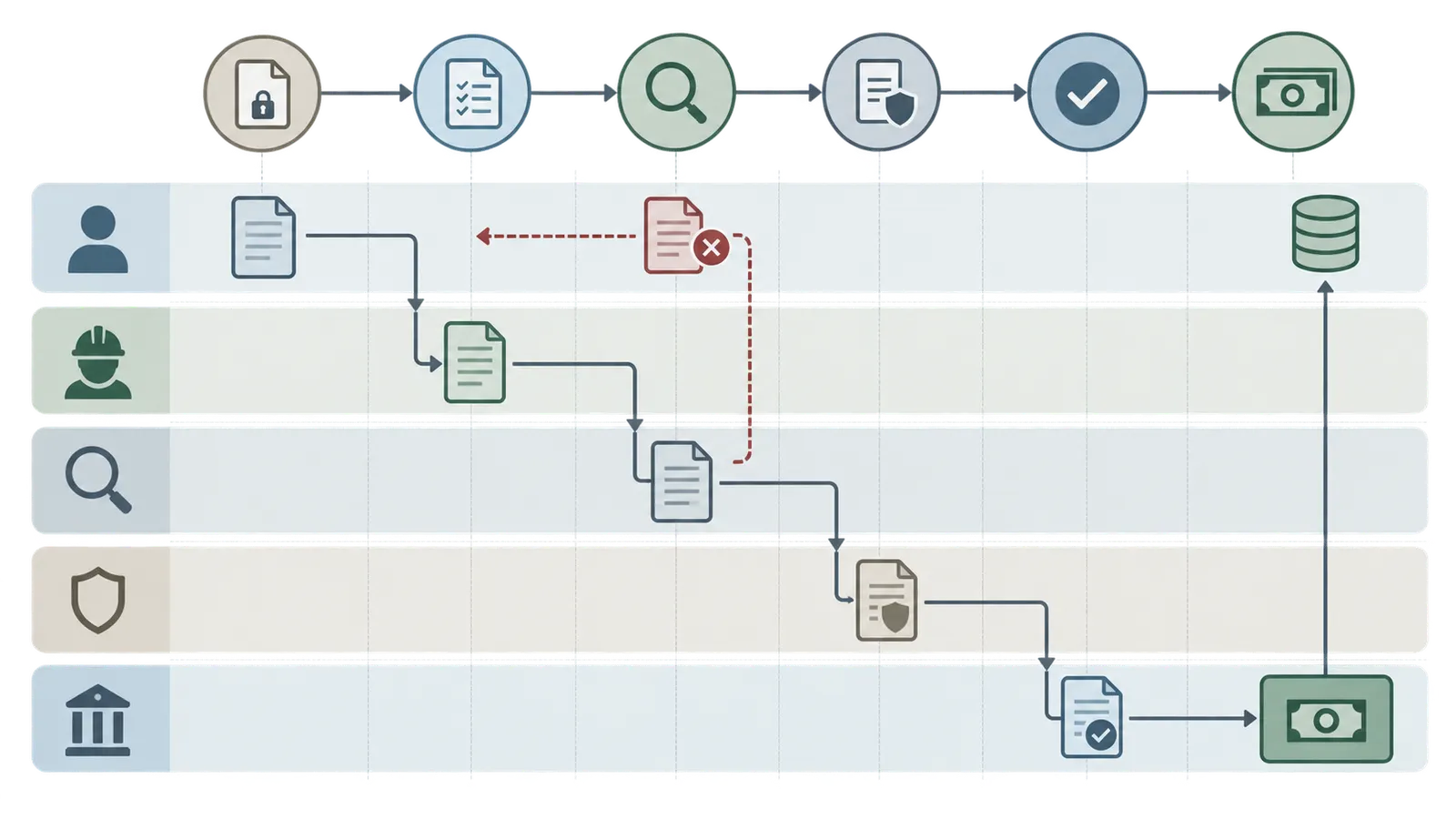
The no-surprises submission test
Before submitting, ask six questions and record a yes, no, or pending answer rather than relying on memory.
- What exact budget version and draw schedule does this request use?
- What work was accepted in the previous draw, and what remains in each line?
- Which claimed items are installed, which are only delivered or stored, and which are deposits?
- Which amount is the builder requesting, which amount is the inspector expected to approve, and which amount will the lender actually release after any holdback or fee?
- Which person or company owns each missing document, and by what date?
- If the amount arrives five business days late or is reduced, how will the builder and suppliers be paid without using money reserved for an unrelated project cost?
If any answer is unknown, the package may still be uploaded if the lender allows incomplete submissions, but it is not ready for a safe payment commitment. Mark it “submitted—deficiency pending,” set an owner and deadline, and do not tell a trade that lender money is certain. The next decision is whether to correct before submission, submit to start a known inspection clock, or escalate because the due date or loan maturity makes waiting unsafe.
Keep the inspection in its proper role
An inspection in a construction draw is evidence for the lender’s progress and collateral controls. It is not automatically a code inspection, a workmanship warranty inspection, a design review, or a complete defect survey. First Merchants says its site inspection looks at work completed to date, materials on site, and percentage complete; its handbook also says the inspections are for the bank’s benefit. HUD Form 9746-A, which applies to HUD’s Section 203(k) rehabilitation process, similarly has the inspector certify the draw request and report unacceptable or incomplete work. Neither source turns a lender inspection into a homeowner quality guarantee.
For the homeowner, the practical implication is two separate checkboxes:
- “The lender has enough progress evidence to consider a release.”
- “The work meets the project’s contract, plans, specifications, code requirements, and my acceptance criteria.”
The first may be answered by the draw inspection. The second may require the builder’s quality-control process, the local building department’s inspection record, an architect or engineer, or an independent qualified professional. If you see exposed energized wiring, unstable framing, open excavations, fall hazards, unsafe access, or other dangerous conditions, do not enter or test the area casually to collect evidence. Photograph from a safe location, keep people clear, and route the issue to the builder and the appropriate qualified professional or authority having jurisdiction.
Reconcile every budget line before anyone requests money #
Reconcile the current claim to the approved budget and prior accepted draws first; only then calculate a request total. The homeowner should maintain the ledger, but the builder or general contractor should supply the construction facts and invoices. The inspector reports what can be accepted under the applicable process, the lender decides what it will approve, and the title provider controls its own title or disbursement evidence.
The central mistake is treating the builder’s invoice as the draw amount. An invoice answers what someone says is due. A draw ledger answers how much of an approved budget line is still available, how much eligible progress exists, how much the inspection supports, how much the lender authorizes, what is withheld, and what reaches the payee.
Original contribution: Draw-cycle reconciliation worksheet
The original artifact in this guide is a reusable draw-cycle reconciliation worksheet.
Method. For each draw period, freeze the ledger, record the approved budget and prior approved amount, compare the current claim with installed work and inspector approval, apply the lesser-of rule for an illustrative eligible amount, then record lender approval, holdback, fees, dates, and the next responsible owner. The worked example varies inspection delay, holdback, fees, and a change order. This method separates facts owned by the homeowner, builder, inspector, lender, and title provider instead of treating an invoice as proof of a fundable amount. It is built from the staged-disbursement and documentation controls described by CFPB Regulation Z, HUD’s published draw instructions, and lender or title-provider examples from Mercantile Bank and Land Title Guarantee.
Limitations. This is a coordination aid, not a lender form, legal instrument, title opinion, inspection report, or promise of approval. The loan agreement, lender procedures, title provider, property-state lien rules, and local building authority control the real transaction; the example numbers are illustrative. It is not an official lender form, a legal waiver, a workmanship review, or an approval predictor, and it cannot determine the legal effect of a waiver or title exception in an unspecified property state.
Use one row for each budget line, not one row for each vendor invoice. If one budget line contains several scopes, split it into sub-lines only if the lender’s budget and the builder’s cost coding allow that split. Preserve the lender’s original line identifiers so your worksheet can be checked against the official form.
| Field | What to enter | Unit or format | Who supplies or verifies it |
|---|---|---|---|
| Draw period | The period closed for this request | Start and end dates | Homeowner and builder |
| Budget line | Original line number and description | Text plus line ID | Builder and lender budget |
| Approved line budget | Total approved amount for this line | USD | Lender-approved budget |
| Prior approved amount | Amount accepted in earlier draws, whether or not paid | USD | Lender records; homeowner reconciles |
| Prior funded amount | Amount actually disbursed in earlier draws | USD | Lender or title payment records |
| Current claimed amount | Amount requested now for this line | USD | Builder request and invoices |
| Work status | Installed, partially installed, stored, deposit, or not started | Coded text | Builder; inspection evidence |
| Inspector-approved amount | Amount the inspection supports for this line | USD | Inspector or lender report |
| Remaining approved budget | Approved line budget minus prior approved amount | USD | Worksheet formula, checked against lender ledger |
| Illustrative eligible amount | Lesser of current claim, inspector approval, and remaining budget | USD | Worksheet synthesis, not an approval |
| Lender-approved amount | Amount accepted after lender review | USD | Lender notice or portal |
| Retainage or holdback | Amount withheld under the agreement | USD or percentage | Lender agreement |
| Draw or inspection fee | Fee charged, if any, and whether deducted or paid separately | USD | Loan disclosures and lender statement |
| Title or lien status | Pending, clear, exception, waiver deficiency, or other exact status | Coded text plus note | Title provider and builder |
| Requested date | Date and time the complete request was delivered | Local date and time zone | Homeowner or portal record |
| Expected funding date | Lender or title provider estimate, labeled estimate | Date plus confidence note | Lender or title provider |
| Builder due date | Date the builder or supplier requires payment | Date and payment terms | Builder contract or invoice |
| Homeowner cash bridge | Temporary cash required if the draw is late, reduced, or withheld | USD | Homeowner formula |
| Next owner | One named party responsible for the next action | Person or company | Homeowner assigns |
The fields “prior approved amount” and “prior funded amount” are deliberately separate. A lender may approve a draw before a title company cuts checks, or a payment may be split among the builder, subcontractors, and suppliers. If you collapse approval and funding, you can accidentally tell a trade that money is available when it is only authorized in principle.
The line-level formula
For a simple illustrative row, define:
remaining approved budget = approved line budget − prior approved amount
illustrative claimable line = lesser of current claimed amount, inspector-approved amount, and remaining approved budget
Then record the lender-approved amount separately. Do not substitute the illustrative result for the lender’s decision. The formula is a guardrail against three common errors: claiming more than the work observed, claiming more than the budget left, or claiming the same work twice.
If the lender applies a percentage holdback to the approved amount, an illustrative net release is:
net release before other adjustments = lender-approved amount × (1 − holdback percentage)
If a fee is deducted from the proceeds, a simple cash-to-project figure is:
cash available for project payment = net release before other adjustments − fee deducted
If the fee is billed separately, do not subtract it from the project payment and then forget to reserve cash for the bill. Label whether each fee is financed, deducted, charged at closing, charged per draw, or paid directly. CFPB’s Regulation Z interpretation of construction-loan finance charges says inspection and handling fees for staged construction-loan disbursements are finance charges when imposed by the creditor as an incident to or condition of credit. That federal disclosure classification does not tell you the fee amount, whether your contract permits it, or when the lender collects it.
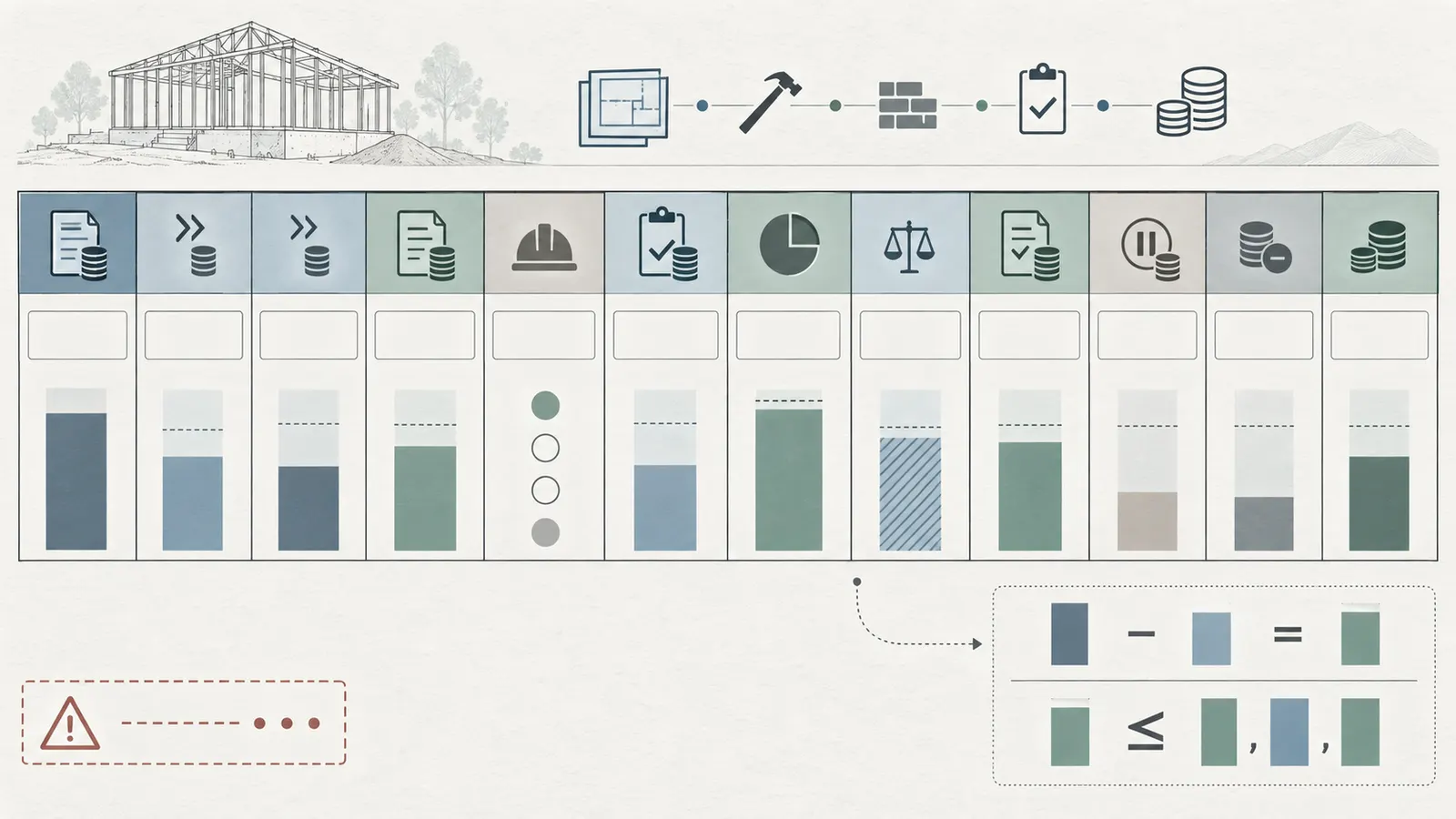
Freeze the period before reconciling it
Choose a cut-off date and write it at the top of the worksheet. The builder should identify work completed or installed by that date, invoices included, payments already made, deposits outstanding, and items intended for a later draw. The homeowner should keep a copy of the budget and the last funded draw before allowing a new request to overwrite the prior state.
The freeze prevents a moving target. If framing continues while the request is being assembled, a builder may include photographs from after the claimed date, a supplier may issue a revised invoice, or a prior payment may be recorded in the wrong period. None of those events is necessarily improper, but each should be dated and explained. If the lender portal records its own submission timestamp, use that timestamp and time zone.
For each line, compare four things:
- The approved budget amount and description.
- The prior accepted or funded amount.
- The current claim and supporting invoice or cost record.
- The physical state of the work at the inspection-ready moment.
Then compare the result with the loan agreement’s eligibility rules. A new-home construction loan may allow certain documented deposits or stored materials, while another program may require installation. Do not generalize from a renovation form or a different lender. HUD’s form instructions say, for its Section 203(k) process, that materials cannot be paid for until they have been acceptably installed and that the request must show actual cost including materials, labor, overhead, and profit. First Merchants’ handbook describes a different lender policy that may permit documented deposits for certain custom or specialty items. These examples point in opposite directions on purpose: eligibility is program-specific.
Treat deposits and stored materials as a separate branch
An invoice marked “paid,” “ordered,” or “delivered” does not by itself prove that a lender will fund it. Create separate status codes:
I: installed and visible for inspection;D: delivered or stored at the site but not installed;P: deposit or prepayment;O: off-site, custom, or held by a supplier;N: not started;C: claimed under an approved change order.
Ask the lender in writing which codes are eligible for this loan and this draw. Include the invoice, delivery record, ownership or risk-of-loss information, and storage location only if the lender requests or permits them. Do not move a D or P item into I because the builder expects it to be installed before the inspection. If the inspection occurs earlier, the record should reflect reality.
The next decision for an ineligible item is not automatically “pay it from cash.” It may be to wait for installation, request a permitted deposit draw, amend the budget through a formal change-order process, or negotiate a supplier payment date. A homeowner should not use the construction loan’s remaining contingency informally; ask who has authority to approve a budget shift and what document makes it effective.
Assign each document and handoff to a responsible party #
The homeowner manages the coordination record, but no single party owns the whole package. Assign each input to the person who can produce it and each verification to the party whose process controls it. This avoids the common failure where the homeowner is told to “get the draw ready” without being able to create a title endorsement, inspector report, or builder sworn statement.
| Party | Owns or supplies | Verifies or decides | Does not guarantee |
|---|---|---|---|
| Homeowner or borrower | Current agreement, approval of release, cash bridge, contacts, submission record, payment confirmation | Whether the packet is complete enough to submit and whether personal funds are available | That the lender will approve, that the builder’s work is defect-free, or that a waiver has a legal effect in the property state |
| Builder or general contractor | Line-item request, schedule status, invoices, subcontractor and supplier list, sworn statement if required, payment allocation, site readiness | What was completed or installed and what is due under the construction contract | That a lender or title company will accept a line, that a payment is funded, or that a state waiver is valid |
| Subcontractor or supplier | Invoice, payment confirmation, waiver or release in the form requested, notice information where applicable | Its own account balance and whether it has received payment | The builder’s budget accuracy or the lender’s approval |
| Draw inspector | Site visit, progress observations, photos or report, adjustments within the assigned inspection process | Whether reported progress appears present or installed under that process | Workmanship, hidden conditions, design compliance, code compliance, or future performance unless separately engaged for those duties |
| Lender construction administrator | Program rules, required form, review, conditions, approval, fee treatment, funding instruction | Whether the request satisfies its agreement and credit controls | Local title law, builder performance, or the title company’s independent work |
| Title or settlement provider | Title update, lien or waiver review, endorsement or settlement statement, disbursement checks if engaged | Whether its title and payment conditions are met | The lender’s approval, a contractor’s solvency, or the law of a state outside its engagement |
| Local building department | Permit and inspection records, and certificate of occupancy where the local jurisdiction issues one | Compliance with the adopted code and local inspection process | Loan eligibility, title status, budget sufficiency, or workmanship outside its inspection scope |
| Attorney, title counsel, architect, engineer, or other qualified professional | Advice within the retained scope | State-law, structural, design, contract, or technical questions | Any issue outside the engagement or any lender payment decision |
This role separation is supported by the published examples. Mercantile’s construction guide lists borrower authorization, an updated builder’s sworn statement, prior-payment lien waivers, a site inspection report, and a title update as draw requirements. Land Title Guarantee’s Colorado disbursement description separates the physical inspection and title update from the lender’s approval and the title company’s later disbursement. First Merchants says the request may be submitted by the owner and builder, while its construction administration team orders inspection and title work. The exact names and route vary, but the handoff pattern is consistent: construction facts originate at the project, independent verification happens at the inspection and title stages, and funds move only after the lender’s decision.
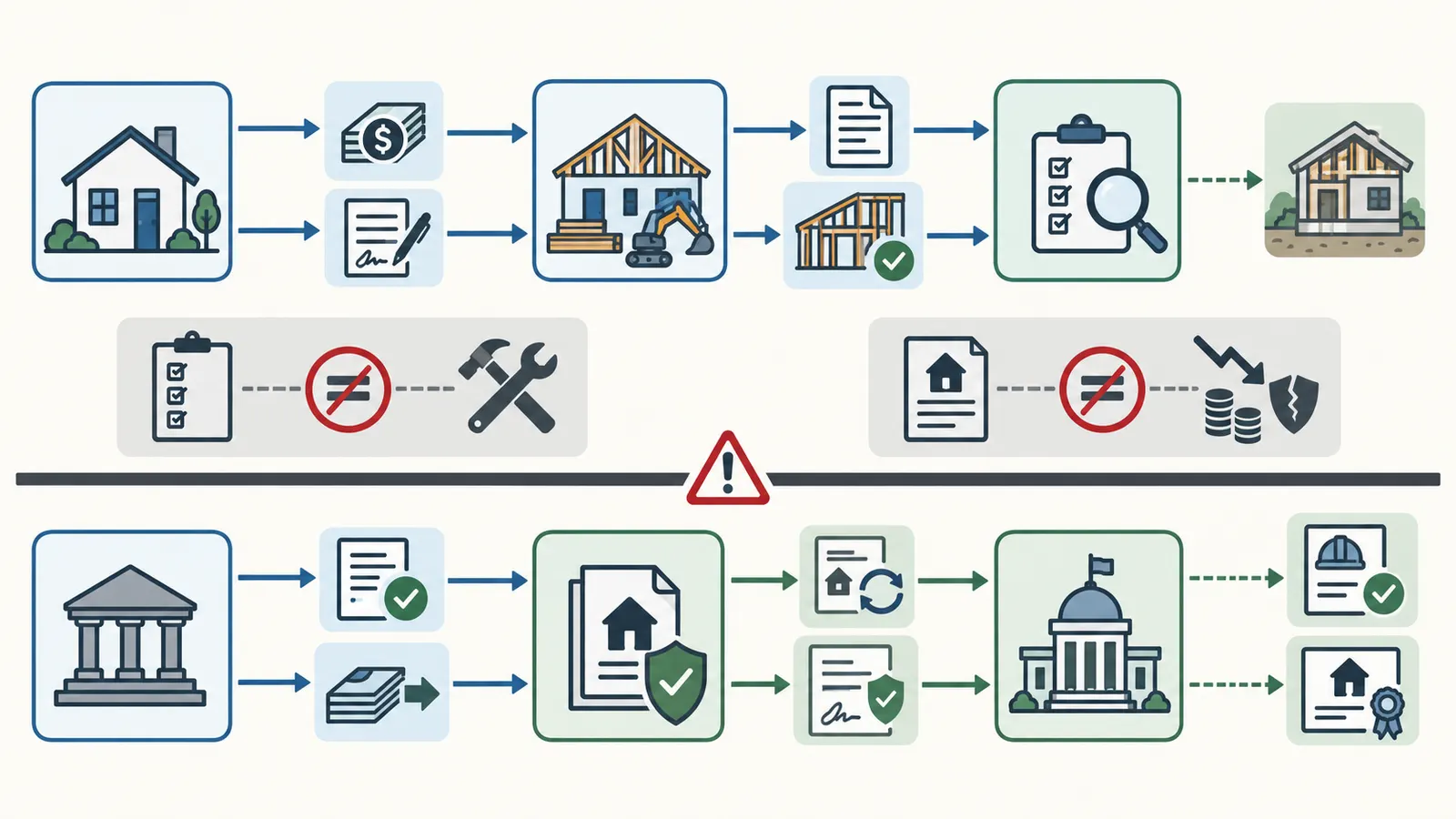
Build a handoff packet instead of a document pile
Name the packet with the property address, draw number, period end date, and version. Use a short index with a status column. A useful index is:
| Packet item | Required? | Version or date | Complete? | Owner | Verification |
|---|---|---|---|---|---|
| Draw request or portal submission | Ask lender | Form version and signed date | Yes / no | Builder and homeowner | Portal receipt or email acknowledgment |
| Line-item budget reconciliation | Usually useful; lender may require its own form | Budget version | Yes / no | Homeowner and builder | Totals agree to lender budget |
| Builder sworn statement | State and lender dependent | Statement date | Yes / no / not applicable | Builder | Lender or title provider confirmation |
| Current invoices and payment allocation | Lender dependent | Invoice dates | Yes / no | Builder | Vendor names and amounts match request |
| Prior payment waivers or releases | State and lender dependent | Waiver period and form | Yes / no / pending | Builder and title provider | Exact status from title provider |
| Current inspection evidence | Usually requested by lender | Inspection order and report date | Pending / complete | Lender or inspector | Report received and exceptions logged |
| Title update or endorsement | Title process dependent | Effective date | Pending / clear / exception | Title provider | Written status and exception detail |
| Borrower authorization | Common lender control | Signed date | Yes / no | Homeowner | Portal or lender acknowledgment |
| Change-order approval | If any budget or scope changed | Change-order number | Yes / no / none | Builder, homeowner, lender as required | Executed approval and revised budget |
| Funding notice and disbursement register | After approval | Funding date and reference | Pending / received | Lender or title provider | Bank or title record |
Do not backfill a missing waiver by downloading a generic form from the internet. The waiver may be governed by the property state, the lender’s title requirements, the builder’s contract, or the title provider’s underwriting instructions. A waiver that is “conditional” may be different from one that is “unconditional,” and the date, amount, claimant, and period may matter. If the property’s state is not yet known, the homeowner cannot safely label a waiver legally sufficient. Identify the state and county, ask the title provider or a qualified local attorney which form and timing apply, and preserve the answer with the draw record.
Use a deficiency log with one next owner
Every missing item should have one owner and one next checkpoint. “Everyone is working on it” is not a status. Use statuses such as requested, received, under review, corrected, accepted, rejected, and escalated. For a title exception, the next owner may be the title examiner; for an invoice mismatch, the builder’s bookkeeper; for a reduced inspection amount, the lender construction administrator; for a dangerous site condition, the builder and qualified professional.
Record the exact question sent. “Please fix lien issue” creates a long loop. “Title update dated October 4 shows an exception for claimant X in the amount of Y; please identify whether the lender needs a release, payoff, affidavit, or other document, and whether the draw may proceed while it is pending” creates a checkable handoff. Do not state that the issue is cured until the title provider or lender confirms the accepted evidence.
Verify installed work, title, waivers, and overages before release #
Verification is complete only when the claimed progress, the inspection result, the title or lien status, and the payment evidence agree—or the lender has explicitly accepted a documented exception. A lender inspection can support a release without proving quality, and a clean title update can coexist with unpaid bills that have not yet become recorded liens. Keep construction verification, legal/title verification, and payment verification as separate records.
Inspection: observe what the process can actually see
The homeowner can safely prepare the site and evidence without performing an unsafe inspection. Ask the builder to identify the areas, line items, and percentage or dollar progress that the request relies on. Compare that list with the construction schedule and the approved budget. Photograph from safe, accessible positions, with the date and location documented if the lender accepts homeowner photos. Do not remove guards, energize circuits, climb framing, enter an excavation, or open a concealed assembly to make a draw easier.
The inspector’s job depends on the engagement and loan program. First Merchants describes inspections as checking completed work, materials on site, and stage percentages and says it typically schedules them 24–48 hours after receiving a draw. HUD’s form instructs its inspector to adjust amounts and certify that the request covers completed, properly installed work for its Section 203(k) process. These support a prudent homeowner rule: claim only what you can identify, date, and support under your actual agreement, and expect the inspector or lender to reduce unsupported lines.
When an inspector reduces a line, do not argue from the total invoice alone. Ask which condition caused the reduction:
- the work was not present or not installed;
- the observed percentage was lower than the request;
- the line exceeded the remaining budget;
- the change order was not approved;
- the inspector could not access or verify the work;
- the lender’s program excludes the item;
- the request included a fee, deposit, or stored material in the wrong field;
- the inspection report contains a factual error.
Send the correction using the inspector’s line number and attach the evidence requested. If the report is factually wrong, ask for a reinspection or lender review through the stated process. Do not pressure a field inspector to classify incomplete work as complete. If the work is unsafe or materially deficient, route that issue to the builder and the appropriate qualified professional rather than treating payment approval as the remedy.
Title and lien evidence: identify the jurisdiction and exact status
There is no single United States homeowner rule for the form, timing, notice, priority, or legal effect of every mechanic’s lien waiver. The controlling jurisdiction is generally the state where the property is located, along with the transaction documents and the title provider’s underwriting requirements. County recording practices and the lender’s title policy may also affect the process. Because the opportunity brief does not identify a property state, this guide makes no state-law conclusion.
The safe national workflow is procedural:
- Ask the title or settlement provider which title update or endorsement is required for this draw.
- Ask the builder for the claimant list, current balances, and the exact waivers or releases requested.
- Ask which payment period each waiver covers and whether it is conditional on payment or effective immediately.
- Compare names, project address, draw period, amount, and claimant identity across invoices, sworn statements, waivers, and title records.
- Forward recorded notices or title exceptions to the lender’s construction team promptly.
- Do not sign a waiver you do not understand; ask the title provider or a qualified attorney admitted in the property state about its effect.
First Merchants’ handbook says state-specific requirements can include sworn statements and lien waivers and that its process cannot process a draw without the correct waiver form. Its handbook separately gives a Michigan example involving notice of intent to file a lien; that Michigan example should not be generalized to another state. Land Title Guarantee, headquartered in Denver, Colorado, describes a 101 Endorsement process that updates title with each draw and provides lien-waiver protection to the lender; that is a Colorado title-company service description, not a national protection for every homeowner.
The distinction matters because “the title company checked” can mean different things. It may mean a current public-record search, an endorsement issued after specific documents, a commitment update, or a full-service disbursement service. Record the exact document name, effective date, exceptions, and who accepted it. A verbal “we should be fine” is not a title status.
Overages and change orders: do not hide a new scope in an old line
An overage is not automatically a draw deficiency. It may be a builder cost above the approved line budget, a homeowner-selected upgrade, a pricing change, a design correction, or a cost that belongs in contingency. First identify cause and responsibility under the construction contract. Then ask the lender whether the budget can be reallocated, whether a formal change order is required, whether owner cash must cover the difference before release, and whether the revised budget changes the loan-to-cost or permanent-financing assumptions.
Mercantile’s published guide says that borrower overages must be covered before release in its process. First Merchants describes a published limit for certain documented deposits and says additional draw fees may apply after included draws. These are lender examples, not a national standard. A change order is not funded merely because the builder and homeowner signed it; the lender may require an approved revised budget and additional underwriting.
Use this change-order record:
| Question | Record |
|---|---|
| What changed? | Scope, quantity, specification, schedule, or price |
| Why did it change? | Site condition, owner choice, design correction, market price, error, or other cause |
| What is the gross change? | Original amount, new amount, and delta in USD |
| Which budget line or contingency pays? | Original line, approved contingency, owner cash, or financing request |
| Who approved the contract change? | Builder, homeowner, architect or engineer if engaged, lender if required |
| What happens to the remaining budget? | Revised line and remaining amount |
| Does the draw package change? | New invoice, revised sworn statement, inspection note, title or waiver impact |
| What is the next decision? | Proceed, defer, redesign, pay cash, or escalate |
Do not use an unapproved change order to make an old line appear complete. Keep the old budget, the signed change, and the lender’s decision traceable. The next owner may be the lender rather than the builder if the change affects the loan commitment or the final appraisal.
Final-draw verification is a different gate
The final draw can carry requirements that do not apply to an interim draw: local certificate of occupancy, final appraisal or completion inspection, final title or lien evidence, insurance conversion, closeout documents, and a remaining holdback. First Merchants’ handbook says its process holds at least 5% of total construction hard costs for the final draw and requires completion documentation; it also describes a local building department certificate of occupancy and a switch from builder’s risk to homeowners insurance for its final process. Mercantile’s guide lists a final appraisal inspection, permanent certificate of occupancy, homeowners insurance, and payment of remaining builder overages in its final-draw process.
The applicable local authority is the city or county building department that has jurisdiction over the property, not a generic national “CO office.” Some jurisdictions issue a certificate of occupancy, some use a certificate of completion or another final approval, and some projects are not required to use the same document. Ask the lender and local building department for the exact name. Do not move in, close out insurance, or represent the work as complete solely because the inspector approved an interim draw.
Calculate funding timing, interest, and the homeowner cash bridge #
Estimate cash exposure from the builder’s due date backward, using provider-specific timing as a range rather than a promise. The homeowner’s exposure is the amount that must be paid before the draw’s usable funds arrive, plus any holdback, deducted fee, reduced approval, or approved cost that the loan will not cover. Separately estimate additional interest during a delay using the contract’s balance and day-count convention.
Build a dated funding timeline
There is no national five-day draw guarantee. First Merchants says inspections are typically conducted 24–48 hours after receipt of a request. Land Title Guarantee, a Colorado provider, says a field inspection is scheduled within two business days, documents go to the lender after the title update, funds are disbursed within 24 hours of lender funding, and its goal is five business days from submission to checks ready. Those statements show how a process can be staged; they do not bind another lender, title company, inspector, state, or project.
Use the actual parties’ estimates in this format:
| Event | Date or range | Owner | Proof to save | Effect if late |
|---|---|---|---|---|
| Builder freezes claim | Date and local time | Builder | Signed line ledger and invoices | Claim may change during review |
| Homeowner checks packet | Same day or next business day | Homeowner | Checklist and deficiency log | Submission moves or starts incomplete |
| Complete request received | Timestamp | Lender or title provider | Portal receipt or email | Inspection clock may begin |
| Inspection scheduled | Provider estimate | Inspector or lender | Order confirmation | Builder should not conceal or alter claimed work |
| Inspection report delivered | Provider estimate | Inspector | Report and photos | Unsupported lines may be reduced |
| Title update or endorsement | Provider estimate | Title company | Effective document and exceptions | Lender may not release |
| Lender decision | Contract or provider estimate | Lender | Approval, conditions, or denial | Amount may differ from request |
| Funds sent to title or payee | Actual date | Lender | Funding notification or wire reference | Approval is not yet cash |
| Checks or payment received | Actual date | Title provider, builder, or lender | Disbursement register or bank record | Payment obligation may remain open |
| Waivers updated | After payment, if required | Builder and title provider | Correct period and amount | Next draw or final closeout may be blocked |
If the lender does not provide a service estimate, ask for the next controlled event, not an unsupported promise: “Has the request been deemed complete? Has inspection been ordered? Is title clear or under review? What condition remains before approval? If approved today, is funding to the title company or direct to the builder?”
Estimate construction-phase interest without mistaking it for a bill
CFPB’s construction-loan disclosure guide explains that construction-phase interest-only payments are typically calculated from amounts advanced and can increase as advances accumulate. The current CFPB Appendix D guidance explains disclosure methods for multiple advances and notes that an interest reserve may be established in some loans. Your actual note and disclosures control.
For a simple illustrative daily estimate, use:
additional interest ≈ outstanding principal × annual interest rate ÷ contract day-count basis × delay days
Example inputs, labeled illustrative:
- Outstanding construction principal:
$180,000. - Annual rate:
8.25% = 0.0825. - Delay:
5 business days, treated as5 calendar interest daysonly for this simplified illustration. - Day-count basis:
365, not a claim about the note.
$180,000 × 0.0825 ÷ 365 × 5 = $203.42 approximate additional interest.
If the note uses a 360-day basis, accrues by exact calendar days, charges interest on a different balance, or uses an interest reserve, the actual number differs. A five-business-day operational delay is not automatically five interest days, and weekends or payment posting rules matter. Ask the lender for the balance, accrual dates, and day-count method used on the statement.
This calculation is useful for deciding whether to escalate a delay, not for forecasting a guaranteed bill. It also does not include a late fee, extension fee, wire fee, additional inspection fee, or the cost of using personal cash. CFPB says certain inspection and handling fees are finance charges for disclosure purposes; that does not mean every fee in a specific construction transaction is calculated the same way.
Worked example: a draw that is approved below the request
The following is an illustrative modeled example, not a Brictale project record, quote, lender policy, or field measurement.
Assume one draw period has these inputs:
- Approved plumbing budget:
$42,000. - Prior lender-approved plumbing amount:
$13,000. - Current builder claim:
$27,500. - Inspector-supported amount:
$26,000. - Remaining approved budget:
$42,000 − $13,000 = $29,000. - Lender-approved amount after its review:
$25,000. - Contract holdback applied to this draw:
5%. - Draw fee deducted from proceeds:
$300. - Builder’s payment due at funding:
$30,000. - Other cash available for this invoice:
$0.
The worksheet first tests the illustrative eligible amount:
lesser of $27,500, $26,000, and $29,000 = $26,000
The lender’s actual approved amount is $25,000, so the homeowner must use $25,000 for the release calculation, not $26,000.
$25,000 × (1 − 0.05) = $23,750 after the illustrative holdback.
$23,750 − $300 = $23,450 available from the draw if the fee is deducted from the proceeds.
$30,000 − $23,450 = $6,550 temporary homeowner cash bridge, assuming no other available funds.
The result does not mean the homeowner must immediately pay $6,550. It means the builder’s stated due amount exceeds the modeled usable draw by that amount. The next decision is to confirm whether the builder will accept staged payment, whether the holdback is retained until final completion, whether the fee is charged separately, whether the lender can reconsider a line adjustment, whether an owner-funded overage is required, or whether the request should be corrected before the due date.
Sensitivity: test the events most likely to change the decision
Use one-variable changes first so the effect is visible. Then combine them if the lender confirms they can occur together.
| Scenario | Changed input | Modeled usable draw | Modeled cash bridge | Decision implication |
|---|---|---|---|---|
| Base | $25,000 approval, 5% holdback, $300 fee, $30,000 due | $23,450 | $6,550 | Confirm payment terms and funding date before committing |
| No holdback | Holdback 0%; fee remains $300 | $24,700 | $5,300 | A holdback decision changes cash exposure by $1,250; verify the agreement |
| Extra fee | Base plus another $150 fee | $23,300 | $6,700 | Ask whether the fee is disclosed, permitted, and deducted or billed separately |
| Five-day delay | Cash amount unchanged; funding moves five interest days later | $23,450 | $6,550 plus delay cost | Add builder and supplier timing risk; illustrative interest on $180,000 is about $203.42 |
$2,000 change order | Builder due amount rises to $32,000; no lender budget approval yet | $23,450 | $8,550 | Do not bury the change in the old line; obtain approval or allocate owner cash |
| Reduced approval | Lender approval falls to $22,000; base holdback and fee | $20,600 | $9,400 | Ask for the exact reduction reason and correction path before payment promise |
The sensitivity shows why the homeowner should not track only “draw requested.” A holdback, fee, or reduction can change the cash bridge even when the construction progress is unchanged. A change order can change the builder’s due amount without increasing the lender-approved budget. A delay can leave the nominal draw unchanged while extending interest, supplier pressure, and the risk of a missed construction-loan maturity.
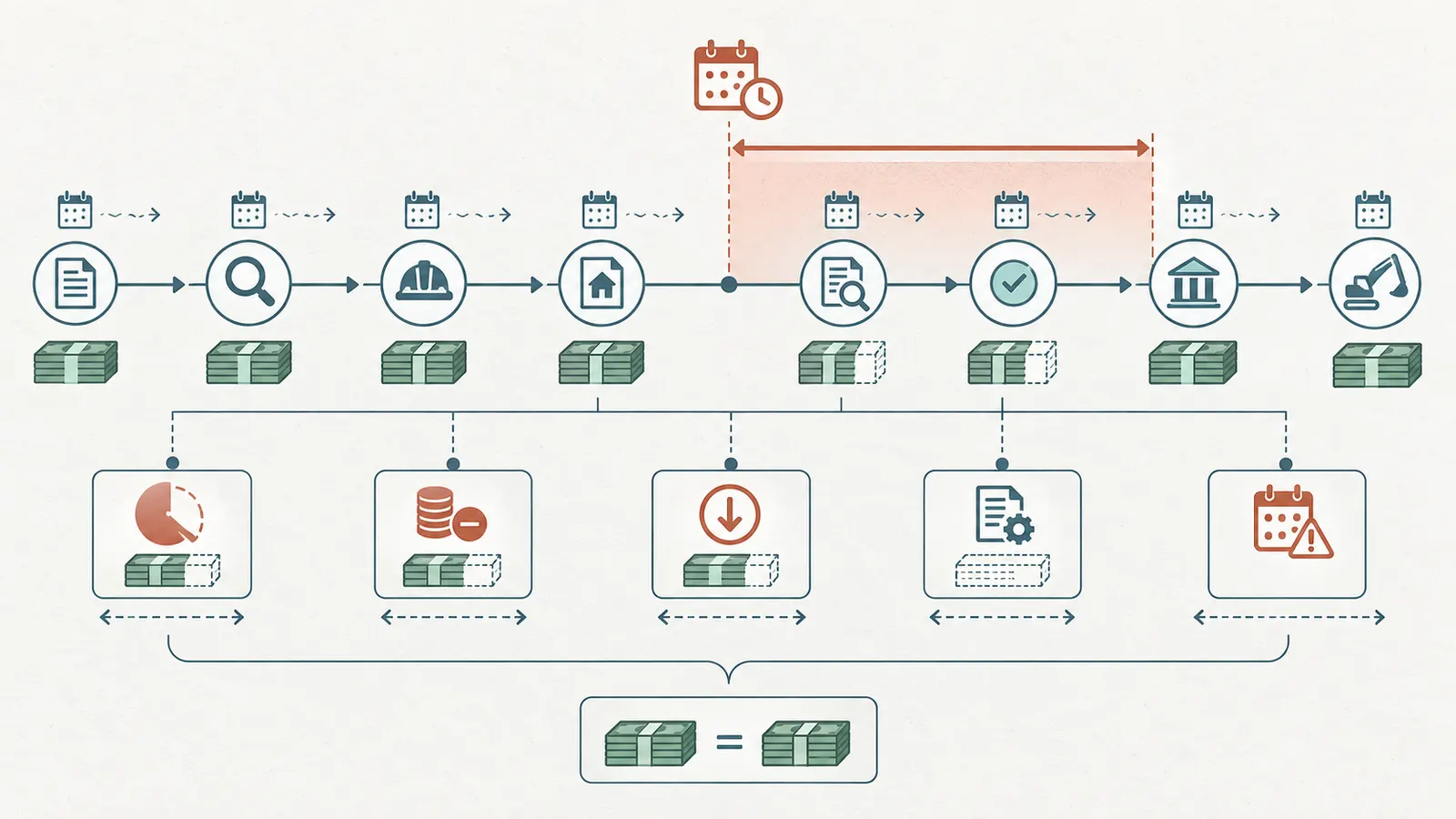
Track the loan term as a separate deadline
A draw delay becomes more serious when the construction period is near maturity. First Merchants says its process sends extension paperwork 15–30 days before maturity and that no additional draw requests are processed after the predetermined period until a modification and appropriate extension fee are received. That is one lender’s published policy. Other lenders may have different notice periods, fees, underwriting, or no extension availability.
Put these dates on the same worksheet as the draw:
- construction-period maturity date;
- latest date for an extension request under the agreement;
- expected date of final inspection and local occupancy approval;
- final draw submission date;
- permanent-phase conversion or payoff date;
- builder’s completion and warranty handoff date.
If the loan will mature before the expected final funding, contact the lender’s construction administrator immediately and ask for the written extension process, fee, required documents, and whether the current draw can be processed while the extension is under review. Do not assume that a pending extension preserves access to funds. Do not use a new loan, credit card, or other borrowing to bridge the gap without personalized advice from a qualified financial professional; that is outside this guide.
Submit the package and monitor it through actual funding #
Submit through the lender’s specified channel, record the complete timestamp, and maintain a status log until the funds are received and allocated. The homeowner’s control is not the ability to accelerate every party; it is the ability to see which gate is open, who owns it, what amount is at stake, and what must happen next.
The submission sequence
Use this sequence for each draw, adapting the names and order to the actual agreement.
- Close the period. The builder and homeowner agree on the date through which work is claimed. Save the budget version and prior draw ledger.
- Reconcile line by line. Match each claim to the original budget line, prior approved amount, current evidence, and remaining budget. Split installed work from stored material or deposit status.
- Prepare payment evidence. Gather invoices, payment allocation, vendor list, sworn statement, and waivers or releases only in the forms requested by the lender or title provider. Keep conditional and unconditional status explicit.
- Prepare the site. Make the claimed work accessible and safe for the scheduled inspection. Do not conceal work that must be inspected, and do not create a hazard for a photographer or inspector.
- Obtain borrower authorization. Review the amount, payees, fees, holdback, and cash bridge. Sign or authorize the lender’s form only if it accurately states what you know and what the form asks you to certify.
- Submit once, with a version. Use the required portal, lender email, or title-company channel. Do not send multiple totals to different parties unless each version is labeled and the lender confirms which one controls.
- Capture receipt. Save the portal confirmation, email, time, draw number, and package index. Ask whether the request is complete enough to order inspection and title work.
- Watch the inspection gate. Record the order date, scheduled date, report receipt, adjustments, photos, and unresolved questions. If the inspector cannot access the site, record the new appointment rather than assuming the original clock continues.
- Watch the title gate. Record the title update date, clear status or exceptions, waiver deficiencies, and the person resolving each exception. Forward recorded notices to the lender promptly.
- Watch lender review. Ask whether the amount is pending, approved, reduced, conditioned, or declined. Request the line-level reason for a reduction and the exact correction path.
- Record funding separately. Save the funding notification, wire or check reference, approved amount, holdback, fee, payees, and actual date funds reached the title company or builder. A portal status that says “approved” is not the same as a bank or title payment record.
- Close the draw. Reconcile funded amounts to the ledger, confirm builder and supplier payments, collect the next required waivers or releases, and carry forward the correct prior approved and funded totals.
This handoff pattern mirrors the stakeholder sequence described by WaFd Bank and the inspection, title, lender, and disbursement steps described by Land Title Guarantee. Land Title’s page is especially useful for showing that a title provider may receive a request, perform inspection and title work, wait for lender approval, and only then disburse. Its stated five-business-day goal is a provider example, not a schedule to quote to a builder in another state.
Keep a requested–approved–funded ledger
At the bottom of every draw record, calculate totals in three columns:
| Stage | Meaning | Amount |
|---|---|---|
| Requested | Builder or borrower asks for this amount | $____ |
| Inspector-supported | Inspection evidence supports this amount under the process | $____ |
| Lender-approved | Lender accepts this amount before holdback or fee treatment | $____ |
| Net disbursed | Actual funds sent after permitted deductions | $____ |
| Paid to builder or suppliers | Amount actually allocated to project payees | $____ |
| Unresolved difference | Requested minus approved, or approved minus funded | $____ |
An unresolved difference requires a note. Possible explanations include an inspection reduction, unapproved change order, lender holdback, title exception, fee, wire timing, split payment, or an accounting error. Do not roll a difference silently into the next draw. Carry it as an open issue with owner, date, and next decision.
Ask questions that produce a usable answer
When a draw stalls, use a short written request with the draw number and property address. Ask:
“Please confirm the current status of Draw __ for [property]. Our ledger shows requested $__, inspector-supported $__, lender-approved $__, and funded $__. Please identify the open gate—document, inspection, title, waiver, budget, borrower authorization, fee, or funding—and name the exact document or correction required. Please also confirm whether the request remains in queue, whether the inspection has been ordered, the expected next business-day event, and whether the construction-loan maturity or builder payment date creates a required escalation.”
This question does not demand a guaranteed approval or timeline. It asks the lender to identify the controlled state. If the lender says the title company owns the next step, forward the same ledger to the title provider. If the title provider says the lender must approve, return the exact status to the lender. Keep the chain visible to the homeowner, builder, and authorized parties.
Continue the broader journey with Brictale’s planning and budget path, construction management path, and handover and ownership path. Those are journey routes, not replacements for your lender or local authority.
Choose the next action when the package fails #
When a draw package fails, classify the failure before reacting: correct the evidence, reduce the claim, fund a confirmed shortfall, revise the approved budget, wait for a controlled inspection or title event, or escalate a deadline. Do not respond to every failure by resubmitting the same packet or paying the builder from cash without confirming the remaining loan and lien consequences.
Failure matrix
| Failure case | What to observe | What it may mean | Safest next step | Owner and evidence |
|---|---|---|---|---|
| Request returned as incomplete | Portal or email lists missing items | The inspection or lender review has not started | Ask for one consolidated deficiency list and the complete-submission timestamp after correction | Homeowner logs; lender confirms |
| Current claim exceeds inspector amount | Inspector report has lower line value | Work was not present, not installed, inaccessible, or less complete than claimed | Ask for line-level reason; correct, defer, or request reinspection | Builder and inspector report |
| Current claim exceeds remaining budget | Formula caps the line | Prior draws or approved changes consumed the line | Reconcile prior approvals; use formal change-order or owner-cash path | Homeowner and lender ledger |
| Lender approval is below inspection amount | Lender reduces after inspection | Program rule, budget, documentation, credit or title condition | Request written reason and correction route; do not treat inspector value as money | Lender decision notice |
| Stored material or deposit rejected | Invoice exists but work is not installed | This loan or program pays only eligible installed work | Ask for written eligibility rule and supplier timing; do not relabel status | Builder, lender, invoice and contract |
| Waiver mismatch | Wrong period, claimant, amount, or conditionality | Title or lender cannot rely on the submitted release | Ask title provider for exact replacement form; obtain local-state advice if effect is unclear | Builder, title provider, property-state counsel if needed |
| New lien or notice appears | Recorded exception or notice from claimant | Title position or payment chain may be affected | Forward immediately to lender and title provider; stop informal assurances | Homeowner, title provider, lender |
| Title update pending | No clear endorsement or exception resolution | Lender may not release even if inspection passed | Ask what document or payoff/release resolves the hold and who must deliver it | Title provider and builder |
| Change order signed but not financed | Contract price changed; budget did not | Builder obligation and loan commitment no longer match | Separate the change; obtain lender budget decision or identify owner cash | Builder, homeowner, lender |
| Builder needs payment before funding | Due date precedes expected funding | Normal construction cash timing has become a liquidity risk | Share the dated bridge; negotiate staged payment or escalate without promising funds | Homeowner and builder |
| Extra draw or inspection fee appears | Fee differs from expected amount | Contract may charge additional draws or services | Compare disclosures and agreement; ask whether collected, deducted, or billed separately | Homeowner and lender |
| Inspection delayed five business days | No report by expected date | Site access, provider capacity, weather, or missing documents may be blocking | Ask whether inspection is ordered and reset the cash and interest model | Lender or inspector; homeowner ledger |
| Loan maturity is near | Final draw or conversion will occur after term | Extension or modification may be required | Contact lender in writing before the deadline; ask process, fee, and funding effect | Homeowner and lender |
| Final draw lacks occupancy or insurance evidence | Home is physically near completion but closeout documents absent | Final funding or permanent conversion gate is open | Ask local building department for exact final document and insurer for required coverage; send lender copies | Homeowner, local authority, insurer, lender |
| Builder disputes the approved amount | Builder says the lender is short-paying | Contract amount, eligible draw, and lender release are being conflated | Put requested, approved, funded, and contract due amounts in one record; seek contract or legal advice if unresolved | Homeowner, builder, lender |
Reduced draw: correct, bridge, or escalate
A reduced draw has three separate questions. First, is the lender’s amount correct under the evidence and agreement? Second, when is the builder’s payment actually due? Third, can the homeowner bridge a confirmed shortfall without compromising other obligations? Answer them in that order.
If the reduction is factual—an inspector missed installed work, a prior draw was duplicated, or an invoice was attached to the wrong line—send a targeted correction. If the reduction is contractual—the item is not eligible, the budget is exhausted, or a holdback applies—do not call it an error. Update the cash bridge and decide whether to defer the item, obtain a change-order approval, or pay from funds already reserved for that purpose. If the reduction is unexplained, ask the lender for the condition in writing and escalate through the lender’s construction administration or servicing contact.
Do not ask the builder to sign a payment waiver for money it has not received. Do not ask a supplier to “wait until the bank catches up” without recording the new due date and the title or lien implications under the property state’s law. If a lien notice or payment dispute is active, get advice from a qualified attorney in the property state and the title provider; Brictale cannot determine priority or waiver effect remotely.
Missing waiver or title exception: pause the right thing
Pausing the draw does not necessarily mean pausing construction, and proceeding with construction does not necessarily mean the draw can be funded. The next step depends on the exception. A missing waiver for a paid invoice may be a document chase. A claimant disputing payment may be a substantive payment and title issue. A recorded lien may require a release, bond, payoff, court process, or other state-specific remedy. The lender and title provider should identify their requirements; a qualified local attorney should advise on legal effect.
Create a short exception record:
- claimant or document name;
- property address and affected draw;
- amount and period claimed;
- whether the claim is recorded, noticed, disputed, or merely missing evidence;
- the title provider’s exact status;
- the lender’s exact funding condition;
- builder’s response and payment record;
- next deadline and owner;
- whether any waiver has been signed and by whom.
Do not rely on a generic statement that “the builder is responsible for subs.” The contract may allocate payment responsibility between homeowner and builder, while state law and title underwriting determine separate rights and risks. Keep both the contract allocation and the title/legal status visible.
Delay and near-maturity: escalate with a completed ledger
An escalation works best when it contains the facts the next decision-maker needs: draw number, complete-submission date, inspection status, title status, requested and approved amounts, fees and holdbacks, builder due date, construction maturity date, and the exact relief requested. Ask for a yes-or-no answer to the next controlled event: inspection date, title cure document, lender review date, funding route, extension packet, or final closeout requirement.
If the construction period may expire, do not wait for the builder to solve the lender’s deadline. The lender may require a formal modification, extension fee, updated budget, revised completion date, or other underwriting. First Merchants’ published handbook is explicit that no additional draws are processed after its predetermined construction period until the modification and fee are received. Treat that as a warning about the category of risk, not as your lender’s rule.
Compact originality brief: how to check this contribution
Current answers. Published lender and title pages commonly explain what a construction draw is, list forms such as invoices, sworn statements, waivers, inspections, title updates, and borrower authorization, and describe a lender-to-title-to-builder payment flow. CFPB explains construction-period interest and the disclosure treatment of inspection or draw fees. These answers are useful but are often lender-facing or presented as a checklist.
Missing decision. The homeowner needs to decide whether the package is ready to submit, who must correct a missing item, what amount could actually arrive, what cash is exposed until it does, and what to do when inspection, title, budget, or timing gates disagree.
Original contribution. The draw-cycle reconciliation worksheet joins the approved budget, prior approved amount, current claim, installed-work status, inspector-supported amount, lender-approved amount, holdback, fees, title or lien status, dates, builder due date, homeowner cash bridge, and next owner. The worked example exposes inputs, units, formulas, and sensitivity to delay, holdback, fees, a change order, and reduced approval.
How it can be checked. A homeowner can compare each field to the lender’s budget and portal, the builder’s signed request and invoices, the inspector’s report, the title provider’s update or endorsement, actual funding records, and the property-state requirements confirmed by the title provider or qualified local attorney. The worksheet is successful when it makes a discrepancy visible and assigns the next handoff; it is not successful merely because its total matches the builder’s invoice.
The final decision should be one of six explicit states: submit, correct and resubmit, wait for a named inspection or title event, fund a confirmed shortfall from an already approved source, request a formal budget or loan-term change, or escalate to the lender, title provider, local authority, or qualified professional. Record that state, the responsible owner, the date, and the evidence that would move it to the next state. That record is what turns a draw package from a document pile into a managed construction-budget decision.
Cite this guide
Brictale. “How to Manage a Construction Loan Draw Request Package.” Published 2026-10-06; updated 2026-10-06.
https://brictale.com/build/budgeting/manage-construction-loan-draw-request-package · Read the Markdown version
Original contribution: Draw-cycle reconciliation worksheet. A source-linked worksheet that reconciles each budget line to claimed work, inspection approval, lender approval, title or lien status, funding timing, and the homeowner's temporary cash exposure.
Sources and scope
Evidence behind this page
- Under Regulation Z's official interpretation of 12 CFR 1026.4(a), inspection and handling fees for the staged disbursement of construction-loan proceeds, including draw fees, are finance charges when imposed by the creditor as an incident to or condition of extending credit.
12 CFR § 1026.4 Finance charge — Consumer Financial Protection Bureau
United States federal Regulation Z interpretation; applies to the disclosure classification of covered consumer-credit charges, not to the amount or timing of a particular lender's draw fee.
Accessed · Link to this claim - CFPB construction-loan disclosure guidance explains that construction-phase interest-only payments are typically based on amounts advanced and may increase as advances accumulate; the contract controls the actual rate, balance, payment date, and any reserve treatment.
TRID Rule: Combined Construction Loan Disclosure Guide — Consumer Financial Protection Bureau
United States federal disclosure guidance for multiple-advance construction loans; descriptive of typical structures and not a personalized loan calculation.
Accessed · Link to this claim - CFPB Appendix D permits creditors, at their option, to estimate and disclose multiple-advance construction-loan terms when the amounts or timing of advances are unknown at consummation, and allows construction and permanent phases to be disclosed separately or together in specified circumstances.
Appendix D to Part 1026 — Multiple Advance Construction Loans
United States federal Regulation Z disclosure procedure; does not tell a homeowner which disclosure structure their creditor selected.
Accessed · Link to this claim - First Merchants Bank's published handbook describes a workflow in which the owner and builder submit a draw request, the lender orders an inspection and title endorsement, the title company authorizes release after review, and funds are wired to the title company for disbursement; its handbook says draws are tied to milestones or completed work.
First Merchants Bank Construction Loan Handbook
One lender's published residential construction-loan handbook; workflow, forms, title process, payment route, and milestone practice are not a national rule.
Accessed · Link to this claim - First Merchants Bank states that its site inspections are typically conducted 24–48 hours after receipt of a draw request and that inspections review completed work, materials on site, and percentage complete; this is an example of that lender's service expectation.
First Merchants Bank Construction Loan Handbook
First Merchants Bank's published handbook; not a national inspection deadline and not a statement that the inspection guarantees workmanship.
Accessed · Link to this claim - First Merchants Bank says state-specific requirements may include a builder's sworn statement and lien waivers, and its handbook states that a draw cannot be processed without the correct waiver of lien form under its stated process.
First Merchants Bank Construction Loan Handbook
A lender's process plus its warning that requirements vary by state; not a statement of the lien-law form, timing, or waiver effect in every United States jurisdiction.
Accessed · Link to this claim - First Merchants Bank's handbook states that at least 5% of total construction hard costs must be held for the final draw and that final completion documentation is required before remaining funds are released; it also lists a certificate of occupancy and conversion to standard homeowners insurance for its final-draw process.
First Merchants Bank Construction Loan Handbook
First Merchants Bank's published requirements; holdbacks, final documents, insurance, and occupancy requirements vary by lender, loan program, property jurisdiction, and contract.
Accessed · Link to this claim - HUD Form 9746-A instructions for its Section 203(k) rehabilitation process state that the borrower or contractor records previous draw totals and the request for the current draw, that materials cannot be paid for until acceptably installed, that an inspector or lender may reduce an amount, and that the inspector cannot approve more than the amount requested.
Instructions: Prior To Appraisal / During Construction, Form HUD-9746-A
HUD's Section 203(k) rehabilitation draw form and instructions; useful as a published control example, not a universal rule for conventional new-home construction loans.
Accessed · Link to this claim - Mercantile Bank's construction guide lists borrower authorization, an updated builder's sworn statement, lien waivers for previous payments, a site inspection report for each draw, and a title update as draw requirements; it also states that borrower overages must be covered before release in its process.
Construction Guide — Mercantile Bank
One lender's published construction guide; document names, overage treatment, and payment sequence are lender- and program-specific.
Accessed · Link to this claim - Mercantile Bank's guide says its final-draw process requires a final appraisal inspection, a permanent certificate of occupancy, homeowners insurance, and payment of remaining builder overages before final loan funds are used; it describes construction-to-permanent conversion as a separate phase of its process.
Construction Guide — Mercantile Bank
Mercantile Bank's published final-draw and conversion guidance; not a national closeout checklist.
Accessed · Link to this claim - WaFd Bank's Built construction-management page presents a stakeholder sequence in which the lender activates the loan, the builder or borrower submits a draw, an inspection is requested and conducted, the lender reviews, approves, and disburses, and the builder or borrower receives a funding notification.
WaFd Bank's described software workflow; it is an example of a platform and lender sequence, not a universal service-level agreement.
Accessed · Link to this claim - Land Title Guarantee describes a Colorado title-provider process in which a draw triggers a physical inspection and title update, clear results are sent to the lender, approved funds are sent to Land Title, and disbursement occurs within 24 hours of funding; it states a goal of five business days from submission to checks ready.
Construction Loan Disbursement — Land Title Guarantee Co.
A Colorado title company's published service description at its Denver headquarters; timing is a stated goal/example and depends on lender approval, documents, inspection, title condition, and local practice.
Accessed · Link to this claim - Land Title Guarantee says its 101 Endorsement service handles draw requests and inspections, provides lien-waiver protection to the lender, updates title with each draw, and cuts checks to subcontractors and suppliers according to the approved draw request.
Construction Loan Disbursement — Land Title Guarantee Co.
Land Title Guarantee's Colorado service offering; endorsement names, protections, waiver treatment, and disbursement roles vary by title provider, lender, and property jurisdiction.
Accessed · Link to this claim - The Federal Reserve's Commercial Bank Examination Manual describes construction loans as financing a project within a specified period funded by supervised disbursements over the construction period, and identifies cost overruns, delayed completion, payment diversion, contractor or supplier failure, and weak monitoring as construction-lending risks.
Commercial Bank Examination Manual, Real Estate Construction Loans
Federal supervisory examination guidance for banks; it explains lender risk controls and does not create a homeowner payment right or a project-specific approval standard.
Accessed · Link to this claim - First Merchants Bank's handbook says its builder may request 10% to 30% for materials that normally require deposits before production, giving windows, doors, cabinets, and countertops as examples; this is the bank's stated flexibility, not a general construction-loan rule.
First Merchants Bank Construction Loan Handbook
First Merchants Bank's published FAQ for its construction-loan process; the 10%–30% range concerns materials that ordinarily require production deposits and does not establish eligibility for another lender, loan program, or property jurisdiction.
Accessed · Link to this claim - First Merchants Bank's handbook says documented deposits eligible for reimbursement must be for custom or specialty items and are limited to 30% of that item's budget; the handbook does not make this a national rule or a promise that any particular deposit will be funded.
First Merchants Bank Construction Loan Handbook
First Merchants Bank's published glossary for its construction and renovation lending; applies only to the bank's stated documented-deposit process and its definition of custom or specialty items.
Accessed · Link to this claim - First Merchants Bank's handbook says its standard fee includes up to five construction draws for a 12-month loan or up to seven for an 18-month loan, and that supplementary fees apply per occurrence when additional draws are needed to complete the project.
First Merchants Bank Construction Loan Handbook
First Merchants Bank's published fee schedule; included-draw counts and supplementary-fee treatment are that lender's stated terms and do not determine another lender's fees or a borrower's contract.
Accessed · Link to this claim - First Merchants Bank's handbook says extension paperwork is sent 15 to 30 days before construction-period maturity, must be returned with the extension fee, and that no additional draw requests are processed after the predetermined construction period until a properly executed modification agreement and appropriate extension fee are received.
First Merchants Bank Construction Loan Handbook
First Merchants Bank's published project-extension terms; the notice window, fee, modification requirement, and draw-processing condition are lender-specific and do not predict another lender's extension process or availability.
Accessed · Link to this claim