How to Maintain a Custom-Home Allowance Decision Calendar
Track each allowance from scope and selection through pricing, approvals, procurement and installation before it becomes an unfunded change order.
The short answer
Maintain one dated record for every open allowance. Define what the allowance includes, work backward from the installation or rough-in deadline, price the selected item with tax, freight, labor and markup, then route contract, permit and lender approvals before ordering. Reconcile the approved change, schedule of values, contingency and owner cash ledger before the next draw or handoff.How to Maintain a Custom-Home Allowance Decision Calendar
Maintain one dated record for every open allowance. Define what the allowance includes, work backward from the installation or rough-in deadline, price the selected item with tax, freight, labor and markup, then route contract, permit and lender approvals before ordering. Reconcile the approved change, schedule of values, contingency and owner cash ledger before the next draw or handoff.
An allowance is not a blank check and it is not a complete forecast. It is a contract or budget provisional amount whose meaning depends on its stated basis: what is included, what quantity or quality is assumed, who buys it, who installs it, and what happens when the final choice costs more or less. A calendar makes that provisional amount actionable. It gives every unresolved decision a responsible person, a date, a price path, a verification step and a next handoff.
This guide is for a United States homeowner during design development through procurement and installation. The controlling documents are your construction contract, plans and specifications, lender instructions, and the rules of the authority having jurisdiction for the property. A city example below is explicitly identified as Austin, Texas; a housing-finance example is identified as a dated HUD Section 184 program document; a lender example is identified as Pillar Private Lending; and a draw-record example is identified as the Wisconsin Housing and Economic Development Authority (WHEDA). None substitutes for the documents governing your project.
What the allowance calendar decides before a selection #
The calendar decides which open allowance must be resolved next by comparing its installation dependency, information quality, approval path, cash exposure and consequence of delay. It does not decide which faucet, tile, appliance or light fixture is aesthetically best; it decides whether the project has enough verified information to price and release that choice without creating an unmanaged change, delay or funding gap.
The decision is easy to state and easy to lose in a custom build: “Which unresolved choice needs an answer now, who must answer it, what will it cost under the contract, and what evidence proves that the next person can act?” A good record answers all four questions on one line. A weak record stores a product link or a meeting note without a quantity, deadline, approval requirement or funding consequence.
Treat each allowance as a live state, not a line of budget
Use the following states in order. A project may move backward when a quote is rejected, a permit reviewer requires a revision, or a selected product becomes unavailable, but the backward move should be recorded rather than silently overwritten.
| State | What is known | What must happen before the next state | Responsible handoff |
|---|---|---|---|
| Allowance | Contract basis and provisional amount | Confirm inclusions, exclusions, quantity and decision date | Homeowner with builder or contract administrator |
| Selected | Product, performance or design choice is identified | Verify dimensions, compatibility, quantity and written price basis | Homeowner to designer, builder or trade |
| Quoted | Supplier or trade has priced the defined scope | Compare like-for-like inclusions and validity date | Builder or estimator to homeowner |
| Approved | Homeowner and any required contract or lender parties have accepted price and treatment | Update contract log, budget, schedule of values and funding record | Contract administrator and lender contact |
| Committed | Purchase order, subcontract or other binding commitment exists | Confirm release, deposit, cancellation terms and delivery evidence | Builder or purchasing lead |
| Ordered | Supplier has accepted the order | Track confirmation, substitutions, damage process and delivery date | Builder or supplier |
| Received | Item or material is delivered and checked | Record quantity, condition, storage and remaining pieces | Builder, trade or homeowner representative |
| Installed | Work is installed in the intended location | Verify against approved selection, plans, manufacturer instructions and required inspection | Builder, trade and applicable inspector |
| Credited or changed | Final cost is reconciled to allowance or a change order | Post credit, variance, contingency and remaining commitments | Builder and homeowner; lender if required |
The state names are an original recordkeeping convention, not an industry certification or contractual definition. Use your contract’s terms if they differ. The point is to prevent the common collapse of “we discussed it” into “it is approved” or “the supplier sent a quote” into “it is funded.”
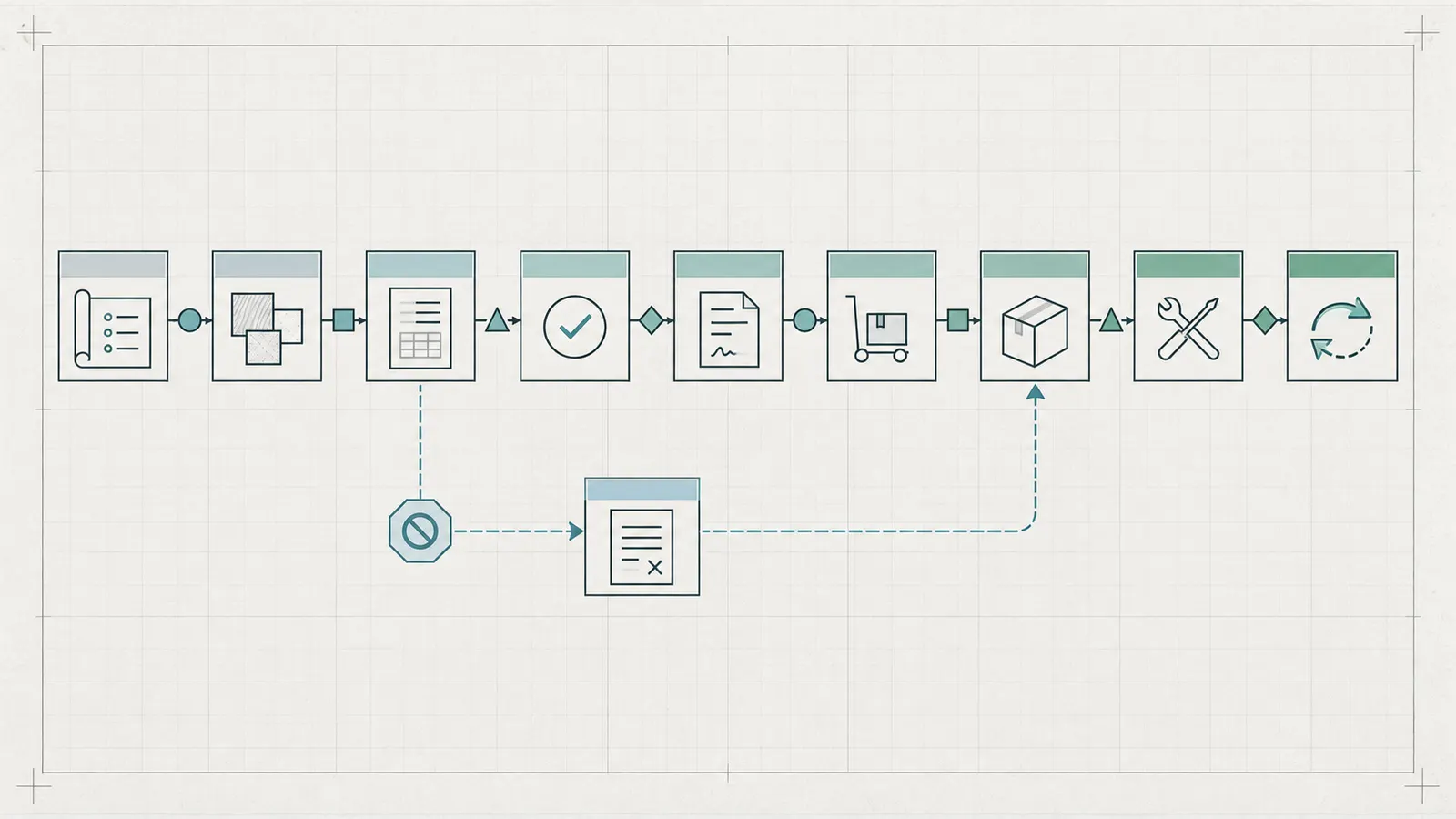
The calendar should also show a “blocked by” field. Typical blockers are an unfinished room dimension, an unavailable structural opening, a missing electrical load, an undecided plumbing fixture, a permit revision, an unresolved builder responsibility, an unconfirmed lender category, or a cash source that has not been authorized. A blocked item is not merely late; it tells you which upstream decision must move first.
Use a priority rule that follows the build, not the shopping list
Sort open allowances using five questions:
- Does installation, rough-in, framing, waterproofing, drywall, trim or final inspection depend on the choice?
- How many working handoffs remain between today and the physical release date?
- Can the price be compared with enough scope detail to make a responsible approval?
- Would a variance consume contingency, require owner cash, alter the loan budget or affect the draw record?
- What is the next irreversible action: design release, fabrication, deposit, ordering, demolition, concealed work or installation?
The highest-priority item is usually the one with the earliest irreversible handoff and the least reliable price information, not necessarily the most expensive item. In this illustrative comparison, a $2,000 shower valve can outrank a $20,000 appliance package if the valve location must be framed and pressure-tested this week while the appliance order is six weeks away. Conversely, a large appliance can outrank a small trim decision if it needs a dedicated circuit, a different cabinet opening or a long fabrication window.
Make the calendar a weekly decision meeting record
A calendar becomes useful when it is reviewed at a fixed cadence with the people who can release work. The homeowner can own the master record, but ownership of the record is not ownership of every technical or contractual decision. Before each meeting, request updated information from the builder, designer, trade, supplier and lender contact as applicable. During the meeting, close each line with one of four outcomes:
- proceed to the next state;
- return for a defined missing input;
- hold with a named consequence and next review date; or
- escalate because the choice may alter contract price, plans, permits, financing or safety.
Record the date, participants, documents reviewed and the exact next action. “Follow up on tile” is not an action. “Homeowner chooses one of the two tile assemblies after builder confirms square-foot quantity and whether waterproofing labor is included by Thursday at 3 p.m.” is an action.
What this calendar is not
It is not a substitute for an estimate, bid, contract review, construction schedule, lender approval, permit, inspection, design professional’s drawing or construction administration. It does not prove that a contractor’s price is reasonable, that a product will perform in a particular assembly, that a change is legally allowed, or that a lender must fund it.
It is also not a promise of lead time. A supplier quote may state an estimated date, but only a written order acknowledgment or other project-specific confirmation can establish what the supplier has accepted. Even then, transportation, damage, substitutions, inspections and site readiness can change the handoff. Keep the evidence attached to the line and write “estimated,” “confirmed,” or “not confirmed” rather than converting a guess into a date.
Set up each allowance with complete inputs #
Set up an allowance by reconstructing its basis before asking for a final selection. The minimum useful record includes the allowance amount and unit, included quantity, quality or performance assumption, included labor, tax and freight treatment, markup rule, exclusions, owner or builder responsibility, decision deadline, installation dependency, approval path and funding source.
The work is investigative. Start with the contract, allowance schedule, plans, specifications, addenda and selection policy. Then compare those documents with the builder’s estimate and the trade’s scope. If two documents disagree, record the conflict and send it to the person authorized to interpret or amend the contract. Do not resolve a material conflict by choosing whichever document produces the lower number.
The allowance basis worksheet
Create one row or card per allowance. Use a stable identifier such as “K-07 kitchen countertops” or “MEP-03 decorative lighting.” The identifier should stay the same even if the state changes or the product is substituted.
| Input | What to record | Why it changes the decision |
|---|---|---|
| Allowance ID and name | Room, system, trade and contract line | Prevents duplicate or missing decisions |
| Contract basis | Dollars, units, quantity, grade, model class or performance assumption | Defines what “inside allowance” means |
| Included work | Material, delivery, install, trim, fasteners, testing and cleanup | Separates a product price from a finished scope |
| Excluded work | Design, demolition, substrate correction, permit, tax, freight, storage or special equipment | Exposes future cash and change risk |
| Quantity basis | Count, linear feet, square feet, cubic feet, hours or lump sum | Makes quotes comparable and calculations reproducible |
| Responsibility | Homeowner, builder, designer, trade, supplier or lender contact | Makes the next handoff actionable |
| Selection evidence | Product number, drawing, finish, technical sheet or written description | Allows a second person to verify the exact choice |
| Price evidence | Quote date, validity, inclusions, exclusions and assumptions | Shows whether the price can be approved |
| Schedule evidence | Required-on-site date, fabrication or delivery evidence and dependency | Connects price to release timing |
| Approval gate | Contract, builder, designer, permit authority, lender or inspection | Prevents premature ordering or work |
| Funding source | Allowance, contingency, owner cash, contract credit, loan category or other documented source | Shows who pays and what must be updated |
| Current state | One state from the calendar | Prevents discussions from being treated as orders |
| Next decision | One verb, person and date | Turns the record into a workflow |
The quantity basis deserves special attention. “Kitchen allowance: $12,000” is not comparable with “30 square feet of standard tile supplied and installed” or “cabinet hardware by owner.” Ask whether the amount represents one fixture, a complete room, a group of rooms, a labor package, a material package or a total installed scope. Record units even when the contract uses a lump sum, because your variance analysis may need to explain what changed.
Separate product, labor and project costs
For a selected item, split the expected final cost into at least these buckets:
- product or material price;
- quantity and waste or overage assumption;
- sales or use tax where applicable;
- freight, delivery, unloading and storage;
- installation labor;
- required accessories, trim, blocking, controls, adapters or finish materials;
- design, engineering, testing or inspection costs attributable to the choice;
- builder or trade markup under the actual contract;
- permit or authority fees if the choice triggers a fee or revision; and
- credits for omitted or replaced scope.
Do not add a percentage “for everything” without naming what it covers. A percentage can be appropriate under a contract, but the basis may differ by builder, trade and cost category. Ask whether markup applies to supplier freight, subcontractor labor, owner-supplied material, taxes, permit fees, credits or only defined cost. If the contract is silent or ambiguous, send the question to the contract administrator or qualified legal adviser familiar with the transaction rather than inventing a universal rule.
Identify who may say yes
The person who chooses the finish may not be able to authorize the price. Build a responsibility map:
| Decision or action | Likely responsible party | Verify before relying on it |
|---|---|---|
| Choose appearance, feature or model | Homeowner, sometimes with designer | Written selection record and any design criteria |
| Confirm dimensions and interfaces | Builder, architect, designer or trade | Current drawings and field conditions |
| Price the complete installed scope | Builder, trade or estimator | Quote scope, tax, freight, labor and markup |
| Confirm contract treatment | Builder’s authorized representative and homeowner | Written contract interpretation or change document |
| Confirm design or permit impact | Design professional and authority having jurisdiction | Jurisdiction-specific submittal or written authority response |
| Confirm loan category or funding eligibility | Homeowner and actual lender or servicer | Current loan documents and lender’s written instruction |
| Release purchase or concealed work | Contractually authorized person, often builder or trade | Approved price, order terms and readiness evidence |
| Verify receipt and installation | Builder, trade and applicable inspector | Delivery record, approved selection and inspection record |
| Reconcile final cost | Builder and homeowner; lender if required | Invoice, credit or change order and updated budget |
“The builder knows” is not a record. “The lender will cover it” is not a record. “The permit office said it is fine” is not a record unless the actual authority and its communication are identified. A calendar can hold verbal context, but material authorization should be represented by the document your contract, lender or jurisdiction requires.
Establish the date backwards from a physical dependency
Start with the date the work must be ready on site or the date a concealed decision becomes irreversible. Work backward through:
- final installation or rough-in;
- site measurement and field verification;
- shop drawing or design review;
- supplier availability and fabrication;
- quote comparison and scope clarification;
- homeowner selection;
- builder, contract, permit or lender approval; and
- the internal review date that leaves room for corrections.
The resulting homeowner decision date is not the supplier’s lead time. It is the latest date by which the people and documents in the chain must be ready for the supplier to receive a complete release. Add a buffer whose reason is explicit: measurement uncertainty, review cycle, freight variability, site access, seasonal work, or a known lender cutoff. Do not claim a universal buffer; choose one with the builder and record the assumption.
For a choice that affects electrical, plumbing, structural framing, fire separation, accessibility, energy compliance, waterproofing or ventilation, the calendar should have a technical-review gate before the homeowner treats the choice as final. Aesthetic approval is not compatibility approval.
Work backward from installation and handoffs #
Work backward from the point at which a late decision would force concealed rework, missed procurement, an inspection problem or an unplanned payment. The homeowner’s job is to keep the chain visible; the builder, designer, trades, suppliers, lender and local authority each perform the part their documents and engagement assign them.
A decision calendar row that can be audited
Use this compact structure for every line:
| Field | Illustrative entry for a modeled cabinet-hardware allowance |
|---|---|
| ID and state | FIN-08; Quoted |
| Contract allowance | $1,200 for hardware, quantity not stated |
| Working basis | 42 pulls and 12 knobs, supplied by owner; install responsibility to confirm |
| Selected evidence | Product family, finish, center-to-center dimensions, supplier link and technical sheet |
| Expected cost | Product $1,050; tax $84; freight $40; install $180; markup $0; total $1,354 |
| Variance | $1,354 − $1,200 = $154 over allowance, before any contract credit or markup rule |
| Dependency | Must be selected before cabinet drilling and before hardware delivery to site |
| Owner | Homeowner chooses; builder confirms drilling and install scope |
| Approval gate | Builder confirms complete price and responsibility; lender check only if budget category changes |
| Evidence status | Product and supplier price dated; labor not yet written by builder |
| Decision date | Illustrative date: 2026-10-01, set from cabinet fabrication and site sequence |
| Next action | Builder issues complete installed-scope price and confirms whether $154 is a change or owner-paid difference |
This row is illustrative. The figures are modeled inputs, not a market quote, survey, contractor price or firsthand purchase. The value is the visibility of the missing labor confirmation and the unresolved contract treatment.
The handoff sequence
For each allowance, trace the following sequence and mark the handoff complete only when the receiving person has the information needed to act.
1. Contract basis to scope confirmation
The homeowner and builder compare the allowance schedule with the contract, plans and specifications. They mark what the allowance covers and what it leaves out. If an item was described as “owner selection” but the scope omits installation, the calendar records that as a question, not as an assumed inclusion.
The verification evidence is a document reference: contract section, estimate line, plan sheet, specification section, selection policy or written clarification. A screenshot of a shopping cart is not enough because it may omit tax, delivery, installation or accessories.
2. Scope confirmation to comparable evidence
The person pricing the work requests a quote or price basis that uses the same quantity and scope for every option. For custom work, request the drawing, material, dimensions, edge or trim profile, finish, hardware, delivery point, installation method and exclusions. For a packaged system, request the model, options, required accessories and commissioning or testing responsibilities.
Comparability matters more than the number of quotes. Three prices that exclude different work are not a three-way comparison. One complete, bounded quote may be more informative than several product-only prices, provided its assumptions are visible.
3. Evidence to technical review
The builder, design professional or trade checks fit, clearances, rough-in, loads, connections, substrate, access, sequencing and manufacturer requirements. The homeowner can collect dimensions and product information, but should not infer compatibility from a product photograph or retailer description.
For structural, electrical, gas, plumbing, fire-safety, waterproofing or ventilation consequences, use the qualified professional responsible for that design or installation. A lender’s draw inspector does not become the design professional because the inspector visits the site. Pillar’s draw guidance expressly distinguishes visible progress review from code inspection, quality warranty and engineering review. Read the lender-specific distinction between draw inspection and technical oversight.
4. Technical review to approval route
Route the decision to every required authority before purchase or concealed work. The route may include homeowner, builder, architect, interior designer, trade, lender, title or draw administrator, and the authority having jurisdiction. The calendar should show a blank field for “not applicable” only after someone with the appropriate responsibility confirms it.
Do not treat a local fee example as a national fee. For example, the City of Austin, Texas says its FY 2025–26 fee schedules took effect October 1, 2025. Its Land Development Engineering page lists examples such as $180 for residential driveway or sidewalk review, $100 for a site-plan completeness check and $690 for a site-plan revision, while directing applicants to Austin’s Land Development Code and Transportation Criteria Manual for complete details. Check Austin’s current fee page. Check Austin’s Land Development Engineering guidance and cited local code.
Those numbers belong to Austin, Texas and to the stated fiscal-year schedule. They do not establish a fee for another city, county, state, tribal jurisdiction or private utility. If a selection changes a plan, site feature, right-of-way condition or permit application, ask the actual authority having jurisdiction or the design professional handling the submittal what review is required and what current fee applies.
5. Approval to release
The release package should contain the approved selection, complete price basis, contract treatment, responsible payer, required technical documents, required permits or approvals, order terms, required-on-site date and a confirmation that the site is ready. A release with only a product name and a deposit amount is incomplete.
For a lender-funded project, ask the actual lender how a selection is reflected in its budget, draw category, contingency, borrower contribution and documentation process. The CFPB construction-to-permanent disclosure example separates construction contract cost, third-party expenses, contingency reserves, interest-reserve account and other adjustments or allowances. That is useful vocabulary for asking where a cost sits, but it is a disclosure example, not a promise that your lender will use those categories. Review the CFPB’s construction-to-permanent disclosure example.
6. Release to receipt and installation
The builder or purchasing party confirms that the supplier accepted the order, the ordered quantity and specification match the approved record, and the item is scheduled for the intended location. On receipt, the responsible person records cartons, serial numbers, visible damage, finish, dimensions and storage conditions. The delivery record should be attached before installation hides the evidence.
If the item is damaged, substituted, short, late or incompatible, stop the affected handoff and record who decides whether to replace, repair, accept, credit or change the scope. Do not let a field substitution become a permanent change because the original product was not present when the trade arrived.
7. Installation to reconciliation
After installation, compare the installed work with the approved selection and scope. Record the final invoice, credit, unused allowance balance, approved change, owner-paid amount, warranty or care information and any open punch-list item. The final state is not “installed” until the financial and documentary records agree.
Lender and builder responsibilities are different
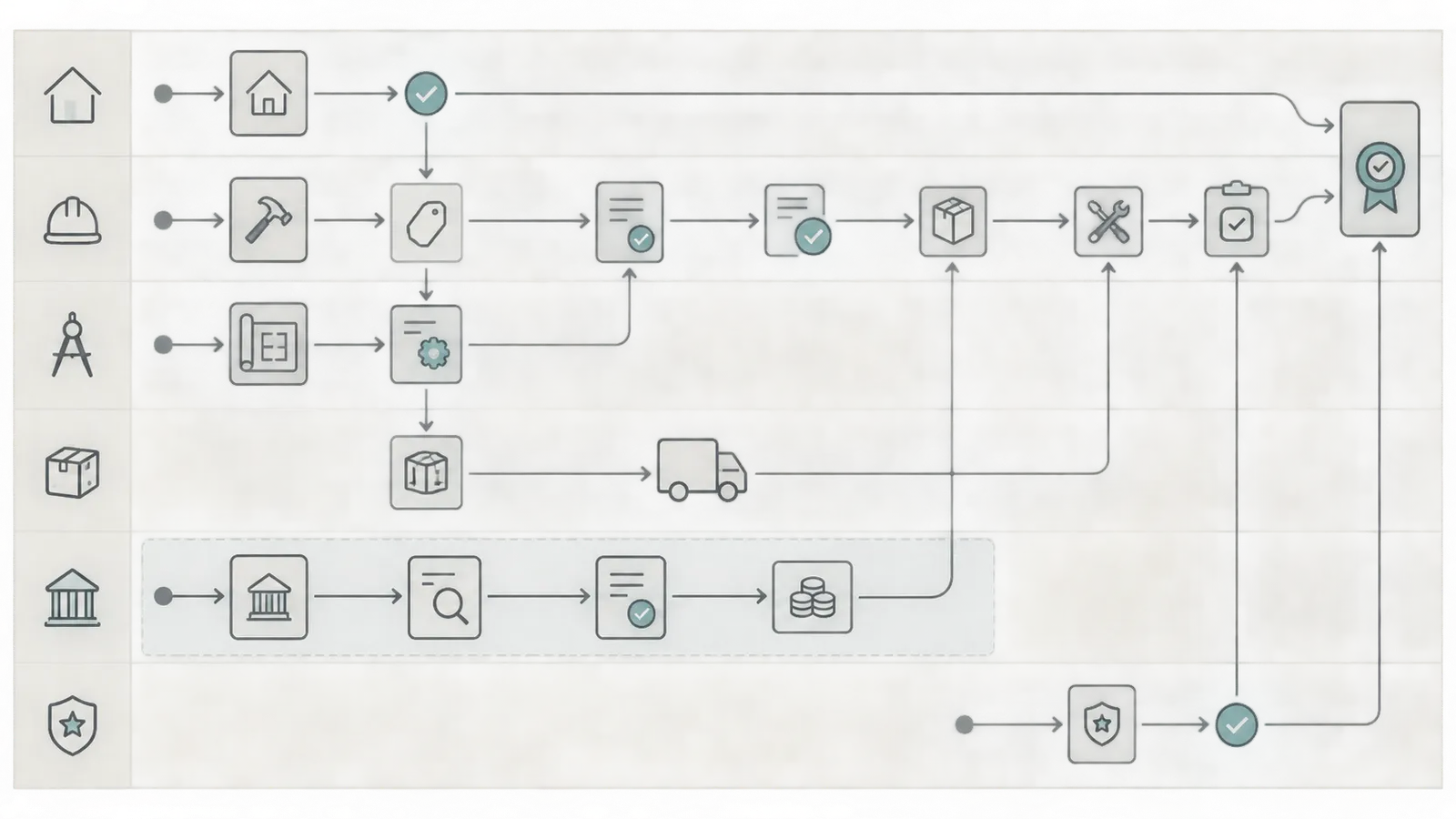
The builder coordinates construction means, methods, trade scopes and site sequence under the contract. The lender controls its own approval and disbursement rules. The municipality or other authority controls its required permit and inspection process. The design professional controls the professional work assigned to that person. The homeowner controls personal selections and payment decisions within the authority granted by the contract and loan documents.
A draw inspection can confirm visible progress for a funding decision without confirming that a selection complies with every code, performs as intended, or matches every invoice. Pillar Private Lending says its draw inspection is not necessarily a code inspection, quality warranty, engineering review or invoice certification. Use the actual engagement and lender instructions for the project.
The safe question at each handoff is: “What exactly is this person being asked to verify?” The answer might be “the item is at the site,” “the requested work is visibly complete,” “the price is within the contract allowance,” “the plan revision is ready for submittal,” or “the lender has approved a budget reallocation.” These are different verifications and should not be merged.
Price variance and owner cash exposure #
Calculate variance from the complete installed-scope cost, then separately calculate who must fund it and whether it changes contingency, the loan budget, a draw category or the contract price. The key formula is not simply selected product minus allowance; it is total approved cost for the defined scope minus the allowance basis, adjusted for credits and the contract’s stated markup and tax rules.
The core formulas
Use consistent units and round only at the final presentation step. Before doing any arithmetic, assign every cost line to one mutually exclusive bucket. This is the control that prevents an owner-paid product or a deposit from being counted once in a complete installed scope and again as a funding gap.
| Bucket | Meaning | Count in selected installed scope? | How to treat it in cash reporting |
|---|---|---|---|
| I — included contract scope | A product, tax, freight, labor, accessory, fee or markup that the contract or allowance says belongs in this installed scope | Yes | It affects allowance variance; it becomes owner cash only if the covered amount leaves a residual that is not funded |
| E — outside-contract owner cash | A cost deliberately excluded from the contract price and assigned to the homeowner, such as an owner-purchased product for a separate scope | No | Add it once to owner cash exposure; never also place it in I |
| D — unfunded included-scope residual | The part of the included scope that remains uncovered after the documented allowance, approved change, lender approval or approved contingency allocation | No; it is a derived residual, not another cost | Add it once to owner cash exposure; do not add the underlying I line again |
| T — timing-only float | Covered dollars that must be paid before the documented funding source arrives, such as a deposit on an I item | It remains in I | Track separately as near-term cash timing; do not add it to total project cost, E or D |
Do not use E for an item that is already in I. Do not use D for the full cost of an item already in I; D is only the uncovered remainder after coverage is identified. Do not use T for a permanently ineligible or excluded amount: classify that amount as E or D according to whether it is outside the contract or an uncovered part of included scope. If a deposit is later reimbursed or paid through the contract, it remains an I cost with a T timing note, not a second cost.
Let:
- (A) = allowance amount for the stated contract basis;
- (Q) = selected quantity;
- (P) = unit product or material price;
- (Tax) = applicable tax amount;
- (F) = freight, delivery, unloading and storage;
- (L) = installation labor;
- (X) = accessories, preparation, design, testing or other defined direct cost;
- (M) = contractually defined markup or fee;
- (C) = credit for omitted, replaced or unused contract scope;
- (E) = outside-contract owner cash assigned to the homeowner; and
- (V) = documented coverage for this allowance scope, such as the allowance, an approved change, a lender-approved budget allocation or an approved contingency allocation. V is a funding-source total, not an additional cost.
Then calculate:
Selected installed scope (I) = (Q × P + Tax + F + L + X + M), using only lines classified as included contract scope
Allowance variance = I − (A) − (C)
Unfunded included-scope residual (D) = max[0, (I − C) − V]
Owner cash exposure = (E) + (D)
The allowance variance describes the contract-line difference. Owner cash exposure describes only amounts assigned to the homeowner: outside-contract cost E plus the uncovered included-scope residual D. There is no safe formula that adds the allowance variance, E and D together, because the variance and D can describe the same included-scope dollars. If a lender has approved only part of an overage, put the approved amount in V and calculate D from the remainder.
Track T, the timing-only float, in a separate cash-timing column. T is the covered part of I that is payable before its funding source arrives, excluding any amount already classified as E or D. For a near-term cash check, use cash due before funding = E due now + D due now + T. This is a liquidity view, not a new project-cost total. A $350 deposit on an included countertop order can appear in T, but it cannot also appear in E or D unless the contract or lender ultimately leaves that same $350 uncovered.
Let (S) = starting contingency, (R) = approved credits or transfers into contingency, and (K) = approved changes expressly allocated to contingency. Identified but not approved exposure is tracked separately and is not deducted yet.
Remaining contingency = (S) + (R) − (K)
These formulas are a recordkeeping model. They do not determine whether a cost is legally owed, tax-exempt, eligible for a loan, or chargeable under a specific construction contract. Ask the builder, lender, tax adviser or legal adviser for the project-specific treatment.
A worked illustrative example
Assume a modeled countertop allowance of $9,000. The contract basis says the allowance is for the countertop material and ordinary installation, but the record does not yet say whether sink cutouts, a waterfall edge, tax, freight or backsplash are included. The homeowner selects a stone at 55 square feet at $112 per square foot. The builder’s written scope then supplies these illustrative inputs. Every row in the first table is classified as I, because the modeled contract basis treats it as part of the selected installed countertop scope:
| Input | Illustrative value | Calculation or note |
|---|---|---|
| Allowance (A) | $9,000 | Contract provisional amount |
| Quantity (Q) | 55 sq ft | Field measure to be verified before fabrication |
| Product price (P) | $112/sq ft | (55 × 112 = $6,160) |
| Tax (Tax) | $492.80 | Illustrative 8% applied to $6,160; actual tax jurisdiction and taxable base control |
| Freight and delivery (F) | $375 | Written supplier amount, illustrative |
| Installation labor (L) | $2,150 | Includes ordinary set and seam labor in the modeled scope |
| Cutouts and edge work (X) | $680 | Two cutouts and selected edge profile, illustrative |
| Markup (M) | $0 | Contract rule assumed to be no additional markup in this example; verify actual contract |
| Credit (C) | $0 | No omitted scope credit identified |
| Selected installed scope (I) | $9,857.80 | $6,160 + $492.80 + $375 + $2,150 + $680 |
| Allowance variance | $857.80 over | $9,857.80 − $9,000 |
The arithmetic is inspectable, but the inputs are not a quote. The 8% tax is an illustrative assumption, not a national rate. The quantity, labor and fee treatment must be replaced with project evidence. If the backsplash was originally inside the allowance and is now omitted, a documented credit may reduce the variance. If the substrate requires repair, that could be a separate scope item rather than a countertop-selection cost.
Now partition the costs that are outside that installed scope. Suppose the homeowner separately buys $240 of backsplash tile that the contract excludes, and the stone supplier requires a $350 deposit. The tile is E: it is not in I and is counted once in owner cash. The deposit is not E and is not D; it is T, because it is a payment-timing fact attached to an I cost. It may be reimbursed or included in a later draw according to the actual contract and lender process.
| Separate funding record | Illustrative value | Bucket and treatment |
|---|---|---|
| Owner-purchased backsplash tile, excluded from countertop contract scope | $240 | E; outside I, so add once to owner cash exposure |
| Supplier deposit on the included stone order | $350 | T; inside I, so track only as cash due before covered funding |
| Documented coverage for the countertop scope | $9,300 | V; allowance plus a $300 approved coverage amount |
| Unfunded included-scope residual | $557.80 | D = max[0, ($9,857.80 − $0) − $9,300] |
| Total owner cash exposure | $797.80 | E + D = $240 + $557.80; the $350 T deposit is not added again |
If the $240 backsplash is later added to the contract, reclassify it into I with its own product, tax, freight and labor lines; remove it from E before recalculating. If the lender later approves the full $9,857.80 included scope, D falls to zero and owner cash exposure becomes $240, subject to the actual payment path. If the deposit is not covered and becomes permanently the homeowner’s responsibility, classify that same $350 once as E or as part of D—never both—and remove it from T. The point of the partition is that a line changes buckets when its contractual or funding status changes; it is not copied into a second bucket.
Suppose the actual lender funds only the original approved category and requires written approval before a budget increase. The $857.80 allowance variance may be a contract change, owner-paid difference, contingency draw, budget transfer or combination. The calendar cannot choose among those possibilities. It must identify the documented amount in V, calculate the remaining D, record any T timing, and route the question to the builder and lender before fabrication.
Show price sensitivity instead of pretending to know the final number
Use a sensitivity table when price, quantity, freight, labor or fee treatment is uncertain. Keep one variable change per row unless a scenario intentionally combines them. For the modeled countertop example, hold tax at the illustrative 8%, freight at $375, labor at $2,150, cutouts and edge work at $680, and vary stone price and quantity. The table is for planning, not a market forecast.
| Scenario | Quantity | Unit price | Product subtotal | Modeled installed scope | Variance from $9,000 |
|---|---|---|---|---|---|
| Lower quantity, lower price | 52 sq ft | $96/sq ft | $4,992 | $8,596.36 | $403.64 under |
| Field-measured base | 55 sq ft | $112/sq ft | $6,160 | $9,857.80 | $857.80 over |
| Higher quantity, same price | 60 sq ft | $112/sq ft | $6,720 | $10,462.60 | $1,462.60 over |
| Same quantity, higher price | 55 sq ft | $132/sq ft | $7,260 | $11,045.80 | $2,045.80 over |
| Higher quantity and price | 60 sq ft | $132/sq ft | $7,920 | $11,758.60 | $2,758.60 over |
The lower-quantity row demonstrates why measuring before approval matters. The higher-quantity rows demonstrate why “the same kitchen” is not a stable quantity. A change to an island overhang, support, sink model or edge can change material, labor and technical review at the same time.
Test fee and markup sensitivity separately
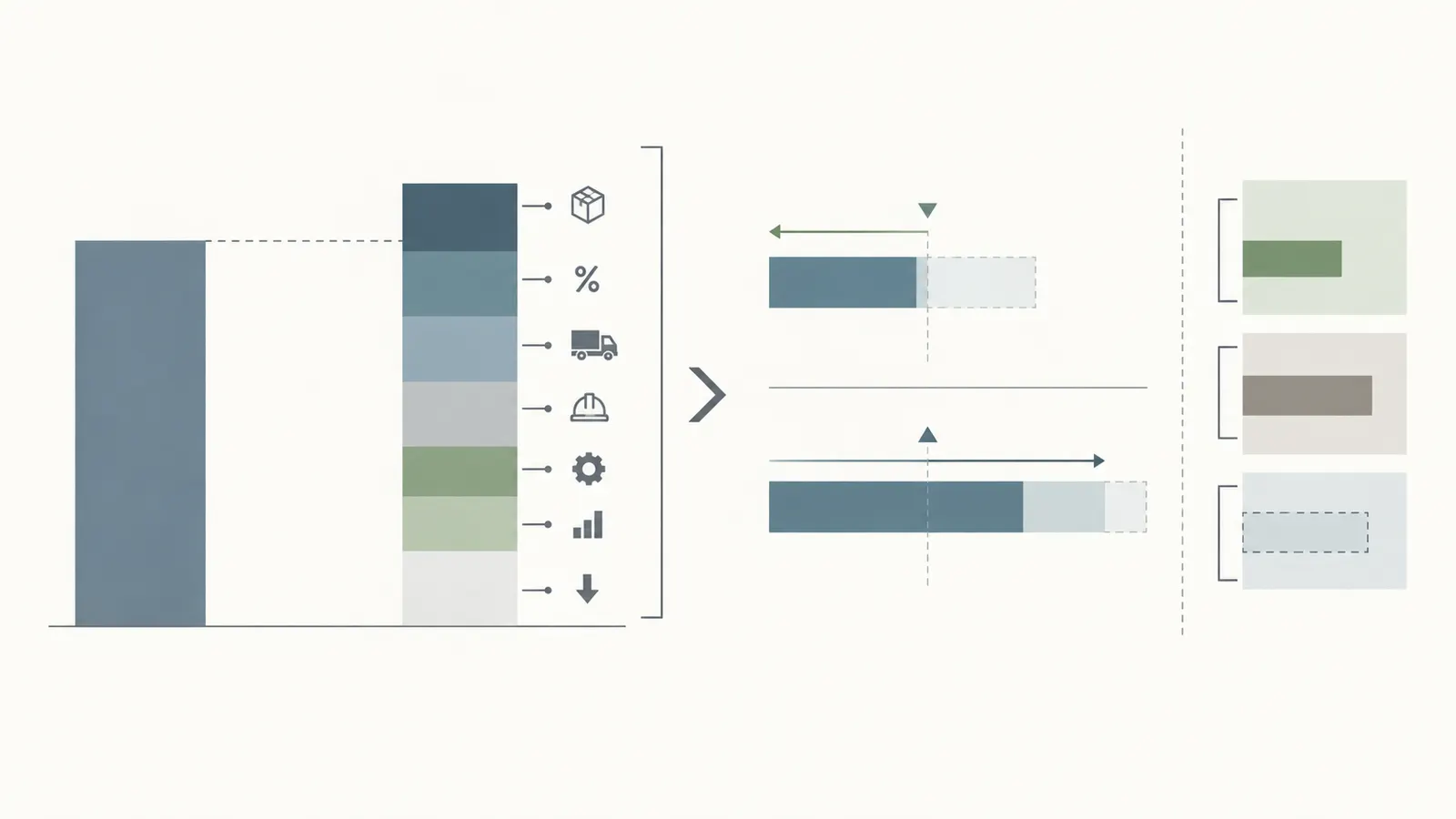
Do not bury uncertain fees in a contingency percentage. Run them as a visible scenario. If the modeled base has $6,160 of product, a contract markup of 10% on product plus freight, and a possible $250 design-review fee, then the question is not “add 10%.” The question is “does the contract apply 10% to product and freight, and who pays the $250 review?”
| Fee scenario | Markup basis | Markup | Added review fee | Modeled scope before allowance comparison |
|---|---|---|---|---|
| No extra fee | No markup in example | $0 | $0 | $9,857.80 |
| Product-only markup | 10% of $6,160 | $616 | $0 | $10,473.80 |
| Product plus freight markup | 10% of $6,535 | $653.50 | $0 | $10,511.30 |
| Product-only markup plus review | 10% of $6,160 | $616 | $250 | $10,723.80 |
These are modeled calculations. The percentages do not come from a national construction practice or a quote. Use the actual contract formula and local fee schedule. A local fee may not apply at all; an Austin, Texas fee should never be copied into another jurisdiction.
Track contingency without double counting
A contingency ledger should distinguish four things:
- a reserve that has not been assigned;
- a variance that has been identified but not approved;
- a change that has been approved and funded from the reserve; and
- an owner cash exposure that is outside the reserve or not yet eligible for a draw.
Suppose starting contingency is $35,000. The calendar identifies the countertop variance at $857.80, a $2,400 lighting variance and a $1,100 permit revision estimate, all illustrative. If only the countertop is approved and allocated to contingency, remaining contingency is $34,142.20. The lighting and permit figures remain identified exposure, not deducted and not treated as paid. If both are later approved and allocated to contingency, the ledger becomes $30,642.20, subject to the actual lender and contract treatment. If either is assigned to owner cash instead, it remains outside the contingency subtraction and appears in the owner-cash ledger.
This distinction prevents two opposite errors. A homeowner can overstate available contingency by ignoring known decisions, or understate it by deducting an estimate twice—once when it is identified and again when it is approved. Use separate columns for “identified exposure,” “approved contingency allocation,” “funding source,” “funded,” “paid,” “retained,” “owner cash,” and “remaining commitment.” An identified amount changes the exposure view; only an approved amount assigned to contingency changes remaining contingency. A credit used in the allowance variance is not entered again as a second cash deduction.
Include schedule cost, not only dollar cost
A late choice can cost money even when the product itself is within allowance. The calendar should note temporary storage, remobilization, expediting, resequencing, protection, temporary work, additional design time, lender review, permit revision and extended financing or housing costs only when they are documented or reasonably identified by the responsible party. Do not turn a possible delay into an invented dollar estimate.
Use a qualitative schedule exposure when the number is unknown:
| Schedule exposure | Meaning | Next evidence |
|---|---|---|
| None identified | Choice does not affect a current dependency | Builder confirms no release or rough-in dependency |
| Watch | Date or quantity uncertain, but alternate path exists | Supplier or trade confirmation and next review date |
| Active | The current sequence depends on the choice or approval | Written required-on-site date and recovery options |
| Critical | Late choice may stop work, conceal incompatible work or affect permit or financing | Builder/design professional/lender escalation before work proceeds |
The safer record says “schedule exposure: active; consequence not priced; builder to provide recovery options” instead of inventing “two-week delay.” The calendar is allowed to reveal uncertainty.
Decide allowance versus change order and approvals #
Treat a selection as a possible change until the contract administrator confirms in writing whether it is included, credited, priced under an allowance mechanism or handled through a change order. A homeowner’s preference and a contract authorization are different events.
Four contract-treatment outcomes
Use these as questions for the builder and contract administrator, not as universal legal categories.
| Outcome | What it might mean | Record required |
|---|---|---|
| Within allowance | Selected scope fits the defined basis and no excluded work changes | Selection record, complete price and responsibility confirmation |
| Allowance reconciliation | Actual defined cost is higher or lower than provisional amount under the contract’s allowance rule | Quote/invoice, variance, credit or charge calculation and approval |
| Owner-selected change | Selection adds scope, changes performance or replaces an included item | Written change description, price, schedule and authorization under contract |
| Unresolved extra or disputed scope | Documents conflict or responsibility is unclear | Open issue, competing interpretations, no release until authorized |
Do not label every overage a change order or every selection an allowance reconciliation. The contract controls. This is why the calendar includes both “contract treatment” and “state.” The record can say “quoted, contract treatment unresolved” without forcing a premature conclusion.
Use the dated HUD example correctly
The HUD Section 184 material dated April 1, 2011 provides a useful example of why written approval belongs before work. It says additions or subtractions to the cost estimate are accomplished through an approved change order during construction, and the referenced construction contract language says changes must be in writing and signed by the owner and accepted by the lender and HUD in that program. Its borrower certification also says work completed before an accepted change order may be at the borrower’s risk and that disbursement is subject to inspection and approval. Read the dated HUD Section 184 example at the relevant change-order and certification passages.
That document is not a national rule. It is not a legal conclusion about your contract, and it is not current evidence of every HUD or lender process. Its value here is the control concept: if a required approval is missing, the person ordering or performing the work may not have the funding or contractual protection they assumed. Your actual contract and lender documents may use different forms, signatures and timing.
Build the approval packet
For a material allowance, assemble one packet with:
- the original allowance line and contract reference;
- the selected product, model, finish, dimensions or performance description;
- current plans, elevations, shop drawings or specifications affected;
- quantity takeoff and field-measure record;
- quote or supplier confirmation with date, validity, exclusions and delivery terms;
- labor and installation scope;
- tax, freight, accessories, permit or review fees and markup basis;
- credit for omitted work, if any;
- allowance variance and funding source;
- schedule effect, required-on-site date and recovery option;
- permit, design or inspection question and responsible reviewer;
- lender budget, category, contingency or draw question;
- change-order or written-approval document, if required; and
- next handoff and verification evidence.
The packet can be short when the decision is simple, but it should not be incomplete. In this illustrative comparison, a $150 choice that affects a rough-in can need more technical documentation than a $3,000 finish that arrives after the affected work is complete.
The no-release gate
Pause ordering or concealed work when any of these conditions exists:
- the product is identified but dimensions are not verified;
- the quote is product-only and the contract decision is based on installed cost;
- quantity or waste assumptions are missing;
- the selection changes load, connection, clearance, support, waterproofing, fire or structural conditions and no qualified reviewer has responded;
- the contract says written approval is required and the approval is missing;
- the lender’s category, contingency or cash source is unknown;
- the quote is expired or a substitution has not been accepted;
- the supplier’s lead time is only a verbal estimate;
- the permit authority has not accepted a required revision; or
- the builder cannot identify who receives, stores, protects and verifies the item.
The no-release gate is a coordination control. It is not a claim that the homeowner may stop a contractor unilaterally in every contract. If work is scheduled imminently, notify the builder’s authorized representative and the relevant professional promptly, then follow the contract’s communication and dispute process.
What to do when someone says “we can fix it later”
Ask what “later” means in four documents: the selection record, the schedule, the budget and the approval path. If the answer is not written, put the item in the calendar as a blocked decision with an owner and a deadline. A field workaround can be sensible, but it needs a defined temporary condition, who pays, whether it will be removed, and what evidence closes the issue.
Do not let urgency turn into a silent change. The actual risk may be small, but you cannot evaluate it while scope, price or responsibility is invisible.
Reconcile lender draws and permit records #
Reconcile a selection across the contract budget, lender records, schedule of values, contingency ledger, payment ledger, permit file and installed work before treating the decision as complete. The governing lender and authority may require different records, but the homeowner should be able to trace the same dollar and scope from allowance through final installation.
Build a line-item reconciliation
For each allowance that affects financing or a draw, use a row like this:
| Reconciliation field | Required question |
|---|---|
| Original budget line | Where did the allowance appear in the approved budget or schedule of values? |
| Prior approved amount | What has already been approved or funded against the line? |
| Current requested amount | What is being requested now, and for what completed or committed scope? |
| Remaining balance | What budget remains after the current approval? |
| Cost to complete | What does it still take to finish the whole line, including committed and known exposure? |
| Borrower-paid amount | What has the homeowner paid and what evidence does the lender require? |
| Retained or held amount | What is withheld, by whom, under what document and when can it be released? |
| Change or transfer | Was the budget moved, and who approved the move? |
| Draw status | Requested, inspected, approved, funded, corrected, held or rejected |
| Final reconciliation | Does invoice, credit, change order, installed scope and budget agree? |
Pillar Private Lending describes these schedule-of-values fields as a way to connect approved budget with measurable progress and remaining balance, and says the schedule should reconcile with plans, specifications, the contractor agreement and approved budget. That is lender-specific educational guidance, not a universal form. Use your lender’s required schedule and cutoff process.
WHEDA’s January 2025 draw-process document gives another program-specific example: its budget summary tracks costs draw by draw against approved loan-budget line items, and its instructions call for supporting invoices and payment evidence for certain soft costs. Review WHEDA’s stated draw records and timing only as a program example.
The actionable lesson is not “all lenders need these exact forms.” It is “ask the actual lender what must agree before funds release, and maintain a copy of the submitted and approved version.” A homeowner who sees only a builder invoice cannot tell whether the lender approved the same amount, the same category or the same scope.
Do not schedule work to a generic draw promise
Draw timing may depend on a complete request, inspection availability, title or lien review, banking cutoffs, corrections, documentation and the lender’s internal process. Pillar says its timing varies with these dependencies and advises planning around the documented process rather than a promised generic draw date. Read the lender’s timing caveat.
For the calendar, record four different dates:
- the date work or material is ready for the request;
- the date the draw package is submitted;
- the date the lender or inspector confirms approval; and
- the date funds are actually available to the authorized payee.
Do not treat the inspection date as the funding date. Do not treat the lender’s approved amount as money already in the builder’s account. Do not treat a construction loan commitment as proof that a particular selection is eligible. The homeowner’s cash ledger should show the gap among these states.
Separate visible progress from code and quality verification
The calendar should have separate columns for lender or draw verification, municipal inspection, design or engineering review, and homeowner selection verification. A draw inspector may see that cabinets are installed; that does not necessarily verify the cabinet opening, anchorage, accessibility, electrical coordination, finish quality or contract compliance. A municipal inspector may inspect the work within the authority’s scope; that does not necessarily verify the homeowner’s price or supplier invoice.
If the selection affects structural work, electrical or gas work, plumbing, fire protection, egress, waterproofing or other regulated work, ask the responsible qualified professional what must be inspected or documented in the actual jurisdiction. A remote article cannot determine whether a permit revision, licensed trade, special inspection or professional certification applies at your property.
Track retainage and holdbacks without using them as free contingency
Retainage or a holdback may arise from a contract, lender, title process or applicable law, but the percentage and release condition are transaction-specific. WHEDA’s January 2025 process says it usually retains 5% of project hard costs until substantial completion in that program. Read the WHEDA source and do not generalize its 5% to another project.
Record retained amounts separately from remaining unearned budget. A held amount is not the same as free cash, unassigned contingency or an approved credit. Add the release condition, expected evidence and responsible person. If the final draw depends on substantial completion, certificate, lien release, inspection, occupancy document or other requirement, the calendar should show that dependency months before closeout rather than discovering it at the end.
The three-way closeout test
Before closing an allowance, compare:
- the approved scope and selection;
- the final installed work; and
- the financial record.
If any one differs, leave the line open. Examples:
- The installed faucet is a different model from the approved record: verify substitution approval and warranty documentation.
- The invoice is lower than the allowance: verify whether the contract requires a credit, whether unused labor was omitted, and whether tax or freight was billed elsewhere.
- The builder says the item is complete but the lender’s schedule shows no approved category: ask the lender and builder how it is funded before assuming the next draw will cover it.
- The draw was approved but the trade has not been paid: reconcile retainage, direct payment, borrower reimbursement and the contract’s payment path.
Close the line only when the discrepancy has an owner, written disposition and updated downstream records.
Run the weekly calendar and failure branches #
Run the calendar as a weekly control loop: refresh states and dates, compare each open item with the current construction sequence, escalate blocked handoffs, approve only complete packets, reconcile money after each decision, and set the next review date. The loop keeps the calendar alive after the original selection meeting.
A practical weekly agenda
Use a 30- to 45-minute meeting or asynchronous review, depending on the project’s communication plan.
Before the review
The homeowner updates selected items, price evidence, owner decisions and cash availability. The builder or project manager updates the current schedule, field dimensions, trade dependencies, approved changes, procurement status and items that must be released. The designer or architect updates affected drawings. The lender contact supplies current budget or draw questions only through the channel the lender permits. Suppliers update written availability and order status.
Do not ask every participant to review every allowance. Filter the list to items whose deadline, state, exposure or dependency changed. Keep an archive of the prior row so a date or amount change can be understood later.
During the review
For each item, read the answer-first line: “Decision required, by whom, by when, with what evidence, and what happens next.” Then ask:
- What changed since the last review?
- Is the current price for the same scope as the allowance?
- What is still excluded or unverified?
- Does the choice alter plans, rough-in, permit, inspection, schedule or funding?
- Who has authority to approve the next state?
- What evidence will prove the handoff is complete?
- What is the consequence if no decision is made by the next date?
End with a written action: person, verb, document, date and receiving party.
After the review
Change the state only when the evidence exists. Send the packet to the next person and record when it was sent. Update the contingency and owner cash ledger only for identified or approved amounts according to the ledger’s rules. Add a reminder for the next decision, not simply for the item.
Failure branch: selection chosen but not price-complete
Observe: The homeowner has selected a model or finish, but the quote covers only the product.
Interpret: The choice is in “Selected,” not “Quoted” or “Approved.” Installation, accessories, tax, freight, markup, preparation and possible plan changes remain unknown.
Do not infer: A retailer’s displayed price is the complete contract cost. A product being the same size as the allowance description does not prove that it fits the assembly or includes all work.
Safest next step: Ask the builder or trade for a defined installed-scope price with quantity, delivery, labor, accessories, exclusions and required-on-site date. Keep the allowance open and record the decision deadline.
Bring to a professional: contract line, product number, dimensions, current drawings, field measurements, installation method and any manufacturer requirements.
Next decision: Approve within allowance, approve a documented variance or route a change-order question.
Failure branch: quote is complete but allowance basis is unclear
Observe: The builder supplies a total but cannot say whether the allowance included the same material, quantity or labor.
Interpret: The numbers are not comparable. A lower total may omit work; a higher total may include work that belongs in another line.
Do not infer: The difference is automatically an owner upgrade or contractor overcharge.
Safest next step: Reconstruct the allowance basis from the contract, estimate, plans and specifications. Ask the builder’s authorized representative to identify inclusions, exclusions and contract treatment in writing.
Bring to a professional: both scopes side by side, quantity takeoff, plan reference, quote validity and any selection policy.
Next decision: Re-price like-for-like or resolve the contract interpretation before selection approval.
Failure branch: price is approved but lender category is not
Observe: The homeowner and builder agree on the overage, but the lender has not confirmed a budget transfer, contingency draw or borrower contribution.
Interpret: Contract approval and funding approval are separate gates.
Do not infer: An owner-signed change will automatically be funded. Pillar’s lender guidance states that an owner-approved change is not automatically eligible for loan funding. Read that lender-specific warning.
Safest next step: Send the approved scope and variance through the actual lender’s documented process before ordering if the loan is expected to fund it. Record the lender’s response, approved category, timing, required documents and owner cash amount.
Bring to a professional: loan budget, schedule of values, change order, cost-to-complete update, contingency balance and payment terms.
Next decision: Release with confirmed funding, release with documented owner cash, or hold while the lender reviews.
Failure branch: permit or design review appears after approval
Observe: A selected item changes a drawing, load, opening, right-of-way condition, fire separation, drainage condition or other regulated aspect after the budget approval.
Interpret: The financial decision is incomplete because the physical scope has changed.
Do not infer: A permit is unnecessary because a similar item was previously approved, or because a retailer says the product is residential.
Safest next step: Ask the responsible design professional and actual authority having jurisdiction what submittal, inspection or revision is required. Preserve the old approval and open a new technical-review gate.
Bring to a professional: approved selection, affected plan sheet, product documentation, existing permit number, jurisdiction and site-specific constraints.
Next decision: Revise the design, select a compatible alternative, obtain the required approval or document that the responsible reviewer found no change necessary.
Failure branch: item is ordered but site is not ready
Observe: The order is confirmed, but field dimensions, substrate, electrical rough-in, plumbing location, storage or access is not ready.
Interpret: The state is “Ordered,” not “Received” or “Ready for installation.”
Do not infer: Delivery equals acceptance, or temporary storage is harmless. Damage, moisture, theft, wrong quantity and premature installation can create a new dispute.
Safest next step: Builder and supplier confirm delivery, storage and inspection responsibility. If the item arrives early, document condition and storage conditions; do not install until the receiving trade confirms readiness.
Bring to a professional: purchase order, delivery terms, site photos, approved dimensions, manufacturer storage instructions and schedule.
Next decision: Accept and store, delay shipment if permitted, inspect and replace, or document a substitution or change.
Failure branch: the allowance is under budget but the project is still exposed
Observe: The selected item costs less than the allowance, but another scope item was omitted or the credit was assumed before final installation.
Interpret: A paper credit is not available contingency until the contract and final cost record establish it.
Do not infer: An apparent savings can fund another upgrade immediately.
Safest next step: Close the full allowance scope, confirm the final invoice and any required credit, then update the budget and contingency ledger. Keep a commitment for related work that remains incomplete.
Bring to a professional: allowance line, original scope, final invoice, omitted work list, installed photos and payment record.
Next decision: Post the credit, retain it against the original scope, or resolve the remaining commitment.
Failure branch: draw inspection passes but the selection is wrong
Observe: Funds were approved after a progress visit, but the installed finish, model or quantity does not match the approved record.
Interpret: Funding verification and selection verification were different controls. The issue may be a substitution, documentation error, workmanship issue or contract issue.
Do not infer: A funded draw proves acceptance of the product or waives the homeowner’s contract rights.
Safest next step: Photograph the installed condition, compare it with the approved selection and notify the builder through the contract’s process. Ask the lender whether any correction affects a draw record, but do not ask the lender to determine technical or contract responsibility.
Bring to a professional: approved selection, purchase order, delivery ticket, invoice, photos, plans and written communications.
Next decision: Accept a documented substitution, require correction, issue a credit or route a formal dispute.
Safety and remote-assessment limits
This calendar involves moderate safety risk because a late selection can touch electrical, gas, plumbing, structural framing, waterproofing, ladders, stored materials or an active construction site. Homeowners can safely organize records, ask questions, compare written scopes, observe from an authorized safe location and photograph accessible conditions. They should not open energized equipment, alter wiring, move structural components, enter a crawlspace or confined space, climb unfinished framing, handle gas connections, modify pressure systems, perform demolition around unknown utilities, or direct a trade to bypass a required inspection.
Assign electrical, gas, structural, plumbing, fire-safety, waterproofing and other regulated work to the qualified professional responsible for the work and the applicable jurisdiction. Keep children and visitors out of active work areas. Follow the builder’s site-access and personal protective equipment rules. If a selection changes a load, support, opening, connection or life-safety condition, the responsible design professional or licensed trade should review it before release.
Contamination boundary: Brictale’s remote article cannot identify, clear or diagnose suspected mold, asbestos, lead, sewage, contaminated soil or other hazardous contamination. The homeowner should not disturb, sample, remove or clean suspected contamination without the appropriately qualified local professional and jurisdiction-specific direction. Stop the affected activity, keep people and pets away as appropriate, and ask the builder, the actual authority having jurisdiction or the qualified professional handling the site what protective and reporting steps apply in that location. Do not treat a photograph, odor, surface appearance or an online checklist as a diagnosis or clearance.
This article cannot inspect the property, read a private contract, determine the authority having jurisdiction, confirm a local fee, assess a lender’s credit or draw decision, verify concealed work or forecast a supplier’s performance. Bring the full record to the appropriate professional instead of relying on a remote conclusion.
Originality brief, limits and the next decision #
This page’s original contribution is the Allowance-to-Change-Order Decision Calendar. Method: The worksheet combines the contract allowance, quantity and unit assumptions with tax, freight, labor, markup, lead-time evidence, permit or lender review, responsible person, release date and funding source. It calculates allowance variance, owner cash exposure and remaining contingency, then tests price, schedule and fee sensitivities against the next handoff. Limitations: Illustrative recordkeeping and decision aid only. It is not a bid, loan-eligibility test, permit determination, legal interpretation of a contract, contractor forecast, or forecast of local prices. The actual contract, lender, builder, design professional and permitting jurisdiction control.
What current answers provide and what they miss
Current online answers commonly explain that allowances are provisional amounts, that selections should be made early, and that construction loans use staged draws. Contractor-oriented allowance explainers can clarify why an incomplete scope creates overages. Lender draw summaries can explain schedules of values, inspections and remaining costs. Those answers are useful starting points, but they often stop at advice such as “track allowances” or “communicate with your builder.”
The missing decision is more specific: which allowance must be priced and approved next, what exact evidence is still missing, whether the result remains inside the contract or becomes a documented change, who must approve it, how much owner cash or contingency is exposed, and what must agree before ordering, inspection, installation or the next draw. The calendar fills that gap by preserving the state transitions and the handoff evidence rather than merely listing finish categories.
How a homeowner can check the contribution
Take five open allowances and try to complete these columns without asking anyone to interpret hidden assumptions:
| Check | Pass condition |
|---|---|
| Scope basis | Contract line, quantity, inclusions and exclusions are written |
| Decision priority | Required-on-site or irreversible date is known or explicitly unconfirmed |
| Price completeness | Product, tax, freight, labor, accessories, markup and credits are separately visible |
| Responsibility | One person owns the next action and the receiving party is named |
| Technical gate | Design, permit, inspection and compatibility questions are answered or escalated |
| Contract gate | Allowance reconciliation, credit, change or unresolved scope is identified |
| Funding gate | Actual lender or owner-cash source is recorded, not assumed |
| State evidence | The state is supported by a selection, quote, approval, order, delivery or installation record |
| Reconciliation | Budget, schedule of values, contingency, payment and installed work agree |
| Next decision | The next verb, person, evidence and date are visible |
If a line fails two or more checks, it is not ready for release even if a product has been selected. If it fails the contract, technical or funding gate, escalate before ordering or concealed work. If it passes all checks, record the authorization and move the line to the next state rather than leaving it in a meeting note.
The one-page review prompt
At the end of each weekly review, the homeowner should be able to answer:
What must be decided next? Name the allowance and state.
Why now? Name the installation, rough-in, procurement, permit, draw or cash dependency.
What is the complete price basis? Show units, formulas, taxes, freight, labor, markup, credits and exclusions.
Who is responsible? Name the person who must act and the person who must receive or approve the handoff.
What proves readiness? Name the drawing, written quote, approval, order acknowledgment, delivery record, inspection or final invoice.
What happens if the decision slips? State the next safe action and the consequence without inventing a delay or cost.
Does it remain inside the contract? Record the confirmed allowance treatment, credit, change order or unresolved issue.
What must agree before the next draw? Reconcile the builder’s record, lender category, owner cash, contingency, schedule of values and completed work as applicable.
The next decision is not always “pick a product.” Sometimes it is “obtain a field measure,” “ask the builder to price installation,” “send the change to the lender,” “request the authority’s review,” “hold the order,” “document a credit,” or “bring a contract conflict to qualified legal counsel.” A useful allowance calendar makes that next decision obvious while there is still time to act.
For broader homeowner planning context, use the Brictale homeowner blog; this page remains focused on maintaining the budgeting and change-control record for a custom build.
Cite this guide
Brictale. “How to Maintain a Custom-Home Allowance Decision Calendar.” Published 2026-10-06; updated 2026-10-06.
https://brictale.com/build/budgeting/maintain-custom-home-allowance-decision-calendar · Read the Markdown version
Original contribution: Allowance-to-Change-Order Decision Calendar. A homeowner-owned calendar that moves each unresolved allowance from contract basis through selection, pricing, approval, procurement, installation, credit or change order, while exposing cash and contingency effects.
Sources and scope
Evidence behind this page
- The CFPB construction-to-permanent disclosure example separates total construction cost into construction contract, lot purchase or payoff, subcontractor or other third-party expense, contingency reserves, interest reserves account and other adjustments or allowances.
Consumer Financial Protection Bureau — Construction to Permanent TRID Disclosures Addendum
United States; CFPB addendum and disclosure example, not individualized loan advice and not a universal construction-loan contract. Used to structure categories in the calendar, not to determine a reader's financing terms.
Accessed · Link to this claim - The dated HUD Section 184 construction-loan form says owner, contractor or architect additions or subtractions are handled through an approved change order, and its construction contract language requires changes to be in writing and accepted by the lender and HUD in that program.
U.S. Department of Housing and Urban Development — Section 184 Chapter 4 Appendix
United States; dated April 1, 2011 HUD Section 184 program material. Program-specific example only; it is not a national rule or a conclusion about a private homeowner's contract.
Accessed · Link to this claim - Pillar Private Lending advises documenting a change's scope, price, schedule effect, permit or design impact and funding source before authorization, then updating schedule-of-values and cost-to-complete analysis after material changes and seeking required lender approval before reallocating categories or contingency.
Pillar Private Lending — Construction Loan Draws: Schedules, Inspections, and Funding
Lender-specific educational guidance for construction draws; requirements vary by lender, transaction and jurisdiction. Used as workflow evidence, not as a promise about any reader's lender.
Accessed · Link to this claim - Pillar Private Lending describes a schedule of values as identifiable, measurable line items that should reconcile with plans, specifications, the contractor agreement and approved budget; it identifies original budget, prior approved, current request, remaining balance and percent complete as useful fields.
Pillar Private Lending — Construction Loan Draws: Schedules, Inspections, and Funding
Lender-specific educational guidance; not an AIA form requirement and not universal lender policy. Used to define reconciliation fields in the homeowner worksheet.
Accessed · Link to this claim - WHEDA's January 2025 construction-draw process says the budget summary tracks costs draw by draw against approved budget line items and says soft-cost invoices and payment evidence support the draw submission.
Wisconsin Housing and Economic Development Authority — Construction Draw Process
Wisconsin Housing and Economic Development Authority multifamily financing process; program-specific example, not a national residential construction-loan rule. Used to support maintaining line-item and payment records.
Accessed · Link to this claim - The City of Austin states that its FY 2025-26 fee schedules took effect October 1, 2025.
City of Austin Development Services — Fees
City of Austin, Texas; FY 2025-26 fee schedule timing only. Local example; fees, forms and effective dates in another jurisdiction may differ.
Accessed · Link to this claim - The City of Austin Land Development Engineering page lists FY26 examples including a $180 residential driveway or sidewalk review fee, a $100 site-plan completeness check and a $690 site-plan revision fee, while directing applicants to Austin's Land Development Code and Transportation Criteria Manual for complete details.
City of Austin Transportation and Public Works — Land Development Engineering
City of Austin, Texas; FY26 local land-development examples, not a national permit-fee schedule or a prediction of a building permit charge.
Accessed · Link to this claim - The dated HUD Section 184 borrower certification says escrowed funds may be disbursed only after work is installed, completed, inspected and approved by the inspector, and says a change should have a written approved change order before the change or may be at the borrower's risk.
U.S. Department of Housing and Urban Development — Section 184 Chapter 4 Appendix
United States; dated April 1, 2011 HUD Section 184 program material. Program-specific control example only; lender, contract and jurisdiction govern the reader.
Accessed · Link to this claim - Pillar Private Lending says a draw inspection generally documents visible progress and may identify incomplete work or discrepancies, but is not necessarily a code inspection, quality warranty, engineering review or certification that every invoice is valid.
Pillar Private Lending — Construction Loan Draws: Schedules, Inspections, and Funding
Lender-specific educational guidance; inspection scope depends on the engagement. Municipal inspections and professional oversight remain separate.
Accessed · Link to this claim - WHEDA's January 2025 process says it usually retains 5% of project hard costs until substantial completion and tracks retainage separately from disbursed funds.
Wisconsin Housing and Economic Development Authority — Construction Draw Process
Wisconsin Housing and Economic Development Authority multifamily financing process; the stated 5% is program-specific and not a national requirement or a reader's expected holdback.
Accessed · Link to this claim