How to Compare One-Close vs. Two-Close Construction-to-Permanent Loans for a New Home
Compare one-close and two-close construction-to-permanent loans by cash flow, fees, rate locks, requalification, title, draws, overruns, and conversion gates.
The short answer
Use one-close when a lender can document the permanent terms, draw control, rate treatment, and conversion path that fit your build timeline. Use two-close when you need construction-lender flexibility or a later permanent-loan choice and can carry a second underwriting, title, and closing risk. Compare written term sheets on the same cash-flow timeline; neither structure is universally cheaper.How to Compare One-Close vs. Two-Close Construction-to-Permanent Loans for a New Home
For a new site-built primary residence in the United States, treat one-close and two-close construction-to-permanent financing as different handoff plans, not as labels for a universally cheaper loan. One-close combines construction and permanent terms at the first closing; two-close uses interim construction financing first and a new permanent closing later. Request written term sheets for both only if each lender states the draw, cash, rate, title, requalification, overrun, extension, and conversion rules you can actually verify.
Scope: This is a planning and document-comparison guide, not personalized borrowing, investment, tax, legal, appraisal, or lending advice. It assumes a homeowner is evaluating financing before a construction-loan commitment for a site-built primary residence. It does not select a lender, calculate eligibility, or state a rule for a particular state, county, municipality, title office, or recording jurisdiction. Ask the lender, builder, appraiser, title company, and the closing attorney or settlement agent for the terms that govern your property.
Originality brief. Current answers usually explain staged advances, interest-only payments, inspections, or the product distinction in isolation. The missing decision is how to reconcile each offer with the homeowner's actual cash timing and handoffs from lot title through certificate of occupancy. The original contribution here is the Construction-to-permanent term-sheet and cash-flow worksheet: it can be checked by tracing every cell to a lender document or the cited federal/investor guidance, then recomputing the illustrative formulas with the reader's own dates, balances, fees, and state or county terms.
1. Decide which structure deserves a full term sheet #
One-close deserves a full term sheet when you value one initial closing and a documented permanent-loan path, and the lender can show how rate, draw control, construction duration, completion evidence, and any requalification work. Two-close deserves a full term sheet when you value the ability to separate the construction lender from the permanent lender or preserve a later permanent-loan choice, and you can carry a second closing and second approval risk. Neither structure should be selected from the advertised number of closings alone.
What “one-close” actually commits you to
In a one-close, or single-closing, construction-to-permanent transaction, the construction loan and permanent financing are closed together. Under Fannie Mae's single-closing framework, the loan documents specify the permanent terms, the construction loan automatically converts when construction is completed, and the lender is responsible for managing disbursement to the builder, contractor, or other authorized suppliers. That is a program framework, not a promise that every bank uses the same note, conversion rider, rate lock, or draw administrator. Read the Fannie Mae single-closing transaction guidance beside the lender's own note, rider, commitment, and construction agreement.
The practical advantage is an earlier decision about the long-term loan. If the permanent rate is locked, capped, or otherwise specified at the first closing, the borrower may have more price certainty during a long build. The practical cost is that the first underwriting decision has to accommodate a project that may not be complete for months. You must understand what happens if the house costs more, construction runs late, the appraised value changes, your income changes, the loan amount changes, or the lender's permanent product changes before conversion.
Do not turn “automatic conversion” into “no conditions.” Completion will normally require a defined package such as a final inspection, appraisal or completion report, lien releases, insurance evidence, title updates, and a certificate of occupancy or its local equivalent. The exact package belongs in the lender's commitment and construction documents. Ask whether the construction loan simply converts by a contractual date or whether a conversion request and evidence package are still required. Ask who orders each item, who pays for it, and what happens if the county or municipality has not issued the certificate on the expected date.
What “two-close” actually commits you to
In a two-close transaction, interim construction financing closes first and a new permanent note closes after the improvements are complete. Fannie Mae describes two separate closings and two separate sets of legal documents; the permanent lender may be different from the construction lender and must underwrite the borrower based on the permanent mortgage terms. See the Fannie Mae two-closing transaction guidance.
That separation can be useful. You may find a construction lender with a draw process suited to your builder and a different permanent lender with better long-term terms. Fannie Mae's construction products overview describes this flexibility as a reason a borrower may shop for construction-financing terms without committing to the permanent lender upfront. But flexibility is not a free option: the later lender can apply its own credit, income, debt, appraisal, title, reserve, occupancy, loan-to-value, and property rules. A construction approval is not a guarantee of permanent approval.
The most important two-close question is not “Who has the lowest construction rate?” It is “What legally and operationally ensures that the interim loan can be paid off by the permanent loan when the home is complete?” Request the permanent lender's written eligibility conditions before the first construction closing, including the required construction loan documents, maximum age of plans and appraisal, acceptable builder and contract, minimum completion evidence, rate-lock or float-down process, payoff statement timing, and the consequences if the permanent loan is denied or delayed.
A quick screening decision
Use one-close as the first candidate when all of these are true:
- Your builder's schedule fits the lender's documented construction period, including extension rules.
- You want the permanent loan selected now and can live with the rate, term, amortization, and modification rules.
- You have a lender that will provide a complete draw schedule, inspection standard, title-update process, and completion checklist.
- The lender has explained whether requalification can occur and exactly what triggers it.
- Your cash reserve can cover non-financeable costs, timing gaps, and a realistic overrun without assuming an unpromised reimbursement.
Use two-close as the first candidate when all of these are true:
- The project needs a construction lender or draw process that your preferred permanent lender does not offer.
- You want to preserve the ability to shop for the permanent loan after the build, and you understand the later underwriting risk.
- The permanent lender has already reviewed the lot, plans, contract, appraisal assumptions, builder, construction loan documents, and projected payoff.
- You have budgeted the second closing, possible second title work, new appraisal or inspections, rate-lock costs, and the possibility of a higher permanent rate.
- The construction agreement and extension provisions do not force a payoff before the permanent lender can close.
If neither candidate satisfies those conditions, stop comparing rate columns. The next decision is to resolve the missing document or obtain a different lender structure, not to choose a product from a marketing page.
The documents that turn a candidate into a comparable offer
Ask each lender for the same bundle, labeled by phase and date:
- Loan Estimate or other applicable disclosure package for the construction and permanent phases.
- Construction note, deed of trust or mortgage, rider, and construction-to-permanent agreement.
- Written commitment showing loan amount, lot treatment, value method, rate, term, amortization, and expiration dates.
- Draw schedule showing milestone, inspection, documents, payee, timing, retainage if any, and partial-draw policy.
- Fee schedule showing origination, inspection, draw, title update, recording, appraisal, extension, rate-lock, and conversion charges.
- Overrun and change-order policy, including whether the borrower must pay first and whether any later financing can include the amount.
- Completion checklist naming final inspection, appraisal or completion form, certificate of occupancy, lien waivers, insurance, title update, and payoff or conversion steps.
- Written answer on requalification, credit refresh, employment or asset updates, debt changes, and the consequences of a lower final value.
Do not compare an informal quote from one lender with a formal commitment from another. A usable comparison has the same project cost, lot status, builder contract, completion date, permanent loan amount, down payment, credit assumptions, and fee scope on both sides.
2. Establish the prerequisites, lot status, and jurisdiction before comparing price #
Before a lender can compare one-close and two-close on equal terms, you need a defined property, a financeable scope of work, a credible builder contract, a usable completion schedule, and a clear answer to who owns the lot at the first advance. The state and county are not decorative fields: title recording, lien practice, permit and certificate terminology, settlement charges, and local taxes can change the cash and handoffs. Name the actual state, county, and municipality in your worksheet instead of writing “local rules.”
The homeowner's input packet
Prepare one identical packet for every lender. Include:
- Property address, parcel or legal description, state, county, municipality, and whether the lot is inside a city, town, township, county, or special district.
- Purchase contract or recorded deed, current lien statement, settlement statement, and the date you acquired or will acquire the lot.
- Site plan, construction plans, specifications, energy or code documents requested by the lender, and a signed builder or general-contractor contract.
- A cost breakdown that separates land, site work, construction, design and permit costs, lender fees, title and recording, contingency, owner-supplied items, temporary housing, storage, utilities, and furnishings.
- Builder license, insurance, financial information, references or approval materials requested by the lender. If you plan to act as your own general contractor, ask early whether the lender accepts that role and what experience evidence is required.
- Appraisal basis: purchase price plus construction cost, as-completed value, or another stated method. Record who ordered the appraisal and which version of plans and specifications it used.
- Income, asset, debt, credit, and reserve documents, with expiration dates and the date each lender expects to refresh them.
- Expected first advance, milestone dates, monthly draw dates, construction end date, certificate-of-occupancy target, and permanent-loan start date.
TD Bank's public construction-loan example says the lender reviews borrower financial information, the builder contract, plans and specifications, and builder financial, license, and insurance documents; it also says a self-building or owner-builder borrower may need to demonstrate experience as a licensed and insured builder. That is a TD example, not a national rule. Use its published application-document list as a prompt, then ask the actual lender for the exact checklist.
Lot ownership is a transaction branch, not a footnote
The first advance and lot title determine whether a lender treats the transaction as a purchase, a limited-cash-out refinance, or another structure. Under Fannie Mae's single-close guidance, a purchase structure is used when the borrower is not the owner of record at the first interim advance and construction proceeds may purchase the lot; a limited-cash-out structure requires legal title before the first advance and can pay existing lot liens. Read the lot-ownership and transaction-purpose provisions for the Fannie Mae framework, then ask the lender and closing professional to classify your actual title status.
Record four separate facts:
- Who is the owner of record on the day the first construction advance is made?
- Is there a purchase contract, seller-financed balance, deed of trust, tax lien, judgment, or other lien that must be paid or subordinated?
- Will the first advance fund the lot, reimburse a recent lot purchase, pay a lot loan, or fund construction only?
- What does the title company require before a builder can mobilize and before each draw can be released?
Do not infer that owning a lot means its full market value automatically becomes available equity. The lender may use the acquisition price, documented value, appraised value, seasoning rules, lien balance, or its own program limits. TD Bank publishes an example saying land, architectural drawings, and permits may count toward a down payment, while also stating that its program terms apply within its service area. That is a lender-specific illustration, not permission to assume every lender credits every prior cost.
Local jurisdiction questions
This guide does not state a local rule because no property jurisdiction was supplied. Put these questions in the lender packet for the actual state, county, and municipality:
- Which document proves that construction is legally complete: certificate of occupancy, certificate of completion, final inspection approval, or another local document?
- Which office issues it, and what happens if the property is in a jurisdiction that uses a different term or does not issue a certificate of occupancy for this type of dwelling?
- Which title updates, lien waivers, affidavits, mechanic's-lien releases, or statutory notices are required before a draw and at final closing?
- Who selects the closing attorney, title company, settlement agent, surveyor, inspector, and appraiser, and which services may the homeowner shop for?
- Which recording fees, transfer taxes, settlement charges, county taxes, and prepaid items apply in the actual county?
- Does the lender require a local permit, final inspection, utility release, septic or well approval, flood determination, or insurance endorsement before conversion?
Send jurisdiction questions to the settlement agent or closing attorney because a lender's national product page cannot answer the recording practice in your county. Send permit, inspection, and certificate questions to the municipality or the professionals responsible for the work. Send loan eligibility questions to the lender. Keep the answers as dated documents, not as oral recollections.
The first handoff test
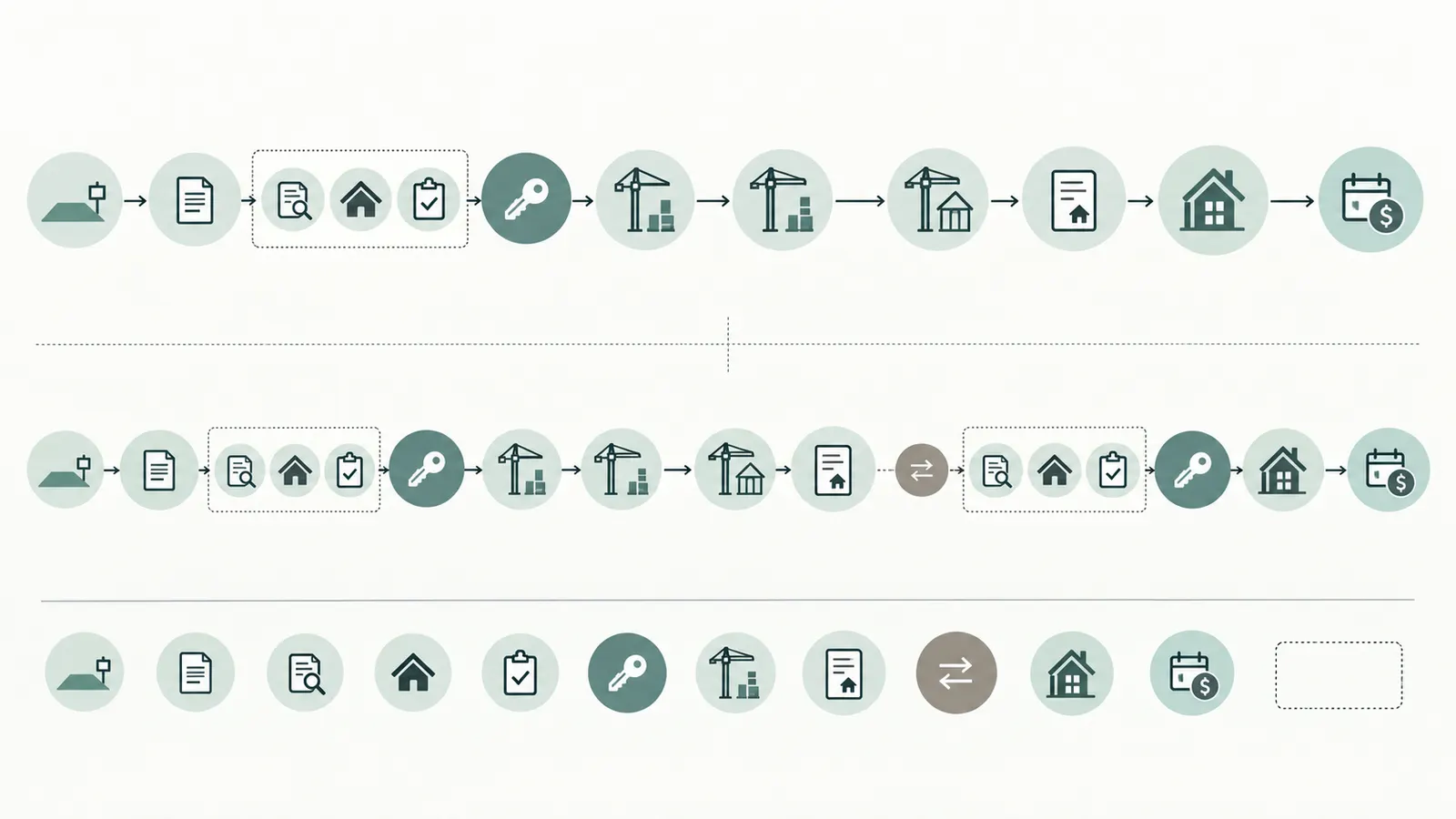
You are ready to request comparable term sheets when each lender can answer this sentence without a blank:
“On [date], for [property and jurisdiction], [borrower or seller] owns the lot, [loan] funds [lot/construction items], the first advance occurs after [documents], the builder is paid by [method], interest is charged on [balance], the construction phase ends when [evidence], and the permanent phase begins after [conversion or second closing steps].”
If the sentence cannot be completed, the offer is not yet comparable. The next action is to obtain the missing lot, draw, title, or completion term in writing.
3. Map the cash and draw timeline before comparing monthly payments #
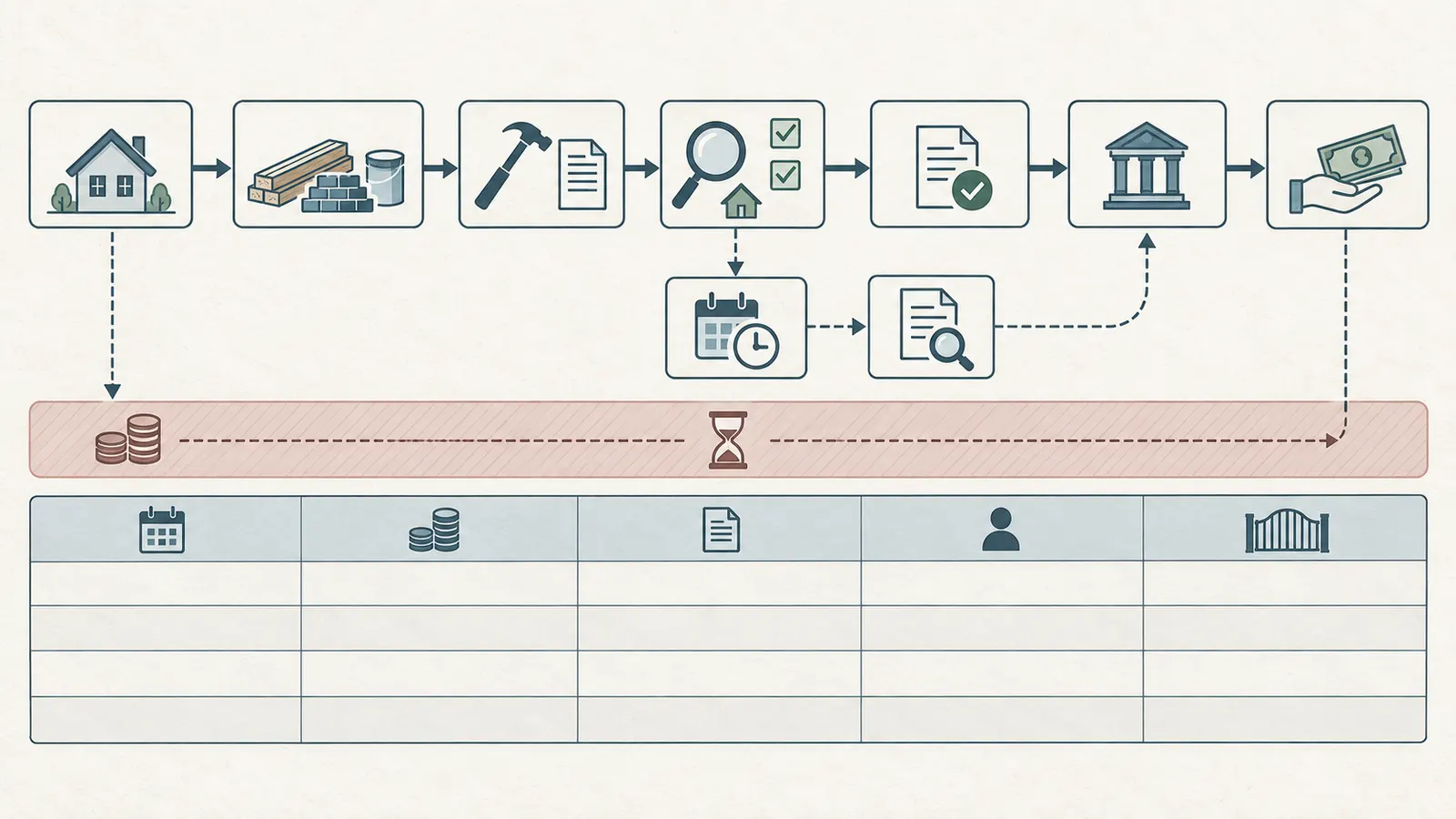
The correct construction-phase cash comparison is a dated ledger of money paid, money advanced, money held in reserve, interest charged, and money that remains the homeowner's responsibility. Construction loans usually fund in advances as work progresses, and the CFPB describes that staged-advance pattern in its consumer construction-loan guidance. A low first payment can simply mean that less has been advanced, not that the project is cheaper.
Draw schedule anatomy
A draw schedule should identify more than percentages. For every milestone, record:
| Field | What to record | Who verifies it | What can fail |
|---|---|---|---|
| Milestone | Foundation, framing, rough-ins, drywall, substantial completion, or the lender's defined stage | Builder and lender | The contract stage does not match the lender's inspection form |
| Eligible scope | Labor, installed materials, permanent fixtures, site work, permits, or excluded items | Lender and builder | Owner-supplied items or temporary work are assumed financeable |
| Amount | Dollar amount or percentage, retainage, and cumulative total | Lender closing or construction department | Schedule is mathematically inconsistent with the commitment |
| Evidence | Inspection, invoice, paid receipt, lien waiver, photo, permit, or other required record | Inspector, lender, title company | Work is complete but the required document is missing |
| Payee | Builder, borrower and builder jointly, supplier, or another authorized payee | Lender and closing team | Builder cannot pay subcontractors while check is held |
| Timing | Request date, inspection date, approval date, funding date, and cutoff | Builder and lender | A weekend, holiday, title update, or correction adds days |
| Next gate | What must be true before the next draw | Homeowner, builder, lender | The project advances beyond paid work without a funded next stage |
TD Bank's published example states that its draw schedule is agreed with the builder, that draws can only be used for building the home and permanent fixtures, and that an inspection verifies completed work while title updates occur multiple times. Citizens' example similarly says the builder requests funds for completed work, the lender orders an inspection, and the lender disburses a draw after verification. These are useful examples of questions to ask, not proof that another lender uses the same inspection threshold or title cadence. Compare the TD construction draw description and the Citizens draw and payment explanation with the actual lender agreement.
Cash timing has three different balances
Track three balances rather than one project total:
- Committed project cost: the current approved cost of the lot, construction, design, site work, permits, lender-required reserves, and other eligible items.
- Loan proceeds available: the undisbursed commitment, less any lender-controlled reserve, retainage, excluded costs, and amounts already advanced.
- Homeowner cash exposed: money already paid or required before the next draw, plus temporary housing and other costs that the loan does not cover.
The third balance is what breaks otherwise affordable projects. A builder may require a deposit, the jurisdiction may require permits before work, an engineer or architect may need payment, a supplier may require a deposit, or a draw may reimburse only after inspection. Ask which costs must be paid from cash, which are advanced at closing, which are reimbursed, which are paid jointly to homeowner and builder, and which are excluded altogether.
Do not call an amount “reimbursable” because it appears in the builder's budget. Ask for the lender's written rule and the evidence needed. Some lenders may count certain prior costs toward a down payment or include them in a loan calculation; that does not mean the homeowner receives cash back on the date it was paid. The difference matters when a lot deposit, plan fee, permit, or site invoice arrives before the first draw.
Worked illustrative draw example
The following is a modeled example, not a national rate, lender quote, or prediction. It shows why cumulative advances matter. Assume a construction commitment of $450,000, a fixed construction-phase rate of 8.00% per year, monthly interest-only billing, and this simplified end-of-month draw pattern:
| Months | Cumulative advanced balance | Monthly rate | Illustrative monthly interest | Period subtotal |
|---|---|---|---|---|
| 1–2 | $60,000 | 8% / 12 = 0.0066667 | $60,000 × 0.0066667 = $400.00 | $800.00 |
| 3–4 | $150,000 | 0.0066667 | $1,000.00 | $2,000.00 |
| 5–6 | $270,000 | 0.0066667 | $1,800.00 | $3,600.00 |
| 7–8 | $370,000 | 0.0066667 | $2,466.67 | $4,933.34 |
| 9–12 | $450,000 | 0.0066667 | $3,000.00 | $12,000.00 |
| Total | $23,333.34 |
Formula: monthly interest = cumulative principal advanced × annual interest rate ÷ 12. This is intentionally simple. A real lender may use actual days, a 360-day or 365-day convention, mid-month funding, daily accrual, an interest reserve, minimum charges, or a different payment date. Use the lender's note and statement methodology for the final model. Citizens publishes the same basic conceptual relationship in its own product example: interest-only payments are based on the amount the lender has previously disbursed for completed work. The Citizens construction-to-permanent page is the source for that lender-specific example, not for the illustrative $23,333.34 result.
Worked pre-reimbursement cash-gap sensitivity
The cash-gap test asks how much of your own money must be available before a draw can return or pay for eligible work. It is different from the final project cost and from the loan amount. Use this illustrative schedule to make the timing visible; replace every assumption with the actual lender's draw agreement, builder contract, title requirements, and the rules of the property's state, county, and municipality.
Illustrative inputs and timing assumptions:
- The construction-phase rate is 8.00% per year only for the optional carrying-cost check below; it is not a rate quote.
- The builder requires an $8,000 mobilization deposit on day 0, $6,000 for plans and permits on day 7, $14,000 for site work on day 18, and $10,000 for materials on day 25. All amounts are dollars paid from homeowner cash.
- The model treats all $38,000 as eligible for the first draw. That is an assumption, not a reimbursement promise.
- The model's written draw term says the lender will inspect on day 28 and release a $38,000 draw five business days after an acceptable inspection, shown here as day 35. The builder is paid directly or through the lender's stated check process; the homeowner must confirm the actual payee and whether the draw reimburses the homeowner.
Use this formula for each date:
pre-reimbursement cash gap = cumulative eligible cash paid − reimbursements or credits actually received
The peak is the largest positive result before the next confirmed funding event:
peak gap = max over dates (cumulative cash paid − cash received back)
| Date in model | Cash event | Cash paid cumulatively | Confirmed cash received | Gap after event |
|---|---|---|---|---|
| Day 0 | Mobilization deposit | $8,000 | $0 | $8,000 |
| Day 7 | Plans and permits | $14,000 | $0 | $14,000 |
| Day 18 | Site work | $28,000 | $0 | $28,000 |
| Day 25 | Materials before inspection | $38,000 | $0 | $38,000 |
| Day 28 | Inspection passes; no funds released yet | $38,000 | $0 | $38,000 |
| Day 35 | First draw released five business days after inspection | $38,000 | $38,000 | $0 |
Result: under these assumptions, the homeowner must have $38,000 available before the first draw, and the peak pre-reimbursement gap is $38,000. The formula is $38,000 paid − $0 received = $38,000; after the scheduled draw it is $38,000 paid − $38,000 received = $0. “Confirmed” here means confirmed in the model's assumed written draw term. If your lender has not put the inspection standard, payee, eligible-cost rule, and funding date in writing, the reimbursement is not confirmed for your project.
Changed-timing case: suppose the inspection moves from day 28 to day 35, the lender does not permit a partial draw, and a supplier requires another $12,000 eligible materials payment on day 30. The first $38,000 draw is now released on day 42, five business days after the delayed inspection. The peak becomes $38,000 + $12,000 − $0 = $50,000; after the first draw, the remaining gap is $50,000 − $38,000 = $12,000 until a separately confirmed second draw. If the second $12,000 draw arrives on day 49, the extra cash is tied up for 19 days. At the illustrative 8% rate, a simple opportunity-cost screen is $12,000 × 0.08 × 19 ÷ 365 = $49.97, before any lender fee, supplier charge, housing cost, or tax effect. The larger issue is liquidity: the homeowner needs $12,000 more cash capacity than in the base case.
This model does not establish that a lender must reimburse prior spending, that a title update will be available on either date, or that a builder can wait for funding. A lender may pay the builder rather than reimburse the homeowner, exclude deposits or permits, require lien waivers before release, use business days rather than calendar days, or delay funding when an inspection, title search, certificate, or local filing is incomplete. Confirm each timing input with the lender and builder; confirm state-, county-, and municipality-specific title, permit, recording, and occupancy requirements with the closing professional and the actual jurisdiction. Keep the base and changed cases in the worksheet so a lender can answer the exact cash question instead of only quoting a monthly payment.
Interest-reserve branch
Ask whether interest is paid monthly from household cash or from an interest reserve included in the commitment. CFPB Appendix D says a creditor may establish an interest reserve and explains that if the reserve automatically pays accrued interest, the calculation must reflect interest accruing on those interest payments as well as on other proceeds. Read the CFPB multiple-advance construction-loan appendix for the disclosure treatment.
For your worksheet, record:
- Initial commitment before and after the reserve.
- Whether the reserve is an advance, a separate account, or a borrower-funded balance.
- Whether reserve-paid interest increases principal or reduces available construction funds.
- The month in which the reserve is expected to be exhausted.
- The payment due after exhaustion.
- Whether the permanent loan amount includes, excludes, or refinances any unpaid construction interest.
An interest reserve can reduce the monthly cash bill while construction is active, but it is not free. It may consume borrowing capacity, increase the balance, or create a larger permanent payment. Compare both household cash paid and total balance, not just the monthly construction bill.
Sensitivity to delay
Using the same illustrative $450,000 balance at 8%, each full month after the balance is fully drawn adds approximately:
$450,000 × 8% ÷ 12 = $3,000
Three months of delay after full funding therefore adds about $9,000 of interest before any rent, storage, insurance, taxes, extension fee, rate change, or builder standby cost. At a hypothetical 10% rate, the same three-month delay is $11,250. These are arithmetic sensitivities, not rate forecasts. Put the actual construction rate and extension rate from each offer into the same formula.
Then ask a more important question: what is the loan status during the delay? A one-close product may have a documented maximum construction period and extension path; Fannie Mae's eligible single-closing framework limits a single construction period to no more than 12 months and total construction to no more than 18 months, with specific documentation requirements. See the Fannie Mae construction-period limits. That is not a national deadline. A lender may have a shorter deadline, and a different investor or loan type may use different rules.
The next decision after the delay sensitivity is whether your cash reserve covers both the extra carrying cost and the lender's extension requirements. If not, the project schedule and financing structure are not yet aligned.
4. Compare rate, fee, and permanent-payment economics on equal terms #
Compare one-close and two-close by total phase-specific cost and risk, not by the construction interest rate or the phrase “one closing.” A one-close offer may have one set of title and lender charges but a higher rate or stricter product; a two-close offer may allow better later terms but create a second appraisal, title, recording, origination, and underwriting event. Only the lender's itemized disclosures and contract documents tell you which costs apply.
Separate five cost buckets
Build five columns for each offer:
- Lot and project cash: purchase price, deposits, prior lot balance, design, permits, site work, utility connection, builder-required deposits, owner-supplied items, temporary housing, and contingency.
- Construction-phase financing: interest, origination, commitment, inspection, draw, administration, wire, interest-reserve, extension, and unused-line charges.
- First closing: title search, lender's title policy, owner's title policy if selected or required, settlement or attorney charges, recording, transfer taxes, prepaid interest, insurance, and escrow.
- Permanent phase: permanent origination or discount points, new appraisal, credit report, underwriting, title update or policy endorsement, recording, settlement, prepaid items, rate-lock or float-down cost, and any payoff charge.
- Failure and delay exposure: rejected draw, inspection re-order, lien release, requalification, value shortfall, extension, rate change, second closing delay, and cash required before reimbursement.
CFPB's Regulation Z commentary says that when construction-permanent credit is disclosed as multiple transactions, construction-only finance charges and points or fees are allocated to the construction phase. It specifically identifies inspection and handling fees for staged disbursements as construction-phase charges and says they should not be placed in the permanent phase disclosures. Review the CFPB allocation guidance and then check whether the economic burden appears in your Loan Estimate, commitment, draw agreement, or later invoice.
Allocation for disclosure is not the same as “the fee is included in the loan” or “the fee is paid only once.” A fee can be correctly disclosed in a phase and still be paid from cash, financed through proceeds, deducted from an advance, or charged by a third party. Ask four questions for every fee: when is it charged, to whom is it paid, can it be financed, and does it repeat at conversion or the second closing?
Illustrative fee-duplication sensitivity
Use your own written fees. To demonstrate the method only, suppose a hypothetical one-close offer has:
- First-closing lender and settlement costs: $5,500.
- Construction inspection and draw administration: $3,000.
- One appraisal and title work already included in those categories.
- Total modeled financing-related charges: $8,500.
Suppose a hypothetical two-close path has the same $5,500 construction closing and $3,000 construction administration, then adds at permanent closing:
- Permanent lender charges: $3,500.
- New appraisal or completion valuation: $1,200.
- New or extended title and settlement work: $2,000.
- New recording and document charges: $600.
The modeled incremental second-close amount is $7,300, so the modeled total is $15,800 before interest-rate differences, extension, taxes, insurance, and any credits. This is not a price range and must not be copied into a budget. It is a sensitivity template. Replace each value with the actual Loan Estimate or written fee schedule. If a lender says a fee is waived, record the condition and expiration. If the permanent lender is different, obtain its separate written estimate rather than assuming the construction lender's fee schedule carries forward.
The break-even question is:
two-close extra fees + extra construction carry + expected extension/rate risk compared with one-close pricing premium + one-close restrictions + one-close failure risk.
There may be no meaningful single number for “cheaper” until you assign a probability or scenario to delay and permanent-rate movement. Since those inputs are uncertain, show at least a base case, a three-month delay case, and a permanent-loan requalification or value-shortfall case.
Compare the permanent payment, not just construction interest
The construction-phase payment is usually interest-only, but the permanent loan may be fully amortizing principal and interest, may include mortgage insurance or escrow, and may use a different rate or term. CFPB's construction-loan guidance notes that the balance may convert to a conventional mortgage or require a new application depending on the lender and the borrower's circumstances. Use the CFPB construction-loan explanation as the general federal consumer description, then use the offer documents for the actual conversion promise.
For each offer, write down:
- Permanent note amount and whether it includes lot, construction, financed fees, reserves, or allowable overruns.
- Fixed or adjustable rate, rate-lock date, lock duration, extension cost, float-down rights, and what happens if the project is not ready before lock expiration.
- Amortization term, first principal-and-interest payment date, balloon or maturity date, prepayment terms, and escrow treatment.
- Whether construction interest is paid in cash, capitalized, paid from reserve, or added to the payoff.
- Whether the permanent payment starts only at completion or after a stated date even if the house is not ready.
- Whether taxes, insurance, flood insurance, mortgage insurance, and local assessments begin during construction or at conversion.
TD Bank's public example describes interest-only construction payments tied to the amount and draw schedule, then principal-and-interest payments after completion and a certificate of occupancy. It also publishes a one-application, one-closing example and says its permanent rate can be locked at the start of construction. Treat those as TD's own product statements, not a national definition; the TD construction-to-permanent description is a useful checklist for the questions to put to another lender.
Dollar Bank publishes another lender-specific example: one closing, automatic movement to a permanent mortgage at the same rate, interest-only payments on the amount disbursed after each advance, and inspections before draws. Its closing-process page also gives a six-to-12-month construction duration as typical for that product example. Those statements are not a national benchmark; use the Dollar Bank closing-process page only to see which terms must be replaced by your lender's written terms.
Rate lock is a contract feature
Ask whether “rate locked at closing” means the permanent rate is fixed in the note, fixed but eligible for a documented modification, capped, or merely expected to be available at conversion. Ask whether a lower rate can be used if rates fall, whether the loan amount or term may change, and whether a higher rate is triggered by delay. Fannie Mae's single-close guidance allows certain modifications before or at conversion, including interest rate, loan amount, loan term, and amortization type, but it also says changed terms can trigger re-underwriting and that increases to the loan amount are limited to documented increased construction costs under the framework. Review the Fannie Mae modification and underwriting provisions.
Do not use a rate-lock statement to infer a permanent payment. A fixed rate can still be attached to a different final balance. A lower rate can still be more expensive if it requires points, has a short lock, or expires before completion. A floating two-close rate can be reasonable if the permanent lender has already confirmed the future process and your cash reserves absorb the uncertainty. The decision is about risk you can carry and verify.
5. Stress-test underwriting, title, overruns, completion, and conversion #
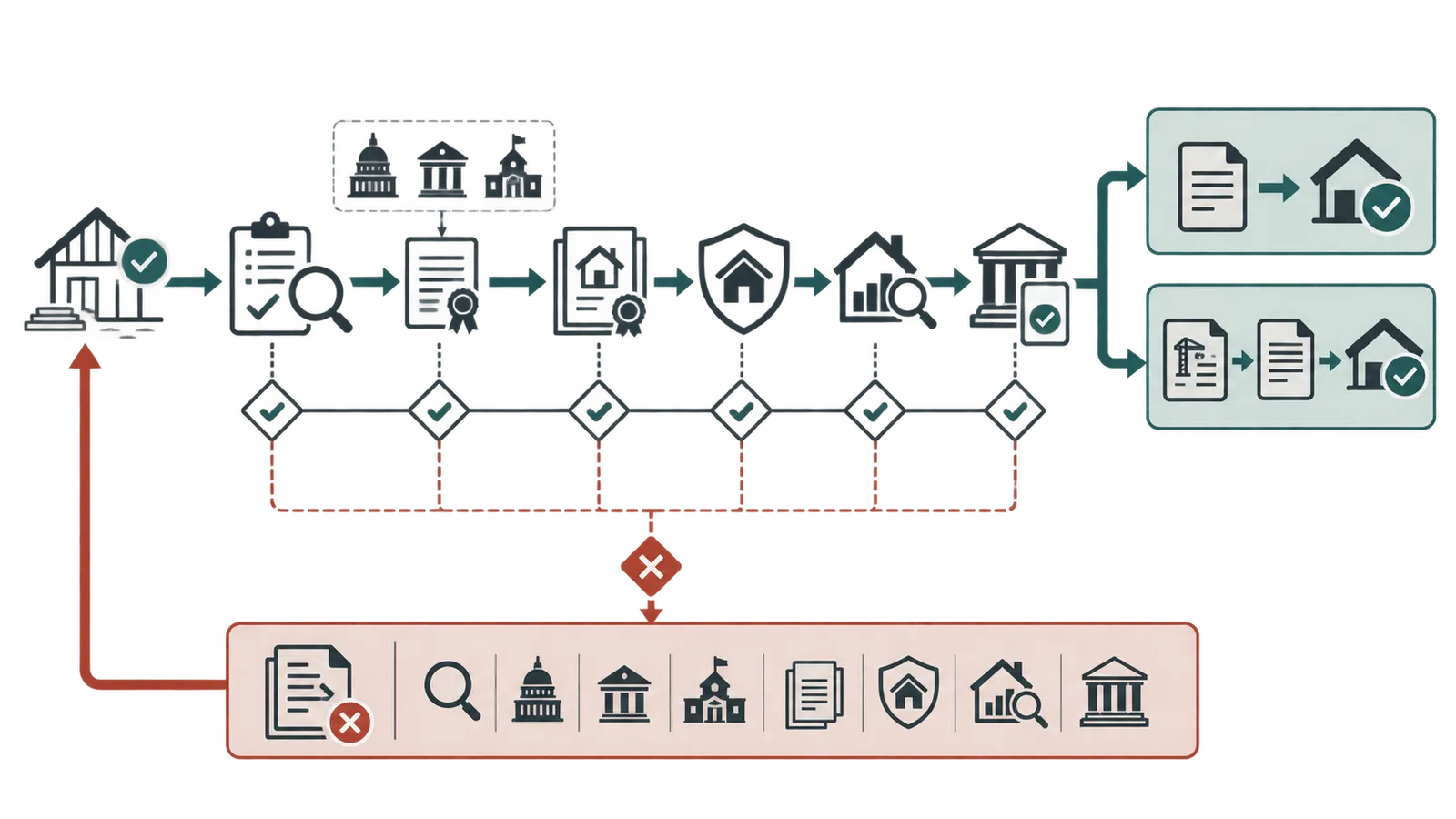
The most important comparison is the set of events that can stop, reprice, or delay the handoff. One-close reduces the number of formal closings but does not eliminate construction risk; two-close creates a second approval and closing gate but may preserve lender choice. Run both structures through the same failure cases before signing a commitment.
Requalification and document aging
Ask “Will I have to requalify?” as a trigger question, not a yes-or-no marketing question. Under Fannie Mae's single-close guidance, the loan is underwritten using permanent-financing terms, and requalification at conversion is required in specified circumstances such as a value decline that increases LTV, updated credit documents, or certain modified terms. Fannie Mae's requalification provisions do not mean a particular lender will never request updated documents; lender overlays and the actual loan program still control.
Record the lender's answer to each event:
| Event before completion | One-close question | Two-close question | Evidence to request |
|---|---|---|---|
| Employment or income changes | Does the lender refresh and re-underwrite? | Will the permanent lender re-underwrite from current documents? | Written underwriting or commitment condition |
| New debt or credit change | What is the tolerance, and who monitors it? | Can the permanent lender decline or reprice? | Credit-refresh policy and debt-to-income assumptions |
| Appraised value falls | Is a new appraisal required and how is LTV recalculated? | Which lender orders the value and what if the permanent value is short? | Appraisal age, completion appraisal, LTV remedy |
| Loan amount increases | Can documented overruns be added, and who supplies cash first? | Can the permanent loan refinance eligible overruns? | Change-order and overrun clause |
| Documents age out | Which income, asset, credit, and title documents expire? | Which lender's age rules apply at closing two? | Document-age schedule |
| Construction runs late | Does the rate or commitment survive? | Does the interim maturity arrive before permanent closing? | Extension, lock, and maturity terms |
Fannie Mae's public construction-products page says an eligible single-close enhancement can extend some credit-document age up to 18 months when specific LTV/CLTV/HCLTV and automated-underwriting conditions are met. That is not a general promise that your lender will keep your documents for 18 months. Put the exact product, underwriting method, ratio condition, and lender confirmation in the worksheet.
Title updates and lien risk
Construction payments can expose the homeowner to unpaid-builder or subcontractor claims if the draw and lien-release process is unclear. The safe planning question is not whether a lender says it orders title updates; it is what evidence must be current before each draw and what happens if a lien, judgment, tax issue, boundary issue, or title exception appears.
Ask the title company or closing attorney for the actual state and county process, including:
- The form and timing of lien waivers or releases from the builder and relevant subcontractors.
- Whether waivers are conditional on payment or unconditional after payment.
- Whether the lender requires a title search or endorsement before each draw, after a threshold, or only at final closing.
- How a mechanic's lien notice, unpaid supplier, contractor dispute, or recording delay pauses a draw.
- Who verifies that a draw is not being used to pay an earlier unpaid claim.
- Whether an owner's title policy, lender's policy, endorsements, survey, or affidavit must be updated at conversion or closing two.
TD Bank's published page says title updates are completed multiple times during construction for its example. Do not broaden that into a rule for every lender or state. Ask for the actual TD title-update and draw process in your commitment and have the title professional explain what the update means in the property's jurisdiction.
Overruns and change orders
An overrun is a financing event only if the documents say it is. First classify the cause: owner choice, builder error, unknown site condition, allowance shortfall, material price change, permit condition, damage, or delay. Then ask who approves the change, who pays before work proceeds, whether the lender revises the commitment, whether the appraiser must update the as-completed value, and whether the permanent loan can include the amount.
Fannie Mae's construction-to-permanent FAQ provides a narrow example in which documented construction-cost overruns outside the interim construction loan may be included in a two-closing limited-cash-out refinance when paid directly to the builder at the permanent closing and other conditions are satisfied. It also says self-financed overruns are treated differently. Read the Fannie Mae overrun FAQ and ask the actual lender to classify your overrun before you spend the cash. This is not a reimbursement guarantee.
Make a cash rule for the project: no change order starts until the homeowner, builder, and lender have recorded the revised scope, price, funding source, schedule effect, and appraisal or underwriting effect. A signed builder change order alone may not increase the loan commitment. A lender approval alone may not change the builder's contract price. Keep both handoffs.
Completion, final inspection, and certificate of occupancy
Completion is not the same as “the house looks finished.” The lender's completion gate may require a final inspection, an appraiser's completion report, a survey, lien releases, insurance, utility confirmation, repairs, and a certificate of occupancy or local equivalent. A municipality may use a different document name or may issue separate approvals for the building, electrical, plumbing, mechanical, septic, well, or other systems. Only the actual jurisdiction can answer which approvals apply.
Ask the lender for a one-page completion checklist and ask the builder to map each item to the construction schedule. Ask the municipality or county office what document it will issue and the conditions for issuance. Ask the appraiser what must be observable for the final report. Ask the title company what must be recorded or released. Ask the homeowner-insurance carrier when the construction policy changes to a completed-home policy.
Do not move the permanent-loan date earlier just because a builder says substantial completion is near. Do not authorize hazardous unfinished work to make a checklist look complete. Excavation, structural work, work at height, electrical work, and other regulated or hazardous construction tasks belong to qualified, properly licensed or otherwise authorized professionals under the actual jurisdiction and project requirements. The homeowner can collect documents and observe safely from an appropriate location; do not enter an unsafe site, open electrical equipment, climb unfinished framing, or perform a professional inspection from photographs.
The conversion or second-closing handoff
At the final handoff, reconcile five ledgers:
- Scope ledger: original plans, approved changes, allowances, substitutions, and completed work.
- Money ledger: commitment, advances, borrower cash, retainage, unpaid invoices, credits, and remaining balance.
- Title ledger: current owner, liens, releases, title updates, recording, and required endorsements.
- Condition ledger: inspection reports, appraiser completion, repairs, permits, final approvals, and insurance.
- Loan ledger: final amount, rate, term, amortization, escrow, payoff, conversion document, or new permanent note.
In a one-close structure, ask whether the lender records an amended rider or separate modification agreement at conversion. Fannie Mae's guidance describes those documentation options and says applicable conversion documents must be executed and recorded in the jurisdiction before sale to Fannie Mae. That is a good reason to ask the settlement agent what will actually be recorded in the property county. In a two-close structure, confirm the permanent lender's payoff statement, wire timing, new deed of trust or mortgage, title policy requirements, and what happens if the interim lender's maturity date arrives first.
The next decision is not “the home is finished, so which lender do I call?” It is “which party owns the next unresolved condition, and what document proves it is cleared?” If that answer is not written, delay the handoff conversation and resolve the condition.
6. Assign each question to the responsible party and verify the handoff #
The homeowner coordinates the comparison, but the homeowner is not the lender's underwriter, the builder's superintendent, the appraiser, the title examiner, or the municipality. Assign each question to the party with authority to answer it and record the evidence. This prevents a builder's schedule estimate from being treated as a loan commitment or a loan officer's general statement from being treated as a county requirement.
Responsibility map
| Decision or record | Primary responsible party | Homeowner's job | Verification |
|---|---|---|---|
| Loan structure and product eligibility | Lender and its underwriting team | Provide complete inputs and compare written terms | Commitment, note, rider, Loan Estimate, underwriting conditions |
| Lot title and liens | Title company or closing attorney/settlement agent for the actual jurisdiction | Supply deed, contract, lien data, and ownership dates | Title commitment, payoff, deed, recorded documents |
| Plans, specifications, scope, and price | Builder, architect, engineer, and homeowner | Confirm one version is sent to every lender | Signed contract, plans, specification set, allowance schedule |
| Builder approval | Lender and builder | Ask what approval means and when it expires | Approval letter, license, insurance, financial documents |
| Draw milestone | Builder and lender construction department | Match paid work to the approved schedule | Inspection report, invoice, waiver, draw authorization |
| Work quality and code compliance | Builder, inspectors, architect, engineer, and jurisdictional authority as applicable | Keep records and request professional verification | Inspection approvals, reports, certificates, engineer documents |
| Appraised value | Independent appraiser engaged through the lender | Review scope and facts for errors through the lender | Appraisal, completion report, corrected report if needed |
| Rate and permanent terms | Lender or permanent lender | Ask for lock, cap, float-down, and modification rules | Note, lock agreement, commitment, revised disclosure |
| Final completion and occupancy | Municipality or county office for local approval; lender for loan completion | Confirm local document and lender checklist match | Certificate of occupancy or local equivalent, lender completion approval |
| Permanent payoff or conversion | Construction lender, permanent lender, and closing agent | Coordinate dates and funds | Payoff statement, conversion agreement or new note, recording receipt |
A document-control routine
Use one folder with a dated index. For each document, record the date, sender, version, property, loan phase, and unresolved question. When plans change, archive the prior set instead of overwriting it. When a lender updates a fee or rate, preserve the prior disclosure and write the reason for the change. When the builder requests a draw, keep the request, inspection, invoice, lien waiver, approval, payee record, and funding date together.
At least weekly during an active build, reconcile:
- Construction work completed versus the last approved draw.
- Builder invoices and subcontractor payment evidence versus lender-funded amounts.
- Remaining commitment versus the latest cost-to-complete forecast.
- Household cash spent versus the cash reserve and next required payment.
- Construction days elapsed versus the maturity, extension, and rate-lock dates.
- Unresolved title, permit, inspection, insurance, or certificate conditions.
This is not an official inspection or accounting record. It is a homeowner coordination log. The lender's records, the builder's contract, the title company's file, and the jurisdiction's approvals control their respective subjects.
What to ask at the term-sheet meeting
Ask the loan officer to answer these in writing, with a document name and page reference:
- Is this one-close or two-close in the legal documents, not just in the advertisement?
- If one-close, what exactly fixes or changes the permanent rate, term, loan amount, and amortization?
- If two-close, has the permanent lender reviewed the construction lender, plans, lot status, builder, appraisal basis, and proposed payoff?
- What is the maximum construction period, the extension process, the extension fee, and the rate during extension?
- Does interest accrue on the amount advanced, the full commitment, or a balance that includes an interest reserve?
- Who requests, orders, pays for, and approves each draw inspection?
- Are partial draws permitted? Are joint checks used? How long after an approved inspection is funding released?
- Which title updates and lien waivers are required for each draw and at final completion?
- What costs are excluded from the loan and what cash must be available before reimbursement?
- Which change orders require lender approval before the builder starts?
- What is the lender's overrun rule if the borrower pays first?
- What exact local completion document is acceptable for the actual property jurisdiction?
- What triggers a new appraisal, credit report, income verification, asset verification, or full re-underwrite?
- Who is the named contact during construction, and who is the named contact for conversion or closing two?
If the answer is “that is standard,” ask for the standard document. If the answer is “we will know later,” write the condition as unresolved and do not count the offer as comparable.
7. Run the worksheet, choose the next action, and preserve the unresolved terms #
The best financing structure is the one whose obligations, timing, and failure branches you can fund and verify for your actual lot, builder, lender, and jurisdiction. Complete one row for one-close and one for two-close, use the same project inputs, and mark any blank cell as a decision blocker rather than a favorable assumption.
Construction-to-permanent term-sheet and cash-flow worksheet
Copy this table into a working document. The “answer” column should contain a number, date, named party, or exact document reference. “Unknown” is a useful result when it creates a follow-up; it is not a loan term.
| Row to complete | One-close offer | Two-close offer | Evidence or owner of answer |
|---|---|---|---|
| Property state, county, municipality, parcel | Homeowner; deed or contract | ||
| Lot owner on first advance date | Title company; deed and closing file | ||
| Lot purchase or lot-loan payoff included? | Lender commitment and payoff | ||
| Total project cost and version date | Builder contract, plans, cost schedule | ||
| Loan commitment and maximum balance | Note and commitment | ||
| Appraisal basis and as-completed value | Appraisal instructions and report | ||
| Borrower cash due at first closing | Loan Estimate and settlement statement | ||
| Cash paid before first advance | Builder, design, permit, and site invoices | ||
| Items excluded from loan | Construction agreement and lender exclusions | ||
| First advance date and amount | Draw schedule and closing statement | ||
| Draw milestones and cumulative amounts | Approved draw schedule | ||
| Inspection trigger and standard | Construction-loan agreement | ||
| Inspection fee, draw fee, or handling fee | Loan Estimate and fee schedule | ||
| Title update frequency and cost | Title company and lender instructions | ||
| Builder payee and check/wire method | Draw agreement | ||
| Partial-draw rule and funding time | Draw agreement and service standard | ||
| Construction interest rate and day-count method | Note and payment disclosure | ||
| Interest on advanced balance or full commitment? | Note, disclosure, lender confirmation | ||
| Interest reserve amount and compounding treatment | Commitment and disclosure | ||
| Illustrative monthly interest formula | balance × rate ÷ 12, then lender method | ||
| Construction-period fees | Itemized fee schedule | ||
| First closing title, recording, tax, and settlement | State/county closing estimate | ||
| Permanent closing or conversion fees | Conversion agreement or second Loan Estimate | ||
| Permanent lender and construction lender | Commitment and lender names | ||
| Rate lock, cap, float-down, and expiration | Lock agreement and note | ||
| Permanent rate and amortization | Permanent note or commitment | ||
| Construction period maximum | Note, commitment, investor guide | ||
| Extension terms, fee, and rate | Extension clause | ||
| Overrun approval and cash-first rule | Change-order and overrun policy | ||
| Can eligible overruns enter final loan? | Permanent lender written answer | ||
| Requalification triggers | Underwriting conditions | ||
| Credit, income, asset, and appraisal expiration | Underwriting checklist | ||
| Final inspection or completion report | Lender completion checklist | ||
| Certificate of occupancy or local equivalent | Municipality/county and lender | ||
| Final lien waivers and title update | Title company and lender | ||
| Conversion date or closing-two target | Note, payoff, and closing schedule | ||
| Payoff amount and wire deadline | Interim lender payoff statement | ||
| First permanent principal-and-interest payment | Permanent disclosure or note | ||
| Next unresolved decision | Homeowner action log |
Formulas and sensitivity checks
Use a separate row for every draw and month. For each month m:
interest_m = (opening advanced balance_m + any applicable mid-period advance adjustment) × annual rate ÷ day-count factor
For a simple monthly screen, use cumulative advances × annual rate ÷ 12. For the total construction-phase screen:
construction interest = sum of monthly interest + reserve interest + lender-specific charges that are paid or financed
For cash exposure:
cash exposure at date = cash already paid + cash required before next draw + temporary living costs − confirmed reimbursements or credits
For a delay case:
delay cost = months delayed × balance during delay × annual rate ÷ 12 + extension fees + housing and other carrying costs
For a fee-duplication case:
two-close incremental cost = second lender fees + second title/recording/appraisal costs + extra rate-lock cost + additional cash timing cost
Run at least these scenarios:
- Base: the lender's stated schedule, rate, fees, and completion date.
- Three-month delay: all draws after the delay move three months, extension terms apply, and temporary housing continues.
- Higher final cost: a documented change order increases cost; calculate the amount paid from cash and the amount, if any, accepted into the loan.
- Lower final value: the completion appraisal is lower than expected; calculate the new LTV and the cash needed to preserve the lender's limit.
- Second-close disruption: the permanent lender requires updated documents, a new appraisal, or a different rate before the interim maturity date.
Label every number as one of: lender-provided, jurisdiction-provided, builder-provided, homeowner assumption, or illustrative. Do not blend an illustrative 8% rate, a lender's public “typical” construction duration, and a county fee into one apparently authoritative total.
Decision rules that are safe to hand back to a lender
Choose the one-close term sheet for the next diligence round if it has a complete and acceptable answer for the permanent rate treatment, construction duration, draw mechanics, completion evidence, requalification triggers, overrun funding, and title path, and its base and delay scenarios fit your cash reserve. It may still be rejected later if the full underwriting or contract review fails.
Choose the two-close term sheet for the next diligence round if the permanent lender has reviewed the construction setup, the second closing is financially and contractually possible, and the value of lender choice or construction flexibility outweighs duplicate charges and future underwriting uncertainty. Do not choose it merely because the first construction rate is lower.
Pause both if any of these is true:
- The lender will not state whether interest applies to advances or the full commitment.
- The first advance, lot title, or lien-payoff condition is unclear.
- The draw schedule does not align with builder payment obligations.
- The extension or interim maturity date arrives before a realistic completion and final closing.
- The permanent lender has not confirmed how it will accept the plans, builder, appraisal, and construction note.
- The overrun policy assumes the homeowner can borrow or refinance later without written eligibility.
- The completion package names no responsible party for the certificate of occupancy, title update, lien releases, or final inspection.
The next handoff
Give the lender a short unresolved-terms memo with three sections: confirmed, assumed, and unresolved. Attach the same worksheet, builder cost schedule, draw schedule, lot documents, and jurisdiction answers to every lender. Ask for a response that preserves the row numbers and cites the governing document.
Then hand the lender's final questions to the right professional: title and recording to the closing attorney or settlement agent; local permits and occupancy to the municipality or county; construction quality, safety, and code work to the builder and qualified inspectors or design professionals; appraisal corrections to the lender and appraiser; underwriting and loan terms to the lender. Keep the response with the dated file.
The decision is ready for a commitment only when you can state who is responsible, what happens first, what money moves, what evidence is required, what happens if the project is late or over budget, and what the next decision is. A one-close or two-close label is only the beginning of that map.
Method. For each structure, record the lender's written term, responsible party, verification document, and date; calculate interest from cumulative advances and run delay, fee-duplication, and pre-reimbursement cash-gap sensitivities.
Limitations. The modeled numbers are illustrative inputs, not national rates or fees; eligibility, disclosures, title practice, builder approval, recording, inspections, and state or county requirements must be confirmed for the actual lender and property jurisdiction.
The Brictale budgeting topic is the appropriate place to keep this comparison with the wider project budget, and the Brictale blog carries the broader homeowner decision journey. Neither route replaces the lender's disclosures or the actual jurisdiction's closing and construction records.
Cite this guide
Brictale. “How to Compare One-Close vs. Two-Close Construction-to-Permanent Loans for a New Home.” Published 2026-09-24; updated 2026-09-24.
https://brictale.com/build/budgeting/compare-one-close-vs-two-close-construction-loans · Read the Markdown version
Original contribution: Construction-to-permanent term-sheet and cash-flow worksheet. A source-linked worksheet that places one-close and two-close financing on the same timeline and exposes cash, fee, underwriting, title, and conversion handoffs.
Sources and scope
Evidence behind this page
- The Consumer Financial Protection Bureau describes a construction loan as generally short-term, often higher-interest than a longer-term purchase mortgage, with funds typically provided in advances as construction progresses; payments may begin six to 24 months after the loan is made.
Federal consumer guidance; general description, not a promise about any lender's rate, timing, or conversion terms.
Accessed · Link to this claim - Regulation Z commentary says a construction-to-permanent transaction may use one combined disclosure for construction and permanent financing or separate disclosures for the two phases; if the consumer is obligated on both phases at consummation, both disclosure sets must be provided initially when separate disclosures are used.
12 CFR 1026.17, Official Interpretations, paragraph 17(c)(6)
Federal Regulation Z disclosure interpretation; disclosure treatment does not by itself determine whether a lender offers one-close or two-close financing.
Accessed · Link to this claim - When a creditor discloses construction-permanent credit as multiple transactions, Regulation Z commentary requires construction-only finance charges and points or fees to be allocated to the construction phase; staged-disbursement inspection and handling fees belong in the construction disclosures rather than the permanent disclosures.
12 CFR 1026.17, Official Interpretations, paragraph 17(c)(6), allocation of costs
Federal disclosure allocation rule; it does not cap a lender's contract fee or decide who economically pays it.
Accessed · Link to this claim - CFPB Appendix D says a creditor may establish an interest reserve in a multiple-advance construction loan; if the reserve automatically pays interest, the disclosures and calculations must reflect interest accruing on those interest payments as well as on other proceeds.
Appendix D to Part 1026 — Multiple Advance Construction Loans
Federal disclosure calculation guidance; the existence, size, and funding mechanics of an interest reserve are lender-specific.
Accessed · Link to this claim - Fannie Mae's single-closing guidance treats the construction loan and permanent financing as closing at the same time; the loan documents specify the permanent terms, the construction loan automatically converts after completion, and the lender manages disbursement to the builder, contractor, or authorized suppliers.
Conversion of Construction-to-Permanent Financing: Single-Closing Transactions
Fannie Mae Selling Guide eligibility framework; a lender's product may differ and may not be sold to Fannie Mae.
Accessed · Link to this claim - For Fannie Mae-eligible single-closing construction-to-permanent transactions, no single construction period may exceed 12 months and the total construction period may not exceed 18 months; an extension may bring the total to no more than 18 months, subject to the guide's documentation structure.
Conversion of Construction-to-Permanent Financing: Single-Closing Transactions
Fannie Mae eligibility limit for the specified conventional product; not a national construction-law deadline or a universal lender limit.
Accessed · Link to this claim - Under Fannie Mae's single-closing guidance, a purchase transaction generally means the borrower is not the lot owner of record at the first interim advance, while a limited cash-out refinance structure requires the borrower to hold legal title before the first advance.
Conversion of Construction-to-Permanent Financing: Single-Closing Transactions
Fannie Mae transaction-classification and LTV framework; title status, lien payoff, and lender overlays must be confirmed for the actual property and jurisdiction.
Accessed · Link to this claim - Fannie Mae says single-closing loans are underwritten on permanent-financing terms, and requalification at conversion is required in specified cases including increased LTV from a value decline, updated credit documents, or certain modified terms; current credit-document age and underwriting tolerances matter.
Conversion of Construction-to-Permanent Financing: Single-Closing Transactions
Fannie Mae eligibility guidance; it is not a guarantee that a particular lender will never ask for updated documents or re-underwriting.
Accessed · Link to this claim - Fannie Mae's two-closing guidance describes two separate loan closings and legal-document sets: interim construction financing first and a new permanent note upon completion; the permanent lender underwrites to the permanent mortgage terms and may be different from the construction lender.
Conversion of Construction-to-Permanent Financing: Two-Closing Transactions
Fannie Mae eligibility framework for the permanent loan; it does not promise approval, pricing, or automatic conversion in a two-close transaction.
Accessed · Link to this claim - Fannie Mae's construction-products overview says a two-closing structure can allow the borrower to shop for construction-financing terms without committing to permanent-lender terms upfront, because the original construction financing may come from any lender under that framework.
Fannie Mae program overview; actual lender participation, construction-loan payoff terms, and permanent-loan eligibility remain transaction-specific.
Accessed · Link to this claim - Fannie Mae's construction-to-permanent FAQ says documented construction-cost overruns outside the interim construction loan may be included in a two-closing limited-cash-out refinance when the overrun costs are paid directly to the builder at closing and other requirements are met; self-financed overruns are treated differently.
FAQs: Construction-to-Permanent Financing
Fannie Mae FAQ for eligible transactions; not a promise of reimbursement, cash-out treatment, or overrun financing by every lender.
Accessed · Link to this claim - TD Bank's published construction-to-permanent example says its construction phase uses interest-only payments tied to the outstanding construction balance and draw schedule, converts after completion when a certificate of occupancy is provided, and uses inspections and multiple title updates for draw requests.
New Home Construction Loans and Mortgage Financing
TD Bank's published product example in the states it serves; not a national product standard or a promise about another lender.
Accessed · Link to this claim - Citizens' published construction-to-permanent example describes a single closing, interest-only payments during construction, staged builder funding after lender inspection, and monthly interest calculated from the amount previously disbursed for completed work.
Construction-to-Permanent Loan
Citizens Bank product example; lender service areas, rates, fees, underwriting, draw controls, and contract terms may vary.
Accessed · Link to this claim - Dollar Bank's published construction-mortgage example advertises one closing with automatic movement to a permanent mortgage at the same rate and interest-only payments on the amount disbursed after each advance; its published closing page says inspections precede draws and construction commonly lasts six to 12 months for that example.
Dollar Bank marketing and process example; it is geographically and product limited, and its typical duration is not a universal schedule.
Accessed · Link to this claim