How to Compare Construction Contingency Reserves Before Signing a Custom-Home Loan
Compare owner cash, lender contingency, interest reserve and change money before a U.S. custom-home construction loan closing.
The short answer
Compare reserves by permitted use, controller, approval gate, draw evidence, unused-fund treatment, and cash exposure—not by one percentage. Put the contract scope, lender contingency, interest reserve, owner-change money, allowances, and personal liquidity in separate rows. Then model an eligible overrun, an owner-selected change, and a combined case. Before signing, get each row and the exhaustion and unused-fund rules in the lender’s written agreement.How to Compare Construction Contingency Reserves Before Signing a Custom-Home Loan
Compare reserves by permitted use, controller, approval gate, draw evidence, unused-fund treatment, and cash exposure—not by one percentage. Put the contract scope, lender contingency, interest reserve, owner-change money, allowances, and personal liquidity in separate rows. Then model an eligible overrun, an owner-selected change, and a combined case. Before signing, get each row and the exhaustion and unused-fund rules in the lender’s written agreement.
This guide is for a homeowner in the United States who is close to a custom-home construction or construction-to-permanent closing. It is a decision surface for organizing questions and comparing documents. It is not personalized borrowing, underwriting, investment, tax, legal, or loan-selection advice. A lender’s note, construction-loan agreement, escrow agreement, builder contract, and applicable program guide control over this general explanation. The example rules below name their actual programs and should not be treated as national rules.
1. Compare the reserve architecture, not the headline percentage #
The sound comparison is a row-by-row map of uncertainty to money, authority, evidence, timing, and consequence. A “10% contingency” can mean a USDA program reserve, an architect’s owner contingency, a builder’s internal risk allowance, or an amount a lender will release only after an inspection. Those are not interchangeable dollars.
Start by writing the decision in one sentence: “At closing, which source pays for which type of uncertainty, who may authorize it, what document proves the need, and what happens to the balance when construction ends?” If a proposed loan cannot answer that sentence in writing, the percentage is not yet comparable.
The first distinction is between project money and liquidity. Project money is assigned to the home’s approved scope, a lender-controlled reserve, or a payment reserve. Liquidity is cash you retain so a problem does not force an unsafe or rushed decision. A cash reserve can be essential without being deposited into the construction escrow, and an escrow can be large without being available for a late owner-selected upgrade.
The second distinction is between risk and choice. A concealed condition, design omission, or necessary correction is different from deciding after framing that you now want taller windows. Both can be called “changes,” but a lender, builder, architect, appraiser, or contract may treat them differently. The American Institute of Architects’ guidance on contingency allowances describes owner, contractor, and designer contingencies as different risk buckets and warns that there is no one-size-fits-all owner-contingency amount. That is professional project-management guidance, not a mortgage rule, but it explains why one blended percentage hides decisions.
The five buckets to put on separate rows
Use these labels even if your lender uses different names. The purpose is not to force a universal structure; it is to make the lender’s structure legible.
| Bucket | What it is for | Typical controller | What releases it | Main cash consequence |
|---|---|---|---|---|
| Approved base scope | The work already described by plans, specifications, allowances, contract, and outside-contract budget | Homeowner, builder, design team, and lender at closing | Normal draw request and completion evidence | It is the amount every reserve calculation rests on |
| Lender-controlled construction contingency | Eligible unforeseen work, corrections, or permitted change orders under the loan and program | Lender, often with homeowner and builder input | Written request, revised cost, approval, and sometimes inspection/appraisal review | Unused loan funds may reduce principal rather than become cash |
| Owner cash reserve | Personal liquidity for an exhaustion event, excluded cost, deductible, delay, or a cost the loan cannot fund | Homeowner | Homeowner decides to pay, but the lender may still require written approval for the underlying change | Cash leaves the owner’s account and may affect closing or requalification |
| Interest reserve or payment reserve | Interest, or sometimes principal, interest, taxes, and insurance, during the construction period | Lender or servicer | Scheduled payment or interest charge under the loan documents | A short reserve can become a monthly cash obligation; an unused loan reserve may not be refundable |
| Owner-change money | A deliberately chosen envelope for upgrades or scope decisions the owner may request | Homeowner, subject to builder, lender, design, and appraisal gates | Signed change order with price, schedule, and funding source | It is not a general emergency reserve; spending it can leave no room for preference changes |
Allowances are a sixth row, not a synonym for contingency. An allowance is a provisional amount for a defined item—such as flooring, fixtures, or appliances—where the final selection or price is not fixed. If the selected item exceeds the allowance, the difference is usually a scope or owner-funding question. If the allowance is too low because the estimate was incomplete, the contract and lender may treat the gap differently. Put the allowance amount, inclusions, tax, labor, installation, and approval process in the budget instead of silently calling the gap contingency.
Escalation is a seventh row when the contract or supply plan exposes you to a price change before purchase. The Bureau of Labor Statistics explains that the Producer Price Index measures average changes in prices received by domestic producers. That makes PPI useful for a dated sensitivity input, such as “what if the lumber-exposed package changes by 5%,” but PPI is not a local quote, a retail price, a subcontractor bid, or a prediction of your house’s final cost.
The architecture should also show what is not funded: furniture, personal electronics, moving costs, a larger appliance chosen after closing, a tax or fee imposed by a local authority, or a cost that the loan documents classify as ineligible. USDA’s single-close handbook, for example, says items such as furniture, electronic and home-entertainment equipment, and personal items are not included in the cost to construct for that program. The rule is program-specific, but the planning lesson is broad: “the budget” must name exclusions.
The first comparison test
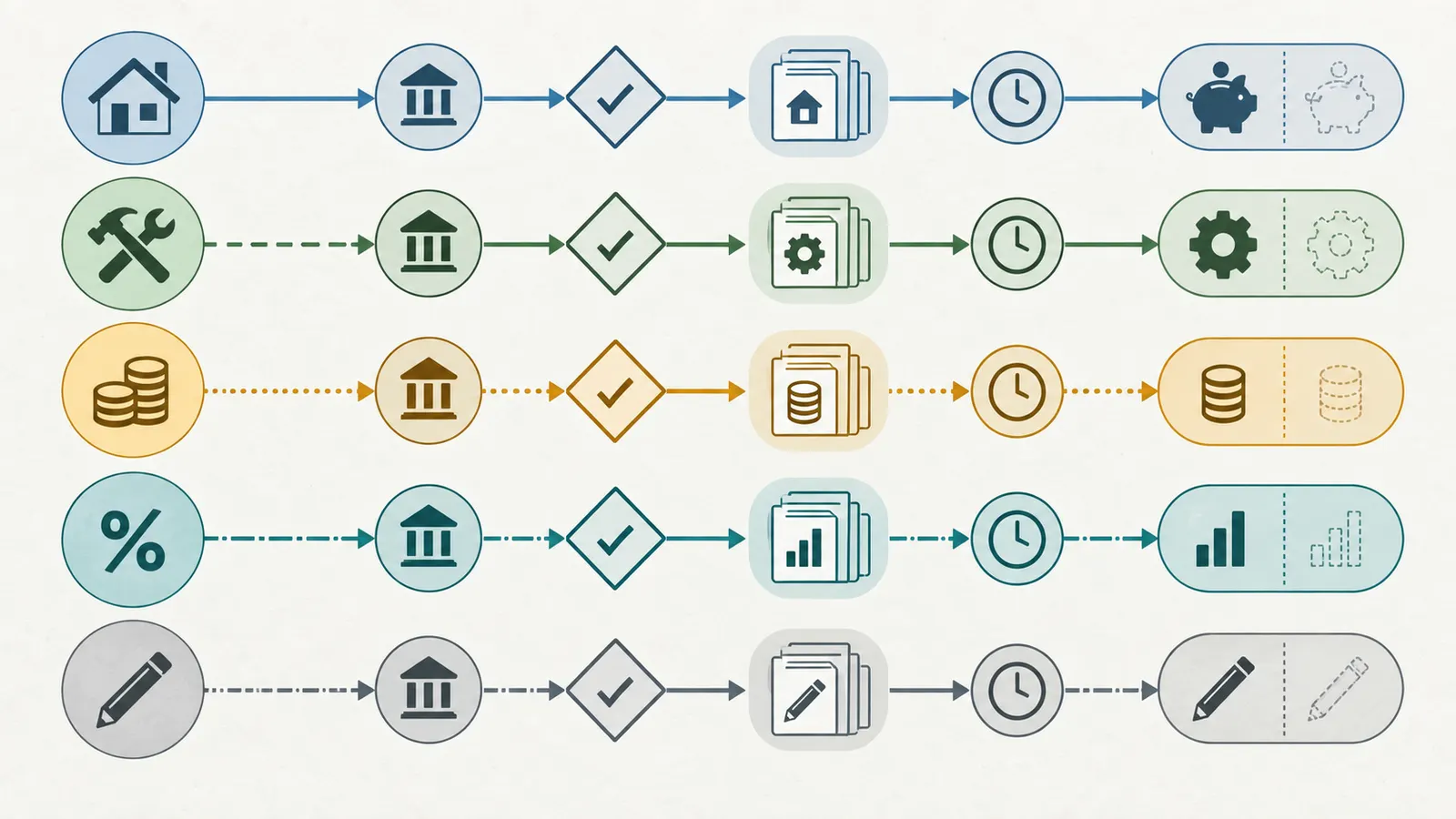
Take two loan proposals and cover their percentages. Ask these six questions for every dollar:
- What exact event makes this dollar eligible?
- Who controls the account or approval?
- What must the homeowner, builder, inspector, architect, appraiser, title company, or lender submit?
- Is the money released before work, after work, or at a scheduled draw?
- If the reserve is not used, does it return to the homeowner, reduce principal, fund approved additional work, or remain subject to a different rule?
- If the reserve is exhausted, what funds the next dollar and what happens to the schedule?
If an answer is “the lender will decide later,” record that as an unresolved closing issue. A verbal explanation can help you understand a document, but it should not replace the document that governs you.
2. Match each reserve to its permitted use and program scope #
The permitted-use rule matters more than the amount because a large reserve that cannot pay the actual problem is not usable contingency. Federal and industry sources illustrate different layers: CFPB addresses disclosure concepts, USDA gives a program-specific construction example, Fannie Mae gives a renovation-escrow example, and AIA discusses contract administration. None should be merged into a universal custom-home rule.
What CFPB Appendix D does and does not tell you
The CFPB’s current Appendix D to Regulation Z provides a special procedure creditors may use to estimate and disclose multiple-advance construction loans when the amount or timing of advances is unknown at consummation. It is a disclosure-concepts reference, not proof of your lender’s present terms, an offer of an interest reserve, or a substitute for the current loan agreement for a September 2026 closing.
The CFPB discussion says a creditor may establish an “interest reserve” by designating part of the loan to pay interest as it accrues. It distinguishes a situation in which the consumer makes interest payments as due from one in which the creditor automatically deducts them from the reserve. It also explains that the calculation must reflect the effect of interest accruing on interest payments when the reserve itself is part of the outstanding balance. The practical question is therefore not simply “How many months of interest are reserved?” Ask:
- Is the reserve calculated on the commitment, the amount advanced, or a lender-specific draw curve?
- Does the reserved interest itself increase the balance on which interest accrues?
- What construction-period rate is assumed, and can it change?
- What happens if construction takes longer than the modeled term?
- Who pays the shortage, and when?
- Is the construction and permanent financing disclosed as one transaction or separate transactions?
Do not infer from Appendix D that an interest reserve is required, that the reserve is free money, or that every lender uses the same calculation. It is a federal disclosure framework, not a product comparison table.
What the USDA example shows
The USDA HB-1-3555 Chapter 12 handbook is a useful illustration because it names several separate categories. In its single-close new-construction feature, the handbook allows an eligible contingency reserve for unplanned construction problems or change orders, limited to 10% of construction cost including labor, materials, and soft costs, with funds deposited into the construction reserve account. It also lists contingency reserve, interest reserve, and PITI payment reserve as separate eligible loan-cost categories, subject to the handbook’s conditions.
That 10% is not a recommendation for every homeowner. It is not a conventional-loan rule, a national custom-home rule, or a substitute for asking whether your lender offers the USDA feature. If you are considering a USDA-guaranteed loan, ask your approved lender to identify the current handbook section and the exact way the reserve appears in your loan documents. If you are not using USDA, do not copy the percentage into your budget without program and lender confirmation.
The same USDA chapter says the approved lender manages draws, maintains a draw and disbursement ledger, and requires at least evidence of a third-party inspection, a signed conditional lien waiver from the contractor or builder, and a title-insurance endorsement for each draw in the described program. This is a strong model for your evidence packet even when your own program differs. It also makes responsibility visible: the builder supports the request, the homeowner approves or acknowledges as required, and the lender controls disbursement and file evidence.
For change orders, the USDA handbook says lenders approve changes during construction and borrowers are responsible for costs above available contingency funds or for ineligible loan purposes after closing. It also says proposed changes should not affect the project scope or appraised value in the described program. That combination is important. A change can be physically possible and still be unfinanceable under a program, or it can require a revised appraisal, underwriting decision, or new cash before work proceeds.
For unused funds, the same USDA handbook says excess construction proceeds are applied to reduce the permanent-loan principal. It permits remaining contingency funds after completion to be used for an eligible loan purpose or applied to principal, and it separately describes limited cash back for certain prepaid expenses paid from the borrower’s personal funds and not representing loan funds. Do not write “unused contingency comes back to me” in your worksheet unless your loan agreement says so.
What the Fannie Mae example shows
Fannie Mae’s current HomeStyle Renovation costs and escrow guidance is for renovation mortgages, not automatically for a custom new-build construction-to-permanent loan. It is still useful as a labeled example of how a secondary-market program can separate costs, reserve, payment escrow, borrower funds, inspections, and unused balances.
The guidance says a contingency reserve can cover renovation-related labor, materials, fees, permits, plans and specifications, inspection costs, and other renovation expenses. For that HomeStyle Renovation feature, a reserve is not required for a one-unit property, although the lender may establish one; a two- to four-unit property requires a reserve equal to 10% of repair and renovation costs, and the lender may increase it to 15% when it determines that the higher reserve is appropriate for the scope and scale. Those figures must stay attached to HomeStyle Renovation; they are not a generic custom-home recommendation.
Fannie Mae also says the renovation escrow can include renovation costs, contingency, applicable mortgage payments, and borrower-provided funds. The lender or agent administers the account, releases funds after the applicable work is completed according to the agreed schedule and after a specific request, and obtains periodic inspections before further draws. If costs increase, the borrower or lender must fund the increase; the lender may not simply increase the loan amount to offset it. These are useful questions to ask your own lender, not terms to assume.
The unused-fund treatment is exactly why your worksheet needs a “source of funds” column. Fannie Mae says unused contingency funds, unless received directly from the borrower, must reduce the renovation-loan balance after completion and certification, subject to the stated provisions for additional improvements or repairs. A borrower-funded amount may be treated differently from a loan-funded amount. Ask whether your own money is identifiable in the ledger, how it can be reimbursed, and how it is treated at completion.
What AIA adds—and what it cannot decide
The AIA contingency allowance guidance says contingencies can address errors and omissions, scope modifications, unknown conditions, escalation, or necessary construction changes. It distinguishes owner, contractor, and designer contingencies. It also says an owner should establish an internal process rather than apply a one-size-fits-all number.
This helps with the construction contract, but AIA does not determine whether a lender will release an escrow dollar. A contractor’s internal contingency may be part of the contract price, invisible to the homeowner as a separate account, or governed by a negotiated delivery method. An architect’s design contingency may protect the design process but not fund a lender-approved draw. A lender’s reserve may be controlled by the lender and unavailable for design changes. Put the contract role and the loan role on different rows.

3. Build the worksheet before you sign #
Complete the worksheet with your lender, builder, and design team before signing, because the comparison is only useful when every row has a controller, gate, evidence packet, and exhaustion rule. The homeowner owns the coordination task, but does not unilaterally control lender approvals, construction means and methods, inspections, title endorsements, or local permits.
Start with prerequisites and inputs
Gather the version of the documents that will actually be signed. At minimum, assemble:
- the plans, specifications, finish schedule, and any addenda;
- the fixed-price or cost-plus construction contract and builder’s exclusions;
- the budget broken into contract work, outside-contract work, soft costs, allowances, taxes, permits, inspection fees, and lender fees;
- the draw schedule and construction-loan agreement;
- the Loan Estimate, Closing Disclosure when available, and any construction-period payment schedule;
- the interest-reserve calculation and assumptions;
- the written contingency and change-order procedure;
- the lender’s instructions for owner contributions and reimbursement;
- the appraisal or value condition that applies to changes;
- the construction duration, projected completion, certificate-of-occupancy path, and conversion conditions; and
- the cash you can retain without jeopardizing ordinary household obligations.
Do not treat an appraisal’s “as completed” value as a guarantee that every desired change is financeable. Do not treat a builder’s allowance schedule as a reserve. Do not treat the lender’s maximum loan amount as a promise that later cost increases can be added. The Fannie Mae renovation example explicitly says an increased cost must be funded by the borrower or lender and that the loan amount cannot simply be increased to offset it; your own product may differ, but the risk deserves a written answer.
Fill one row per uncertainty
Copy this structure into your budget or a private planning sheet. The confirmation fields are deliberate: they force a handoff to the person who can answer them.
| Uncertainty or budget line | Amount and unit | Eligible use or exclusion | Controller | Approval gate | Evidence packet | Release timing | Unused balance | Cash exposure |
|---|---|---|---|---|---|---|---|---|
| Base contract scope | Amount to confirm | Plans, specs, inclusions | Confirm controller | Contract and lender approval | Signed contract, plans, bids | Scheduled draws | Not a reserve | Normal funded scope |
| Outside-contract site or utility work | Amount to confirm | Well, septic, road, utility, landscape, or other named work | Confirm controller | Lender and applicable local authority | Bid, permit, invoice, inspection | Draw or owner payment | Confirm treatment | Amount to confirm |
| Allowance: item to confirm | Amount to confirm | Item, quantity, installation, tax | Confirm controller | Selection and change-order gate | Allowance schedule, quote, selection | When ordered or installed | Credit/change rule | Difference above allowance |
| Lender contingency | Amount to confirm | Unforeseen and eligible only | Lender / confirm other approver | Written request and confirm gate | Change order, cause, invoice, inspection | Confirm release point | Principal / approved use / other | Shortfall after exhaustion |
| Owner cash reserve | Amount to confirm | Excluded, ineligible, or exhaustion events | Homeowner | Underlying lender and contract approvals still apply | Proof of payment and source | As needed | Remains owner cash if unused | Direct cash loss |
| Owner-change envelope | Amount to confirm | Optional scope chosen by owner | Homeowner + confirm other approver | Signed change order, value check | PCO, quote, revised plan | Before work or next draw | Remains / reallocates / gone | Cash or loan source |
| Interest reserve | Amount to confirm | Construction-period interest | Lender / servicer | Schedule and calculation | Rate, balance curve, term | Scheduled payments | Principal / other | Shortfall after term |
| PITI or payment reserve | Amount to confirm | Principal, interest, tax, insurance if allowed | Lender / servicer | Program and occupancy conditions | Payment schedule, escrow instructions | Monthly due dates | Confirm treatment | Monthly shortfall |
The “amount and unit” column needs more than a dollar total. For an interest reserve, record dollars, months, rate assumption, and whether the balance is actual advanced principal or a commitment. For an allowance, record quantity, unit price, installation, freight, tax, and the date the price expires. For price escalation, record the exposed package in dollars and the date of the price source. For an owner-change envelope, record whether it is cash already available, a future sale or gift, or an amount the lender has expressly approved.
The “controller” column is not a label for blame. It answers who can say “yes” to using money. The homeowner may decide that a larger window is desirable, but the builder must price and schedule it; the architect or engineer may need to revise documents; the lender may need to approve the funding and appraised-value effect; and the building department may require a permit revision under the rules of the actual city, county, or state jurisdiction. If a licensed professional or public authority is required, do not self-approve the row.
Write the evidence packet before the problem happens
For each reserve, specify a minimum packet. A practical packet may include the original budget line, a description of the event, a dated proposal, affected subcontractor pricing, a signed proposed change order, schedule impact, revised drawing or specification, permit impact, appraisal/value impact, inspection report, invoice or receipt, and the draw request. The applicable program may demand less or more.
The USDA handbook is a helpful program-specific example because it calls for a ledger and documents such as third-party inspections, conditional lien waivers, title endorsements, receipts, invoices, draw requests, change orders, completion evidence, and warranties. Its Chapter 12 file-documentation section should be read as a source for questions, not copied as a universal lender checklist.
Keep a running reserve ledger with five balances:
- original authorized amount;
- approved commitments not yet paid;
- paid or drawn amount;
- remaining available amount; and
- owner cash required or retained.
Do not subtract a verbal promise from the balance. Subtract an approved commitment when the lender or contract process treats it as committed, and identify whether the amount is gross or net of credits, refunds, allowances, and builder fee. An owner who tracks only checks paid can discover too late that a signed change order has already consumed the reserve.
The sequence from budget to signature
Use this order so the numbers are not compared out of sequence:
- Freeze the current scope sufficiently to identify what is known, unknown, excluded, and optional.
- Reconcile the builder’s proposal to the plans and specifications line by line.
- Identify outside-contract work and who contracts for it.
- Separate allowances from contingency and price exposure.
- Ask the lender to label each account, its permitted use, controller, draw trigger, exhaustion rule, and unused-fund treatment.
- Ask the builder and design professional to explain their own contingencies and change-order authority separately from the loan reserve.
- Run the three scenarios below using the same inputs for every loan option.
- Put unresolved answers on the closing-condition list; do not treat them as assumptions.
- Have the appropriate licensed or regulated professional review the final agreement for your situation and jurisdiction.
- Save the signed versions, exhibits, approvals, and a versioned budget where all responsible people can find them.
The next handoff after signing is not “the lender has the budget.” It is a controlled draw process. The homeowner should know who submits the request, who confirms work, who approves the change, who checks title and liens, who updates the ledger, and who tells the lender that the project is ready for conversion.
4. Run an illustrative sensitivity model before choosing the structure #
Use a sensitivity model to expose funding consequences, not to predict the final cost. The following numbers are illustrative, clearly labeled, and chosen to show the mechanics; they are not an underwriting example, a recommended reserve percentage, or a forecast for a particular home.
Inputs and units
Assume a homeowner has the following draft budget in U.S. dollars:
| Input | Symbol | Illustrative value | Meaning |
|---|---|---|---|
| Approved construction and soft-cost scope | (B) | $455,000 | Base work and named soft costs before the modeled reserves |
| Lender-controlled construction contingency | (L) | $42,000 | A lender/program-controlled amount, shown only as an input |
| Interest reserve | (I) | $24,000 | A scheduled reserve for construction-period interest |
| Owner-change envelope | (O) | $20,000 | Optional scope money, not emergency contingency |
| Owner liquidity reserve | (C) | $30,000 | Cash retained outside the project account |
| Construction period | (T) | 12 months | The lender’s initial schedule assumption |
| Illustrative contract-rate input | (r) | 8.25% per year | Not a quote or commitment |
| Average outstanding balance | (A) | $200,000 | A simple model input, not the lender’s actual draw curve |
The project funding envelope excluding retained liquidity is:
[ F = B + L + I + O ]
[ F = 455{,}000 + 42{,}000 + 24{,}000 + 20{,}000 = 541{,}000 ]
The $30,000 owner liquidity reserve is not added to (F) because it is intentionally retained rather than assigned to the project. The total potential resources under this illustration are $571,000, but that does not mean every dollar is usable for every purpose. A lender may control the $42,000 and $24,000, the owner may control the $20,000, and the $30,000 may be needed for a shortage that the loan cannot pay.
For a simple interest cross-check:
[
I_{simple} = A \times r \times (T/12) ]
[
I_{simple} = 200{,}000 \times 0.0825 \times 1 = 16{,}500 ]
The illustrative $24,000 interest reserve is therefore $7,500 above this simple cross-check. That difference could be a cushion for a different draw curve, fees, rate movement, a longer period, or a lender-specific method. It does not prove that $24,000 is adequate. The CFPB Appendix D discussion of interest reserves explains why the lender’s actual calculation can account for interest reserve treatment and the timing of advances. Ask for the lender’s schedule, not just the reserve total.
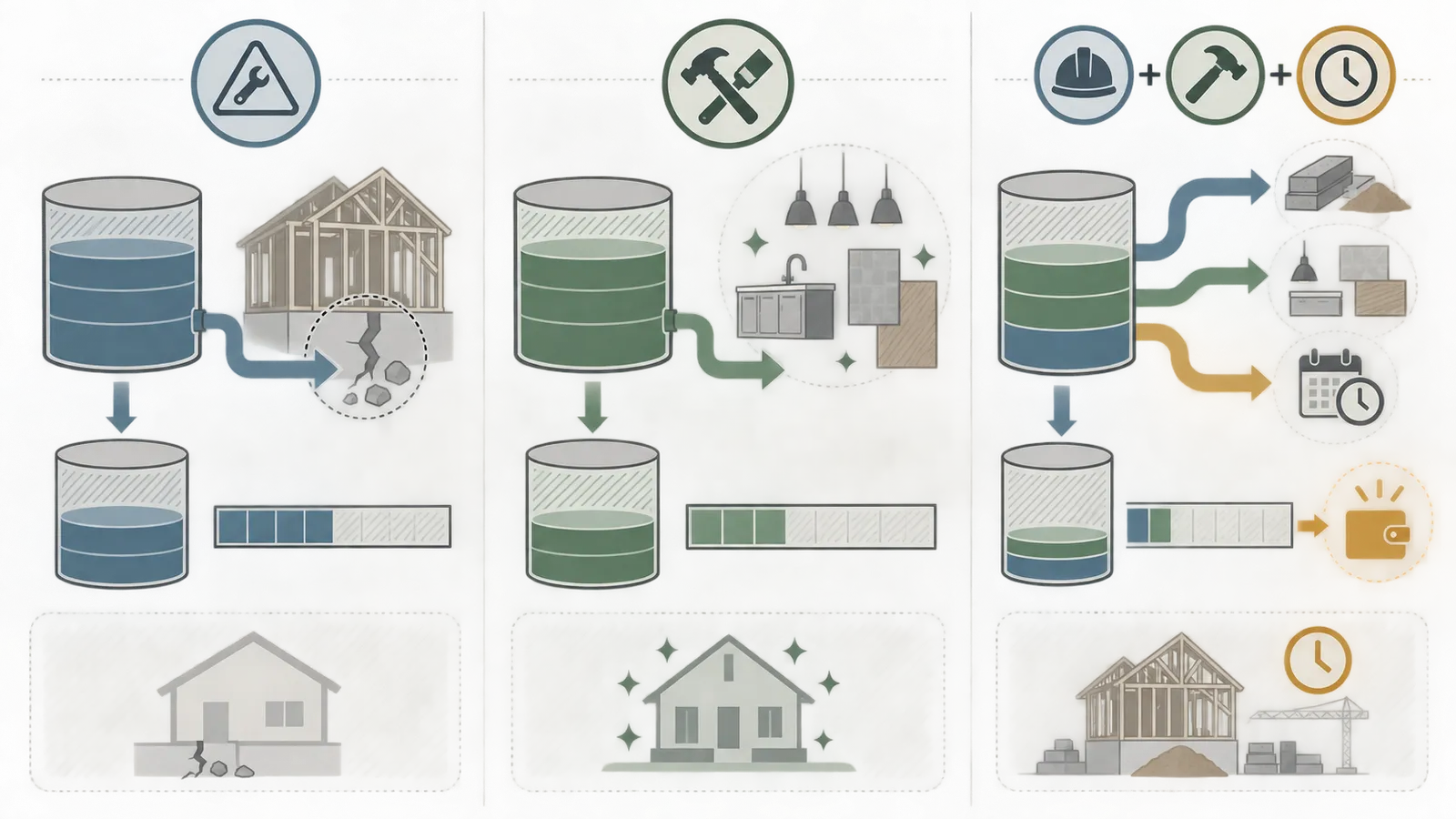
Scenario A: eligible unforeseen work
Model an $18,000 concealed-condition correction that the lender confirms is eligible and an $18,000 approved change order. The two events may happen together, but they belong to different rows if one is necessary work and the other is a preference.
For an eligible correction only:
[ L_{remaining} = L - 18{,}000 = 42{,}000 - 18{,}000 = 24{,}000 ]
[ O_{remaining} = O = 20{,}000 ]
[ I_{remaining} = I = 24{,}000 ]
The modeled owner cash exposure is $0 if the lender actually approves the work and the draw covers the full cost. That $0 is conditional; it is not a promise. If the inspection, appraisal, contract, lien, or program test fails, the cash consequence changes. The homeowner should not authorize the builder to start based only on a probable reimbursement.
Scenario B: owner-selected change
Model a $18,000 upgrade, such as a different finish package or a requested layout change, that is not an unforeseen correction. If the owner-change envelope is available and the builder signs a fixed-price change order:
[ O_{remaining} = 20{,}000 - 18{,}000 = 2{,}000 ]
[ L_{remaining} = 42{,}000 ]
[ I_{remaining} = 24{,}000 ]
The immediate modeled owner cash exposure is $0, but the owner has spent 90% of the change envelope and still has the same construction uncertainty. Calling the entire $42,000 lender contingency “available” would be misleading if the loan prohibits optional upgrades from that bucket. This is the point of keeping (O) separate from (L): the owner can make the choice while seeing that preference money reduces flexibility for later preferences.
Scenario C: combined overrun, upgrade, and interest shortfall
Model a $35,000 eligible overrun, a $24,000 owner-selected upgrade, and $30,000 of construction-period interest due after a longer build. The illustrative interest reserve is still only $24,000, so the interest shortfall is $6,000 and the reserve is exhausted. Assume the lender approves the overrun and the loan agreement allows the change process, but the project has no unused owner-change envelope beyond $20,000.
[ L_{remaining} = 42{,}000 - 35{,}000 = 7{,}000 ]
[ O_{shortfall} = 24{,}000 - 20{,}000 = 4{,}000 ]
[ O_{remaining} = max(O - 24{,}000, 0) = max(20{,}000 - 24{,}000, 0) = 0 ]
[ I_{due} = 30{,}000
I_{shortfall} = I_{due} - I = 30{,}000 - 24{,}000 = 6{,}000
I_{remaining} = max(I - I_{due}, 0) = max(24{,}000 - 30{,}000, 0) = 0 ]
[ Cash_{required} = O_{shortfall} + I_{shortfall} = 4{,}000 + 6{,}000 = 10{,}000 ]
[ Reserve_{remaining} = L_{remaining} + I_{remaining} + O_{remaining} = 7{,}000 + 0 + 0 = 7{,}000 ]
The owner’s $30,000 retained liquidity would fall to $20,000 if the $10,000 shortfall is actually paid from it. That is the cash-at-risk result to compare across loan structures. The remaining $7,000 is not one interchangeable reserve: it is the lender-controlled construction contingency, while the $24,000 interest reserve has been fully consumed and the optional-change bucket is exhausted. The interest reserve cannot rescue the construction contingency, and the construction contingency cannot be assumed to pay the interest shortfall.
| Modeled case | Lender contingency used | Owner-change money used | Interest reserve change | Immediate modeled owner cash required | Remaining labeled balances |
|---|---|---|---|---|---|
| A. Eligible correction, $18,000 | $18,000 | $0 | $0 | $0 | L $24,000; O $20,000; I $24,000 |
| B. Optional change, $18,000 | $0 | $18,000 | $0 | $0 | L $42,000; O $2,000; I $24,000 |
| C. $35,000 eligible overrun + $24,000 upgrade + $6,000 interest shortage | $35,000 | $20,000 | $24,000 used; $6,000 shortage | $10,000 | L $7,000; O $0; I $0; owner liquidity $20,000 |
Add dated price sensitivity without pretending it is a forecast
Suppose the budget contains a $90,000 lumber-exposed package. The archived BLS July 2026 PPI release, accessed September 14, 2026, reports that prices for lumber increased 5.0% in July in its product-detail narrative. Its table separately reports softwood lumber at 15.0% unadjusted over July 2025 to July 2026 and 8.2% seasonally adjusted from June to July. For this worksheet, use the 5.0% figure only as a dated illustrative monthly scenario input:
[ Price\ sensitivity = exposed\ package \times dated\ movement ]
[ Price\ sensitivity = 90{,}000 \times 0.05 = 4{,}500 ]
This says, “If the relevant exposed package moved by 5% under this simplified assumption, the arithmetic difference would be $4,500.” It does not say your supplier will increase the price 5%, that the package is entirely represented by the BLS series, or that labor, freight, waste, taxes, and subcontractor margins move with it. The BLS definition of PPI is a national producer-price measure, and the archived release may later be revised. Your decision is to ask the builder which prices are locked, which expire, which are allowances, and which have escalation language.
If you add the $4,500 to Scenario C, the owner cash requirement could rise from $10,000 to $14,500 only if the lender classifies the price movement as ineligible or the relevant reserve is already consumed. If the contract contingency covers it, the cash consequence may instead be zero and the lender-contingency balance falls from $7,000 to $2,500. The model is useful because it makes the classification visible; it cannot choose the classification for you.
Sensitivity to a longer construction period
Now change only the duration and average balance: (T=15) months and (A=$260,000).
[ I_{simple,long} = 260{,}000 \times 0.0825 \times (15/12) = 26{,}812.50 ]
Against the illustrative $24,000 reserve, the simple difference is $2,812.50. A lender’s calculation may differ because the balance rises through draws, the rate may change, the reserve may itself accrue interest, or the construction period may have extension fees. The safe next action is to request a written “base schedule / one-month extension / three-month extension” table from the lender and to identify the person who can approve an extension.
5. Compare the lender’s written package before the signing appointment #
Choose the structure whose written terms give you the clearest answer to permitted use, approval, exhaustion, and unused money—not automatically the structure with the largest reserve or the lowest initial cash requirement. A high reserve can increase principal, payments, fees, or later cash exposure if it is not usable for your actual risks.
Questions that belong in the lender comparison
Ask the same questions in writing for each lender or program:
| Comparison question | Why it changes the decision | What to obtain |
|---|---|---|
| Is the contingency inside the loan amount, funded separately by me, or a mix? | Loan-funded money and borrower-funded money may have different unused-fund treatment | Budget, commitment letter, construction agreement, escrow instructions |
| What exact costs are eligible? | A reserve cannot pay an excluded item | Program section, written lender policy, examples tied to your budget |
| Who may approve a release? | The person who can spend the money may not be the person who controls the account | Named lender contact, borrower consent rule, builder authority |
| Is approval required before work begins? | Starting first can leave you with an unpaid invoice or ineligible draw | Change-order and draw procedure |
| What proves completion? | The lender may need inspection, invoice, lien waiver, title update, or completion evidence | Draw checklist and sample request |
| How are allowances and credits netted? | A credit may restore contingency, reduce a draw, or simply change the contract | Updated budget and ledger convention |
| What happens when contingency is exhausted? | This is the true owner cash exposure | Written shortage, re-underwriting, lien-priority, and closing procedures |
| What happens if the build runs long? | Interest and payment reserves are time-dependent | Extension policy, rate assumption, reserve replenishment rule |
| What happens to unused contingency? | It may reduce principal, fund eligible work, or be treated differently if you deposited it | Completion and curtailment language |
| Can remaining funds be used for an owner-selected improvement? | A change may be physically possible but financing-ineligible | Written modification process and value/appraisal conditions |
| Will the lender approve an increased loan after closing? | Some programs prohibit increasing the original amount to cover increases | Express written answer tied to your product |
| How do owner funds affect lien priority or reimbursement? | An informal advance can create documentation and priority problems | Contribution agreement, receipts, consent, title instructions |
Do not compare an advertised rate or maximum loan amount in isolation. Compare the total cash path: money needed at closing, money retained after closing, scheduled payments during construction, draw timing, extension exposure, and the amount that remains if the first major problem consumes a reserve. Include lender fees, inspection fees, extension fees, interest, and any required minimum balance only when the documents establish them.
Ask about the interest reserve as a schedule
Request the lender’s interest-reserve worksheet. It should identify the construction period, rate or rate assumptions, expected draw timing, starting balance, maximum balance, and treatment of the interest reserve itself. Use the simple formula in this guide only as a cross-check. If the lender’s result differs, ask for the reason rather than assuming the lender is wrong or that your simple arithmetic is enough.
Ask whether the reserve pays only construction-period interest or also includes principal, taxes, insurance, or other payments. USDA’s handbook, for example, identifies interest reserve and PITI payment reserve as different eligible categories in its program example. A payment reserve can protect the construction-period cash flow but does not make an overrun fundable. An interest reserve can reduce monthly cash payments but can increase the financed balance or leave a shortage after an extension.
Ask how owner money is recorded
A homeowner may pay a design fee, permit, survey, deposit, or approved construction item from personal funds before the construction account is ready. Ask whether the payment is eligible for reimbursement, whether it counts toward the required contribution, whether the lender requires receipts and canceled checks, and whether the payment changes the lien or title documentation. Do not assume “I paid it” means “the loan will repay it.”
Fannie Mae’s renovation guidance says borrower-provided funds can be deposited into the renovation escrow and that some borrower deposits may be reimbursed when used for eligible renovation-related costs intended to be financed. That is an example of why source-of-funds tracing matters, not a promise for a custom new-build loan. USDA’s guidance likewise emphasizes receipts, canceled checks, draw requests, change orders, and lien waivers in the permanent file. Ask which of those rules apply to your documents.
Ask what happens at conversion and completion
The comparison is incomplete until you understand the final inspection, certificate of occupancy, title update, completion certification, final draw, reserve release, principal curtailment, and conversion to permanent payments. Ask:
- Who decides that construction is complete?
- What documents must be delivered before the final draw?
- Is the final draw withheld until a certificate of occupancy, final inspection, or appraisal update?
- How are outstanding punch-list items treated?
- Is unused loan-funded contingency applied to principal automatically?
- If an owner-funded balance remains, can it be reimbursed or does it remain your money?
- When does the permanent payment begin, and what is the first payment if the reserve ends early?
- What happens if the home cannot be occupied on schedule?
The Fannie Mae HomeStyle example ties reserve release and unused funds to completion and certification. The USDA handbook ties its described process to completion evidence, principal reduction, and program-specific file documentation. Your own agreement may use different words; the handoff should be equally explicit.
6. Operate the change and draw sequence without losing the reserve #
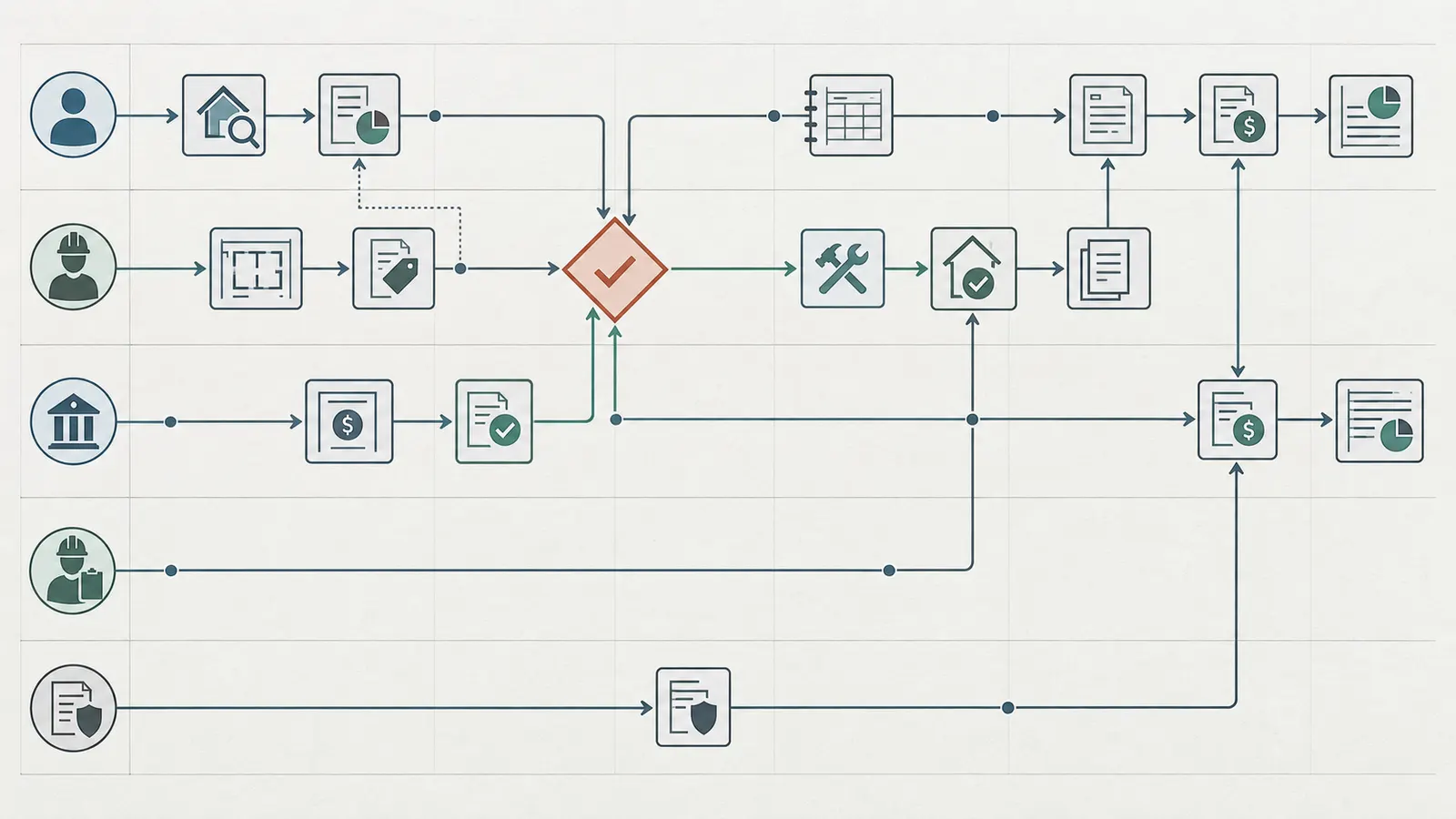
Treat every nontrivial change as a controlled sequence: identify the event, classify the funding source, price the work, obtain the right approvals, revise the ledger, complete the work, assemble evidence, and request the draw. A verbal “we’ll sort it out in the next draw” is a risk signal when the lender requires approval before work or the contract requires a signed change order.
Before closing
The homeowner coordinates the comparison but should assign ownership of each action:
- The homeowner confirms priorities, retained liquidity, exclusions, owner-change limits, and the final questions to the lender.
- The builder confirms scope, inclusions, exclusions, allowances, procurement assumptions, schedule, change-order markup, and the evidence needed for payment.
- The architect, engineer, or designer confirms that plans and specifications are sufficiently complete for pricing and identifies a design or document change that needs professional review.
- The lender confirms program eligibility, reserve categories, draw conditions, interest and payment reserve calculations, unused-fund treatment, and what happens after exhaustion.
- The title company, inspector, appraiser, or other required professional confirms the documents they need at each gate under the applicable program and jurisdiction.
Before signing, make the budget version number and date visible. If the closing package contains a different contract amount or reserve than the version you modeled, stop the comparison and reconcile it. A small difference in a base scope can distort a percentage reserve, the loan amount, the appraisal, the interest curve, and the retained cash requirement.
At closing
Confirm that the signed package contains or clearly incorporates:
- approved plans and specifications;
- the construction budget and cost breakdown;
- the construction contract and change-order terms;
- reserve amounts and account locations;
- interest and payment reserve assumptions;
- draw schedule and request requirements;
- inspection, lien-waiver, title, and completion requirements;
- borrower-consent and owner-contribution procedures;
- the shortage and extension path; and
- unused-fund and principal-curtailment treatment.
A closing professional may explain documents but cannot rewrite the lender’s policy by conversation. If the document is silent on a high-consequence question, ask for a written clarification or amendment through the appropriate lender and closing channel. Keep the clarification with the signed package.
During construction
At each progress point, compare four numbers: work in place, money already drawn, approved commitments, and remaining reserve. The builder’s progress report and the lender’s ledger may use different timing, so reconcile them before approving a request. A draw that looks small can be unsafe if it includes an unrecorded change order, an unresolved lien, or work not verified by the required inspection.
For a proposed change, create a one-page record with:
- change-order number and date;
- reason: unknown condition, error or omission, owner choice, allowance difference, code or permit requirement, price exposure, or other named category;
- original scope and revised scope;
- labor, materials, tax, fee, and builder markup as separate amounts;
- schedule and critical-path effect;
- permit, engineering, appraisal, and inspection effect;
- funding source and remaining balance before and after;
- signatures or electronic approvals required by the contract and lender; and
- instruction: do not start, may start, or emergency direction under the contract.
AIA guidance says a proposed change order should give affected parties a chance to review the requested change and that affected subcontractors should be included in the review. It also describes a construction change directive for situations where time is critical but the work and price still need to be recorded in a change-order log. Use that AIA process guidance to improve your contract administration, while using your signed contract and lender procedure to determine actual authority.
The draw evidence packet
Before requesting a draw, ask the lender’s checklist owner to confirm what is required for that request. A robust packet may include the signed draw request, updated budget and reserve ledger, inspection report, invoices, paid receipts where required, conditional or unconditional lien waivers as applicable, title endorsement or update, approved change orders, revised plans, permit evidence, and homeowner consent. The program may require a subset or additional items.
USDA’s handbook says its lender must maintain documentation that the work was completed and, at minimum for the described draws, include third-party inspection evidence, a signed conditional lien waiver, and a title-insurance endorsement. That level of specificity shows why a homeowner should not treat a contractor’s invoice as the only proof. It also shows why title and lien questions belong to the lender and title professionals, not to a homeowner trying to interpret an email.
When a problem is discovered mid-work
Pause the affected work when doing so is safe and contractually appropriate. Photographing or recording the condition can preserve information, but photos do not replace an inspection, engineering opinion, permit decision, or lender approval. Notify the builder and the responsible design or technical professional, then notify the lender using the agreed channel. Ask for a written classification and a funding decision before authorizing irreversible work unless an actual safety emergency requires immediate action by qualified professionals.
Do not enter an excavation, climb an unfinished structure, handle energized electrical equipment, disturb suspected asbestos or lead, or investigate a confined space to document a cost problem. Do not open, cut, cap, pressurize, depressurize, or diagnose a pressurized plumbing, gas, hydronic, steam, or other pressure-containing system when the budget event involves a leak, discharge, unexpected pressure loss, combustion concern, damaged line, or unknown condition. That is an explicit non-diagnostic stop rule: pause the affected work if it is safe to do so, keep people away from the hazard, and hand the condition to a qualified, appropriately licensed local professional before testing or repair. Confirm permit, inspection, licensing, and emergency requirements with the authority having jurisdiction for the project—such as the actual city, county, state, tribal, or other local building, plumbing, mechanical, gas, or fire authority. Those are physical hazards, not budgeting tasks. Remote review cannot verify site conditions, structural adequacy, safe temporary work, code compliance, lien status, or permit approval.
7. Resolve the failure branches before they become cash surprises #
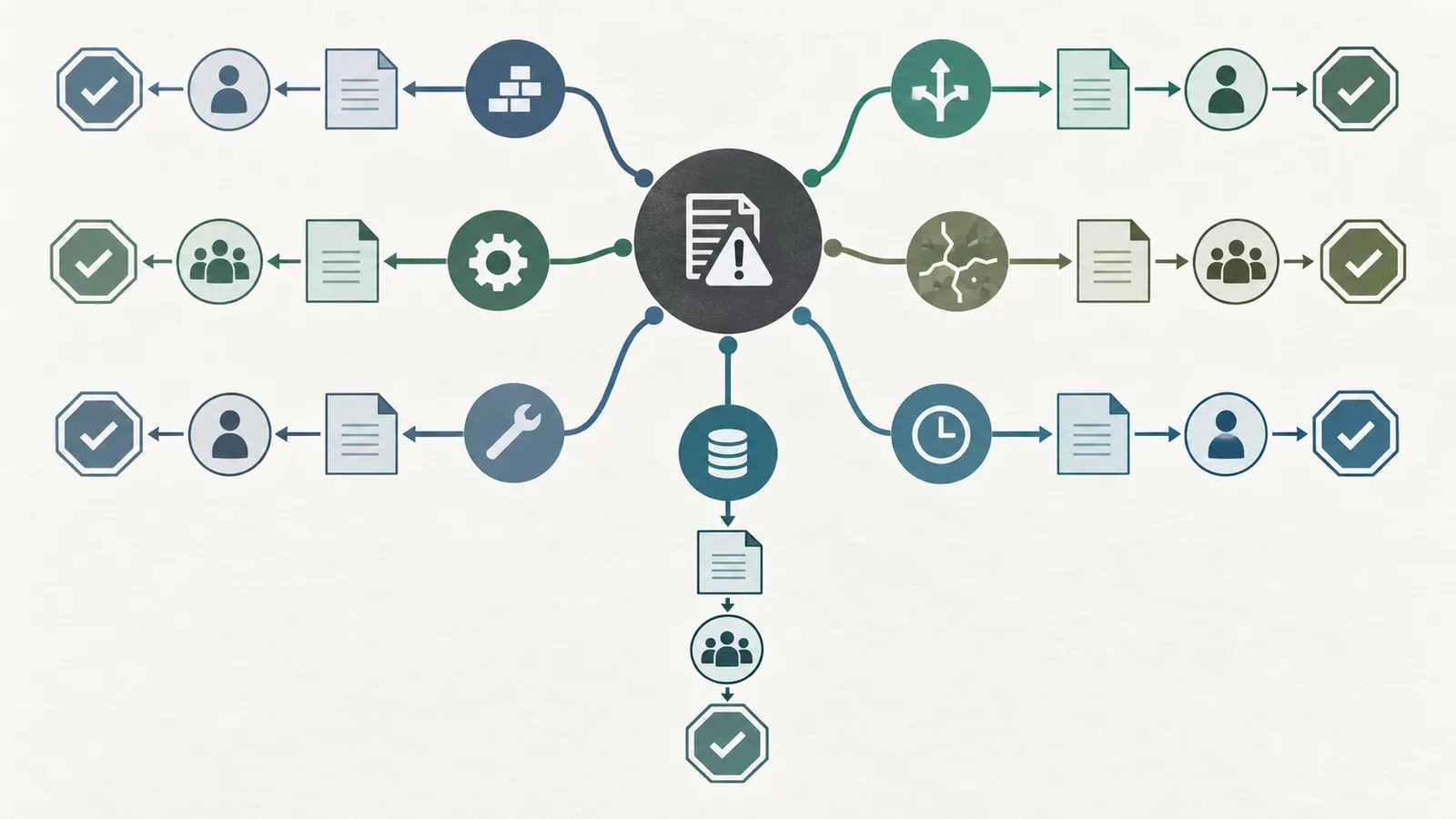
The next decision is to fix the row that fails the test, not to increase every reserve blindly. A reserve architecture is ready for signing only when you can say what happens in the most likely failure branches and who must act first.
| Failure branch | Why the initial comparison fails | Safest next action | Information to bring |
|---|---|---|---|
| Every dollar is called “contingency” | The controller and eligible use are hidden | Split lender, owner, contractor, designer, interest, and owner-change rows | Budget, contract, lender terms, AIA-style change process |
| An allowance is too low | The gap may be a selection change, an estimate error, or an excluded installation | Ask for a fully installed quote and written funding treatment before selection | Allowance schedule, quantity, quote, tax, freight, labor |
| Builder wants work started before lender approval | The cost may be ineligible or unreimbursable | Get written direction from lender and builder under the contract | PCO, schedule impact, loan clause, permit impact |
| Hidden condition consumes contingency | Reserve is being used for a fact not known at pricing | Document condition, price, technical need, lender eligibility, and new balance | Inspection, photos for orientation, professional report, quote |
| Owner chooses a late upgrade | Preference money is mistaken for emergency money | Use the owner-change row and re-run all three scenarios | Signed change order, value effect, cash source |
| Reserve is exhausted | The next dollar is not identified | Ask for the shortage, extension, re-underwriting, and payment path in writing | Ledger, approved commitments, remaining scope, liquidity statement |
| Construction takes longer | Interest or payment reserve was modeled only to the original date | Request extension cost and reserve replenishment calculation immediately | Schedule update, draw curve, rate, reserve ledger |
| Loan-funded money remains at completion | The homeowner expects a refund that the program may not allow | Ask for final accounting and principal-curtailment rule | Final inspection, completion certificate, ledger, source-of-funds record |
| Owner-funded money remains | The source of funds is not distinguishable | Reconcile deposits, receipts, reimbursements, and final balance | Bank records, canceled checks, invoices, contribution agreement |
| Change affects value, scope, or permit | The change may trigger appraisal, plan, or jurisdictional review | Stop classification by the lender, design professional, appraiser, and authority as applicable | Revised plan, PCO, appraisal instruction, permit question |
| Verbal lender answer conflicts with the agreement | The owner cannot know which instruction governs | Escalate through the lender’s documented channel before relying on it | Signed agreement, question, written response, version date |
| Contractor’s contingency is confused with lender reserve | A builder’s internal pricing tool may not be withdrawable by the owner | Ask where the amount appears and who has contractual authority | Contract, proposal, fee and markup schedule |
When the lender says the reserve is “available”
Ask what available means. It may mean the amount is included in the commitment, not that a borrower can request it for any purpose. It may mean the balance is available subject to inspection. It may mean the lender can consider a request, not that approval is automatic. Put “available subject to the written approval conditions in the loan documents” in the worksheet until those conditions are confirmed.
When the builder says the change is “free”
A no-cost change may still affect schedule, permits, design responsibility, warranty, performance, procurement, or an allowance credit. Record it as a zero-dollar change only after the scope and schedule effect are documented. A change that looks free can consume a reserve indirectly if it causes a delay, rework, restocking charge, or extension of the loan.
When the lender and builder disagree about completion
Do not use a final reserve balance to bridge a disagreement about work quality or completion. The lender’s release condition, the construction contract, the inspection result, the certificate of occupancy, and applicable law may involve different standards. Ask the lender and builder to identify the unresolved item and the professional or public authority responsible for deciding it. A homeowner can keep the records organized, but should not make an engineering, legal, title, code, or payment determination from a remote article.
State and local limits
The United States has federal disclosure and program rules, but construction contracts, licensing, lien rules, permit procedures, inspections, taxes, and required notices can depend on the actual state, county, city, tribal, or other jurisdiction where the home will be built. This article does not name a local rule because no project location was provided. Replace each general question with the rule and authority for your jurisdiction. Ask your lender, closing professional, builder, architect or engineer, title company, and local building department which requirements apply. Do not turn a USDA or Fannie Mae example into a local code requirement, and do not treat a national producer index as a local price.
8. Originality brief, decision checkpoint, and next handoff #
The useful next decision is whether each proposed reserve has a documented job and a documented failure path; if it does not, postpone signing long enough to obtain the missing terms. This page’s original contribution is a checkable worksheet and sensitivity model, not a new percentage or a prediction.
Compact originality brief
Current answers: Common consumer explanations say a contingency is prudent, often present one percentage, and note that lenders may review change orders. They usually collapse owner cash, lender-controlled construction contingency, interest reserve, allowances, escalation, and owner-selected changes into one pool.
Missing decision: The homeowner needs to decide which uncertainty belongs in which reserve, who can release it, what evidence is needed, what happens if it is exhausted, and whether an unused or borrower-funded balance becomes principal, approved additional work, or owner cash.
Original contribution: The “Reserve-architecture worksheet and illustrative sensitivity model” maps each input to permitted use, controller, approval gate, evidence packet, draw timing, unused-fund treatment, and cash exposure. The model calculates a $541,000 illustrative project funding envelope, a simple interest cross-check, three change scenarios, a dated PPI-based sensitivity, and a longer-build interest sensitivity.
How it can be checked: Recreate the worksheet from the signed contract, current lender documents, program guide, draw instructions, allowance schedule, and current budget. Verify every modeled input, replace the illustrative numbers, and compare the lender’s ledger after each approved commitment. Check every source claim against the cited CFPB, Fannie Mae, USDA, AIA, or BLS page and keep the scope attached to the claim.
Method: List each uncertainty, permitted use, controller, approval gate, evidence packet, draw timing, unused-fund treatment, and cash exposure; then apply the article formulas to three labeled scenarios. The worksheet is source-derived. It does not collect field data or test loan products. It classifies uncertainty by decision responsibility, then applies transparent arithmetic. The scenario numbers show inputs, units, formulas, and sensitivity so another homeowner can substitute their own values without treating the result as a forecast.
Limitations: This is a planning model, not underwriting, legal, tax, investment, lending, cost, or overrun advice. Program examples are not universal lender terms, and the modeled numbers are illustrative rather than a prediction. The worksheet cannot interpret a borrower’s legal rights, approve a draw, determine code compliance, assess a structure, price a local bid, predict material markets, or choose a loan. CFPB Appendix D is a current disclosure-concepts source; Fannie Mae and USDA examples are program-specific; AIA guidance is professional practice guidance; BLS PPI is national producer-price context. Your signed documents, current program, lender, professionals, and actual jurisdiction control.
The sign-before-closing checkpoint
You are ready to make the signing decision only when you can answer “yes” or “no” to each item without guessing:
- I know the exact base scope and what is outside it.
- I can name every reserve and what it is not allowed to pay.
- I know who controls every reserve and who must approve a change.
- I have a written draw and evidence checklist.
- I have modeled an eligible overrun, an owner-selected change, and a combined case.
- I know how a longer build changes interest or payment obligations.
- I know whether owner cash is retained, deposited, reimbursable, or subject to separate documentation.
- I know what happens when the contingency is exhausted.
- I know how unused loan-funded and borrower-funded money are treated.
- I know which questions require a lender, builder, design professional, title professional, appraiser, or local authority.
- I have not used a national source to infer a state or local rule.
- I have saved the version of the documents that matches the numbers I modeled.
If any answer is “not yet,” the next handoff is to the named responsible person, with a specific question and the budget row attached. For example: “Please confirm whether the $18,000 foundation correction is eligible under the construction reserve, what inspection and lien evidence is required, whether approval must precede work, and how the remaining balance will be recorded.” That question is more actionable than “Do I have enough contingency?”
Keep the final worksheet with the loan documents, contract, plans, draw ledger, approvals, and receipts. A reserve is not a magic percentage. It is a chain of authority and evidence that has to survive the handoff from homeowner to builder to professional reviewer to lender and back to the permanent loan.
Cite this guide
Brictale. “How to Compare Construction Contingency Reserves Before Signing a Custom-Home Loan.” Published 2026-09-25; updated 2026-09-25.
https://brictale.com/build/budgeting/compare-construction-contingency-reserve-options-before-signing · Read the Markdown version
Original contribution: Reserve-architecture worksheet and illustrative sensitivity model. A source-derived way to separate owner cash, lender-controlled contingency, interest reserve, and owner-change money before a custom-home construction-to-permanent closing.
Sources and scope
Evidence behind this page
- CFPB Regulation Z Appendix D says a creditor may establish an interest reserve in a multiple-advance construction loan, and explains that the reserve is a portion of the loan designated to pay accruing interest; the disclosure treatment depends on whether the consumer pays interest as due or the reserve is automatically used.
Appendix D to Part 1026 — Multiple Advance Construction Loans
U.S. federal Regulation Z Appendix D current CFPB page accessed September 8, 2026; disclosure guidance for multiple-advance construction loans, not a promise that a lender must offer an interest reserve or a universal construction-loan term.
Accessed · Link to this claim - Fannie Mae HomeStyle Renovation guidance says a contingency reserve can cover renovation-related labor, materials, fees, permits, plans and specifications, inspection costs, and other renovation expenses. For that program, a reserve is not required for a one-unit property (although the lender may establish one); a two- to four-unit property requires a reserve equal to 10% of repair and renovation costs, and the lender may increase it to 15% when appropriate for the scope and scale. The same guidance says unused contingency funds not received directly from the borrower must reduce the renovation-loan balance after completion and certification, subject to its stated exceptions.
B5-3.2-04, HomeStyle Renovation Mortgages: Costs and Escrow Accounts
Fannie Mae HomeStyle Renovation mortgages, guidance updated December 10, 2025 and accessed September 14, 2026; the one-unit, two- to four-unit, 10%, and 15% figures apply only to this renovation program, not every new custom-home construction-to-permanent loan.
Accessed · Link to this claim - Fannie Mae HomeStyle Renovation guidance says that if costs increase during the renovation period, the borrower or lender must fund the increase, and the lender may not increase the loan amount to offset it; additional funds must be obtained without affecting Fannie Mae's lien priority.
B5-3.2-04, HomeStyle Renovation Mortgages: Costs and Escrow Accounts
Fannie Mae HomeStyle Renovation mortgages, not a nationwide rule or a guarantee of a lender's treatment of a custom new-build loan.
Accessed · Link to this claim - Fannie Mae HomeStyle Renovation guidance says the lender or agent administers the renovation escrow, releases funds only after the applicable work is completed according to the agreed schedule and a specific request is received, and requires periodic inspections before additional draws.
B5-3.2-04, HomeStyle Renovation Mortgages: Costs and Escrow Accounts
Fannie Mae HomeStyle Renovation escrow administration and release example; actual construction-loan draw requirements are controlled by the applicable lender and program documents.
Accessed · Link to this claim - Fannie Mae HomeStyle Renovation guidance says borrower deposits may be reimbursed from the renovation-escrow draw when the funds were used for renovation-related costs and were intended to be financed through the renovation loan.
B5-3.2-04, HomeStyle Renovation Mortgages: Costs and Escrow Accounts
Fannie Mae HomeStyle Renovation borrower-deposit reimbursement example; the source does not establish reimbursement for a custom new-build construction-to-permanent loan or any other lender's product.
Accessed · Link to this claim - USDA Rural Development HB-1-3555 Chapter 12 says its single-close new-construction feature may use a contingency reserve for eligible unplanned construction problems or change orders, limited to 10% of construction cost including labor, materials, and soft costs, with reserve funds deposited into the construction reserve account.
USDA Single Family Housing Guaranteed Loan Program handbook, Chapter 12, revised April 1, 2024 in the advance-copy PDF; a USDA program example with eligibility and lender conditions, not a national custom-loan percentage.
Accessed · Link to this claim - USDA Rural Development HB-1-3555 says furniture, electronic and home-entertainment equipment, and personal items are not included in the cost to construct for the described single-close new-construction program.
USDA Single Family Housing Guaranteed Loan Program handbook, Chapter 12, single-close new-construction eligible-cost example; program-specific exclusion, not a national rule for conventional, FHA, VA, bank, or private construction loans.
Accessed · Link to this claim - USDA HB-1-3555 lists contingency reserve, interest reserve, and principal-interest-tax-insurance payment reserve as separate eligible loan-cost categories in its single-close construction feature, subject to the handbook's limits and conditions.
USDA Rural Development single-close program example; not a statement that all lenders or programs offer or size these reserves the same way.
Accessed · Link to this claim - USDA HB-1-3555 says approved lenders manage construction draws, maintain a draw and disbursement ledger, and require evidence including a third-party inspection, signed conditional lien waiver, and title-insurance endorsement for each draw in the described single-close program.
USDA single-close construction draws under Chapter 12; lender-file requirements for that program, not a universal checklist for every U.S. construction loan.
Accessed · Link to this claim - USDA HB-1-3555 says lenders approve change orders during construction, while borrowers are responsible for costs that exceed available contingency funds or are for ineligible loan purposes after closing; proposed changes should not affect project scope or appraised value in the described program.
USDA single-close program-specific change-order rule; not a general rule for conventional, FHA, VA, bank, or private construction loans.
Accessed · Link to this claim - USDA HB-1-3555 says excess construction proceeds are applied to reduce the permanent-loan principal, and remaining contingency funds may be used for an eligible loan purpose or applied to principal; it separately allows limited cash back for certain prepaid expenses paid from the borrower's personal funds and not representing loan funds.
USDA single-close program-specific excess-fund and cash-back treatment after closing and completion.
Accessed · Link to this claim - USDA HB-1-3555 says the permanent loan file for the described single-close transaction should contain documentation such as the construction agreement, plans and specifications, receipts, invoices, lien waivers, draw requests, change orders, title endorsements, completion evidence, and warranties.
USDA single-close mortgage-file documentation; an example of an evidence packet, not a universal lender checklist.
Accessed · Link to this claim - The American Institute of Architects describes contingency as an amount or percentage held for unpredictable changes and distinguishes owner, contractor, and designer contingencies because they address different project risks; it says there is no one-size-fits-all owner-contingency amount.
Managing the contingency allowance
AIA professional practice guidance published November 30, 2023; contract and project-management guidance, not mortgage underwriting or a required percentage.
Accessed · Link to this claim - AIA guidance recommends using a proposed change order to document a requested change, including review by affected subcontractors, and says a construction change directive can be used when time is critical while still recording the work and price in a change-order log.
Managing the contingency allowance
AIA professional practice guidance for project contingency and change-order administration; actual contract forms and authority depend on the signed construction agreement and jurisdiction.
Accessed · Link to this claim - The U.S. Bureau of Labor Statistics says the Producer Price Index measures average change over time in selling prices received by domestic producers, with prices from the first commercial transaction for many products and services.
U.S. national producer-price measure; it is not a project-specific bid, retail quote, local material price, or forecast of a homeowner's construction cost.
Accessed · Link to this claim - The archived BLS Producer Price Index news release for July 2026 reports that prices for lumber increased 5.0% in July in its product-detail narrative; the release's table separately reports softwood lumber at 15.0% unadjusted over July 2025 to July 2026 and 8.2% seasonally adjusted from June to July. The 5.0% figure can be used only as a dated illustrative sensitivity input for an exposed lumber package, not as a prediction of a project's lumber cost.
Producer Price Index News Release — July 2026
Archived U.S. Bureau of Labor Statistics July 2026 PPI release, accessed September 14, 2026; the 5.0% product-detail movement and the table's separate softwood-lumber measures are national historical producer-price context, subject to later revisions, not a local quote, contract escalation term, or project forecast.
Accessed · Link to this claim