Can a Construction Loan Pay for Material Deposits Before Installation?
A U.S. homeowner decision path for material deposits: compare loan terms, lender evidence, inspections, title checks, and cash exposed before authorization.
The short answer
Sometimes. A construction loan may fund a material deposit before installation only when the loan documents, draw schedule, and lender process allow it. [Dart Bank](https://dart.bank/wp-content/uploads/2022/11/Construction-Permanent-Lending-Borrower-Information-Guide.pdf) and [Herring Bank](https://www.herringbank.com/mortgage/new-home-construction-loan/) describe completed-work baselines, while [First Merchants](https://www.firstmerchants.com/personal/borrowing/mortgages/compare-mortgages/construction-loans/how-does-my-builder-get-paid) and [Hingham](https://helpcenter.hinghamsavings.com/en/articles/2017159-construction-inspection-process) show lender-specific deposit exceptions. Before paying, classify the material state, collect records, obtain written lender confirmation, and calculate cash at risk if funding is delayed or denied.Can a Construction Loan Pay for Material Deposits Before Installation?
Sometimes. A construction loan may fund a material deposit before installation only when the loan documents, draw schedule, and lender process allow it. Dart Bank and Herring Bank describe completed-work baselines, while First Merchants and Hingham show lender-specific deposit exceptions. Before paying, classify the material state, collect records, obtain written lender confirmation, and calculate cash at risk if funding is delayed or denied.
This is a United States homeowner decision surface for a construction-to-permanent or separate construction loan used with a general contractor. It is not a lending approval, personalized borrowing advice, legal conclusion, title opinion, or promise that any lender will fund a supplier. “United States” is the governing market scope here; no single state, county, or city lien, recording, permit, occupancy, or consumer-credit rule is being substituted for the requirements of the property’s actual jurisdiction. Your signed construction-loan agreement, approved budget and draw schedule, builder contract, title company, and lender’s current instructions control.
A construction loan can pay a material deposit only when the loan documents and lender workflow make that payment eligible #
The short answer is conditional because “construction loan” describes a financing structure, not one national reimbursement rule. The Consumer Financial Protection Bureau’s construction-loan explanation describes funds generally being provided in a series of advances as construction progresses. A lender’s advance can therefore be tied to a completed scope, a percentage of a budget line, an item already in place, or a specifically approved exception. The label on the builder’s invoice does not decide eligibility.
The first decision is not “Does this supplier want 30%?” It is “What does this payment represent in the lender’s approved funding model, and what can the lender verify today?” A payment called a deposit can be five different things in practical terms:
- a supplier’s reservation or production deposit for an item still off site;
- a payment for materials purchased and stored in a bonded warehouse;
- a payment for materials physically delivered to the lot but not installed;
- a payment for an installed component or work completed to a measurable percentage; or
- a contractor’s general cash-flow request that is not traceable to a specific budget line, purchase order, or supplier.
Those states have different evidence and different risk. A lender may reject the first, consider the second only with insurance and custody documentation, accept the third under a specific inspection procedure, or pay the fourth as part of a progress draw. The fifth needs clarification before money moves.
Published lender material shows why a neutral answer must preserve the distinction. First Merchants Bank says its draws are typically for completed work or deposits needed to order certain items, and it publishes a 10% to 30% flexibility example for windows, doors, cabinets, and countertops. That is evidence of a particular bank’s program, not a normal U.S. allowance. First Merchants’ published builder-payment explanation also says the bank verifies completed work with a site inspection, checks for supplier or subcontractor liens through its title company, and confirms borrower authorization before release.
Other published policies are more restrictive. Dart Bank says it typically reimburses items and work already completed, while exceptions for material or supplier deposits require approval from its construction lending department. Herring Bank says its builder can request draws for completed work only, not work in progress, and that an inspection determines the amount released for requested line items. Read together, Dart Bank’s borrower guide and Herring Bank’s construction-loan process support a useful default: assume a pre-installation deposit is homeowner or contractor cash until the lender has approved an exception in the signed or written draw instructions.
First Federal Bank’s Idaho construction-process page adds a narrower example: it bases draw approvals on the percentage of completion on site, calls for invoices when a request includes materials not on site or labor not completed, requires lender approval of borrower-and-builder-signed change orders before material purchases or work on site, and says each draw is reviewed by its Construction Department. First Federal’s Idaho construction process is evidence of that lender’s Idaho workflow only; it does not establish a United States rule or make an off-site deposit eligible for another loan.
The federal disclosure framework does not change that conclusion. The CFPB’s TRID construction-loan guide explains how construction-only and construction-permanent loans can use multiple advances and how costs, inspection charges, and draw fees can be disclosed. It explains disclosure treatment; it does not promise that a particular supplier invoice is an eligible advance. Treat “the loan has a construction phase” and “this deposit will be reimbursed now” as separate questions.
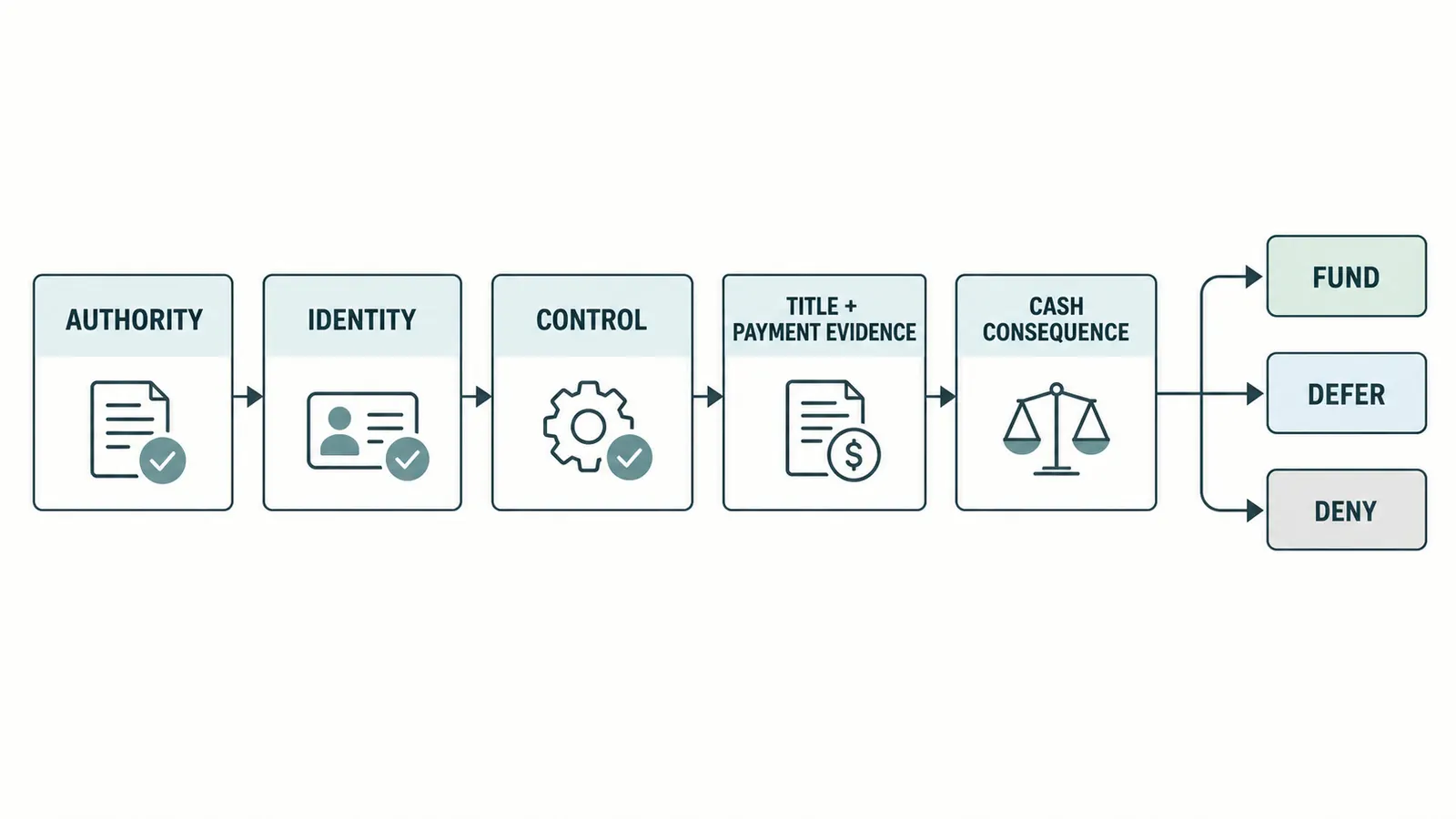
The approval test
Use this five-part test before authorizing a deposit:
- Authority: Is the requested payment within the executed construction-loan agreement, approved budget, and current draw schedule, or has the lender named a written exception process?
- Identity: Does the request identify the exact project line, supplier, material, quantity, unit, delivery location, and payment amount?
- Control: Can the lender or its inspector verify ownership, delivery, storage, insurance, and intended use without relying only on a contractor statement?
- Title and payment evidence: Can the builder, supplier, and title company provide the invoices, waivers, receipts, endorsements, or other records required by this lender and this property jurisdiction?
- Cash consequence: If the lender says no, delays the inspection, or advances only part of the request, can the project continue without an unsafe shortcut, unpaid supplier, or unplanned borrowing?
If any answer is unknown, the safe next action is a written question to the lender’s construction-loan or draw department, copied to the general contractor. Ask the lender to state whether the payment is eligible, the maximum eligible amount, the triggering condition for release, the required documents, the inspection timing, the title update requirement, and who receives the funds. “The builder said it is covered” is not the same as lender authorization.
What this answer does not decide
This page does not decide whether a contractor may require a deposit under the construction contract or under the law of the property’s state. It does not decide whether a supplier can file a mechanics lien, whether a waiver is effective, whether a warehouse has adequate custody controls, or whether a product meets plans and specifications. Those questions belong to the contract, the applicable jurisdiction, the title company, and qualified legal, design, insurance, or construction professionals as appropriate.
It also does not turn a lender inspection into a code inspection. A draw inspector may be verifying progress or the presence of a budgeted item for funding purposes. The city or county building official in the actual jurisdiction decides permit and inspection matters under that jurisdiction’s rules. An appraiser, title company, lender inspector, and building official have different responsibilities. Do not ask one to certify the others’ work.
Classify the payment by physical state before comparing it with the draw schedule #
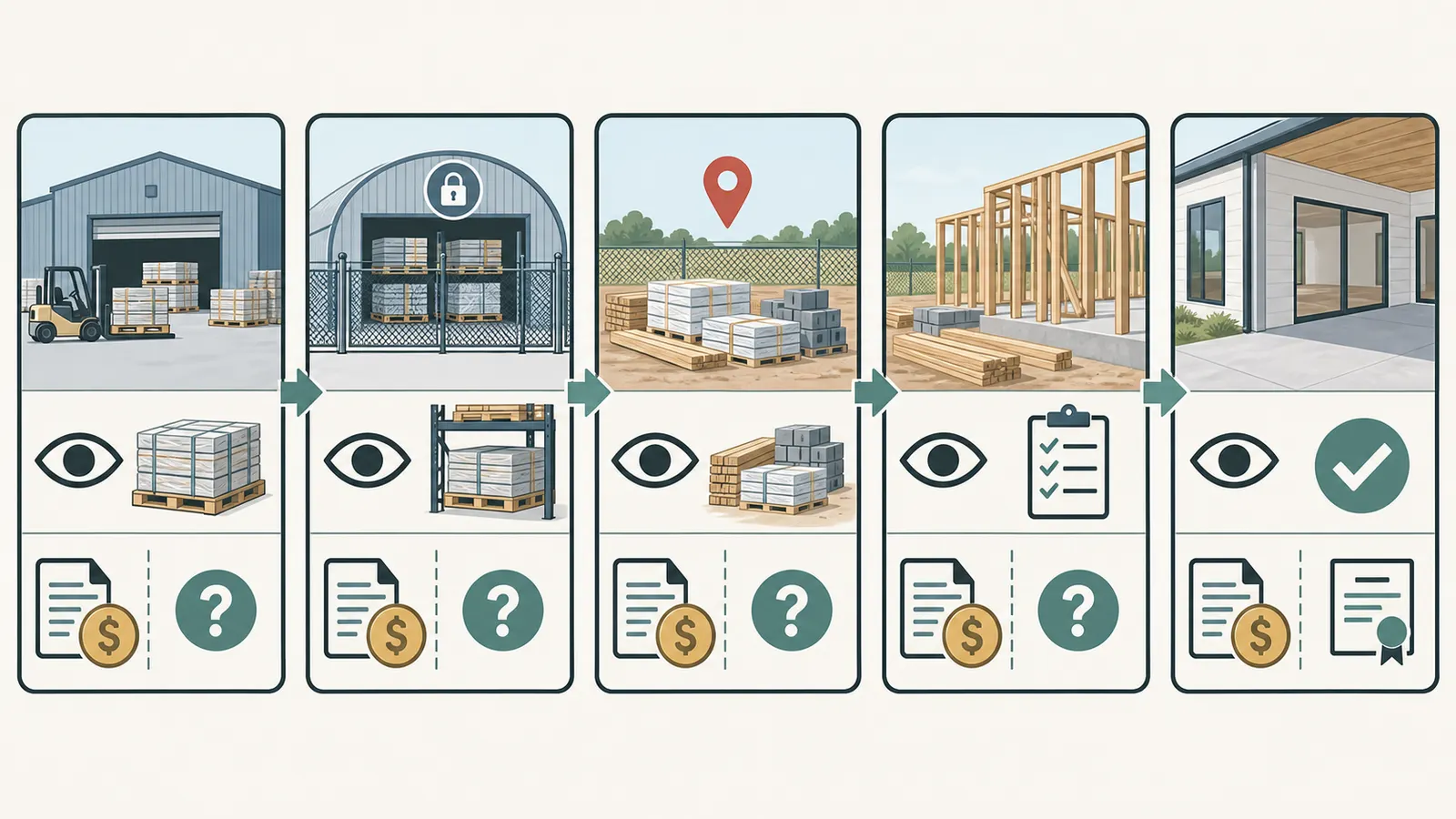
The most reliable first step is to classify the requested payment by what exists, where it exists, who controls it, and what the lender can inspect—not by the invoice label “deposit.” The classification should appear on the draw request and be supported by a document trail that a person who was not in the builder’s office can follow.
State 1: off-site order or supplier deposit
An off-site order is a payment made before the material is at the lot or an approved storage location. Examples include a deposit to release a window package into production, a cabinet deposit before fabrication, a countertop slab reservation, or an order for trusses that has not shipped. The homeowner has cash exposure because the lender may not yet control or inspect the item, the supplier may have cancellation or refund limits, and the component may be changed by a later field measurement.
This is the state most likely to be confused with an eligible draw. A purchase order proves that an order exists; it does not prove that the material is delivered, insured, unencumbered, compliant with the plans, or recoverable if the builder relationship fails. A supplier invoice proves an amount was billed; it does not by itself prove that the lender’s draw condition is satisfied.
Some lenders publish exceptions. First Merchants describes deposits required to order certain items and gives a 10% to 30% example for several long-lead categories. Dart describes a special process for exceptions and separately describes a kit or modular deposit structure. Hingham says it disburses on a completed-and-in-place basis but may consider materials and deposits case by case. These examples establish the right question—“What exception does this program allow?”—not the right answer for your loan.
For an off-site order, ask the lender specifically whether the request is a supplier deposit, a contractor advance, or an eligible long-lead exception. Ask whether the payment must go directly to the supplier or through a title company, whether a refund or cancellation assignment is needed, whether the supplier must sign a waiver, whether the builder must contribute first, and what happens if the item is substituted. Do not make a large payment based on a verbal “we always do it this way.”
State 2: bonded-warehouse storage
Bonded-warehouse storage is different from an ordinary off-site order because the material may exist and be identifiable while a third party holds it. It is not automatically equivalent to material on the lot. The lender still needs to know what is stored, where, under whose insurance, under whose title or control, and whether it can be released only for this project.
Live Oak Bank’s published payment sheet says that when a deposit or material payment is requested, purchase orders or invoices and required waivers are submitted, and the materials must be onsite or at a bonded warehouse during inspection; it also notes that additional proof of insurance may be required. This is a lender-specific checklist, but it demonstrates the evidence burden because it names the storage condition rather than treating every “ordered” item as the same.
For this state, your evidence packet should identify the warehouse by legal name and physical address, the storage receipt or release number, the material description and quantity, photographs or inventory records if accepted by the lender, the insurance certificate, the party responsible for loss or damage, and the supplier’s statement that the material is allocated to the project. Ask the title company or lender whether storage off the real property affects its lien or collateral analysis. Do not infer that “bonded” means “insured for the amount of your deposit” or “owned free and clear by the borrower.” Those are separate questions.
State 3: materials on the lot but not installed
Materials on the lot are physically present but may not yet be part of the completed work. Lumber stacked on a protected site, delivered windows still crated, or cabinets stored in a locked dry room may be observable. Whether they count toward a draw depends on the lender’s program, the draw schedule, the inspector, security, insurance, and the risk that materials are damaged, stolen, rejected, or moved to another project.
TD Bank’s published construction-loan page says its draw schedule describes how it will disburse funds as construction progresses, that draws are for building the home and permanent fixtures, and that an inspection verifies work completed at each draw while title updates occur multiple times during construction. Hingham’s published process uses a stricter baseline—work-completed and in-place only—while saying it may consider materials and deposits case by case. The distinction matters: “on the lot” can be an eligible condition for one program and insufficient for another.
Ask the inspector what can be verified from the site visit. A photo of a pallet may show presence but not quantity, ownership, or allocation. A delivery ticket may show arrival but not acceptance. A serial-number list may show identity but not whether the material is intended for this plan. If the item is custom or nonreturnable, ask who verifies that the approved plans and specifications still call for it before the lender advances.
State 4: work in progress
Work in progress is a partly performed scope: framing has begun but is not complete, cabinets are being fabricated, mechanical rough-in is partially installed, or a subcontractor has mobilized but has not reached a measurable draw milestone. A lender may allow a percentage draw against a budget line, or it may require the requested line item to be complete. The phrase “work in progress” is therefore not enough; the lender’s calculation method controls.
Herring Bank expressly says its builder may request draws for completed work only, not work in progress, and bases the released amount on the percentage completed for the requested line items after inspection. Dart Bank’s borrower guide similarly describes disbursements based on the amount of work completed as judged by an inspector. Do not translate those two statements into every lender’s rule; use them as a reason to ask your lender which lines can be prorated and which cannot. Herring’s construction-loan process is the source for its completed-work example.
For a partially completed line, record the approved budget, the original scope, the percent-complete method, the inspector’s measurement, previous draws, the amount requested now, and the remaining balance. The arithmetic should reconcile to the draw schedule. If the builder asks for a deposit plus a progress amount in one line, separate them so the lender can decide each state instead of rejecting an unclear blended request.
State 5: installed or completed work
Installed work has the strongest connection to the lender’s progress model because the component can be observed as part of the house. It still is not automatically payable. The inspector may need to confirm the scope, the draw schedule may hold back a percentage, the title company may require a date-down endorsement, and the lender may require invoices, sworn statements, or lien waivers.
First Merchants’ draw explanation says it verifies completed work through a site inspection and checks for supplier and subcontractor liens through its title company. Dart’s borrower guide says sworn statements and lien waivers or receipts support the draw request. Herring’s loan process says the draw amount is based on the percentage completed from the requested line items. These are separate verification layers: physical progress, payment documentation, and title status.
Do not ask the contractor to call the installed work “a deposit” just because a supplier still wants payment. That creates a record mismatch. Describe the physical state honestly, identify what has already been paid, and ask the lender whether its process pays the builder, supplier, title company, or borrower. The cleanest request is one where the invoice, inspection observation, budget line, and payment recipient all tell the same story.
Classification worksheet
Complete this row before asking for authorization:
| Field | Record your answer | Why it matters |
|---|---|---|
| Material or scope | Exact description, model, quantity, and approved plan/spec reference | Prevents a generic “materials” line from hiding a substitution or allowance issue |
| Physical state | Off-site order, bonded warehouse, on lot, work in progress, installed, or completed | Determines what can be inspected and which branch of the lender policy applies |
| Location | Supplier, warehouse, lot, or installed room/area | Establishes custody and inspection boundary |
| Current owner or custodian | Homeowner, builder, supplier, warehouse, or other named party | Identifies who bears loss, can release the material, and must sign records |
| Amount requested | Deposit, reimbursement, progress amount, tax, shipping, or combined request | Allows the lender to separate eligible and ineligible components |
| Budget line | Approved line name, budget, previous draws, remaining balance | Prevents the request from exceeding the budget or double-counting a prior advance |
| Evidence available | Invoice, purchase order, delivery ticket, waiver, receipt, insurance, photos, inspection, title update | Turns a verbal request into a checkable handoff |
| Decision needed | Fund, partially fund, defer until delivery, defer until installation, or approve exception | Makes the lender’s response actionable |
If you cannot fill in the location, custodian, budget line, and decision needed, do not treat the request as ready for authorization. The next decision is to clarify the missing field with the general contractor and lender’s construction specialist.
The evidence packet should let the lender verify amount, custody, progress, payment, insurance, and title #
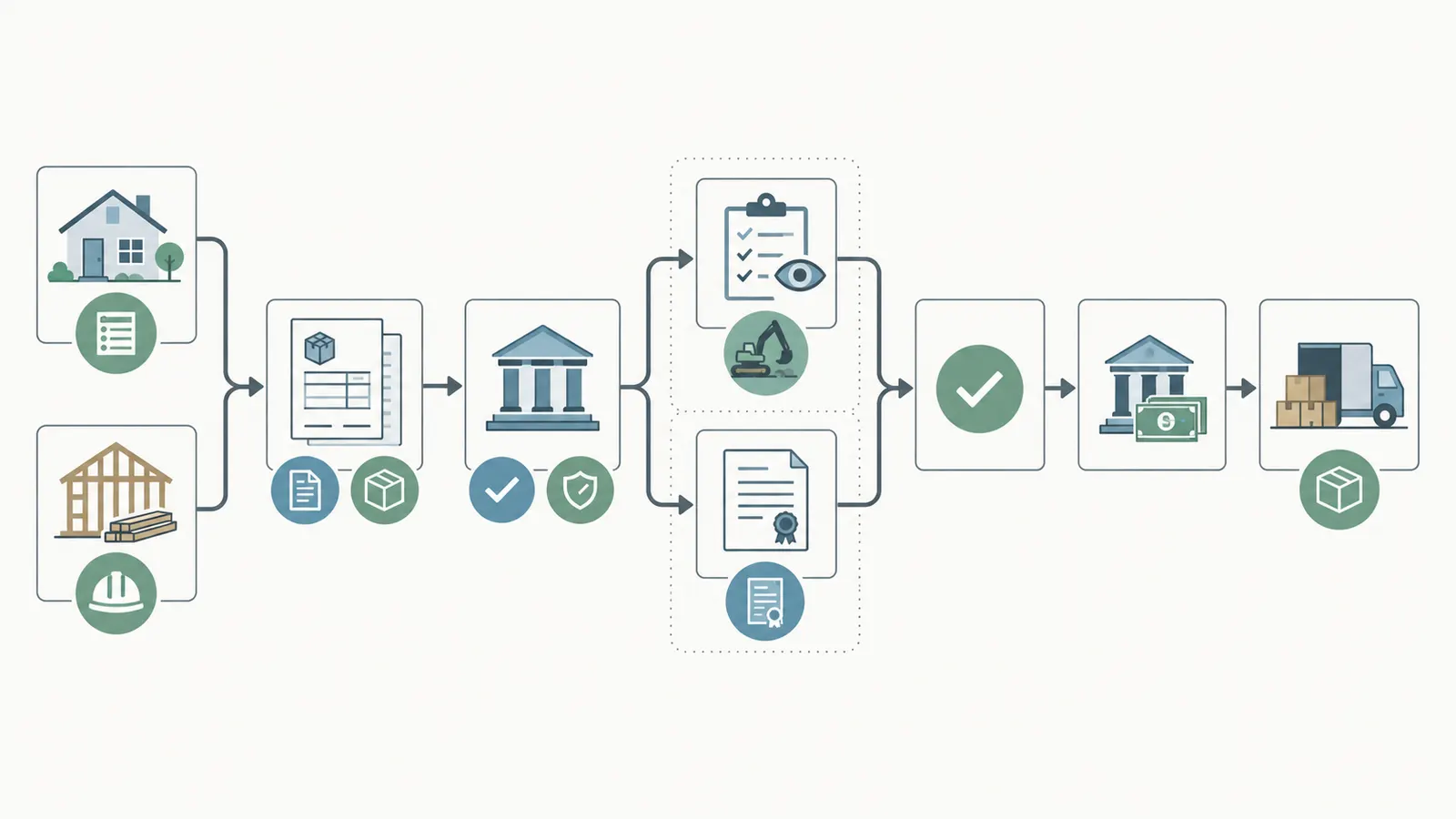
The lender should be able to identify what is being funded, verify the condition that makes it eligible, and see how the money will be paid without reconstructing the project from text messages. The builder usually assembles the draw request, but the homeowner remains responsible for understanding what authorization means under the loan documents.
Layer 1: contract and budget authority
Start with the executed construction-loan agreement, the approved cost breakdown, the draw schedule, and the builder’s signed contract. Look for definitions of construction costs, eligible advances, deposits, stored materials, change orders, retainage or holdback, inspections, fees, and required approvals. Check whether the lender can amend the schedule in writing and whether a deposit exception must be approved before the supplier is paid.
The federal disclosure material helps explain why the loan may have a multiple-advance structure, but it does not replace your documents. The CFPB separate-construction disclosure guide says creditors may handle a multiple-advance construction phase under the disclosure choices described in the TRID framework. That tells you the financing can be staged; it does not tell you whether your cabinetry deposit is an eligible stage.
Compare four numbers: the approved line-item budget, total prior draws, the current request, and the uncommitted balance. If the current request plus prior draws exceeds the line, stop and ask whether there is an approved change order, a substitution credit, or a contingency allocation. Never use “there is still money in the total loan” as proof that a specific budget line can be advanced.
Layer 2: commercial proof
The commercial proof identifies what was ordered and at what price. Depending on the lender, it may include a signed purchase order, supplier invoice, contract exhibit, deposit schedule, delivery ticket, receipt, cancelled check, or wire confirmation. Live Oak’s payment checklist says purchase orders or invoices need to be submitted for requested deposits or material payments and that cancelled checks may be required when reimbursement is requested.
The request should show whether tax, freight, storage, fabrication, installation, allowance reconciliation, and change-order amounts are included. Separate refundable and nonrefundable portions. Separate material from labor. Separate the builder’s markup if the lender’s budget defines that category differently. A supplier invoice for a $24,000 window package and a contractor request for $24,000 are not necessarily the same thing if the builder has already paid $6,000 or is adding a contract markup.
For custom items, add the approval record tying the item to the plans and specifications. The lender may care about collateral value and budget eligibility, while the designer, architect, or builder is responsible for whether the item satisfies the approved design. Do not ask the lender’s draw inspector to approve a design substitution unless the lender’s process explicitly assigns that review.
Layer 3: payment and lien documentation
A draw can move money without proving that every downstream party was paid, so lenders often require sworn statements and lien waivers at defined stages. Dart’s guide says sworn statements and lien waivers or receipts are submitted to the title company and construction department as a basis for processing a request. Live Oak’s checklist describes conditional and unconditional progress waivers, supplier waivers, and other project-specific requirements.
The type and timing of a waiver matter, but do not infer from a label alone what effect the document has. The form’s wording, conditions, signatures, payment status, and the law of the property’s jurisdiction all need to be checked. This article does not state when any waiver is legally effective in your state. Ask the title company or a construction attorney licensed in the property’s jurisdiction to explain the form before signing or accepting it, especially when the payment is a deposit, the supplier is unpaid, or the builder has a dispute. Dart’s guide and Live Oak’s checklist show that waiver requirements are part of lender-specific draw documentation.
Do not sign a statement that says all suppliers are paid if a deposit is still held by the builder or if a supplier’s payment is pending. Ask the builder and title company how a partial or conditional payment should be represented. The objective is a truthful chain: who billed, who paid, who still has a claim, and what document changes after the draw clears.
Layer 4: physical verification
The inspection question is not merely “Is there a pallet?” It is “Can the lender verify the requested budgeted condition at the time and in the manner required by the program?” TD says an inspection is performed at each draw to verify work completed and title updates occur multiple times during construction. Hingham says an inspector visits after a disbursement request and bases the draw on the inspector’s report and approved schedule. Herring says the draw specialist orders an inspection and uses the percentage completed for requested line items.
Ask what the inspector will be asked to verify: installed percentage, materials on site, stored materials, quantity, location, weather protection, or a completion milestone. Ask who may be present to identify materials and whether access, lighting, or safe walking surfaces are required. A remote photo review, if accepted, is a lender procedure; it is not a substitute for a site inspection when the lender requires one.
Layer 5: insurance and custody
A material that has been paid for but is damaged or stolen can create both a cash-flow problem and a project delay. Live Oak’s payment checklist notes that additional proof of insurance may be required for materials at the time of inspection and lists current owner and general-contractor insurance in its payment documentation. Dart’s borrower guide says builder’s-risk insurance or dwelling-under-construction coverage is required in its construction-loan context and that responsibility should be stated in the negotiated contract.
Confirm the policy name, insured parties, coverage dates, location, deductible, storage conditions, and responsibility for a loss. Do not assume that a builder’s risk certificate proves the exact high-value custom item is covered while off site. Ask the lender and insurance agent. If the material is in a warehouse, ask whether the warehouse’s coverage and the project policy coordinate, and who bears the deductible.
Layer 6: title and jurisdiction records
Title verification is a separate handoff from physical inspection. First Merchants’ draw explanation says its title company checks whether subcontractor or supplier liens have been filed. Live Oak’s checklist lists a date-down endorsement that must confirm the property is free of mechanics liens, and Herring’s final-draw examples describe a date-down title endorsement.
These references do not create a single U.S. lien rule. Mechanics-lien rights, notice procedures, waiver forms, recording, title updates, and deadlines vary by the state where the property is located and may interact with county recording practice. Name the actual jurisdiction in your project file—such as “property in [state], [county], [city]”—and ask the title company what it needs for that property. If the title company flags a notice, claim, or gap, do not solve it by sending another draw without understanding the defect.
Packet checklist by responsible party
| Responsible party | Prepare or confirm | Verification question | Handoff |
|---|---|---|---|
| Homeowner | Signed loan agreement, approved budget, draw schedule, written lender answer | Does the requested state fit an approved funding condition? | Send the relevant pages to the builder and draw contact |
| General contractor | Draw form, cost breakdown, invoice and purchase order, sworn statement, current progress | Is the request for a named line and an honest physical state? | Submit through the lender’s stated channel |
| Supplier | Invoice, order confirmation, delivery or storage record, required waiver, payment instructions | Does the document identify the exact project and amount still due? | Return records to builder/title company |
| Inspector | Site observation or accepted inspection report | What was visible, where, and at what completion percentage? | Report to lender/draw department |
| Insurance agent or contractor | Current builder’s-risk and required liability certificates | Is the item and storage location covered for the relevant period? | Provide certificates to lender if requested |
| Title company | Title update, date-down endorsement, lien-status report, jurisdiction-specific forms | Is there a title issue or recorded claim that blocks release? | Report clearance or exception to lender |
| Lender | Eligibility decision, amount, condition, recipient, timing, fee, and deficiency list | What exactly must happen before funds release? | Written approval or written reason to defer/deny |
| Homeowner and builder | Authorization and revised cash plan | Can the project continue if the draw is partial or delayed? | Decide whether to pay, wait, revise, or escalate |
The handoff is complete only when the receiving party confirms receipt and identifies any missing item. An email that says “sent” is not proof that the lender accepted the packet. Keep a dated log of submission, inspection, title update, lender questions, approval, funding, and the supplier’s confirmation of payment.
Published lender policies show a spectrum from completed work to limited deposit exceptions #
The published examples support comparison, not a universal ranking. Use them to identify questions for your lender and to see which condition your request resembles. A policy comparison is useful only when it preserves each bank’s scope, terminology, and exceptions.
| Payment state | Published example | What the example supports | What it does not support |
|---|---|---|---|
| Completed or installed work | TD describes draw schedules, inspections for completed work, and title updates; Herring says completed work only | Ask whether the draw schedule and inspection can verify this line now | It does not prove every completed invoice is payable without waivers or title clearance |
| Off-site supplier deposit | First Merchants describes deposits required to order certain items; Dart says deposit exceptions require special approval | Ask whether your program has a named long-lead or deposit exception | It does not make any supplier deposit automatically eligible |
| Materials on lot | Hingham uses a completed-and-in-place baseline and may consider materials case by case | Ask whether presence, quantity, custody, and insurance satisfy the program | It does not prove “delivered” equals “in place” for every lender |
| Bonded warehouse | Live Oak says materials may be onsite or at a bonded warehouse during inspection, with purchase orders/invoices and possible insurance proof | Ask whether an approved storage location can satisfy your program | It does not establish that all bonded warehouses or off-site storage qualify |
| Kit or modular package | Dart publishes a 20% deposit and 80% delivery example for kit or modular funds | Ask whether your project is within the lender’s defined package category | It does not set a 20% national deposit standard for site-built construction |
| Work in progress | Dart describes disbursement based on inspected completion; Herring excludes work in progress in its published process | Ask whether partial line-item draws are allowed and how percent complete is measured | It does not tell you how your lender treats every partially fabricated item |
| First Federal (Idaho) draw review | First Federal’s Idaho process bases approvals on percentage completed on site, requests invoices for materials not on site or labor not completed, and requires prior approval of signed change orders | Ask whether your lender uses the same condition and what evidence is needed for an off-site item | It does not generalize an Idaho-specific lender workflow to the United States |
| Title and payment records | First Merchants, Dart, Live Oak, and Herring describe inspection, waivers, title, insurance, or final records | Build the packet before requesting the advance | It does not replace the title company’s jurisdiction-specific review |
How to read a lender example without overgeneralizing
Separate five kinds of statements:
- Baseline rule: “We reimburse completed work.”
- Named exception: “We may consider deposits case by case.”
- Category rule: “We publish a kit or modular deposit structure.”
- Document condition: “Submit invoices, waivers, insurance, or title evidence.”
- Operational timing: “An inspector visits and funds are released after review.”
A lender can have all five at once. A named exception does not erase the baseline, and a document condition does not guarantee approval. If First Merchants describes a 10% to 30% deposit range for certain items, you should record it as “published First Merchants example,” not “the deposit allowance.” If Dart describes 20% for a kit or modular package, record the category and delivery trigger, not “construction loans pay 20% upfront.” If Hingham says case by case, record the approval dependency, not “Hingham always pays deposits.”
This wording discipline matters because a builder may work with multiple lenders and carry habits from another project. The same window order could be treated as an off-site deposit, a stored-material draw, a completed delivery, or a contract advance depending on the lender’s documents. Your lender’s written answer is the controlling next decision.
Questions to ask the lender before the builder pays
Use the following email or call script, then ask for a written response:
We are requesting $____ for [exact material or scope], under budget line [name], for property at [city, county, state]. The item is currently [off-site order / bonded warehouse / on lot / work in progress / installed]. The supplier is [name], the builder is [name], and the attached documents are [list]. Under our signed agreement and approved draw schedule, is this payment eligible now? If yes, what amount, recipient, inspection, title update, insurance proof, waiver, receipt, and timing condition apply? If no, what event would make it eligible, and what cash must we plan to carry until then?
The purpose is not to negotiate a policy through a generic inbox. It is to create a record that identifies the material state and the decision condition. Ask whether the lender’s answer is an underwriting approval, a draw-department instruction, or only a preliminary explanation. If the answer is conditional, list each condition and assign an owner.
The homeowner’s cash exposure is the deposit minus the eligible advance plus a delay reserve #
The decision is not affordable merely because the eventual draw is expected to reimburse the deposit. Cash exposure is the amount you must fund and continue to carry while eligibility, inspection, title, and payment timing remain unresolved. A simple worksheet can expose the shortfall without pretending to forecast a market price or lender outcome.
Original contribution: Deposit eligibility matrix and cash-exposure worksheet
This is the article’s original, inspectable contribution. It synthesizes the lender examples above into a reusable record with one row per payment state. The method is source comparison plus a modeled calculation: classify the state, attach the evidence required by the lender, assign the verifier, record the expected eligible advance only after written confirmation, and calculate the remaining exposure. It is not collected data, a lender underwriting model, a legal form, or a prediction of approval.
The declared method for this contribution is: Compare the signed loan agreement and approved draw schedule with published lender procedures. Classify the requested payment by physical state, attach the matching invoice, purchase order, waiver, inspection, insurance, and title records, then calculate illustrative cash exposure as deposit minus eligible advance plus a delay reserve. This makes the source comparison and the calculation reproducible without treating a published example as a promise.
The declared limitations are: Published lender procedures are examples, not a national rule or a promise of approval. The executed agreement, lender decision, contractor contract, title company, and applicable state, county, or city requirements control. Modeled numbers are illustrative and are not a borrowing recommendation. In particular, this worksheet cannot determine a lien right, title defect, insurance coverage, design compliance, supplier solvency, or the enforceability of a contract in the property’s actual jurisdiction.
For each request, enter:
- D — deposit or payment paid before the expected draw, in U.S. dollars;
- A — eligible advance expected from the lender, in U.S. dollars, but only after the lender states the amount or a documented rule gives a bounded amount;
- R — delay reserve, in U.S. dollars, for the extra cash the homeowner chooses to hold while inspection, title, supplier, or lender review may delay release;
- E — homeowner cash exposure, calculated as
E = D - A + R.
If the lender has not approved an advance, use A = $0 for the conservative cash-availability test. You can also show a range with A_low and A_high when the lender has given a conditional range: E_low = D - A_high + R and E_high = D - A_low + R. The range is a planning tool, not a probability distribution.
Illustrative worked example
The following is modeled and labeled illustrative. It is not a market estimate and does not describe an actual borrower, project, lender decision, contractor, or supplier.
Suppose a builder requests a $24,000 deposit for a custom window package. The approved budget line is $60,000. The supplier requires $24,000 before production. The windows are not yet delivered, so the physical state is “off-site order.” The homeowner has written confirmation that the lender may consider a deposit exception up to $14,400 after receipt of the purchase order, supplier invoice, builder affidavit, current insurance certificate, and lender approval. The homeowner chooses a $3,000 delay reserve for possible inspection, title, or timing friction.
Inputs:
D = $24,000deposit requested;A = $14,400potential advance, equal to the written conditional cap;R = $3,000homeowner-selected delay reserve.
Formula:
E = D - A + R
E = $24,000 - $14,400 + $3,000 = $12,600
Under those assumptions, the homeowner must be prepared to carry $12,600 of exposure even if the conditional advance is later released. That number is not “the cost of the windows.” It is the modeled cash still exposed after the expected partial advance plus the reserve. If the lender declines the exception, the conservative no-advance case is $24,000 - $0 + $3,000 = $27,000.
The homeowner should not wire the $24,000 merely because the formula works. The formula answers liquidity; it does not answer eligibility, supplier reliability, title status, insurance, design fit, or contract rights. The next decision remains “Has the lender approved this exact state and recipient in writing?”
Sensitivity table
| Scenario | D: payment before draw | A: eligible advance | R: delay reserve | E: modeled exposure |
|---|---|---|---|---|
| No exception approved | $24,000 | $0 | $3,000 | $27,000 |
| Conditional 60% advance | $24,000 | $14,400 | $3,000 | $12,600 |
| Conditional 50% advance | $24,000 | $12,000 | $3,000 | $15,000 |
| Full reimbursement after delivery | $24,000 | $24,000 | $3,000 | $3,000 |
| Partial advance delayed | $24,000 | $14,400 | $7,000 | $16,600 |
The sensitivity demonstrates why “the lender will reimburse it” is incomplete. The amount, timing, condition, and reserve all matter. If the advance is released only after delivery, the homeowner may need the full $24,000 until the delivery event even when the ultimate eligible advance is $14,400. If the supplier deposit is nonrefundable and the product is changed, the cash-exposure formula still understates the replacement or dispute risk because it tracks funding, not recoverability.
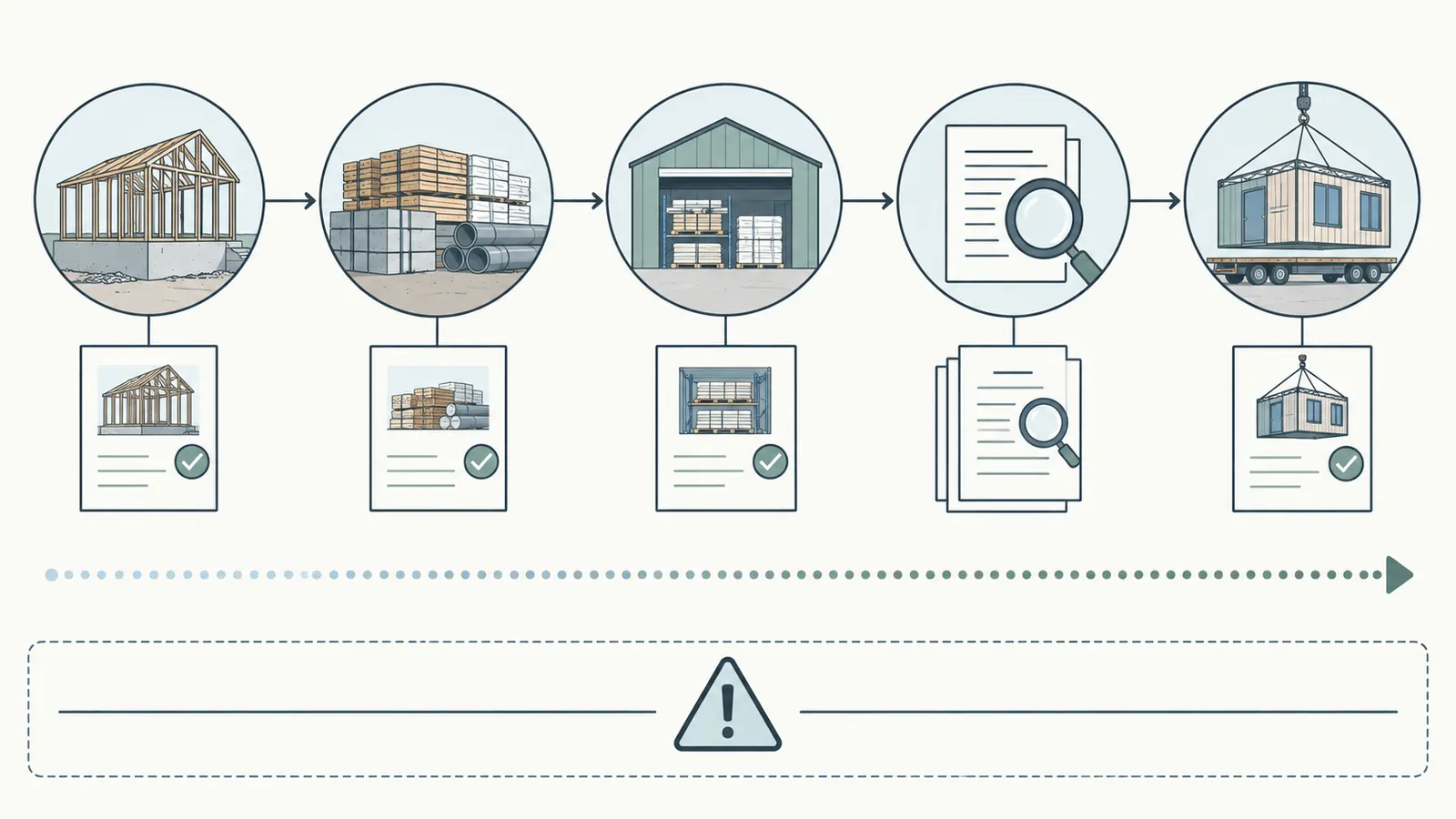
Matrix for five common payment states
Use this as a starting worksheet. Replace every “confirm” item with the words in your own lender’s agreement or written instruction.
| State | Likely lender posture to test | Evidence to assemble | Who verifies | Advance to record | Cash at risk until confirmed | Next handoff |
|---|---|---|---|---|---|---|
| Off-site order | Often not payable unless a named deposit or long-lead exception exists | Purchase order, invoice, approved plans/spec, deposit terms, supplier identity, cancellation terms, insurance, waivers if required | Lender draw department; builder; possibly title company | $0 until written exception; otherwise lender-stated amount | Entire payment D, plus reserve | Lender decides exception; builder waits or funds |
| Bonded warehouse | May be considered if lender accepts the warehouse and can inspect | Invoice, warehouse receipt, inventory, project allocation, release control, insurance, waiver, title instructions | Inspector, lender, insurer, title company as applicable | Lender-stated amount after storage condition is accepted | Amount not advanced plus reserve | Warehouse and builder provide custody proof |
| On lot, not installed | May be eligible only if stored-material draws are allowed | Invoice, delivery ticket, photos or inspection, quantity, secure storage, insurance, waiver, budget line | Inspector and lender; builder confirms allocation | Amount lender assigns to stored material | Unadvanced balance and loss/delay risk | Inspector reports; lender confirms or defers |
| Work in progress | Depends on whether partial line-item draws are allowed | Progress calculation, prior draws, invoice, sworn statement, percent-complete support, waiver, inspection | Inspector and lender; builder measures scope | Percentage or amount expressly approved | Unadvanced portion plus completion cash need | Builder corrects deficiency or completes milestone |
| Installed/completed | Often closest to a progress draw, but still subject to records and title | Invoice, completion evidence, inspection, waiver, receipt, title update, insurance, change-order approval | Inspector, lender, title company; homeowner authorizes where required | Amount within remaining budget and lender calculation | Holdback, rejected work, title or document gap | Lender/title release; builder pays supplier |
The “cash at risk” column should be filled with dollars, not a reassuring phrase. If a request combines a $10,000 supplier deposit with $15,000 of installed labor, record two rows. A lender may approve the installed labor and reject the deposit, and the homeowner needs to know that before signing a single authorization for $25,000.
What to include in the delay reserve
The reserve is not a market estimate. It is the homeowner’s chosen liquidity buffer for known project timing risks. Consider separate rows for:
- one additional inspection or draw-processing cycle if your lender charges or schedules one;
- a title update or correction that delays funding;
- a supplier’s payment deadline that arrives before the lender’s next inspection;
- storage, security, or insurance that continues while an item waits;
- a temporary substitution or restocking decision if the approved item changes;
- rent, interest, or other living costs caused by a schedule shift, if those costs are within your household plan; and
- a contractor-required payment that the loan documents expressly place on the homeowner.
Do not use a generic percentage merely because it feels prudent. Write the event and dollar amount you are reserving for. Hingham, for example, publishes a $300 to $500 inspection-cost range in its own process, but that does not make $300 to $500 a national draw fee. If your lender has no similar fee, enter zero for that row and reserve only for actual documented risks. Hingham’s inspection-process page is a source example, not a quote for your loan.
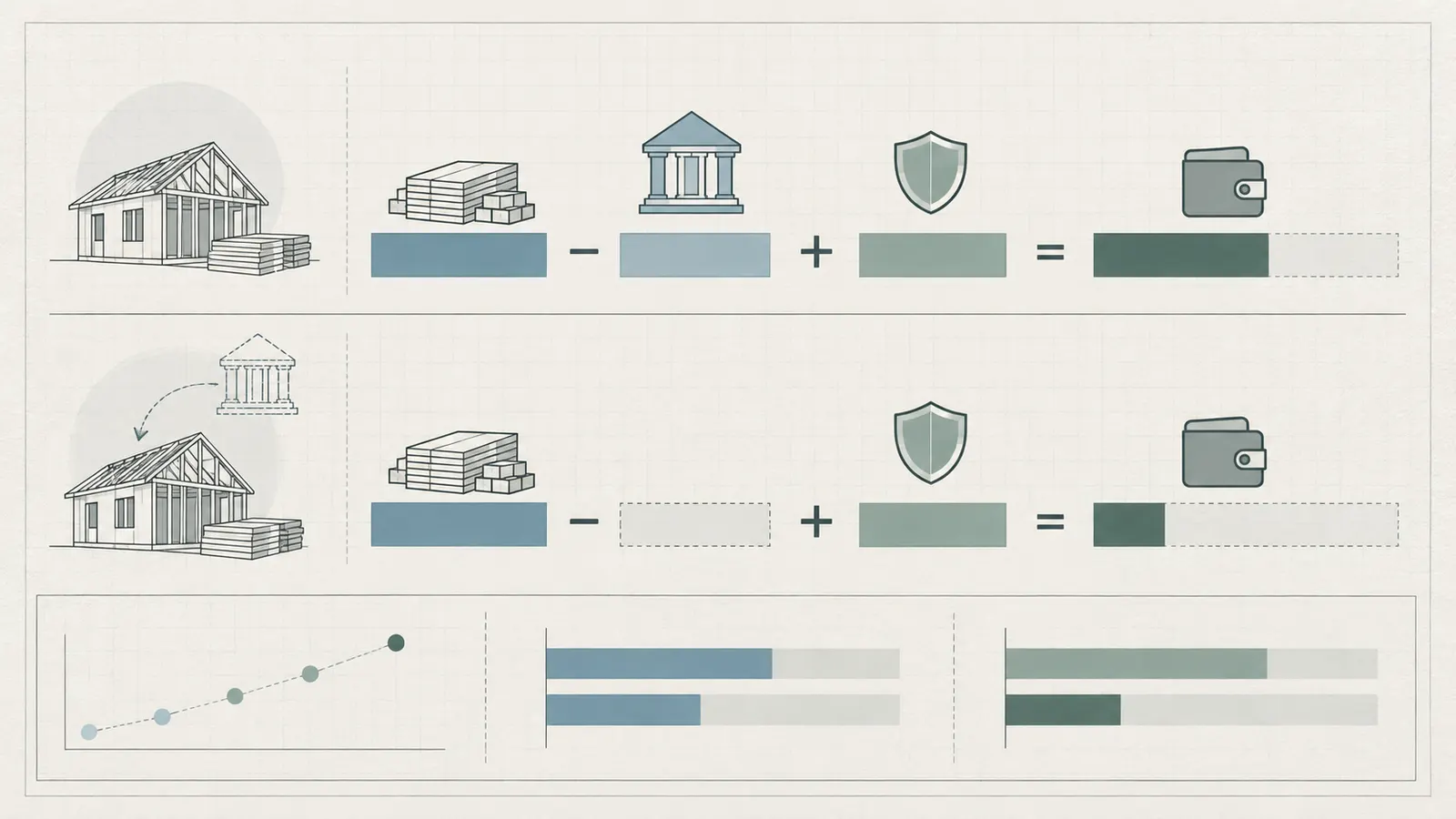
The draw request is a sequence of accountable handoffs, not a single builder invoice #
The safest sequence is to classify, document, ask, inspect, clear title, authorize, fund, and reconcile. The exact order may vary by lender, but skipping a handoff creates the conditions for a denied draw, double payment, or lien dispute.
Step 1: homeowner freezes the decision state
Write down the material, amount, physical state, location, supplier, builder, budget line, due date, and what will happen if payment is delayed. Save the approved plans or specifications that identify the item. Ask the builder not to combine the request with unrelated work or change orders until the lender has classified it.
The homeowner’s responsibility here is not to inspect technical quality. It is to preserve an accurate decision record and prevent a cash-flow assumption from becoming an irreversible payment. If the item is custom, nonreturnable, or fabricated to a field measurement, flag that risk before the deposit is due.
Step 2: builder creates a traceable request
The general contractor prepares the draw form and supporting records required by the lender. The request should map each amount to an approved cost line and distinguish deposit, material, labor, freight, storage, tax, and change order. The builder should identify the party receiving funds and state whether it has already paid the supplier.
Ask the builder to provide the supplier’s legal name and the project reference on the invoice. If the contractor wants funds sent to itself, ask why the lender does not pay the supplier or title company directly. Payment routing is a lender decision, but the homeowner should understand whether the money will be held in trust, applied to a supplier balance, or used for general project cash flow under the contract.
Step 3: lender screens eligibility before the deadline
Send the classification and packet to the lender’s construction-loan contact before the supplier’s deadline. Ask whether the item requires an exception, a site inspection, a storage inspection, a title update, a specific waiver, current builder’s-risk evidence, or a borrower authorization. Obtain the answer in writing and save the version of the draw schedule used.
The CFPB’s general construction-loan explanation describes staged advances, while the lender-specific sources show that the conditions for an advance vary. That combination is why the lender’s screen must happen before the payment, not after a homeowner has already depleted cash.
Step 4: inspector verifies the permitted condition
If an inspection is required, ask the lender what the inspector is expected to observe and how the report will describe it. Make access safe and available. The builder can identify the materials and the relevant budget line; the homeowner can attend if the lender allows; neither should pressure an inspector to report completion that is not visible.
Do not enter an active excavation, climb scaffolding, walk on unfinished framing, open electrical panels, move stored materials, or handle structural or heavy components to help prove a draw. Falls, struck-by hazards, unstable structures, energized systems, and damaged materials are real construction risks. A homeowner can photograph from a safe boundary and collect documents; a qualified professional should perform hazardous access, code inspection, structural review, electrical work, or material handling.
An inspector’s remote review, photograph, or progress report has a limited purpose. It cannot reliably establish concealed installation quality, future performance, code compliance, supplier solvency, or that a payment will cure a title problem. Ask the lender what the report does and does not certify.
Step 5: title company checks the property record
The title company performs the title update or date-down process required by the lender. The check may identify a recorded lien, notice, release gap, or other title issue. The exact records and deadlines depend on the property’s state and county recording system; name those jurisdictions in the project file and follow the title company’s instructions.
First Merchants’ draw process and Live Oak’s payment checklist both describe title-related checks in their published processes. That does not mean every lender requires the same endorsement at the same draw. Ask whether a title update is required before the draw, after the draw, or only at defined thresholds. Do not assume that a signed waiver is equivalent to a recorded release or that an unrecorded claim cannot affect the lender’s decision.
Step 6: homeowner authorizes the requested release
Some programs require the borrower to authorize release to the builder. First Merchants says it confirms borrower authorization before releasing construction-draw funds. Read the authorization carefully: amount, recipient, budget line, conditions, and whether it acknowledges work completed or simply permits the transfer.
Do not authorize an amount that includes a condition you have not verified or a statement you cannot support. If the lender asks for a broad authorization form, attach a written clarification that the authorization applies only to the listed line and amount if the form allows it. If the form makes a legal representation, ask the lender or a qualified attorney licensed in the property’s jurisdiction what it means before signing.
Step 7: lender releases, builder pays, and records reconcile
The lender’s funding notice is not the end of the chain. Confirm the amount actually released, the recipient, the date, any fee, the remaining budget balance, and the supplier’s receipt. Update the draw ledger and the cash-exposure worksheet. If the supplier still shows a balance, ask the builder for evidence of application rather than assuming the lender’s wire cleared the intended obligation.
For a deposit, record the trigger for the next payment: delivery, warehouse inspection, installation, completion, or an approved milestone. Record the documents required at that trigger. The next decision should be visible before the current one is closed.
Sequence table
| Sequence | Primary owner | Output | Stop condition |
|---|---|---|---|
| Classify | Homeowner and builder | State, amount, location, budget line | Unknown physical state or recipient |
| Prepare | Builder and supplier | Invoice, purchase order, delivery/storage proof, waivers | Records do not identify project or amount |
| Screen | Lender | Written eligibility and conditions | Verbal answer only or exception not approved |
| Inspect | Lender-appointed inspector | Progress, presence, or storage observation | Unsafe access or condition not observable |
| Clear title | Title company | Required update or exception report | Lien, notice, missing release, or jurisdiction question |
| Authorize | Homeowner if required | Signed release for defined amount | Authorization misstates completion or payment |
| Fund | Lender or title company | Release notice and payment record | Amount or recipient differs from approval |
| Reconcile | Homeowner and builder | Updated ledger, waiver, supplier receipt, next trigger | Supplier balance or budget mismatch |
Failure cases are signals to stop, document the gap, and choose the next decision #
The most expensive mistake is often not a denied draw; it is paying first, discovering the policy later, and having no cash or documentation to correct the mismatch. The following failure cases keep the response bounded.
“The builder says every construction loan pays deposits”
This is an unverified generalization. Published programs differ: First Merchants describes certain deposit flexibility, Dart describes a typical completed-work baseline with special exceptions, and Hingham describes completed-and-in-place funding with case-by-case consideration of materials and deposits. Ask for your lender’s written rule and the exact category.
Next decision: Does the lender confirm this payment under the signed agreement? If not, decide whether to wait, negotiate the builder’s payment timing, use clearly available contract cash, or change the scope before ordering. Do not treat another bank’s policy as evidence.
“The invoice says paid, so the draw should reimburse it”
Reimbursement is a payment route, not an eligibility test. The lender may require cancelled checks, waivers, inspection, title evidence, or proof that the material is on site or in a bonded warehouse. Live Oak’s published checklist expressly distinguishes documentation for reimbursement and lists multiple supporting records.
Next decision: Does the packet prove both payment and the lender’s required project condition? If the homeowner paid personally, ask whether the lender will reimburse the homeowner or only fund the builder/title-company route. Get the answer before assuming the household account can be replenished.
“The materials are delivered, so they are installed”
Delivery and installation are different states. A delivery ticket can support location, not completion. The lender may accept stored materials, require them to be at the property during inspection, or wait until installation. TD and Hingham describe inspection-based workflows, while Herring’s page describes completed-work restrictions.
Next decision: Which event does the draw schedule name: delivery, in-place storage, installation, or completed line item? Request only the amount tied to that event and preserve the remaining amount for the later trigger.
“The warehouse is bonded, so the lender must pay”
Bonded status may satisfy one evidence condition but does not prove project allocation, ownership, insurance, lien status, or lender acceptance. Live Oak’s page shows how a particular bank combines warehouse storage with purchase orders or invoices, waivers, inspection, and possible insurance proof.
Next decision: Has your lender accepted this exact warehouse and custody arrangement in writing? If not, ask what alternative makes the item eligible—delivery, a different storage arrangement, a limited exception, or payment from non-loan cash.
“The lender approved the deposit by phone”
A phone conversation can be misunderstood or may be preliminary. It may not identify the approval authority, amount, recipient, deadline, documents, or conditions. A draw department may also distinguish a general explanation from a committed approval.
Next decision: Send a confirmation email summarizing the material state, amount, documents, and requested release. Ask the lender to correct it. If the lender will not confirm in writing, treat the advance as unapproved for cash-planning purposes.
“There is enough total loan money, so the line can be moved”
Construction budgets are not an unlimited checking account. A remaining total commitment may be allocated to other line items, subject to appraisal, contingency, change-order, or lender controls. Dart’s guide says borrowers are responsible for change orders or cost overruns and that additional funds may be separate from loan proceeds. Herring likewise says costs beyond the loan scope are the borrower’s responsibility.
Next decision: Ask whether the lender approved a budget transfer, change order, or contingency use. Record the old line, new line, approval date, and effect on remaining work. Never reduce a future safety, code, or completion line just to fund a current deposit without a complete project review.
“A waiver proves the supplier cannot claim anything”
The legal effect of a lien waiver depends on its wording, condition, timing, signatures, payment, and the law of the property’s jurisdiction. A waiver can also be incomplete or signed by the wrong party. The lender’s checklist is not a substitute for legal review.
Next decision: Ask the title company and, when necessary, a construction attorney licensed in the property’s state to review the waiver and payment status. Keep the supplier’s invoice, proof of payment, and final release together.
“The inspector saw it, so the material is approved”
An inspector may report a condition for the lender’s funding decision. That does not necessarily approve product quality, design compliance, code compliance, warranty coverage, or supplier performance. Physical presence also does not prove the item belongs to the project or is free of another claim.
Next decision: Assign each question to the right verifier: lender for funding, inspector for observed progress, builder/designer for plans and specifications, building official for jurisdictional code inspections, insurer for coverage, and title company or attorney for lien and title issues.
“The lender denied the deposit, so the project must stop”
A denied advance may mean the condition is premature, the packet is incomplete, the line is over budget, the lender does not permit deposits, or an exception authority has not reviewed it. It is a financing decision, not necessarily a construction impossibility.
Next decision: Ask for the precise deficiency and the next eligible trigger. Options may include waiting for delivery, using an approved stored-material procedure, revising the payment schedule with the supplier, substituting a contract-compliant product, or escalating through the lender’s construction department. Do not bypass the lender by relabeling the request.
Use the worksheet to make the next authorization decision #
The decision is ready when the homeowner can answer six questions with documents rather than assumptions: what is being paid, where it is, who controls it, what the lender will verify, how much cash remains exposed, and what event comes next. If any answer is missing, the appropriate action is clarification or deferral—not a confident yes.
One-page decision record
Copy this record into the project file for each deposit or pre-installation request:
Project and jurisdiction
- Property: ______________________________________________
- State: __________________ County: __________________ City/town: __________________
- Loan type: construction-only / construction-to-permanent / other: __________________
- Lender and draw contact: ______________________________________________
- General contractor: ______________________________________________
- Request date and supplier deadline: ______________________________________________
Payment classification
- Material or scope: ______________________________________________
- Approved plan/spec reference: ______________________________________________
- Budget line and approved amount: ______________________________________________
- Prior draws on this line: ______________________________________________
- Current amount requested: ______________________________________________
- Physical state: off-site order / bonded warehouse / on lot / work in progress / installed / completed
- Exact location and custodian: ______________________________________________
- Refundable, cancellable, or nonreturnable terms: ______________________________________________
Evidence status
- Executed loan agreement and draw schedule checked
- Builder contract and payment clause checked
- Purchase order or invoice identifies project and material
- Supplier payment terms and cancellation terms attached
- Delivery or warehouse record attached, if applicable
- Builder sworn statement attached, if required
- Conditional or unconditional waiver attached, if required
- Insurance certificate current for the relevant location and dates
- Inspection requested or completed
- Title update, date-down, or other title record requested or completed
- Borrower authorization required and reviewed
- Supplier receipt or payment application confirmed after funding
Cash-exposure calculation
Dpayment before expected draw: $____________Awritten eligible advance: $____________Rdelay reserve: $____________E = D - A + R: $____________- No-advance case
E0 = D - $0 + R: $____________ - If a range applies,
A_low: $,A_high: $ E_high = D - A_low + R: $____________
Written decision
- Lender’s answer: fund / partially fund / defer / deny / exception pending
- Approved amount and recipient: ______________________________________________
- Conditions before release: ______________________________________________
- Inspector or title handoff owner: ______________________________________________
- Next trigger and date: ______________________________________________
- Person who confirmed receipt: ______________________________________________
This worksheet is a project-management record, not an official lender form, inspection report, legal document, or code document. Do not send it as a substitute for the lender’s required forms. Its value is that it makes the hidden assumptions visible before the homeowner commits cash.
Originality brief: how to check the contribution
Current answers are scattered across lender draw pages and borrower guides: some describe completed or in-place work, some describe limited deposit exceptions, some describe kit or modular deposits, and CFPB guidance explains staged advances and construction-loan disclosure treatment. The missing decision is the neutral branch between an off-site order, bonded warehouse, on-site material, work in progress, installed work, and supplier deposit.
The original contribution is the Deposit eligibility matrix and cash-exposure worksheet. It can be checked by taking one real request and verifying whether the row correctly identifies the physical state, required evidence, responsible verifier, lender-stated advance, cash exposed, and next handoff. Reproducibility requires the signed agreement, current draw schedule, lender answer, builder packet, inspection result, title response, and actual payment record. Limitations remain explicit: published lender examples are program-specific, the worksheet does not predict approval, and local title or lien questions require the property’s actual jurisdiction and qualified professionals.
Final authorization gate
Authorize the payment only when all of the following are true:
- the request is mapped to an approved budget line and the material state is accurately described;
- the lender has confirmed the advance or clearly identified the event that will make it eligible;
- the builder and supplier records agree on amount, recipient, project, and payment status;
- required inspection, storage, insurance, waiver, and title conditions are assigned and satisfied or expressly waived by the lender;
- the homeowner knows the no-advance cash exposure and has not mistaken an expected reimbursement for available cash;
- the payment will not force an unsafe construction shortcut, unpaid downstream party, or unapproved budget transfer; and
- the next handoff and next decision are written down.
If the answer is no, hold the payment or escalate the specific missing condition. A construction loan may pay a material deposit before installation, but the homeowner should treat that as a documented lender exception or defined program step—not as the default meaning of construction financing.
For broader homeowner planning context, use Brictale’s homeowner blog and learning area; this guide remains focused on the funding decision and its draw, title, insurance, and contractor handoffs.
Cite this guide
Brictale. “Can a Construction Loan Pay for Material Deposits Before Installation?.” Published 2026-09-26; updated 2026-09-26.
https://brictale.com/build/budgeting/can-construction-loan-pay-for-material-deposits-before-installation · Read the Markdown version
Original contribution: Deposit eligibility matrix and cash-exposure worksheet. A source-linked matrix separates completed work, materials on site, bonded-warehouse storage, off-site orders, and supplier deposits, then records evidence, verifier, eligible advance, cash at risk, and next handoff.
Sources and scope
Evidence behind this page
- The Consumer Financial Protection Bureau describes construction loans as short-term financing generally provided in a series of advances as construction progresses; payment timing and conversion features depend on the lender and loan structure.
U.S. consumer-finance educational guidance from the CFPB; general description, not a promise that a particular deposit is eligible under a particular loan agreement.
Accessed · Link to this claim - The CFPB's TRID guide explains that construction-only and construction-permanent loans can use multiple advances, and that a creditor may disclose a multiple-advance construction phase as one transaction or as separate transactions for each advance under the stated Regulation Z framework.
Federal disclosure guidance under the TRID framework, not a lender's draw-eligibility policy and not legal advice about a borrower's contract.
Accessed · Link to this claim - The CFPB's construction-loan disclosure guide specifically discusses where construction costs and inspection and handling fees, including draw fees, may be disclosed for construction-loan disbursements.
Federal disclosure guidance about presenting loan costs; it does not establish whether a specific lender will advance a supplier deposit.
Accessed · Link to this claim - TD Bank says its construction draw schedule details how funds are disbursed as construction progresses; draws are limited to building the home and permanent fixtures, and an inspection verifies work completed at each draw while title updates occur multiple times during construction.
New Home Construction Loans And Mortgage Financing
TD Bank's published U.S. construction-to-permanent program explanation; program-specific and not a national lender rule.
Accessed · Link to this claim - First Merchants Bank says construction draws are typically for completed work or deposits required to order certain items, and publishes a 10% to 30% deposit flexibility example for items such as windows, doors, cabinets, and countertops, subject to its program terms.
First Merchants Bank construction-loan program; the percentage is an example of that lender's published policy, not a U.S. market norm or borrower entitlement.
Accessed · Link to this claim - First Merchants Bank says it verifies completed work with a site inspection, checks with its title company that subcontractor or supplier liens have not been filed, and confirms borrower authorization before releasing construction-draw funds.
First Merchants Bank's published draw workflow; the exact title and authorization steps vary by lender, title company, loan documents, and property jurisdiction.
Accessed · Link to this claim - Dart Bank says it typically reimburses items and work already completed, while exceptions for material or supplier deposits may be approved by its construction lending department under special circumstances.
Construction Permanent Lending Borrower Information Guide
Dart Bank's published borrower guide; the stated exception is lender-specific and requires approval rather than establishing a general right to a deposit advance.
Accessed · Link to this claim - Dart Bank's published guide says it can disburse 20% of funds allocated to a kit or modular home as a deposit and the remaining 80% when the house or materials are delivered to the site, subject to prior approval and possible modification in specific situations.
Construction Permanent Lending Borrower Information Guide
Dart Bank's kit and modular-home example only; not a rule for ordinary site-built material deposits or other lenders.
Accessed · Link to this claim - Hingham Institution for Savings says its bank disburses on a work-completed and in-place basis only, while it may consider materials and deposits case by case; its inspector's report and approved disbursement schedule determine the draw.
Construction Inspection Process
Hingham Institution for Savings published process; it demonstrates variation and a case-by-case exception, not a national rule.
Accessed · Link to this claim - Hingham Institution for Savings publishes an inspection-cost range of $300 to $500 per inspection and says the fee is funded from the approved draw, with a separate residential owner-occupied arrangement described on its page.
Construction Inspection Process
Hingham's published process and fee example; not a national cost estimate and not applicable unless the borrower's lender uses the same fee arrangement.
Accessed · Link to this claim - Live Oak Bank's payment-documentation sheet says that when deposits or material payments are requested, purchase orders or invoices and required waivers must be submitted, and materials must be onsite or at a bonded warehouse during inspection; additional insurance proof may be required.
Required Documentation For Payments — Detailed
Live Oak Bank construction-loan documentation sheet; the storage and proof conditions are program-specific and do not imply that an off-site order is eligible elsewhere.
Accessed · Link to this claim - Live Oak Bank's payment-documentation sheet describes conditional and unconditional progress lien waivers, invoice backup, cancelled checks for reimbursement requests, third-party site inspection, a date-down endorsement, and current owner and contractor insurance as possible payment documentation.
Required Documentation For Payments — Detailed
Live Oak Bank's published checklist; exact waiver, title, insurance, and reimbursement requirements must be confirmed with the borrower’s lender and title company.
Accessed · Link to this claim - Herring Bank says its builder may request draws for completed work only, not work in progress; its draw specialist orders an inspection and bases the released amount on the percentage completed for the requested line items.
Herring Bank's published one-time-close construction-loan process; program-specific and not a universal interpretation of construction-loan contracts.
Accessed · Link to this claim - Herring Bank says its final-draw process may include a date-down title endorsement, final survey, final lien waiver, affidavit of completion, final inspection or recertification of value, certificate of occupancy where required by the local city or county, and builder's-risk insurance during construction.
Herring Bank's published final-draw examples; local occupancy and recording requirements are jurisdiction-specific and this page does not state a national rule.
Accessed · Link to this claim - First Federal Bank's Idaho construction-process page says draw approvals are based on the percentage of completion on site; its published requirements call for invoices when a draw includes materials not on site or labor not completed, require borrower-signed and lender-approved change orders before material purchases or work on site, and state that each draw is reviewed and approved by its Construction Department.
First Federal Bank's Idaho page for Meridian, Twin Falls, Jerome, and Burley; lender- and Idaho-specific process example, not a United States rule and not evidence that an off-site deposit is eligible.
Accessed · Link to this claim