Is a Private Well Maintenance Service Plan Worth It?
Compare a recurring private-well service plan with an annual checkup paid as needed, using system complexity, response value, scope, exclusions, and written records.
The short answer
Usually, pay-as-needed is enough for a simple, documented well if you reliably schedule the annual checkup and testing. A recurring plan earns its price when it guarantees the same measurable inspection work, qualified response, testing, and a dated written report for a complex, older, poorly documented, difficult-to-access, or high-consequence system. Treat priority access or vague peace of mind as extras—not maintenance.Is a Private Well Maintenance Service Plan Worth It?
Usually, a recurring service plan is worth considering only when it buys scheduled, measurable work that you would otherwise postpone. For a simple, documented well, paying for an annual checkup as needed can be the better value—provided you actually schedule the visit and the required water testing. For an older, complex, poorly documented, difficult-to-access, or high-consequence system, a plan can earn its price by making the visit automatic, preserving a service relationship, and shortening the path to qualified help.
The dividing line is evidence. A useful plan produces a dated scope of work, measurements, laboratory results when testing is included, recommendations, and a record you can retrieve later. A plan that offers only “priority service,” a discount on repairs, or vague peace of mind is not the same thing as preventive maintenance.
1. Use a transparent decision rule #
There is no nationally correct answer based on well age alone. NGWA says there is no standardized water-well maintenance schedule because well construction, components, weather, and geology vary. That makes a universal “everyone needs a plan” claim just as weak as a universal “no one needs a plan” claim.
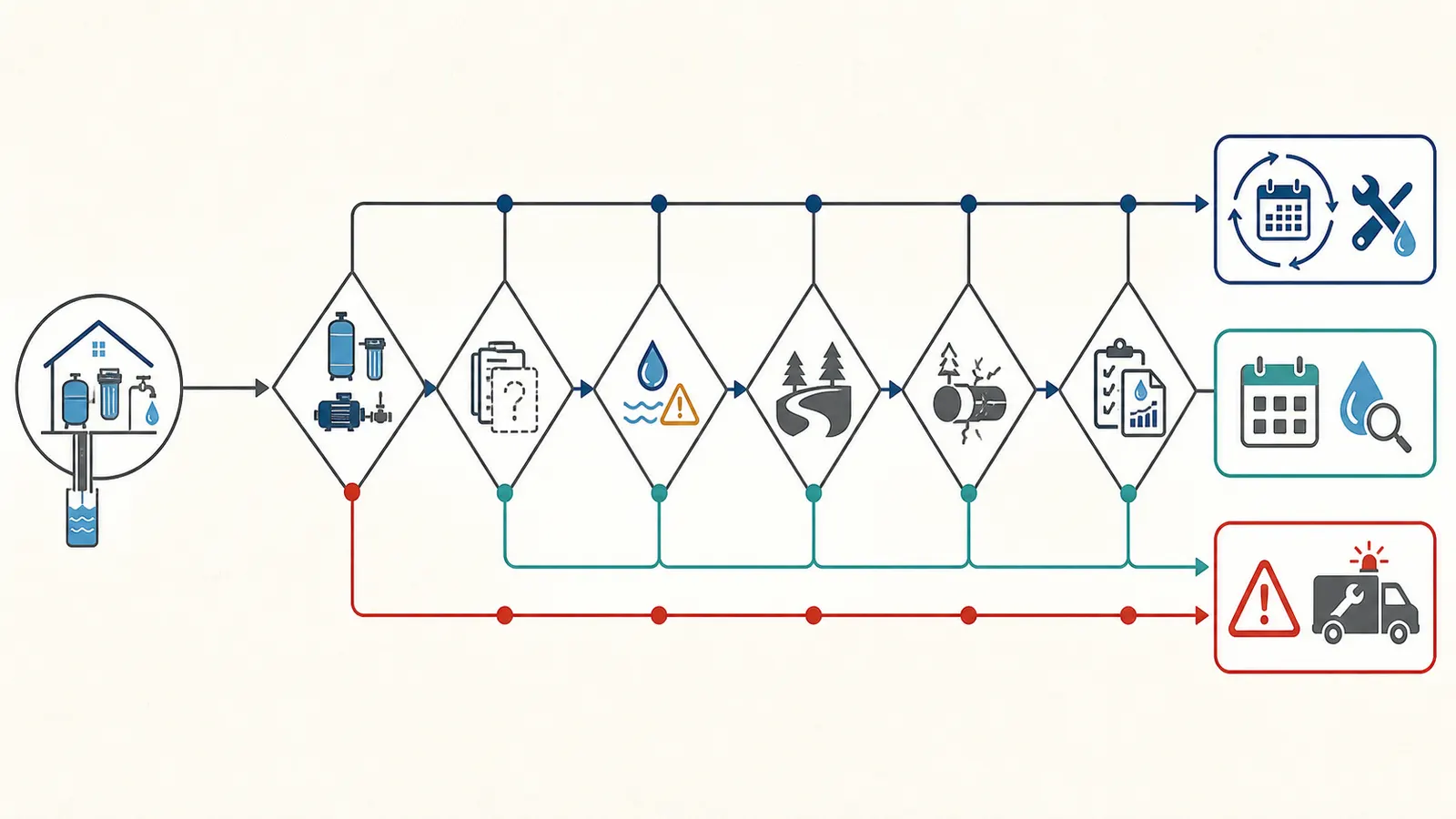
Use the table below as a screening tool. Give yourself one point for every “yes.” It is Brictale’s decision aid, not an official maintenance score and not a substitute for a professional evaluation.
| Question | Yes = 1 point | Why it changes the plan decision |
|---|---|---|
| Does the system include several interacting components, such as a submersible pump, pressure tank, controls, filters, softener, iron treatment, UV, storage, or booster equipment? | 1 | More components create more manufacturer-specific tasks and more opportunities for an undocumented omission. |
| Is the well, pump, pressure tank, or treatment equipment older, age-unknown, or outside a clear warranty? | 1 | A plan may be valuable for continuity, but only if it documents condition rather than merely selling repair access. |
| Are the well log, prior test results, invoices, model numbers, or maintenance records missing? | 1 | The first useful visit may be a records-and-baseline visit; require that deliverable in writing. |
| Would a failure cause a serious disruption because there is no practical backup water, the home is remote, or the household has high daily demand? | 1 | Response time has real value, but response time is still not the same as inspection or water-quality assurance. |
| Has the system had cycling, pressure, sand, flow, taste, odor, color, flooding, repair, or treatment problems? | 1 | A history of symptoms supports a tailored maintenance scope and possibly more frequent testing. |
| Is the well shared, seasonal, difficult to access, or connected to unusually high or variable water demand? | 1 | Coordination, access, and demand make missed or poorly documented visits more costly. |
| Would you realistically forget to book the annual checkup and lab work without an automatic appointment? | 1 | A plan can be a behavioral safeguard if the recurring appointment is guaranteed and documented. |
Interpret the total conservatively:
- 0–2 points: Pay-as-needed is usually reasonable if you can schedule the annual baseline checkup and testing, keep records, and obtain qualified help when a problem appears.
- 3–4 points: Compare both options using the same written scope. The plan is not automatically better; its value depends on what is actually included and what remains excluded.
- 5–7 points: A recurring plan is worth pricing seriously, especially if it guarantees an annual visit, testing coordination, a written report, and a defined response path. Do not sign until the exclusions and extra charges are clear.
Do not use this score to delay an urgent response. A suspected contamination, sudden loss of water, electrical warning, flood, pressure problem, or major change in taste, odor, or appearance is a service decision now—not a reason to wait for the next plan visit.
2. Separate the annual baseline from the contract #
CDC says private-well owners should get a well checkup every year, and its testing guidance says to test at least annually for total coliform bacteria, nitrates, total dissolved solids, and pH using a state-certified laboratory. The health department can help identify additional contaminants based on local conditions. That annual baseline belongs in your household maintenance system whether you purchase a service plan or not.
CDC also identifies events that should trigger testing outside the routine cycle: a known problem in the area, nearby flooding or land disturbance, a well-system repair or replacement, a change in taste, color, or smell, pregnancy, or a child moving into the home. A service contract should not convert those triggers into “wait until your scheduled visit.” Ask the provider how an unscheduled water-quality concern is handled, who arranges the lab, and whether the additional visit and testing are extra.
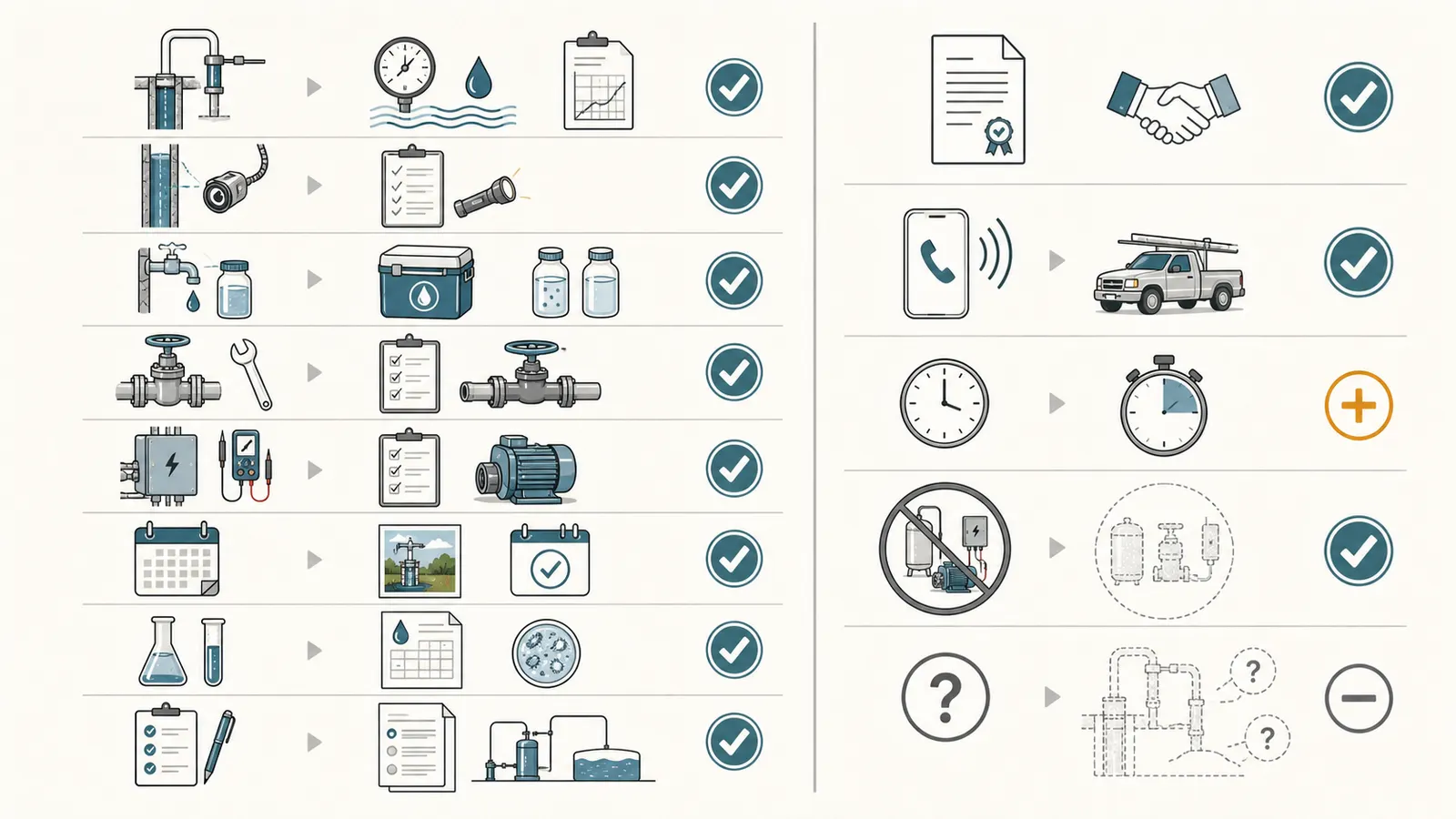
NGWA’s consumer maintenance guidance is more specific about what an annual checkup can contain. It lists a flow test, visual inspection, water-quality testing for coliform and anaerobic bacteria, nitrates, and local concerns, valve checks, and electrical testing. It also says the owner should receive a written report with recommendations and all laboratory and other test results. Those items are the minimum useful comparison scope for a plan quote.
The word “annual” still needs definition. Ask whether the plan provides one visit every 12 months, one visit during a calendar year, or one visit only if you call to schedule it. Ask whether lab testing is collected during the visit or left to you. Ask whether the checkup is a baseline inspection or a repair visit triggered by a symptom. These are materially different products.
Regional advice can be more detailed, but do not import it as a national rule. For example, a Penn State Extension fact sheet gives Pennsylvania-oriented guidance that includes annual obvious-damage inspection and a professional inspection every ten years, along with annual bacteria testing and a defined records set. That is useful evidence that local programs may recommend a longer inspection interval in addition to annual owner checks; it is not proof that every US well should be professionally opened every ten years.
The decision is therefore not “plan or no maintenance.” It is “will the plan reliably deliver the baseline work your system and local guidance call for, at a price and scope that are better than arranging the same work yourself?”
3. Define what the visit must actually measure #
Ask for the provider’s visit sheet before signing. A line such as “inspect well system” is too vague to compare. Use this table to translate sales language into observable deliverables.
| Promised item | Require this evidence after the visit | What a vague promise can hide |
|---|---|---|
| Flow or performance check | The method, measured result, units, test point, and conditions; if no flow test was possible, the reason and next step | A quick faucet observation that says nothing about well yield, pump performance, or household demand |
| Visual inspection | Dated notes, and photos where appropriate, for the accessible wellhead, casing, cap, above-ground piping, gauges, tank, treatment equipment, and visible controls | A checkmark that does not show what was seen or whether an item was inaccessible |
| Water-quality testing | Lab name, analytes, sample point, collection date, method or report identifier when available, units, detection limits, and the full lab report | A contractor’s field strip, an unspecified “water test,” or a result without a lab report |
| Valve and pressure-system review | The components reviewed, any readings the equipment manufacturer or professional uses, and a clear distinction between observation and adjustment | A promise that includes only a visual look at the pressure tank while excluding controls, valves, or repairs |
| Electrical testing | The specific inspection or test, the qualified person who performed it, and any unsafe condition or deferred work | A homeowner being asked to open a control box or a technician checking only whether the pump runs |
| Treatment-equipment maintenance | Model and serial number, task completed, media or cartridge status, settings observed, parts used, and the manufacturer instruction followed | A general “filter serviced” note that does not identify what was changed or what remains due |
| Below-ground evaluation | Whether it is included, what access or equipment it requires, and the separate price if it is not included | “Full inspection” that covers only visible equipment while implying the pump, casing, or screen was evaluated |
| Written report | Visit date, provider, scope completed, measurements, findings, recommendations, lab results, deferred items, and next action | Priority access or “system checked” language with no durable record |
The first four rows are deliberately different. A flow result is not a water-quality result. A visual inspection is not a physical below-ground inspection. A pump that runs is not necessarily a pump that is performing within the system’s design. The plan should identify which facts it will produce and which questions remain outside its scope.
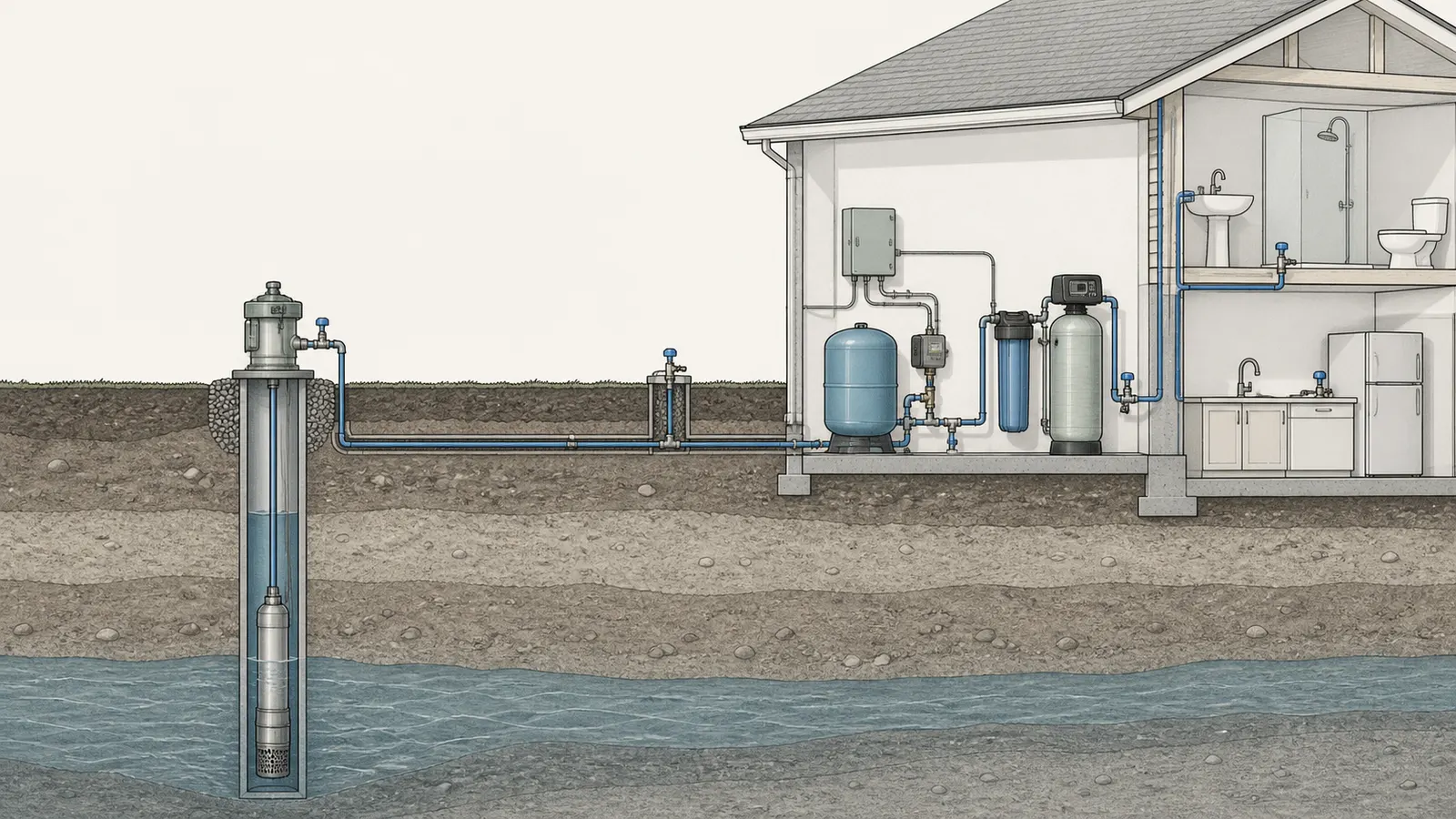
NGWA’s guide describes a thorough inspection as both visual work above ground and physical inspection of below-ground components, followed by a written report and recommendations. That is a useful definition for comparing “annual checkup” with “full inspection,” but it does not mean below-ground work belongs in every annual plan. It may require opening the well, lifting equipment, or using specialized tools. The contract should say so plainly.
4. Compare the money and the risk on equal terms #
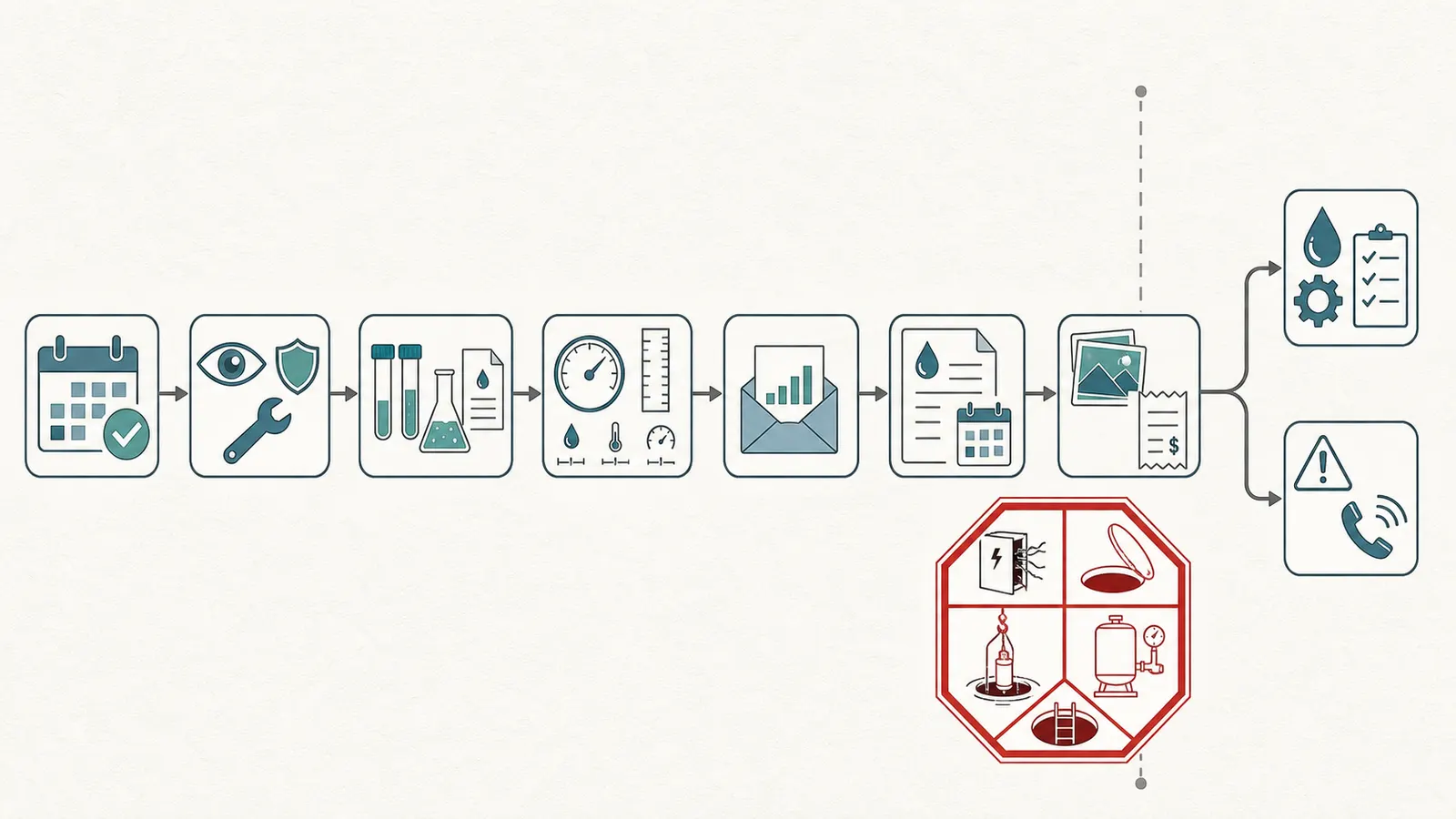
Do not compare an annual plan price with a one-time service-call price unless the two quotes cover the same work. Write the comparison in the following form using the provider’s actual numbers.
| Cost or risk line | Recurring plan | Pay-as-needed |
|---|---|---|
| Scheduled annual visit | Contract fee or included visit count | Quoted annual checkup fee |
| Water testing | Included analytes, lab fee, collection fee, and any required follow-up | Same lab and analytes, booked separately |
| Travel or access | Included area, mileage, seasonal access, after-hours travel | Travel, trip, or access charges on each call |
| Repairs and parts | Labor rate, parts discount, diagnostic fee, deductible, or exclusion | Standard quoted labor and parts terms |
| Emergency response | Response window, service area, and whether priority is guaranteed | Normal availability and after-hours terms |
| Treatment equipment | Media, cartridges, chemicals, regeneration, calibration, and disposal | Same items purchased when due |
| Below-ground or hazardous work | Included, extra, or excluded | Separate professional quote |
| Report and records | Dated report, lab reports, photos, invoices, and record ownership | Same documents requested after each visit |
| Renewal and cancellation | Term, automatic renewal, price changes, cancellation fee | No recurring commitment |
For a simple cash comparison, calculate:
Plan year = annual contract fee + required lab and sample-collection fees + noncovered travel or access + known recurring noncovered scope/add-ons (for example, extra or follow-up visits, treatment media, cartridges, chemicals, disinfection, or other work the contract excludes).
Pay-as-needed year = annual checkup quote + the same required lab and sample-collection fees + expected travel or access fees + the same known recurring noncovered scope/add-ons (for example, extra or follow-up visits, treatment media, cartridges, chemicals, disinfection, or other work supported by your records or a written quote).
Use “expected” only for costs you can support with your own records or a written quote. Do not invent a failure probability or treat a service plan as insurance unless the contract actually provides a defined warranty or covered repair benefit. A repair discount is not the same as a repair guarantee.
The plan can still be worthwhile when the two totals are close. The additional value may be a reserved relationship, an appointment you are unlikely to forget, a defined response window, or consistent records from the same provider. But that value should be named. If the only benefit is “peace of mind,” ask what event, measurement, report, or response promise creates it.
Pay-as-needed can be the better choice when the plan’s annual visit is only a visual glance, lab testing is excluded, the provider can cancel or defer the appointment, emergency response is not guaranteed, or the plan makes repairs the only practical way to recover its price. A lower price is not a bargain if it leaves the homeowner with no test results and no evidence of what was inspected.
Make the quote comparable before you calculate
Ask both providers to price the same visit on the same assumptions. State whether the water sample comes from the normal drinking tap, a treatment-system inlet, or another point; the provider or laboratory should tell you what is appropriate. State whether treatment equipment is included or merely observed. State whether a flow or performance test is included, and what happens if the system cannot be tested safely on the day.
Then write down four separate numbers rather than accepting one bundled total:
- The charge for the scheduled visit and the work it includes.
- The laboratory and sample-collection charges, separated by analyte or package.
- The price of work that is likely but not included, such as treatment media, cartridges, disinfection, or a follow-up visit.
- The emergency, travel, access, or after-hours charges that apply if the system fails between scheduled visits.
This prevents a common comparison error: treating a plan’s included “testing” as equivalent to a state-certified laboratory report when the plan actually means an in-home screening strip. It also prevents a standalone quote from looking cheaper because it silently omits the report, the lab, or the second visit needed to finish the job. If a provider will not split the scope into work, testing, parts, and response terms, you do not yet have a defensible comparison.
Keep the plan’s first-year and renewal-year totals separate. A promotional first year, waived enrollment fee, or included initial inspection can make a plan look attractive while the recurring price changes later. Record what happens to the price, included tests, response window, and cancellation rights at renewal. If the plan is sold with a warranty, ask whether the warranty covers labor, parts, the original installer’s equipment only, or the whole well system; do not assume “service plan” and “warranty” are interchangeable.
5. Match recurring coverage to the system’s actual conditions #
Conditions that favor a recurring plan
Recurring coverage becomes more defensible when several of these conditions are present:
- The system is complex. A pump, pressure tank, controls, storage, filtration, softening, UV, iron treatment, or other equipment may each have a different manual and maintenance boundary. NGWA recommends keeping maintenance and warranty information for the pump, pressure tank, and treatment equipment, which is easier when one provider maintains a complete record.
- The history is unknown. Missing well logs, test results, model numbers, invoices, or prior reports make the first visit a baseline project. Put the record reconstruction in the scope; do not assume it happens because you paid a membership fee.
- The cost of downtime is high. A remote home, no backup water, a shared well, or high demand can make a response promise meaningful. Confirm the promised response window and the geographic or seasonal limits.
- There has been a pattern of problems. Frequent pump cycling, pressure complaints, sand, declining flow, treatment failures, or changes in water quality justify a more deliberate professional evaluation. A plan should not simply reset the symptom at every visit; it should document the finding and the recommended root-cause follow-up.
- The household or site has changing risk. Flooding, land disturbance, nearby waste-disposal sites, or a new pregnancy or child in the home can change the testing conversation. CDC’s trigger list supports treating those events as additional testing questions, not as ordinary plan renewals.
- You know you will otherwise defer the visit. Automatic scheduling can be a real maintenance benefit if the provider sends the appointment date, completes the scope, and delivers the report without requiring a new sales conversation.
Conditions that favor pay-as-needed care
Pay-as-needed is often sensible when the well is straightforward and accessible, the current well log and component records are available, the system has little or no treatment equipment, there is a trusted local provider, the annual test is easy to arrange, and the household can tolerate a normal service response. In that case, buy a written annual checkup with the same evidence requirements as the plan and set your own reminder.
Do not confuse “simple” with “new.” A newer system may have warranty protection, but the warranty, manufacturer maintenance instructions, and annual water testing still need to be tracked. Conversely, an older system is not automatically a reason to buy a plan if the proposed provider cannot explain what will be measured and reported.
Keep water safety separate from equipment convenience
CDC explains that private-well owners are responsible for making sure their water is safe to drink because private wells are not monitored like public water systems. A service plan can coordinate a sample, but it cannot make an untested result safe, and a contractor’s visual inspection cannot rule out every contaminant. Ask for the actual state-certified laboratory report and follow the health department’s guidance for local contaminants.
If a result suggests harmful germs or chemicals, or if the water may be contaminated, CDC advises contacting the health department and using a safe alternate source until the water is treated and tested. Do not let a plan’s “annual” label delay that response.
6. Read the service agreement as a scope sheet #
Before signing, ask the provider to answer each item in writing. Use “included,” “extra,” “excluded,” or “not applicable,” not a verbal assurance.
Scope and timing
- What exact equipment is covered: wellhead, casing and cap, pump, motor, drop pipe, pressure tank, pressure switch, gauges, valves, controls, treatment equipment, storage, buried line, and house-side components?
- Is the visit a visual inspection, a performance test, a water-quality sampling visit, a below-ground inspection, or some combination?
- How often is the visit due, and who schedules it?
- What happens if weather, access, a locked room, unsafe conditions, or an unavailable sample prevents completion?
- Is a second visit included, and if not, what is the charge?
Testing and records
- Which analytes are included, and which local or household concerns are excluded?
- Is the sample collected by the provider, the homeowner, or the laboratory?
- Which state-certified lab performs the work, and who pays the lab fee?
- Will you receive the complete laboratory report, including units and detection information, rather than only a pass/fail summary?
- Will the report include measurements, photos, findings, recommendations, deferred items, and the next due date?
- Who owns the records, and will you receive them if you cancel or the provider stops operating?
Response and exclusions
- What does “priority” mean in hours or business days, and does it apply to water-quality concerns as well as equipment failure?
- Are evenings, weekends, storms, flooding, power events, freezing, lightning, and road access included?
- Are diagnostic charges, travel, labor, parts, pump pulling, well opening, disinfection, treatment media, cartridges, chemicals, and laboratory follow-up separate?
- Does the plan cover only equipment installed by that provider?
- What conditions terminate coverage or move the job to time-and-materials service?
- Does renewal change the price or scope, and how can you cancel?
The phrase “full system inspection” deserves the most scrutiny. Compare it against the actual system drawing and the NGWA checkup components. If the provider cannot name the test, sample, observation, or document produced, treat that line as unproven.
Recognize a priority-access product
Some agreements may be useful even when they do not include much preventive work, but they should be described honestly. A priority-access product may provide a phone number, a preferred scheduling queue, a reduced diagnostic fee, or a discount on labor. Those benefits can matter in a remote home or during a busy season. They do not, by themselves, inspect the well, test the water, verify the pressure system, or create a report.
Treat these phrases as prompts for clarification rather than as proof of maintenance:
- “Annual service” — ask what the technician actually does and measures.
- “Complete inspection” — ask whether below-ground components are evaluated or excluded.
- “Water included” — ask for the analytes, laboratory, sample point, and complete report.
- “Priority response” — ask for the response window, service area, and after-hours terms.
- “No-cost repairs” — ask whether the promise is a discount, a labor allowance, a deductible, or a true coverage obligation.
- “Preventive maintenance” — ask which manufacturer tasks are performed and which are only recommended.
If the answer is “we look everything over and call you if there is a problem,” ask what gets written down even when no problem is found. A clean baseline is useful evidence. A blank invoice is not.
NGWA’s guide also recommends checking a professional’s state license or registration where applicable, qualifications, insurance, references, and written contract. The point is not to select a logo; it is to make the responsible party, scope, terms, and records legible before the visit.
7. Set a safe boundary and preserve the handoff #
Homeowner-safe preparation
You can prepare a useful service visit without opening equipment. Gather the well log or completion report, pump and pressure-tank model information, treatment manuals, warranties, prior lab results, invoices, photographs of visible components, and a timeline of any changes in flow, pressure, taste, odor, color, or cycling. Note whether the symptom is constant, first-draw, fixture-specific, seasonal, or associated with a recent repair.
You may make ordinary observations from a safe location: standing water around the wellhead, visible damage, a loose or broken cover, leaks, unusual noise, repeated pump cycling, a pressure gauge that behaves differently from normal, or a change at the faucet. Observation is not diagnosis. NGWA says owners can see evidence of possible maintenance problems but generally lack the knowledge and experience to diagnose most well-maintenance problems.
Stop and call a qualified professional
Do not open energized controls, test live wiring, open the well cap or casing, pull a pump, enter a pit or other confined space, disconnect pressurized plumbing, adjust a pressure switch or relief valve, or handle disinfectants and treatment chemicals as an improvised diagnostic step. NGWA specifically directs owners to consult a water-well professional when the well needs to be opened, when pressure or water quality changes, when a test reveals a health risk, or when cleaning and disinfection are desired.
Pentair’s Layne submersible-pump manual limits installation, operation, and maintenance to qualified personnel, warns against energized circuits, and requires power removal before maintenance. The exact manufacturer instructions for your equipment control. OSHA explains that pits can be confined spaces with hazardous atmospheres and suffocation or engulfment potential, and that entry planning requires evaluation, air testing, and hazard controls. A homeowner should not enter one to reach a pump or well component; that no-entry instruction is a conservative safety boundary, not a claim that every residential pit is legally covered by OSHA’s construction standard. A contractor’s visit is not permission to perform hazardous work yourself.
Require this report after every included visit
| Report field | What should be present |
|---|---|
| Identity and date | Property or well identifier, provider, technician, arrival and completion date, and the service-plan or work-order number |
| Scope completed | Each included task marked complete, incomplete, not applicable, or deferred, with the reason |
| Observations | Wellhead, cap, casing, visible piping, tank, gauges, treatment equipment, controls, leaks, corrosion, access, and visible hazards |
| Measurements | Flow or performance result, pressure-related observations, electrical test or inspection result, and units or method where applicable |
| Water testing | Sample point, collection date, lab name, analytes, complete report, units, detection information, and any chain-of-custody record |
| Findings | What the professional believes the evidence shows, separated from items that were not evaluated |
| Recommendations | Immediate action, monitor, repair quote, testing follow-up, professional inspection, or no action; include urgency and reason |
| Deferred or excluded work | Below-ground work, pump removal, treatment service, parts, hazardous access, or lab work not included, with a price or next step if known |
| Record package | Photos, invoices, parts and model numbers, warranty notes, and next due date |
This report is the practical test of whether the plan is doing maintenance work. NGWA recommends a written report with recommendations and laboratory and other test results; Penn State Extension likewise recommends retaining well logs, test reports, inspection reports, contractor invoices, and treatment-equipment records. Store the report where a future homeowner, service provider, or health professional can find it.
The best next step is to request two written quotes from the same qualified provider: one for a standalone annual checkup and one for the recurring plan. Give both quotes the same scope: flow or performance check, visual inspection, water testing and lab responsibilities, qualified technical checks, dated report, records delivery, response terms, and exclusions. Then apply the decision table. Choose the plan only when its recurring fee buys work, documentation, or response value you would otherwise fail to obtain—and keep the annual testing and urgent-response rules in force either way.
Cite this guide
Brictale. “Is a Private Well Maintenance Service Plan Worth It?.” Published 2026-09-05; updated 2026-09-05.
https://brictale.com/water/wells/private-well-maintenance-service-plan-worth-it · Read the Markdown version
Sources and scope
Evidence behind this page
- CDC advises private-well owners to get a well checkup every year, including testing for harmful germs and chemicals and checking the well for mechanical problems and cleanliness.
National CDC guidance for private wells; it is an annual baseline and not a universal contract scope or state-specific legal interval.
Accessed · Link to this claim - CDC recommends testing private well water at least annually for total coliform bacteria, nitrates, total dissolved solids, and pH, using a state-certified laboratory and local health-department guidance for additional contaminants.
Guidelines for Testing Well Water
National CDC testing guidance; local conditions and state programs determine additional analytes and any more frequent testing.
Accessed · Link to this claim - CDC lists area well-water problems, nearby flooding or land disturbance, repair or replacement of well components, a change in taste, color, or smell, pregnancy, and a child moving into the home as reasons to test outside the routine annual schedule.
Guidelines for Testing Well Water
National CDC testing triggers; they do not set a universal response time or contaminant panel for every household.
Accessed · Link to this claim - CDC explains that privately owned wells are not regulated, treated, or monitored like public systems and that the well owner is responsible for making sure the tap water is safe to drink.
CDC's general description of private-well responsibility; state and local requirements can differ.
Accessed · Link to this claim - NGWA states that there is no standardized water-well maintenance schedule because systems, components, weather, and geology vary, while describing best-practice categories for staying current.
National Ground Water Association consumer guidance; it supports a tailored scope, not a universal interval.
Accessed · Link to this claim - NGWA's routine maintenance guidance says a minimum annual evaluation by a licensed or certified water-well systems professional should include a flow test, visual inspection, water-quality testing for coliform and anaerobic bacteria, nitrates and local concerns, valve checks, and electrical testing.
Well Owner Routine Maintenance Practices
NGWA's recommended annual checkup scope; it is not a promise that every service plan includes these items.
Accessed · Link to this claim - NGWA says a written report should follow an annual checkup and should include recommendations plus all laboratory and other test results, which the owner should keep with other well reports.
Well Owner Routine Maintenance Practices
NGWA's consumer recommendation for annual checkup documentation.
Accessed · Link to this claim - NGWA describes a thorough inspection as including visual inspection of above-ground components and physical inspection of below-ground components, with a competent professional providing a written report and recommended actions.
NGWA guidance on inspection thoroughness; below-ground work is professional work and may be separately priced.
Accessed · Link to this claim - NGWA recommends that owners keep the well log, maintenance and warranty information for pumps, pressure tanks, and treatment equipment because those records guide proactive or reactive maintenance.
NGWA recordkeeping guidance for private-well owners; the availability of a well log depends on the property and state.
Accessed · Link to this claim - NGWA tells owners to ask a water-well professional whether the professional offers an ongoing well-system maintenance or well-testing service contract.
NGWA presents a service contract as an option to discuss; it does not endorse a standard contract, price, or coverage level.
Accessed · Link to this claim - NGWA advises consulting a water-well systems professional when the well needs to be opened, when there are taste, odor, appearance, capacity, pressure, wellhead, health-risk, cleaning, disinfection, breaker, or control-warning concerns.
NGWA consumer safety and escalation guidance; it does not replace the equipment manufacturer's instructions or local requirements.
Accessed · Link to this claim - A 2025 Penn State Extension fact sheet recommends annual testing for total coliform and E. coli, annual inspection for obvious damage or contamination, and professional inspection every ten years as Pennsylvania guidance; it also recommends keeping well logs, test reports, inspection reports, contractor invoices, and treatment-equipment records.
Water Well Maintenance and Rehabilitation
University Extension guidance with Pennsylvania context; the ten-year interval must not be generalized into a national rule.
Accessed · Link to this claim - Pentair's Layne submersible-pump manual says installation, operation, and maintenance should be performed only by qualified personnel familiar with the manual and applicable electrical, plumbing, and well codes, and warns to remove power before maintenance and avoid energized circuits.
Aurora Layne Submersible Pumps Installation, Operation, and Maintenance Manual
Manufacturer safety instructions for the covered Layne submersible-pump equipment; they are not a universal service interval.
Accessed · Link to this claim - OSHA explains that pits can be confined spaces and that confined spaces can present hazardous atmospheres, suffocation or engulfment potential, and other serious safety or health hazards; entry planning includes evaluation, air testing for oxygen, flammable and toxic substances, and hazard controls.
Confined Spaces in Construction: Pits
OSHA construction safety guidance; it is used here to support a conservative homeowner stop-and-call boundary, not to assert that every residential pit is legally covered by the construction standard.
Accessed · Link to this claim