California AB 2454: Does a Rental Property Private Well Need Testing?
A current homeowner decision path for California AB 2454: check rental status, program boundaries, testing duties, 10-day notice, safe water, and cost limits.
The short answer
Usually, no statewide mandate applies. AB 2454 requires participation only when a domestic well serves a rental property inside a qualifying free State or Regional Water Board program boundary, and only as capacity allows. Share results and interpretation guidance with current residents within 10 days. Safe replacement water is required only when program-collected results exceed a primary standard, the owner or a resident qualifies, and the program offers it; otherwise AB 2454 does not require out-of-pocket payment.California AB 2454: Does a Rental Property Private Well Need Testing?
Usually, no statewide testing mandate applies. California AB 2454 requires the owner of a domestic well serving a rental property to participate only when the well is inside a qualifying free testing-program boundary, and only to the extent that program has capacity. The owner must share program results and interpretation guidance with current residents within 10 days. The owner must provide safe replacement drinking water under the identified program only if program-collected results exceed a primary drinking-water standard, the owner or a resident is eligible, and that program offers replacement water; if it does not, AB 2454 does not require the owner to pay out of pocket.
This page is a homeowner decision aid for AB 2454 as reviewed on August 24, 2026. It is not a legal opinion, a laboratory interpretation, or a substitute for the testing-program administrator, local environmental health agency, or qualified water professional. It answers the state-law question; a county may have separate well, rental, health, or disclosure requirements.
The current California drinking-water code identifies Health and Safety Code section 116688 as added by AB 2454 and effective January 1, 2025.
1. Start with the two coverage gates #
AB 2454 is a two-gate rule. Both gates must be open before the statute’s participation workflow applies:
| Gate | What to establish | If the answer is no | If the answer is yes |
|---|---|---|---|
| 1. Rental service | The domestic well serves a rental property. Current occupancy is not a separate prerequisite to the owner's participation duty; it matters later for the 10-day handoff to current residents. | The AB 2454 rental-property duty is not established by this page. Check other applicable rules and keep ordinary well-safety practices. | Move to the boundary check. |
| 2. Program boundary | The well is within the geographic boundaries of a qualifying free testing program established by, or funded by, the State Water Board or a Regional Water Quality Control Board. | AB 2454 does not create a statewide testing order for this property. Recheck the live directory if the program map or coverage changes. | Confirm capacity and eligibility, then apply through the program. |
The California Legislature’s enrolled AB 2454 text defines the duty around a domestic well serving a rental property within a testing-program boundary. It also defines a “testing program” narrowly: the service must be free to the owner or a resident, cover at least one primary or secondary drinking-water contaminant, use a laboratory accredited by the state for drinking-water sampling and analysis, and be established by or funded by the State or Regional Water Board.
If the rental is vacant when you check coverage or apply, do not treat the absence of a current resident as closing Gate 1. Confirm with the program what the owner may submit and how it wants occupancy documented. If residents change before results arrive, keep the program record current; the 10-day handoff is addressed separately and applies to the current residents when the owner receives the results.
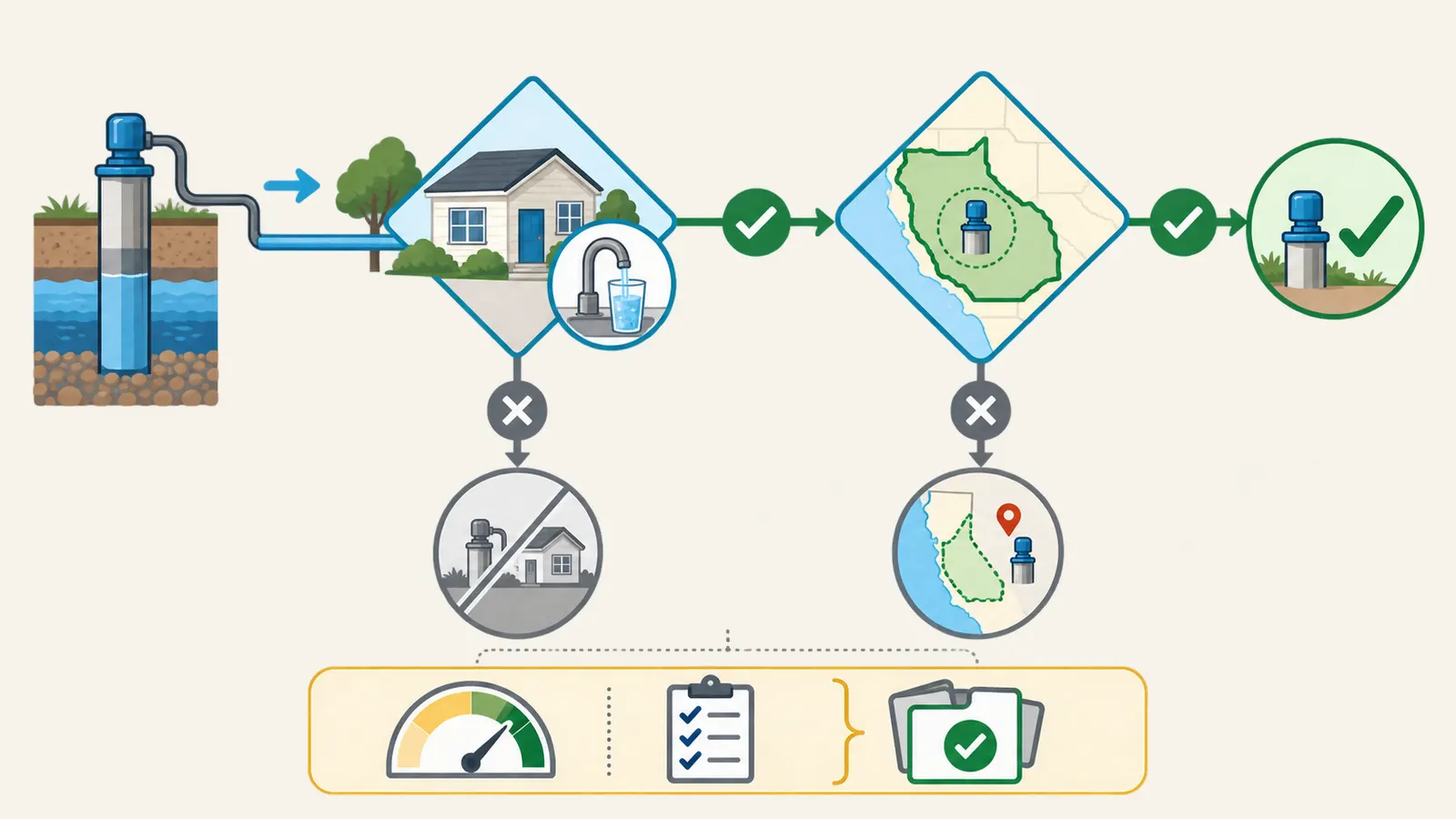
That means a private test you order on your own may be useful for health and maintenance, but do not assume it is the AB 2454 program test. The statute’s result-sharing duty refers to results received from a testing program. If you have already paid for an unrelated test, send it to the program administrator or local environmental health agency and ask what it does and does not establish.
There is also an important distinction between a private well and a public water system. EPA explains that private domestic-well water is not regulated by the federal Safe Drinking Water Act and that private well owners are responsible for safe household drinking water. AB 2454 is a targeted California requirement for a particular rental-property and program-boundary combination; it does not turn every private well in California into a regulated public water system.
2. Check the live boundary, not just the county name #
The State Water Board’s current AB 2454 homeowner guidance and program directory should be your starting point. Select the county, read the program-area description, and then verify the actual parcel or well location with the program administrator. The Board warns that a program may cover an entire county, only a regional water subbasin, or an area that crosses county lines. A county appearing in a directory is not proof that every parcel in that county is covered.
Use this boundary check:
- Record the property address, parcel number if available, and the well’s location. If the well is on a different parcel from the rental dwelling, record both locations.
- Open the State Water Board directory and map. Note the program name, administrator, stated geographic area, application link, and date you checked it.
- Use the program’s own eligibility tool when it has one. If its map is unclear, contact the administrator with the address and coordinates rather than guessing from a county label.
- Ask whether the program currently has capacity for new testing requests. The statute says participation is required “to the extent that the testing program has capacity.”
- Ask whether the owner, the resident, or either one can apply; what proof of rental occupancy or well service is needed; which contaminants are included; the recommended repeat interval; and whether replacement drinking water is offered if a result exceeds a primary drinking-water standard.
The Board currently describes multiple programs with different geographic coverage, application processes, eligibility criteria, and services. Some provide testing only; others may offer bottled water, hauled water, refill stations, point-of-use filtration, well maintenance, or a combination. Treat the directory as a live routing tool, not as a permanent statewide list.
If the well appears to sit within more than one program boundary, you do not need to enroll in all of them. Section 116688(b)(2) of the enrolled statute requires participation in only one program at a time. Choose the program that confirms the property is eligible and can accept the request, and save that confirmation.
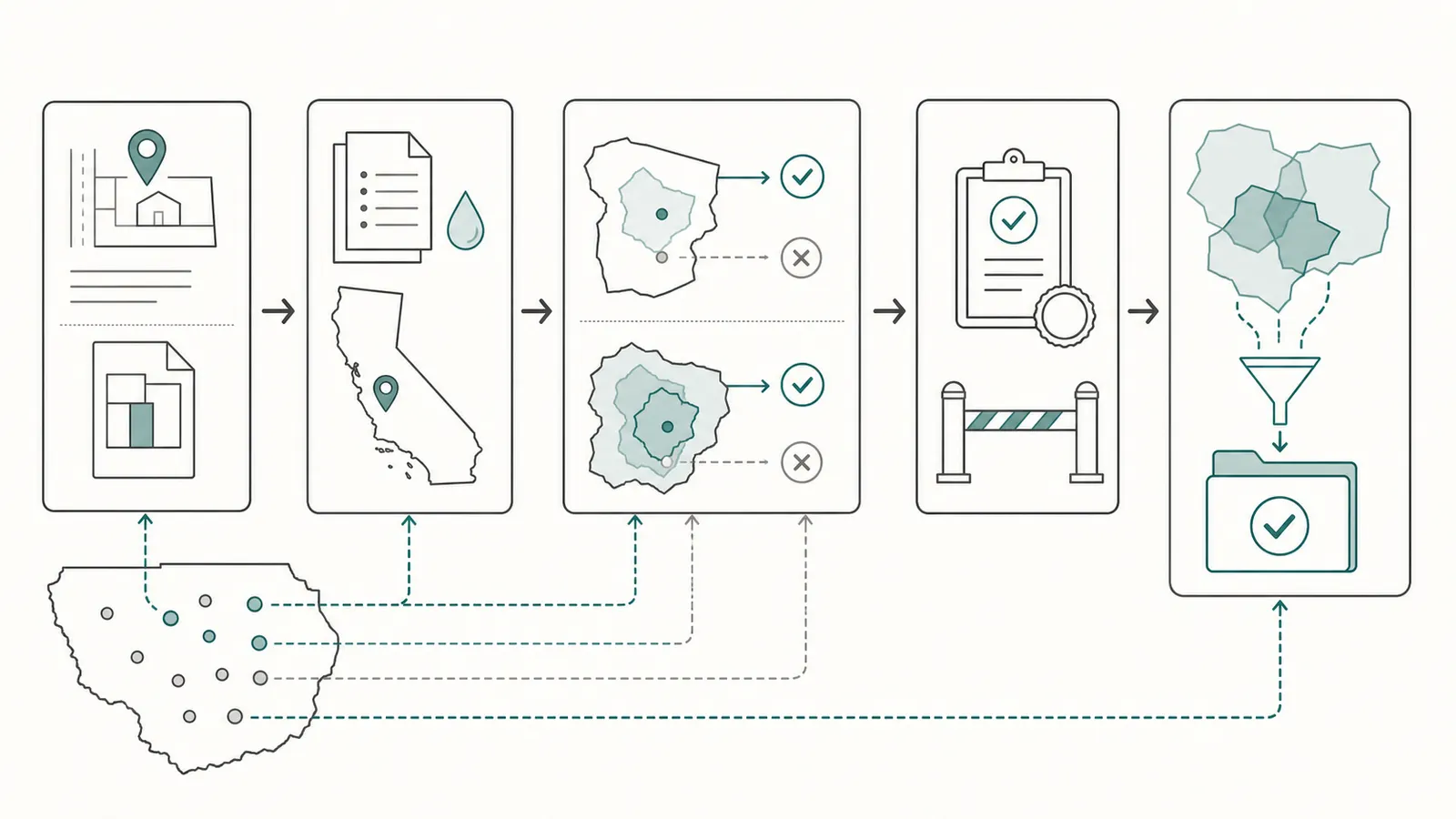
If you cannot find the well record, that is not a reason to open the well or dismantle the system. A California Department of Water Resources Well Completion Report search may provide construction and location information. DWR notes that records can be missing or spatially limited, so use a report as supporting identification rather than as proof of current program eligibility.
3. Apply, consent, and let the program define the test #
Once the two gates are confirmed, the owner’s next action is to contact the eligible program and follow its application process. Do not substitute a generic “well test package” for the program’s scope. The statute gives the owner a specific request duty, subject to capacity:
- Request testing for every primary and secondary drinking-water contaminant the program provides.
- Request a contaminant of emerging concern only if the program offers that option; this is permitted, not a universal requirement.
- Request repeat testing as frequently as the program recommends, again within the program’s capacity.
- Provide the consent the program requires for sampling and for the accredited laboratory to submit results to the State Water Board, a relevant State Board database, the local health officer, or another relevant local agency.
Those requirements are in Health and Safety Code section 116688(b)(1). The practical implication is that the administrator, not a homeowner’s intuition, determines the sampling kit, collection instructions, analyte list, chain of custody, laboratory, and data-sharing path.
Before sampling, make a one-page record of:
| Record | Why it matters |
|---|---|
| Property address, APN, and well location | Lets the program confirm its boundary instead of relying on a county label. |
| Owner and current resident contact details | Supports eligibility, scheduling, and the 10-day results handoff. |
| Whether the well supplies drinking water to the rental | Connects the physical source to the statutory rental-property condition. |
| Program name, administrator, and capacity response | Shows which program is handling the request and whether it accepted the case. |
| Sampling instructions and analytes offered | Prevents accidental substitution of a narrower private test. |
| Consent and data-submission instructions | Documents who may receive or transmit the result. |
| Prior reports, treatment records, and unusual water events | Gives the program or professional context without changing the program’s required test. |
For broader private-well care outside this statute, the State Water Board’s GAMA testing guidance recommends regular testing and explains that laboratory analysis supplies concentrations, while a simple presence/absence kit does not provide the same information. GAMA also notes that testing prices vary with the number of constituents and laboratory or outside service used. That general guidance should not be used to invent a required AB 2454 test panel when a qualifying program has supplied its own panel.
4. Treat the 10-day handoff as a documented deadline #
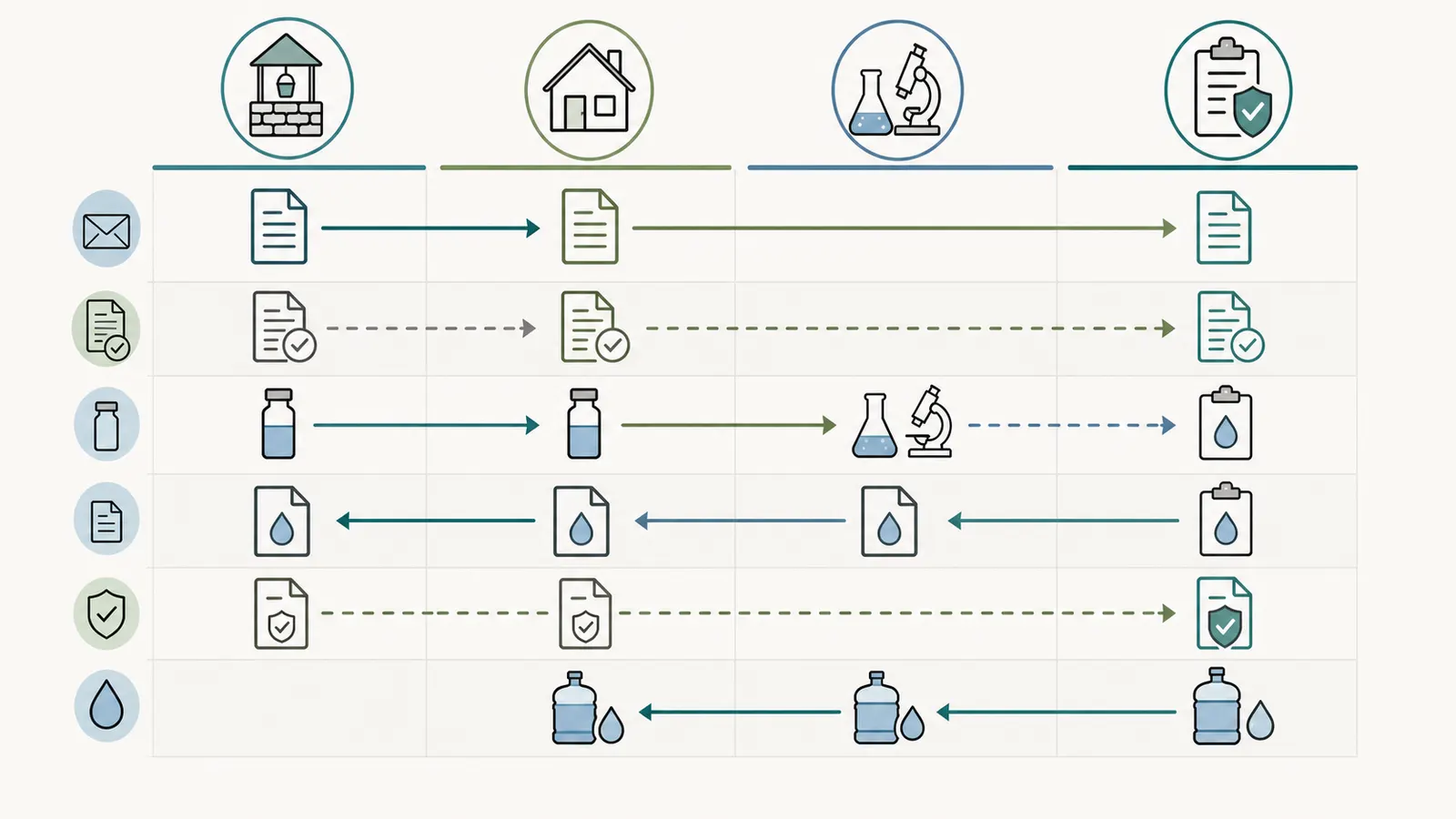
The 10-day clock starts when the domestic-well owner receives test results from the testing program. Within 10 days, the owner must ensure that current residents receive both:
- The test results; and
- The State Board’s information on how to read and understand those results.
That is the wording of section 116688(d), not merely a recommendation to tell residents that testing occurred. The handoff should be complete enough for a resident to see the report, the units, the tested constituents, any laboratory or program notes, and the interpretation guidance supplied or identified by the Board.
Use this compact deadline checklist:
- Write down the date and time the owner received the program report.
- Calculate the 10-day deadline and set a reminder before it arrives.
- Preserve the original report without editing or cropping result pages.
- Include the State Board interpretation guidance or the program’s direct link to it.
- Deliver the package to every current resident using a method that creates a delivery record.
- Save the report, guidance, delivery date, recipient, and any questions raised.
- Ask the program or local health agency to explain any result that is unclear; do not rewrite a laboratory conclusion yourself.
The statute says “current residents,” so do not assume that sending a report only to a property manager, former tenant, or vacant-unit contact completes the handoff. If occupancy changes during the process, ask the administrator or a qualified housing professional how to document the current-resident list. This page does not infer a special delivery method from the statute; use a reliable method and keep evidence of what was provided and when.
Do not delay sharing while waiting for a treatment quote, a second opinion, or a repair plan. Interpretation and remediation are separate steps. If a result is later corrected or superseded by the program, preserve both versions and share the program’s correction promptly.
5. If a result exceeds a primary standard, branch carefully #
An exceedance is a health and program question, not an invitation to improvise a filter. The State Water Board’s GAMA guidance says that if a result is above a primary maximum contaminant level, it is recommended that people not consume the water until appropriate action is taken. It also cautions that the appropriate response can depend on the contaminant and advises contacting the local Environmental Health Department about making the water safe.
For an AB 2454 program result, follow this sequence:
- Share the result and interpretation guidance within the 10-day window even if the result is difficult to interpret.
- Contact the testing-program administrator immediately and ask which result, standard, and eligibility rule controls the program response.
- Confirm whether the result exceeds a primary drinking-water standard, as opposed to a secondary standard or a general aesthetic guideline. Do not treat every taste, odor, or secondary-standard issue as the same statutory branch.
- Confirm whether the owner or a resident is eligible for the program’s safe-drinking-water service.
- Confirm that the program actually offers free replacement drinking water and what form it takes: for example, bottled water, hauled water, a refill station, or another program-defined option.
- Follow the program’s instructions for obtaining and maintaining that replacement supply while the water-quality issue is evaluated.
The State Water Board’s AB 2454 FAQ makes the conditional nature explicit: not all programs provide free replacement water, and some provide it only for a specified contaminant or only when eligibility conditions are met. The Board also states that if the testing program does not provide free replacement water, AB 2454 does not require the owner to pay out of pocket for replacement water under this statute.
The statutory safe-water duty has three linked conditions: the program-collected result demonstrates an exceedance of any primary drinking-water standard; the owner or a resident is eligible for safe drinking water under an identified program; and the owner provides safe drinking water under that program. That is why “the test is high” and “the program will supply bottles” are not interchangeable conclusions.
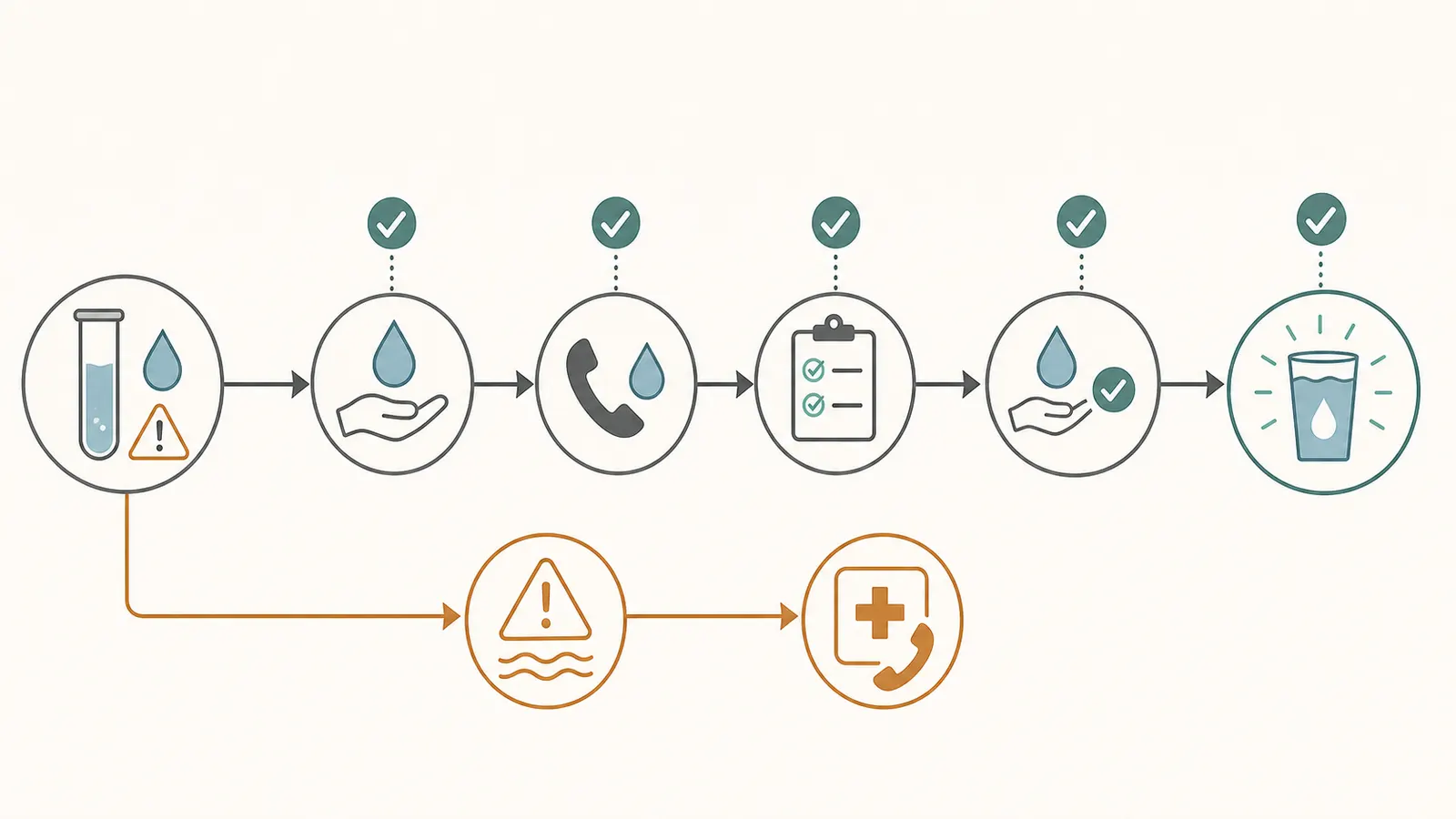
Until the program or health authority gives contaminant-specific direction, do not assume boiling solves the problem. The State Water Board’s private-well owner guide explains that boiling does not remove many commonly found toxic constituents. Use a confirmed safe source for drinking and cooking when advised, and ask the local health agency about any limits on bathing or other uses.
6. Keep costs, rent, and program limits separate #
AB 2454 prohibits the owner from imposing a charge or increasing a fee, rent, or other charge on a resident solely as a result of the statute’s requirements. This is a direct statutory cost rule in section 116688(f). It is not a license to relabel testing, result sharing, or required safe-water service as a new tenant fee.
The phrase “solely as a result” matters. This page does not decide every rent, utility, lease, deposit, or habitability question, and it does not say that every charge in a rental relationship is governed by AB 2454. It does mean that the owner should not create a new water-testing or safe-water charge, or increase rent for that reason, as a way to shift these statutory duties to the resident. Get California landlord-tenant advice before making any related lease or billing change.
Program capacity also matters. The statute requires participation to the extent the program has capacity, and it says the section imposes no new obligation on a testing program. If the administrator says the program is full, paused, outside its service area, or unable to provide a particular service, save that response and ask what the correct next step is. Do not promise residents a testing date or replacement-water service that the program has not confirmed.
7. Know what not to infer, and what to hand a professional #
These conclusions are safe to make from the evidence:
- A California private well is not automatically covered by AB 2454 just because it serves a rental.
- A property is not automatically covered just because its county appears in the directory.
- A qualifying program’s free test is not necessarily the same as a homeowner’s private lab package.
- An overlapping boundary does not require enrollment in multiple programs at once.
- A result exceedance does not, by itself, prove that the program will supply replacement water.
- A safe-water program response does not identify the correct treatment system, repair, or permanent source without professional and program-specific evaluation.
For anything beyond the program’s sampling instructions, use qualified help. A water-quality professional or local Environmental Health Department can help interpret a contaminant-specific result. A licensed well or pump professional can inspect the physical system and advise on repair or treatment. Bring the program confirmation, property and well location, original laboratory report, interpretation guidance, dates, prior results, treatment records, and a list of any recent flooding, construction, pump work, land-use change, taste, odor, or color change.
For general private-well safety, EPA recommends testing at least annually for several common indicators and testing promptly after flooding, significant nearby changes, repairs, or a change in water quality. Those are sensible health-protection triggers, but they do not replace the live AB 2454 boundary and program-capacity check.
Do not open an energized control box, test live wiring, open the well casing, pull a pump, enter a confined space, or manipulate pressurized equipment to answer this legal or water-quality question. Those actions can expose you to shock, stored pressure, falls, contamination, or equipment damage. Leave them to qualified professionals. A homeowner can safely gather documents, check the State Water Board directory, contact the program, record dates, and deliver the report; the hazardous physical work is not part of the AB 2454 decision.
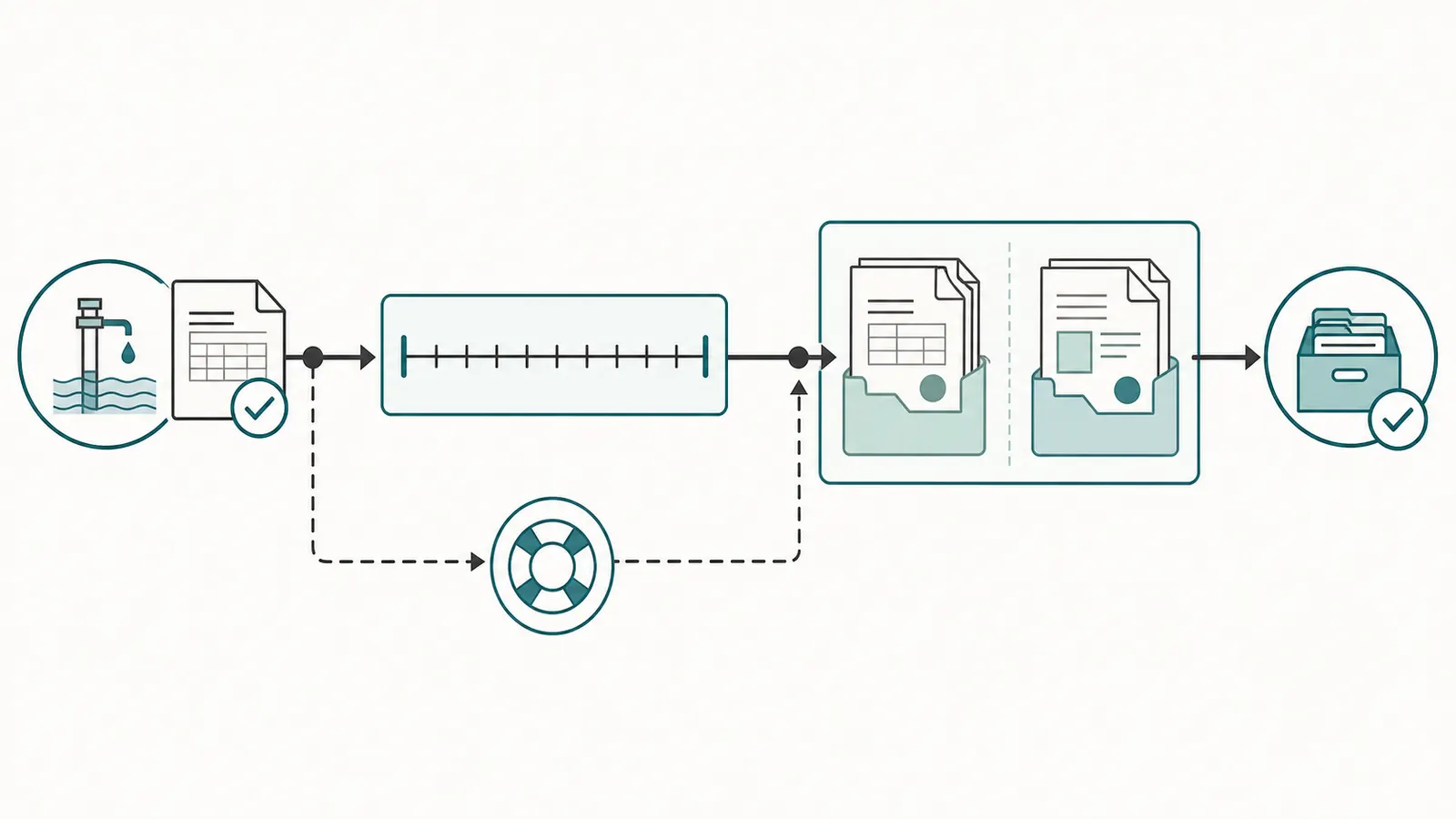
The practical endpoint is a dated file: the property and well location, the program and boundary confirmation, the capacity and eligibility response, consent and sampling instructions, the original result, the 10-day resident handoff, and any safe-water or professional guidance. If those records show both coverage gates are open, follow the program’s test and repeat schedule. If either gate is closed, do not describe AB 2454 as a statewide testing mandate—but keep monitoring the live directory and follow ordinary private-well health practices.
Cite this guide
Brictale. “California AB 2454: Does a Rental Property Private Well Need Testing?.” Published 2026-09-05; updated 2026-09-05.
https://brictale.com/water/wells/california-ab-2454-private-well-rental-testing · Read the Markdown version
Sources and scope
Evidence behind this page
- AB 2454 applies to an owner of a domestic well serving a rental property when the property is within the boundaries of a qualifying testing program; it is not written as a blanket statewide private-well testing mandate.
AB-2454 enrolled bill text, California Legislative Information
California Health and Safety Code section 116688, as added by Stats. 2024, chapter 506; scope of the rental-property duty.
Accessed · Link to this claim - A qualifying testing program is free to the owner or a resident, tests one or more primary or secondary drinking-water contaminants through a state-accredited laboratory, and is established by or funded by the State Water Board or a Regional Water Quality Control Board.
AB-2454 enrolled bill text, California Legislative Information
California Health and Safety Code section 116688(a), definition of testing program.
Accessed · Link to this claim - Within a testing-program boundary and subject to program capacity, the owner must request all primary and secondary contaminants the program tests, may request emerging contaminants if offered, request regular testing as frequently as recommended, and provide required consent for testing and data submission.
AB-2454 enrolled bill text, California Legislative Information
California Health and Safety Code section 116688(b)(1), testing, frequency, capacity, consent, and data-submission duties.
Accessed · Link to this claim - If more than one program boundary covers the well, the owner is required to participate in only one program at a time; if the owner does not qualify but a resident does, the owner participates on the resident’s behalf to the extent the program allows.
AB-2454 enrolled bill text, California Legislative Information
California Health and Safety Code section 116688(b)(2)-(3), overlapping programs and resident eligibility.
Accessed · Link to this claim - The owner must ensure that current residents receive testing-program results and the posted information on how to read and understand them within 10 days after the owner receives the results.
AB-2454 enrolled bill text, California Legislative Information
California Health and Safety Code section 116688(d), deadline and required content of the resident handoff.
Accessed · Link to this claim - If program-collected results exceed a primary drinking-water standard and the owner or a resident is eligible for safe drinking water under an identified program, the owner must provide safe drinking water under that program; the owner may not impose a charge or increase rent or another charge solely because of these requirements.
AB-2454 enrolled bill text, California Legislative Information
California Health and Safety Code section 116688(e)-(f), conditional safe-water duty and cost pass-through prohibition.
Accessed · Link to this claim - The State Water Board directs homeowners to use its current directory and map to check whether a well is covered; coverage may be a whole county, a regional water subbasin, or a cross-county area, and programs differ in services, application process, and eligibility.
Current State Water Board homeowner guidance, boundary verification, directory use, program services, applications, and eligibility.
Accessed · Link to this claim - Not every program provides free replacement drinking water; where offered, replacement water may depend on an exceedance, a specified contaminant, and owner or resident eligibility. The State Water Board says AB 2454 does not require the owner to pay out of pocket when the testing program does not provide replacement water.
Current State Water Board FAQ on replacement-water services, contaminant-specific conditions, eligibility, and out-of-pocket payment.
Accessed · Link to this claim - The current California drinking-water code identifies Health and Safety Code section 116688 as added by AB 2454 and effective January 1, 2025.
2026 Drinking Water Statutes, California State Water Resources Control Board
Current California drinking-water code, section 116688, including effective-date note.
Accessed · Link to this claim - EPA explains that private domestic-well drinking water is not regulated by the federal Safe Drinking Water Act and that private well owners are responsible for delivering safe drinking water to their households; EPA recommends regular testing and additional testing after changes such as flooding, repairs, or water-quality changes.
Private Drinking Water Wells and Protect Your Home’s Water, U.S. Environmental Protection Agency
Federal private-well context and general testing triggers; not a statement of California AB 2454 coverage.
Accessed · Link to this claim - The California State Water Board recommends regular domestic-well water-quality testing, explains the difference between laboratory concentration results and simple self-test presence or absence results, and notes that testing scope and price vary with the constituents and provider.
GAMA - Domestic Well Testing, California State Water Resources Control Board
General California private-well health and testing guidance; not a replacement for a qualifying AB 2454 program’s required panel.
Accessed · Link to this claim - The State Water Board’s private domestic well guide cautions that boiling water does not remove many commonly found toxic constituents, so a contaminant-specific response should come from health authorities or qualified professionals.
General treatment and health-protection limitation for private domestic wells.
Accessed · Link to this claim - EPA recommends regular testing for common private-well indicators and additional testing after flooding, significant nearby changes, well repairs, or a change in water quality.
Protect Your Home’s Water, U.S. Environmental Protection Agency
General federal private-well testing and emergency guidance; not a statement of California AB 2454 coverage.
Accessed · Link to this claim - California DWR provides a Well Completion Report map and explains that reports contain construction and location information that can help a homeowner identify a well record, while records may be incomplete or spatially limited.
Well Completion Reports, California Department of Water Resources
California DWR record-retrieval guidance; a well completion report supports identification but does not itself establish current AB 2454 program eligibility.
Accessed · Link to this claim