An estimate that sits in a “sent” folder is not a sales process. It is an unanswered question.
For a well drilling or pump company, the answer may depend on scope, depth assumptions, timing, access, budget, another decision-maker, or a customer who simply never saw the document. The follow-up has to uncover that reason without making promises the estimate cannot support.
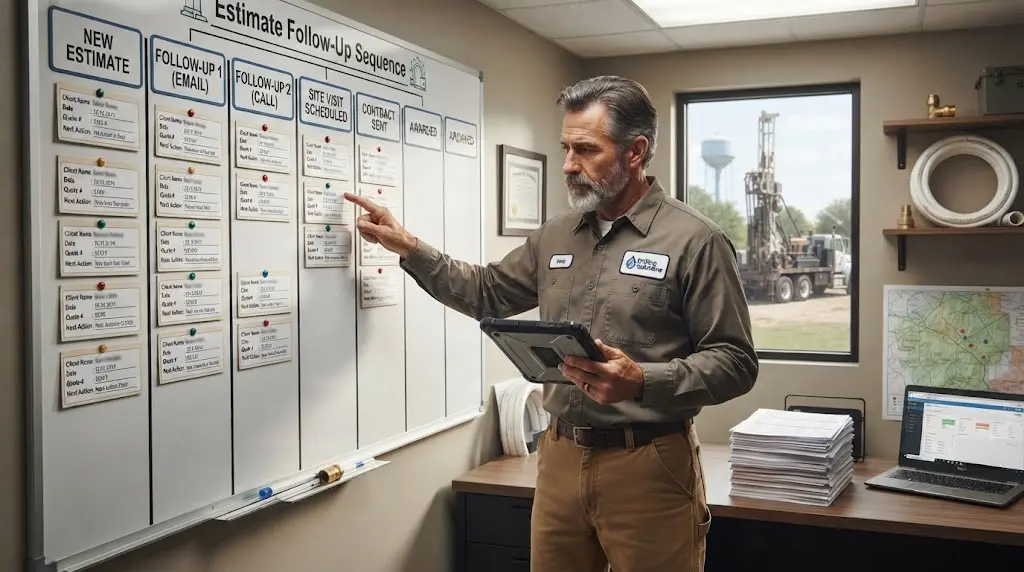
What should a well drilling estimate follow-up sequence accomplish?
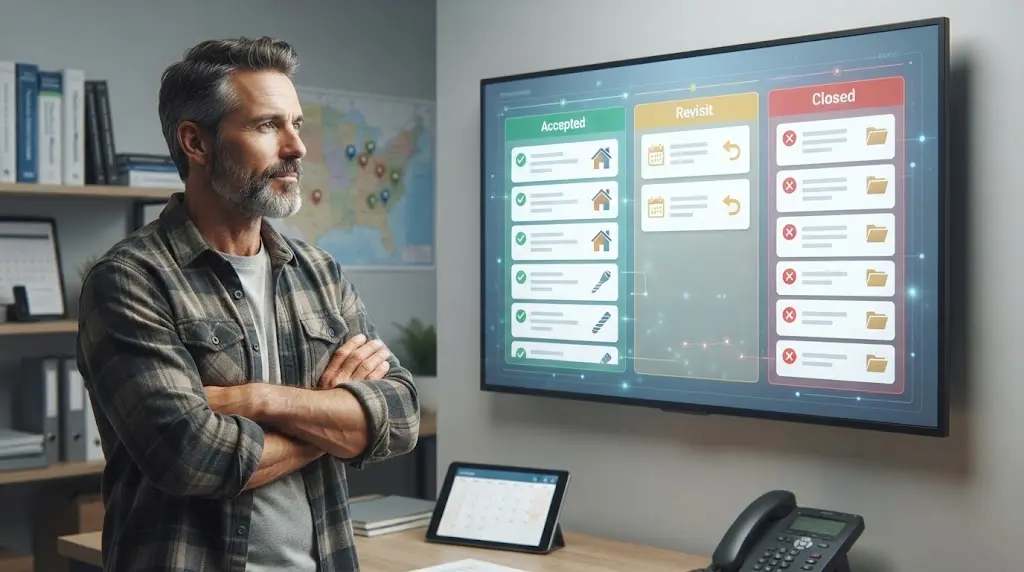
A good sequence moves every open estimate to a known status. It does not try to force every prospect into “won.” The useful outcomes are accepted, changes requested, declined, expired, or follow up later on a date the customer actually named.
That distinction matters because silence is not a status. If every unanswered estimate remains open, the owner cannot tell whether the pipeline is healthy, whether the office is missing replies, or whether the company is carrying old work that will never fit the crew calendar.
The sequence has four jobs:
- Confirm that the estimate reached the right person.
- Find the question or condition blocking a decision.
- Give the customer one useful next step based on the real scope.
- Record the outcome so the estimate can be tied to a booked job.
The broad contractor advice in the current result set gets the first three ideas mostly right. Generic guides commonly recommend a delivery check, a blocker question, a truthful schedule update, and a close-the-loop message. QuoteAnvil's contractor guide also recommends recording statuses such as accepted, changes requested, declined, expired, and follow up later. QuoteAnvil, How to Follow Up on a Contractor Estimate is useful baseline reading, but a well contractor needs branches that reflect drilling and pump work.
The goal of follow-up is a known next state, not an endless stream of reminders.
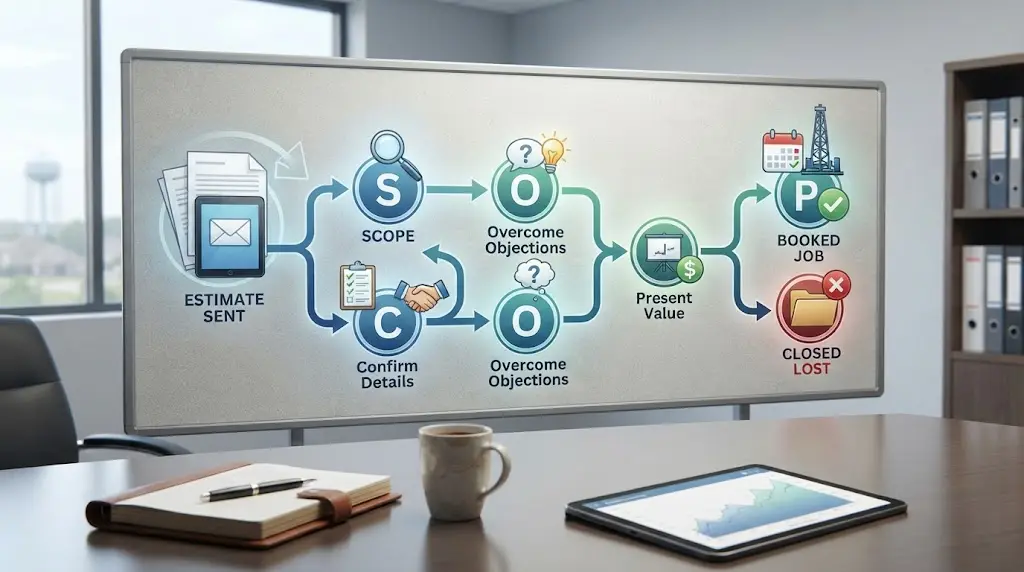
The framework below is called SCOPE:
- S - Send a reviewable estimate. Make the scope, assumptions, exclusions, price, timing, and approval step easy to find.
- C - Confirm delivery. Check that the estimate reached the right person and that the customer can open it.
- O - Open the blocker. Ask whether the issue is scope, timing, budget, access, authority, or uncertainty.
- P - Provide one truthful next step. Answer the question, offer a clearly defined alternate, give a real schedule update, or agree on a future trigger.
- E - End active chasing. Close, pause, or schedule the next contact with a date and reason.
SCOPE is not a claim that every customer follows the same buying path. It is a control system for making sure the office does not skip the same basic decisions every time an estimate goes quiet.
Which estimates belong in the sequence?
Put estimates into the sequence when a real sales or service decision remains. Do not treat every inquiry, rough phone number, or unqualified request as an estimate that deserves the same labor.
The minimum entry rule is simple: a named contact, a real job or property, an estimate record, a next action, and a known owner inside your company.
A practical entry checklist
Before enrolling an estimate, confirm these fields:
| Field | What to record | Why it affects follow-up |
|---|---|---|
| Customer and company | Name, phone, email, company if commercial | Prevents messages going to the wrong person. |
| Job identity | Estimate number, property or project name, service type | Lets every message refer to one specific job. |
| Job class | New well, pump replacement, pump repair, rehabilitation, testing, commercial bid, other | Sets timing and blocker questions. |
| Estimate version | Version number and sent date | Prevents a revised price from being confused with an old one. |
| Scope state | Site visit complete, diagnosis complete, assumptions open, alternate requested | Tells the estimator what can be discussed. |
| Decision-maker | Owner, property manager, general contractor, facilities lead, finance, board, other | Shows who must receive the estimate or approve changes. |
| Timing | Customer target date, contractor start window, material lead time | Keeps urgency factual. |
| Validity | Expiry date or review date and what can change after it | Creates a real reason to revisit without fake scarcity. |
| Source | Referral, organic search, Maps, paid search, repeat customer, partner, other | Connects the estimate to marketing and booked work. |
| Next action | Date, channel, owner, purpose | Stops the estimate from becoming a vague open task. |
An inquiry belongs in a lead-response workflow before it belongs in an estimate follow-up workflow. If a customer asks for a new well but the company still lacks the location, access details, required flow, permit context, or a site-visit decision, the next step may be qualification or scheduling, not quote chasing.
For urgent pump repair or loss-of-water service, the first response should follow the service urgency. A long nurture sequence is not a substitute for a person deciding whether the company can dispatch, diagnose, or refer the job. The estimate sequence begins after the company has made a real recommendation or issued a written scope.
For commercial work, the “customer” may be a project team rather than one person. Record the buyer, technical reviewer, approver, and procurement contact when known. A follow-up that reaches only the field contact can look like a sales failure when the actual blocker is an internal approval path.
What must be in the estimate before follow-up starts?
The estimate should answer enough questions that follow-up can discuss a decision instead of repairing a confusing document. Follow-up cannot compensate for missing scope forever.
The National Ground Water Association's Wellowner.org guidance says a written well contract helps the parties compare what each contractor will do for the stated price. It lists details such as casing, well development, yield evaluation, disinfection, start date, workmanship, and itemized charges for drilling, casing, materials, grouting, testing, deeper drilling, abandonment, and anything excluded from the specification. Wellowner.org, Guidelines for Written Contracts
Montana's Department of Natural Resources and Conservation gives similar operational guidance for water-well work. Its public document recommends written terms around anticipated depth, financial agreement, and additional drilling, and lists itemized components including mobilization, drilling, casing, sealing, materials, development, pump testing, grouting, pump accessories, disinfection, and testing. Those are Montana recommendations, not a universal rule for every state, but they show why a generic “well installation - $X” line is a weak foundation for a follow-up conversation. Montana DNRC, Water Well Drilling for the Prospective Well Owner
Use the estimate as the source of truth
Before sending, check that the document makes these questions answerable:
- What work is included?
- What work is not included?
- What assumptions shape the number?
- Which parts are unit-priced, allowance-based, or subject to site conditions?
- What happens if the planned depth, casing, access, material, or test result changes?
- Who must approve a change?
- What is the realistic start window?
- How long is the estimate valid, and what can change after that date?
- How does the customer approve the work?
- What is the next step after approval?
This is not a request to write a legal contract inside a follow-up email. It is a request to keep the document and the message aligned. If the estimate says “anticipated depth,” the follow-up should not say “the well will be 300 feet.” If the estimate says pump selection depends on field conditions, the follow-up should not imply that the final equipment is fixed when it is not.
Make revisions visible
Never negotiate against an old estimate in a text thread. If the scope changes, create a new version with:
- A new version number or date.
- The changed line items.
- Updated assumptions and exclusions.
- A new total or revised unit basis.
- A clear explanation of what stayed the same.
- A new approval path.
- A note that the earlier version is superseded, if that is your company policy.
When someone says the estimate is too high, the correct next step may be an alternate scope. It may also be a question about timing or what the line items mean. A price cut before that question is answered can reduce margin without solving the actual blocker.
What is the default well drilling estimate follow-up sequence?
Use four active follow-up touches after the estimate is sent, then close, pause, or schedule a dated revisit. The default timing is a starting point for ordinary estimates, not a rule that overrides customer preference, urgency, procurement, weather, material lead times, or state requirements.
| Timing | Channel | Purpose | One question or action | Stop or branch rule |
|---|---|---|---|---|
| Day 0 | Email or estimate portal, plus expected channel if appropriate | Deliver the estimate and define the next step | “Can you confirm you received estimate 1042, and would you like to review scope or timing?” | If the customer is ready, move to approval. If the customer requests a call, do that instead. |
| Day 1-2 | Email, text with expected permission, or human call | Confirm delivery and the right decision-maker | “Did it come through clearly, and is anyone else reviewing it?” | Resend or correct contact details. Do not start objection handling until delivery is confirmed. |
| Day 3-5 | Human call or the channel the customer used | Find the blocker | “Is the open question scope, timing, budget, access, or approval?” | Branch to revision, schedule discussion, alternate, or pause. |
| Day 7-10 | Email or call, text only when expected | Give one useful, truthful update | “Would you like us to hold the current start window, revise an option, or revisit this later?” | Mention schedule or validity only if it is real and documented. |
| Validity date or agreed review date | Email or human call | Close the loop and set the status | “Should we keep it active, revise it, follow up in a named month, or close it for now?” | Stop active follow-up after decline, opt-out, or no response to the close message. |
The sequence is intentionally shorter than an open-ended campaign. A well contractor has limited office capacity, and an old estimate should not consume the same attention as a fresh qualified call or a customer waiting for water service. The point is to make the decision visible, not to win a contest for the highest number of touches.
Every open estimate needs a next action, an owner, and a date.
Why day 0 still matters
The post-estimate sequence is different from new-lead response, but the handoff should still be fast. Harvard Business Review's public page for “The Short Life of Online Sales Leads,” by James B. Oldroyd, Kristina McElheran, and David Elkington, says: “most companies are not responding nearly fast enough.” Harvard Business Review
That quote describes online inquiries, not a proven well-estimate close rate. The practical implication is narrower: when a lead becomes an estimate, send the document while the site visit, diagnosis, or call is still fresh, and set the next contact before the work disappears into the office queue.
The InsideSales Annual 2014 Lead Response Report distinguishes response time from persistency and cites research on the difference between contacting a new web lead within five minutes and waiting 30 minutes. InsideSales, Annual 2014 Lead Response Report This is evidence for prompt handling of a fresh inquiry, not evidence that following up on day 3 instead of day 4 guarantees a sale.
Why the sequence changes after day 2
The customer has had time to open the document, compare it, ask someone else, or notice that a detail is unclear. The message should therefore change from “did it arrive?” to “what is the decision blocked by?”
The question should be easy to answer. Too many questions make the customer write an essay. One useful question gives the office a next move:
- “Is the scope clear, or should I explain one line?”
- “Is the start window the issue, or is the estimate outside the current budget?”
- “Who else needs to see the estimate before you decide?”
- “Would an alternate pump configuration or phased scope help, if it fits the job?”
Do not ask all four at once. Choose the one that matches what the estimate record already tells you.
How should each follow-up message be written?
Every message should name the job, state why you are contacting the customer now, ask one easy question, and make the next action obvious. Replace “just checking in” with a useful reason to reply.
The scripts below are complete examples built around estimate 1042. Before sending one, update the estimate number, project description, timing, and sender details with facts from the job record. Never send an example value unchanged.
Day 0: send the estimate and set the expectation
Subject: Estimate 1042 for the property
Hi there,
Attached is estimate 1042 for the property. It covers the scope discussed during the visit, with the important assumptions and alternates noted in the estimate. The current start window is the one shown in the estimate and remains subject to the documented site conditions.
Please reply with any scope or timing questions. I will check back on the next business day to make sure the estimate came through and see what you need to decide.
Thank you, The service team
The cover message should not bury the scope in a long sales pitch. The customer needs to identify the project, open the document, understand the next step, and know when the company will follow up.
If the estimate is for a new well, name the planning assumptions that matter without turning them into guarantees. For example, refer to anticipated depth, access conditions, unit pricing, or an approval requirement when those items are actually in the estimate.
If it is for pump replacement or repair, say what was diagnosed, what is included, and what the next operational step is. If the customer is without water, do not hide the urgent dispatch or temporary-service decision inside a standard nurture message.
Day 1-2: confirm delivery
Subject: Did estimate 1042 come through?
Hi there, I sent estimate 1042 for the property yesterday. Did it come through clearly? If you want, I can walk through the scope, the timing, or the options before you decide.
This is a delivery check. It is not the right moment to ask, “Have you decided?” A missing attachment, wrong email address, spam filter, or unavailable decision-maker can look like price resistance when the estimate was never reviewed.
If the customer replies that it arrived, update the status to delivery confirmed and ask no second question unless the reply invites it. If the customer says another person must review it, record that person and send one consistent version. If the customer says the document is confusing, schedule a short review or correct the estimate before asking for a decision.
Day 3-5: open the blocker
Subject: Question on estimate 1042
Hi there, I am following up on estimate 1042 for the property. What is the main open question: scope, timing, budget, access, or approval? I can answer the question or revise the estimate if the work needs to change.
For phone calls, use the same structure but leave room for a conversation:
“I am calling about estimate 1042 for the property. I do not want to guess at the reason it is sitting open. Is the issue the scope, the timing, the budget, site access, or someone else needing to approve it?”
This wording does two useful things. It acknowledges that the estimate may be a technical decision, and it gives the customer permission to say “not now” without inventing a price objection.
Day 7-10: provide one useful update
Subject: Timing for estimate 1042
Hi there, estimate 1042 is still valid through the date shown in the estimate. Our current start window is the window shown there, and the documented material, access, or scheduling condition still applies. Would you like us to hold that window, revise an option, or revisit the project later?
Use this message only when the update is true. Do not invent a deadline, claim that the crew is nearly full, or suggest that material pricing will rise unless you have a documented reason. A false deadline may create a short-term reply, but it makes the company harder to trust when the customer notices the pressure.
If nothing changed, the useful addition may be a concise explanation of one line item, a project assumption, or the approval path. Do not add a generic blog link or a long list of reasons to hire the company. The customer needs the next decision, not more content.
Validity date: close the loop
Subject: Keep estimate 1042 open?
Hi there, I am closing the loop on estimate 1042 for the property. Should we keep it active, revise something, schedule a follow-up for a specific month or decision trigger, or close it for now? Any answer is fine. I want the project status to be accurate.
This message is the operational payoff. A “not yet” with a named month is better than an open quote with no date. A decline with a reason is better than a forecast that quietly includes work the customer already awarded elsewhere. An expired estimate should not remain active simply because nobody wanted to mark it lost.
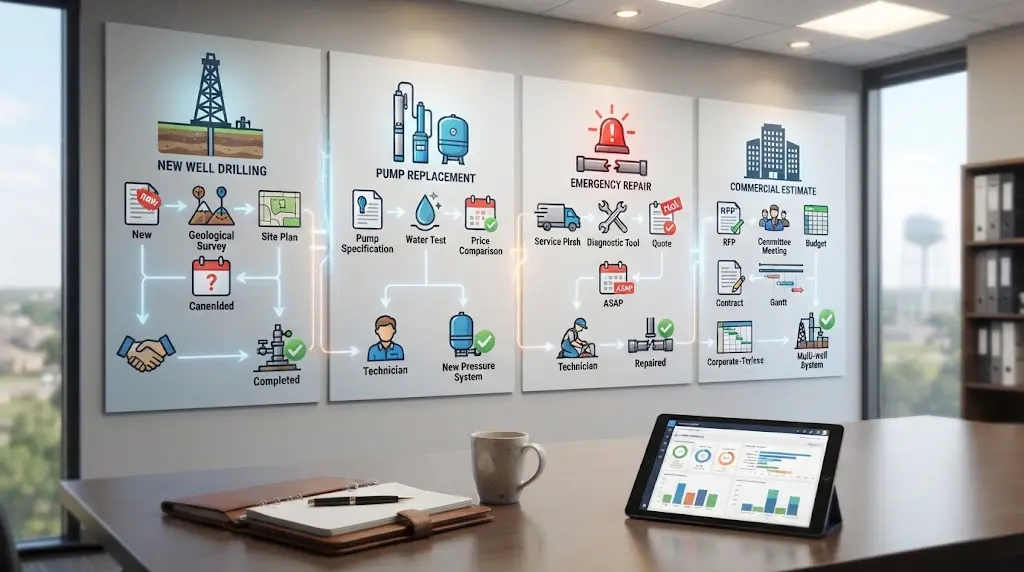
How should the sequence branch by type of well work?
Use the same status logic for every estimate, but change the question and timing by job class. A new well, pump repair, pump replacement, commercial bid, and well rehabilitation do not have the same urgency or uncertainty.
| Job type | Main decision blocker | Best first follow-up question | Timing adjustment | What not to imply |
|---|---|---|---|---|
| New residential or agricultural well | Scope, anticipated depth, access, budget, approval for variable work | “Which part needs clarification: planned scope, assumptions, access, or timing?” | Keep the ordinary sequence unless the customer names a decision date. | Do not promise a water result, final depth, or all-in outcome beyond the written estimate. |
| Pump replacement | Equipment choice, compatibility, installation timing, total price | “Would it help to review the pump option, what is included, or the installation window?” | Use a faster human touch when the existing system is failing or water access is limited. | Do not imply that a selected pump is final if field verification remains open. |
| Pump repair or service estimate | Diagnosis, urgency, repair versus replacement, access | “Do you want to proceed with the repair scope, review replacement options, or schedule a diagnosis?” | Branch to dispatch or scheduling; do not wait for a nurture day if service is urgent. | Do not turn an emergency into an automated sales campaign. |
| Well rehabilitation or testing | Required result, test procedure, access, report timing | “Is the open question the work method, the test, the report, or the timing?” | The review may need a technical call with more than one decision-maker. | Do not promise yield, water quality, or regulatory acceptance unless the scope supports it. |
| Commercial or public-sector bid | Procurement, technical review, insurance, terms, competing approvals | “Who owns technical review and who owns final approval?” | Use the buyer's procurement calendar, not a residential day-14 assumption. | Do not create artificial urgency around a formal bid deadline. |
| Long-lead or seasonal job | Budget cycle, permit, site readiness, weather, material availability | “What event needs to happen before this can move forward?” | Replace generic touches with a dated trigger such as permit approval or spring planning. | Do not keep the estimate forecasted as active with no decision date. |
New well drilling needs assumption discipline
New well work creates a specific follow-up risk. The customer may treat a planning estimate as a fixed promise, while the contractor knows the actual work depends on site conditions and the agreed scope.
The Montana guidance cited above recommends putting anticipated depth, financial terms, and the conditions for additional drilling in writing. The business lesson is not to copy Montana's rules into another state. It is to make the follow-up point back to the written estimate and its agreed change process.
Useful questions include:
- “Would you like us to review the anticipated depth and the terms for additional drilling?”
- “Is the question about the unit pricing, the total planning range, or the work included after drilling?”
- “Would it help to review access and site-preparation assumptions before you decide?”
Avoid:
- “We can definitely finish within that depth.”
- “The water will be there at the number in the estimate.”
- “That is the final price even if the written assumptions change.”
Those statements may be false even when the estimate itself is careful. Follow-up should reduce uncertainty, not erase it with a promise.
Pump work needs urgency discipline
For a pump failure, the customer may value speed more than a polished sequence. A quote follow-up system should have an override: if the customer is without water, a person decides the next action immediately. That might be dispatch, a diagnostic visit, a temporary solution, or a clear explanation that the company cannot serve the location.
The estimate sequence still helps after the urgent contact. It can confirm the repair or replacement scope, ask whether the customer wants to proceed, and move an accepted estimate into scheduling. But it should never delay a service decision just to preserve a day-based cadence.
Commercial bids need a contact map
For a commercial job, the person who requested the estimate may not be the person who approves it. Add a contact map to the record:
| Role | Name | What they need | Next action |
|---|---|---|---|
| Requester | Contact recorded in the job file | Scope and status | Confirm document delivery. |
| Technical reviewer | Contact recorded in the job file | Method, assumptions, compliance, testing | Offer a technical review. |
| Budget owner | Contact recorded in the job file | Price, alternates, payment terms | Send the current version. |
| Procurement or contract contact | Contact recorded in the job file | Formal terms, insurance, schedule | Confirm submission and deadline. |
| Field or site contact | Contact recorded in the job file | Access and readiness | Confirm site conditions before scheduling. |
The follow-up question is not “why have you not signed?” It is “who owns the next decision, and what does that person need?”
The message should change when the job type changes.
How should you handle the six common estimate blockers?
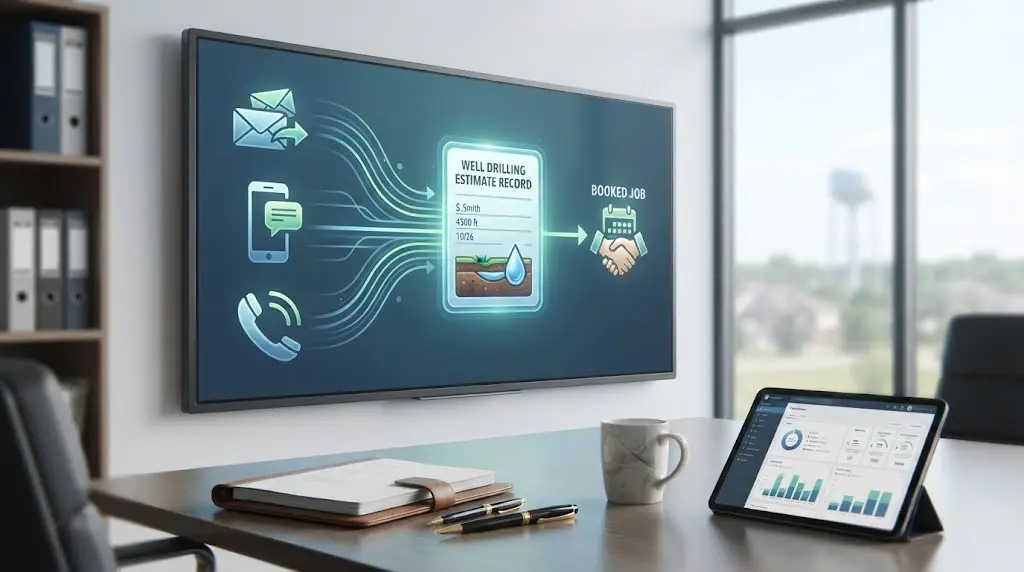
Treat the customer's silence as an unknown, not as proof of a price objection. The office should use the next conversation to identify one blocker, then route the estimate to the correct action.
The estimate was not received
Resend the same version, confirm the contact details, and identify the estimate number and job. Do not revise the price or scope just because delivery failed.
Status: delivery problem
Next action: resend, confirm receipt, and set a new blocker check.
The scope is unclear
Explain one line item at a time. For a well estimate, that might be mobilization, drilling per foot, casing, development, testing, pump accessories, disinfection, or an exclusion. For a pump estimate, it may be the equipment selection, control box, pressure tank, labor, or electrical work.
If the explanation changes the scope, issue a revised version. If it only clarifies the existing scope, record the explanation in the estimate notes.
Status: blocker identified - scope
Next action: technical review or revised estimate.
The total is outside budget
Ask whether the customer wants to change the work, defer it, phase it, or simply understand the total. Then offer an alternate only if it is technically and commercially valid.
An alternate should name what changes and what remains. “Lower price” is not a scope. “Pump replacement with option A instead of option B, excluding electrical upgrade pending field verification” is closer to a decision-ready alternate, if those details are accurate for the job.
Status: blocker identified - budget
Next action: alternate, phase, defer, or close.
Timing is the blocker
Give the earliest realistic start window, not a promise you cannot keep. If the customer needs the work sooner than the company can deliver, say so. It is better to close the estimate accurately than to book a job into an impossible calendar.
Status: blocker identified - timing
Next action: hold a real window, refer, revise date, or close.
Another person must approve
Ask who needs to see the estimate and what format they need. Send one consistent version to the known decision-makers. Avoid creating parallel versions in different text threads.
Status: blocker identified - authority
Next action: share version, schedule review, or set approval date.
The customer is not ready
Ask for a trigger. It might be a permit, property closing, financing decision, seasonal start, board meeting, or a future maintenance event. Record the trigger and the month or date.
Status: follow up later
Next action: create one dated task tied to the trigger. Do not keep sending weekly reminders before it.
The customer selected another contractor
Thank them, record the reason only if they volunteer it, and close the estimate. Do not argue about price or ask them to reconsider in the same message.
Status: declined - competitor selected
Next action: close the estimate and preserve the source and service information for future analysis.
Should you use text, email, or a phone call?
Use the channel the customer expects, and match the channel to the kind of decision being made. Email should carry the estimate and any revised scope. Text can handle a short delivery or scheduling question when texting is expected and permitted. A phone call is better when the issue needs diagnosis, negotiation of scope, or several decision-makers.
Email is the estimate record
Use email or the estimate portal for:
- The original estimate.
- Scope and assumptions.
- Revised estimate versions.
- Exclusions and change conditions.
- Approval instructions.
- Validity or review dates.
- Commercial bid documentation.
Commercial email rules still apply when the recipient already knows the company. The Federal Trade Commission says CAN-SPAM covers commercial messages and requires accurate header information, non-deceptive subject lines, a valid physical postal address, a clear opt-out method, and prompt honoring of opt-outs. FTC, CAN-SPAM Act: A Compliance Guide for Business
Keep the compliance discussion with the company sending the message and its counsel. Whether a specific estimate follow-up is transactional, commercial, or mixed can depend on the content and purpose. The safe operating habit is to use accurate identification, honest subjects, a working opt-out process for commercial email, and a documented suppression rule.
Text is a short convenience channel
Use text for a short message such as:
Hi there, this is the service team. Did estimate 1042 for the property come through? Reply here if you want to review the scope or timing.
Do not send the estimate's technical detail through a string of small texts. Keep the document and the approval trail in email or the estimate system.
Texting rules are not just a deliverability issue. FCC guidance says SMS texts are covered by TCPA protections and discusses prior express consent for calls and texts to wireless numbers. FCC, DA 15-997A1 Permission, channel expectations, opt-out handling, and automation design should be checked for the company's actual workflow and state.
For a conservative workflow:
- Record how the customer gave the number and whether text communication was expected.
- Use an identifiable sender and a clear reason for the message.
- Do not add the customer to a broad marketing sequence because they received one estimate.
- Stop when the customer opts out or asks for no more messages.
- Keep a record of the opt-out and suppress future automated texts.
Phone is for decisions that need a person
Call when:
- The estimate has technical assumptions that are difficult to explain in writing.
- The customer says the price is high but has not described why.
- Access, safety, scheduling, or site conditions need discussion.
- A commercial bid has multiple reviewers.
- The job is urgent.
- The customer requests a call.
Leave a voicemail that names the project, estimate number, reason for the call, and one callback action. Do not leave a vague “call me back about your estimate” message that makes the customer search through old documents.
What if the customer uses a different channel?
Follow the customer's lead. If the customer replies by text to an email, answer the narrow question there, then place any changed scope in a revised estimate. If a customer calls after receiving a quote, update the record with the question and outcome. The channel may change; the source of truth should not.
Email holds the scope record; text and phone carry the conversation.
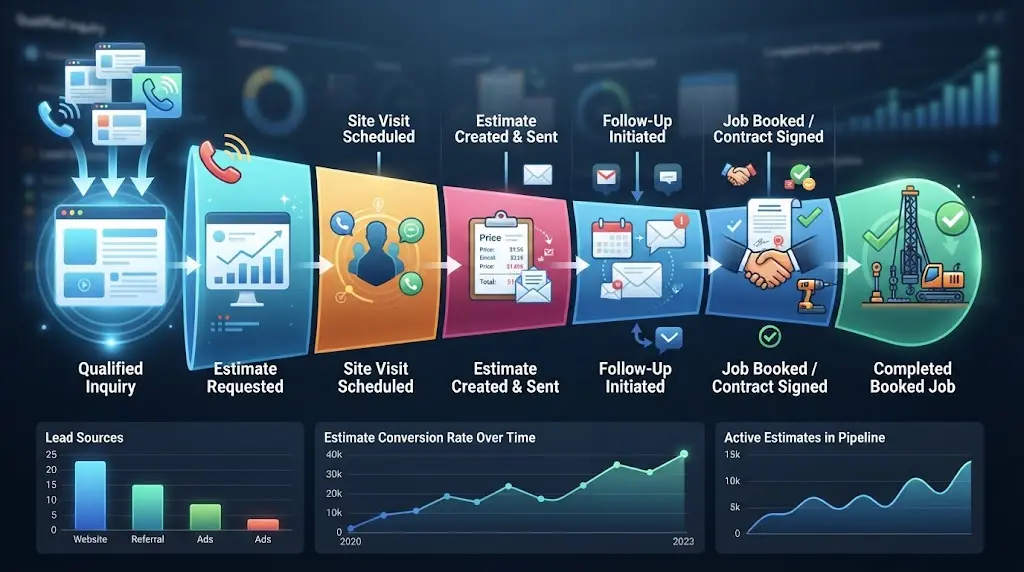
How should the office run the workflow every day?
The owner does not need a complicated sales platform to start. The workflow needs one record, one status, one next action, and one accountable person.
Use a simple state machine
The recommended states are:
draft -> sent -> delivery confirmed -> blocker identified -> action taken -> decision requested -> accepted / changes requested / declined / expired / follow up later
After acceptance, move to booked, then scheduled, then completed as your operation needs. Do not confuse “accepted estimate” with “booked job” if the customer still must pay a deposit, sign a contract, confirm access, or choose a schedule.
Each open state needs a next-action record:
| Required field | Example | Owner question |
|---|---|---|
| Current status | Blocker identified - timing | What is true now? |
| Next action date | 2026-08-27 | When will someone act? |
| Next channel | Phone | Where will the customer see it? |
| Message purpose | Confirm revised start window | Why should they reply? |
| Responsible person | Office manager | Who owns the task? |
| Customer reply | “Waiting on permit” | What did the customer actually say? |
| Estimate version | v2, sent 2026-08-20 | Which document is current? |
| Outcome | Revisit after permit | What closes this task? |
An estimate should never be “open” without a next action or a recorded reason for pause.
Run a daily open-estimate review
Set a short review at the same time each business day. The agenda is not a long meeting. It is a queue check:
- New estimates with no scheduled follow-up.
- Delivery checks due today.
- Estimates with a known blocker and no owner.
- Revised estimates awaiting approval.
- Estimates reaching validity or review date.
- Customer replies that need a human answer.
- Accepted estimates missing a booked or scheduled job.
- Old estimates that should be closed or moved to a dated revisit.
The owner should review exceptions, not manually write every message. If the same blocker appears often, improve the estimate or proposal cover letter. Brictale's well contractor proposal cover letter template can support that front-end improvement, while this page handles what happens after the document is sent.
Assign the right follow-up owner
The estimator may own technical questions. The office manager may own delivery checks and scheduling. The owner or general manager may own commercial approvals or high-value negotiations. The role can vary. The record cannot.
If the customer asks a technical question and the office sends a generic sales reply, the sequence creates friction. If the estimator is the only person who knows the quote status, the workflow stops when the estimator is on a rig or out of the office. Set an owner for the next action and a backup for urgent replies.
Use automation only for predictable steps
Automation is useful for:
- Creating a day 1-2 delivery task when an estimate is marked sent.
- Creating the day 3-5 blocker task when delivery is confirmed.
- Stopping future tasks when the customer replies or the status changes.
- Reminding the owner when a revision has not been approved.
- Creating a validity-date task.
- Logging message timestamp and channel.
Automation should not decide:
- Whether a water result is guaranteed.
- Whether a scope change is technically valid.
- Whether an emergency customer should wait.
- Whether a discount is appropriate.
- Whether a customer has consented to a particular automated text campaign.
The safest automated message is the one assembled from a complete record and sent only when the state still matches the rule. If the customer already replied, the automation should stop.
How should a contractor measure whether follow-up creates booked jobs?
Measure the sequence at the estimate and job levels, not just at the message level. Opens, clicks, and replies are useful diagnostics. They are not the business outcome.
Track the minimum funnel
Use these stages:
qualified inquiry -> site visit or diagnosis -> estimate sent -> estimate reviewed or delivery confirmed -> blocker resolved -> accepted -> booked -> scheduled -> completed
Add declined, expired, and follow up later as real outcomes. If the only options are open and won, the company hides the reasons work did not move.
Google Analytics documentation recommends UTM parameters to identify source, medium, and campaign, with consistent naming so one campaign is not split across multiple labels. Google Analytics, URL builders Use that for web-sourced inquiries, but do not treat it as proof that a click became a booked job.
Google's lead-generation documentation also describes measuring form views, form starts, and form submissions to understand drop-off. Google Analytics, How to Generate More Leads on Your Website A contractor should extend the same discipline into the office record by logging estimate sent, accepted, booked, and completed.
Create a source-to-booked-job record
At minimum, store:
| Stage | Field | Example |
|---|---|---|
| Acquisition | First source | Organic search |
| Acquisition | Specific source | Google Maps, referral partner, paid search, repeat customer |
| Acquisition | Campaign or landing page | pump-repair-spring-2026 |
| Inquiry | Inquiry date | 2026-08-20 |
| Qualification | Service and territory fit | Pump replacement, within service area |
| Estimate | Estimate number and version | 1042 v1 |
| Follow-up | Touch dates and channels | Email 8/20, call 8/25 |
| Decision | Status and reason | Changes requested - access assumption |
| Booking | Booked date and job value field | 2026-08-29, internal value field |
| Delivery | Scheduled and completed | Scheduled 9/10, completed 9/12 |
Do not publish an internal job value in an article or use a generic industry average as if it were your company's economics. The owner should use actual job data to decide which estimate sources and service types deserve more follow-up capacity.
Review the sequence by cohort
After enough estimates move through the workflow, compare groups such as:
- New wells versus pump replacement.
- Referral versus organic versus paid source.
- Estimates with a delivery confirmation versus estimates with no confirmation.
- Estimates with a technical review versus estimates with no reply.
- Jobs with one revision versus jobs with multiple revisions.
- Estimates accepted within the validity period versus accepted after revision.
The goal is not to prove that one message caused a job. The goal is to find where the workflow loses visibility. If many estimates stop at “sent,” the issue may be delivery or follow-up ownership. If many stop at “changes requested,” the estimate or scope review may need work. If many are accepted but never booked, the handoff to scheduling is the problem.
Connect follow-up to the marketing system
Your well drilling call tracking checklist can help structure inbound call source and outcome fields. This page adds the post-estimate layer. Keep the two connected through the customer, job, estimate number, and source fields.
Do not judge a marketing channel from lead volume alone. A source that produces fewer qualified estimates but more booked jobs may deserve more attention than a source that creates a full office queue of unserviceable requests.
A reply is a conversation event, not a booked job.
What mistakes make estimate follow-up fail?
Most failures are operational, not copywriting failures. The message may be fine, but the company sends it to the wrong person, references the wrong version, misses a reply, or keeps chasing a job that should have been closed.
Mistake 1: using “just checking in” as the whole strategy
The phrase is not forbidden. The problem is sending it repeatedly without a job-specific reason. Every touch should confirm delivery, answer a scope question, give a real update, request a status, or schedule a future trigger.
Mistake 2: following up before the estimate is reviewable
If the estimate lacks scope, assumptions, exclusions, or approval instructions, the customer cannot make a clean decision. The office then interprets normal questions as objections and creates unnecessary revisions.
Mistake 3: discounting before diagnosing
Price is visible. It is not always the blocker. The customer may be confused by the scope, unable to schedule, waiting on another approver, or comparing different work packages. Ask one question first.
Mistake 4: inventing scarcity
A crew window, supplier change, permit date, or validity period can be a real business condition. It should be stated accurately. “We only have one spot left” is not a follow-up template. Use it only if it is true and you can honor it.
Mistake 5: treating all well work as one sale
New drilling, pump replacement, emergency repair, testing, and commercial work need different next questions. A single automation rule can handle the status transition, but not every message.
Mistake 6: leaving revisions in text threads
If the scope, price, or assumptions change, send a new estimate version. A text saying “we can probably do it for less” creates an avoidable dispute about what was agreed.
Mistake 7: letting automation continue after a reply
If a customer says “we selected another contractor,” the next scheduled sales email damages trust. Stop the sequence when the record changes to accepted, changes requested, declined, expired, or follow up later.
Mistake 8: counting a reply as a booked job
A reply is a conversation event. An accepted estimate may still need a deposit, signature, schedule, permit, access confirmation, or contract. Keep booked and completed as separate operational stages.
Mistake 9: mixing marketing nurture with estimate follow-up
An estimate follow-up sequence is tied to a real job. A seasonal newsletter, review request, maintenance reminder, or general offer is a different communication. Combining them can make a customer unsure whether the company is handling their project or selling something else.
Mistake 10: ignoring the customer's request to stop
An opt-out should stop the relevant message stream. The FTC requires commercial email senders to honor opt-outs promptly, and FCC rules affect text communications. Keep the suppression record where every person and automation can see it. FTC CAN-SPAM guide and FCC guidance on SMS and consent
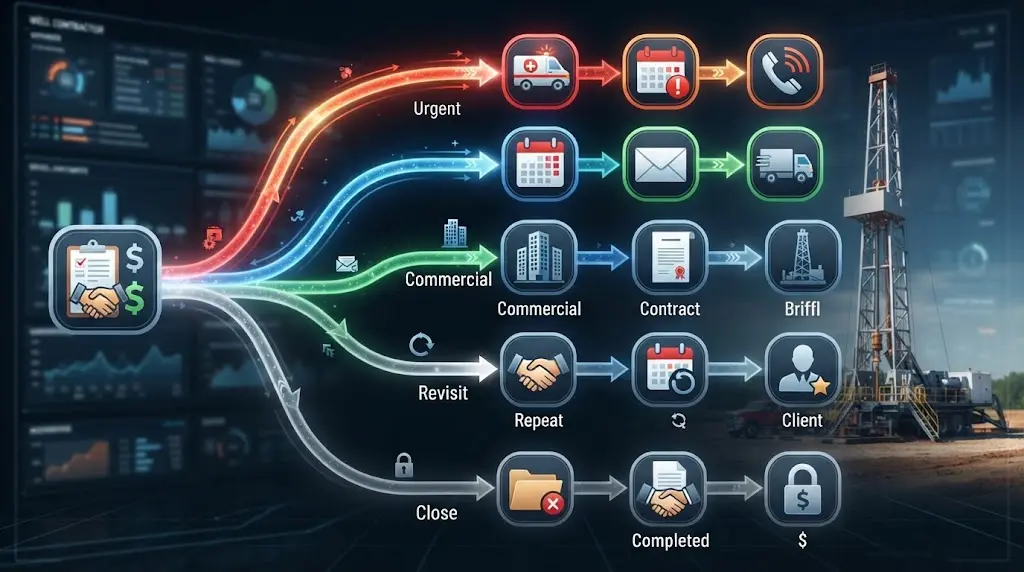
When should you not use the default sequence?
Do not use the ordinary day-based sequence when the customer's situation calls for an immediate human decision, a formal procurement calendar, or a clearly dated future trigger.
Use an urgent branch when:
- The customer is without water.
- A failed pump or pressure system is creating an active service problem.
- The customer asked for a same-day decision.
- Safety, access, or property damage changes the job priority.
Use a commercial branch when:
- The bid has a stated submission deadline.
- Multiple people must review the work.
- Insurance, bonding, licensing, or contract terms are part of approval.
- The customer has a procurement schedule that does not match day 7 or day 14.
Use a dated-revisit branch when:
- The customer is waiting for a permit, financing, property closing, board decision, or season.
- The customer says exactly when the decision can resume.
- The estimate is likely to change materially before the customer is ready.
Use a close branch when:
- The customer clearly declined.
- The customer selected another contractor.
- The estimate expired and the customer has not requested an extension.
- The customer opted out.
- The job is outside the company's territory, service capability, or capacity.
Closing is not failure. It protects the pipeline from false optimism and gives the company cleaner information about which services, sources, and territories deserve attention.
Closing an estimate is a data-quality decision, not a lost-sales confession.
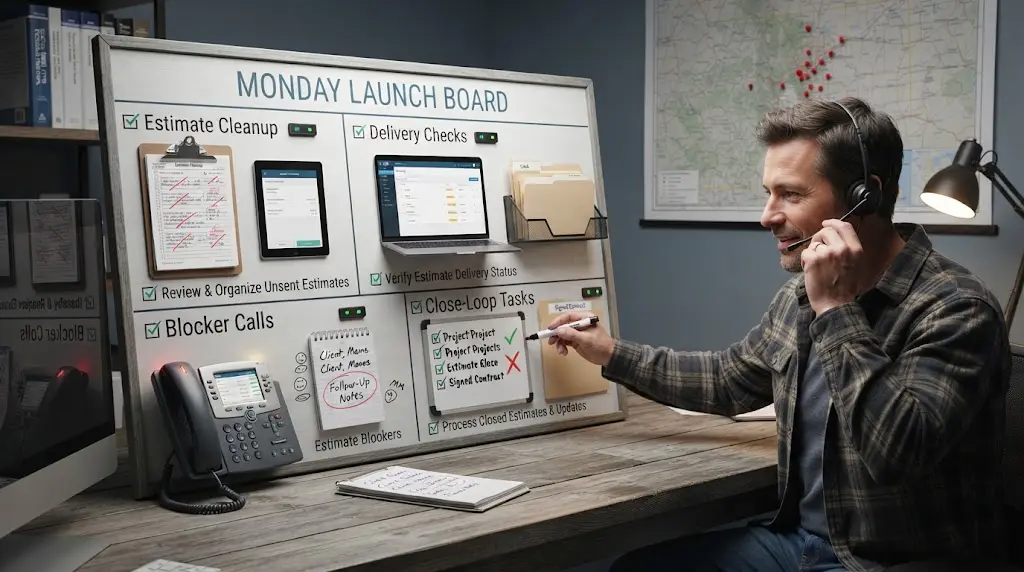
How can an owner launch this sequence on Monday?
Start with the open estimates already in the office. You do not need to wait for a new CRM implementation to learn where the pipeline is stuck.
Day 1: clean the estimate list
Export or list every estimate that is still marked open. Add:
- Customer and job identity.
- Estimate version and sent date.
- Service type.
- Current status.
- Last customer contact.
- Next action date.
- Assigned owner.
- Source, if known.
Close anything that is clearly declined, out of territory, duplicated, or no longer serviceable. Move “not now” work to a dated revisit. Leave only estimates that have a plausible next step in the active queue.
Day 2: repair the documents
Pick the estimates with the highest potential operational value or clearest decision path. Check scope, assumptions, exclusions, schedule, validity, and approval instructions. Create a new version when changes are needed.
Do not use the first follow-up as an excuse to send a document you already know is confusing.
Day 3: send delivery checks
Use the short delivery message. Confirm the estimate number, job, and contact. If the customer did not receive it, fix delivery. If the customer did receive it, record delivery confirmed and schedule the blocker question.
Day 4-5: call the real blockers
Use the blocker question, then route each estimate:
| Customer response | Next status | Next action |
|---|---|---|
| “I did not see it.” | Delivery problem | Resend and confirm. |
| “We need to compare.” | Decision pending | Ask what must be compared and when. |
| “It is too high.” | Budget blocker | Diagnose scope, budget, or timing before alternate. |
| “We need a permit.” | Follow up later | Set permit-triggered task. |
| “We want to proceed.” | Accepted pending booking | Confirm approval requirements and schedule. |
| “We hired someone else.” | Declined | Record and close. |
| No response | Active follow-up | Continue only to the next truthful touch. |
Day 6-10: make the next action visible
Send only the update that belongs to the status. A customer waiting on a permit should receive a dated revisit task, not a generic “we have availability” email. A customer deciding between pump options should receive a technical review invitation, not an expiry warning.
Day 11 onward: close the loop
At the validity or review date, request a status. Then honor it. If the customer wants a future contact, record the month or trigger. If they do not respond to the close message, stop active chasing and mark the estimate accordingly.
What should the owner inspect after two weeks?
Review:
- How many estimates lacked a next action?
- How many were never delivered or opened?
- Which job types created the most blocker conversations?
- How many revisions were caused by unclear scope?
- How many accepted estimates moved to booked?
- Which source produced the most qualified estimates and booked jobs?
- How much office time was spent on estimates that should have been closed?
The point of the first two weeks is not to announce a conversion-rate win. It is to expose the holes in the operating system while the records are still recent.
Brictale's well drilling contractor capacity planning guide is a useful companion once accepted estimates begin competing for the same crew windows. Demand generation, estimate follow-up, and capacity planning are one operating loop. More calls do not help if the company cannot decide which jobs fit the calendar.
What is the final decision for a well contractor?
Use the default sequence when an estimate represents a real job and no customer-specific timing overrides it: send a clear document, confirm delivery, ask one blocker question, provide one truthful update, and close or schedule the next date.
Branch early for emergency pump work, new-well uncertainty, commercial approval, and long-lead projects. Keep the estimate version and customer status in one record. Measure booked work, not just replies.
If the pipeline is full of open estimates with no next action, that is a territory and operating visibility problem, not only a copywriting problem. A free territory audit from Brictale can show where qualified demand, estimate handling, and booked-job tracking are disconnected.