The dangerous moment is not always the difficult formation. It is the moment the crew keeps working while the office still has no written answer to who pays, what changed, or who approved it.
For a well drilling or pump company, a change order has to follow the work. It has to connect the signed scope to the actual borehole, pump system, price, schedule, permit path, and job records.
Quick Answer: Use a written change order when a signed well or pump contract needs a scope, price, material, time, or regulatory change. Record the original contract item, observed condition, exact delta, pricing basis, schedule effect, permit check, attachments, and authorized signatures before extra work proceeds, except for documented emergencies allowed by the contract.


This page gives you a fill-in form and the operating system around it. It is written for US well drilling and pump contractors handling residential, agricultural, commercial, municipal, monitoring, or related groundwater work. The exact permit, notice, licensing, consumer-contract, and payment rules still depend on the job and jurisdiction.
What is a well drilling contract change order?
A well drilling contract change order is a written modification to an existing agreement that records a change in work, price, time, materials, method, quantity, or other contract term. It is not simply a better description of the invoice after the job is complete.
The US EPA's Handbook of Suggested Practices for the Design and Installation of Ground-Water Monitoring Wells defines the core idea this way: “A change order is a written agreement from the purchaser to the contractor authorizing additions, deletions or revisions in the scope of work.” The same handbook also connects the change to the contract price or effective period. Read the EPA handbook.
That definition fits a well company because the original job may be priced before the crew knows the exact formation, water-bearing interval, borehole stability, casing condition, pump performance, or access problem. The uncertainty does not automatically entitle the contractor to more money. It does mean the contract needs a controlled way to respond when the agreed scope no longer matches the work.
The change order should answer six questions:
- What did the original contract require?
- What was observed or requested?
- What exactly is different now?
- How does the difference change cost or time?
- Who is authorized to approve it?
- What records prove the change was performed and closed?
A change order is a control record, not an invoice explanation.
The form in this article is an operational template. It does not decide whether a change is legally recoverable. That answer comes from the signed agreement, incorporated specifications, permit conditions, applicable state and local rules, and the facts of the job.
When do you need a change order instead of another field document?
Use a change order when the work, money, time, or contractual risk changes. Use a different document when the contract already covers the work or when you are preserving notice before the final commercial answer is known.
The names vary across contracts. The distinctions below are a practical operating rule, not a universal legal taxonomy.
| Situation | Primary document | What it should do | Example in well work |
|---|---|---|---|
| The existing contract already covers the action and there is no price or time change | Field clarification or field order | Clarify method, location, sequence, or interpretation | Move the spoil pile to the location already allowed by the site plan |
| A condition may support a price or time claim, but the amount is not yet known | Written notice or change-order request | Preserve the event, date, baseline, condition, and right to price later | Unanticipated caving formation discovered at a measured depth |
| Scope, price, materials, quantity, or time will change | Change order | Authorize the exact delta and commercial effect | Add casing, deeper drilling, or a different pump system |
| Work is defective or fails the existing contract | Correction or nonconformance record | Define the required correction without turning included work into an extra | Reinstall a component that was supplied incorrectly |
| The requested work is outside the original job's general purpose | New proposal, amendment, or new contract | Re-establish scope, risk, price, and authority | Add a separate well on another parcel or a new treatment system |
| Immediate action is needed to prevent injury, damage, contamination, or loss | Emergency notice plus contract-required direction | Protect people and property, document the reason, then price and ratify the work | Secure an unsafe open excavation or prevent damage to a failing wellhead |
Federal acquisition guidance is useful as a documentation model. FAR 43.103 distinguishes bilateral modifications signed by both parties from unilateral modifications issued under the government's contract authority. A private well contractor should not copy that federal authority structure into a private job, but the underlying lesson is sound: the document should show who has authority to change the agreement and how that change becomes effective. See FAR 43.103.
For a public or federal job, follow the contract's named forms and clause language first. A contractor's own change-order sheet may be an attachment or pricing proposal, not the instrument that actually modifies the contract.
What should you do before you fill out the form?
Start with the baseline. You cannot prove a change by describing only what happened today. You need the earlier promise beside the new fact.
Pull these records before pricing:
- Signed contract, proposal, work order, and accepted estimate.
- Scope of work, drawings, specifications, addenda, and incorporated terms.
- Permit, notice of intent, well construction authorization, inspection condition, or public-agency instruction.
- Unit-price schedule, allowances, exclusions, alternates, and stated assumptions.
- Original schedule, notice to proceed, planned mobilization, and completion date.
- Relevant emails, texts, photos, drilling logs, pump test results, delivery records, and field notes.
- Names and titles of the people who can request, recommend, approve, or reject a change.
If the job began as a public, commercial, or partner opportunity, the evidence discipline should match the pre-award file. Brictale's water well contractor prequalification checklist covers the qualification records that often become the baseline for a later scope discussion.
The EPA's monitoring-well handbook recommends specific contract items and says individual pay items can reduce ambiguity. Its examples include drilling by lineal foot or hour, casing, sampling, development, standby, field expenses, installation, demobilization, and depth adjustments. See the EPA pricing discussion.
That is more useful than a single line that says “drill well, install pump, complete site.” A broad line may be acceptable for a small job if the exclusions and contingencies are clear. It becomes a problem when the crew has to decide whether a new depth, material, test, or restoration activity was already included.
The one-page baseline test
Before anyone asks for approval, write one sentence for each item:
- Original promise: “The contract includes ___.”
- Trigger: “On ___ at ___ depth or location, we observed ___.”
- Difference: “This differs from the original because ___.”
- Requested action: “We propose to ___.”
- Commercial effect: “The price basis is ___ and the time effect is ___.”
- Evidence: “The condition is supported by ___.”
If the team cannot write those six sentences, it is too early to put a number on the form. Clarify the baseline or send a written notice first.
Which well and pump events commonly trigger a change order?
The trigger is not the trade word. The trigger is the difference between the signed scope and the work now required.
The table below is a field decision aid. It does not say that every event deserves more money. It tells the operator what to investigate, what to preserve, and what to price if the contract does not already allocate the risk.
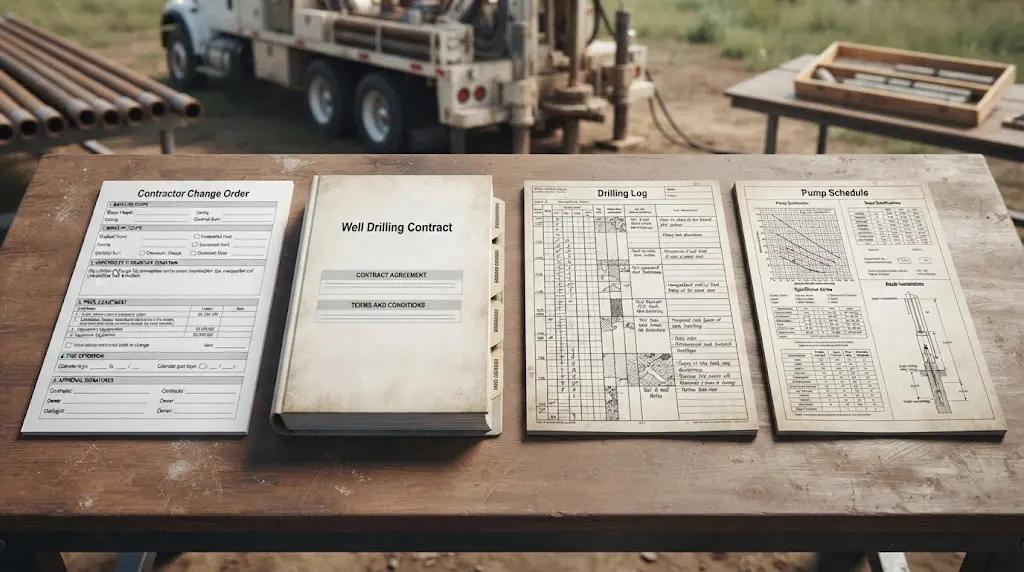
| Trigger | What to document before work continues | Possible change items | What not to assume |
|---|---|---|---|
| Additional depth | Contracted depth, actual depth, measured reason for continuing, formation log, water observation, owner instruction | Drilling per foot or hour, added casing, grout, development, testing, standby, disposal, schedule | More depth is automatically billable or guarantees more yield |
| Insufficient or unexpected yield | Test method, duration, pumping rate, drawdown, recovery, water level, contract performance language | Additional development, test pumping, rehabilitation, deeper drilling, second well, abandonment, engineering | A yield target is the same as a guaranteed result |
| Caving, unstable formation, lost circulation, obstruction | Depth, material, drilling method, fluid or tooling response, photos or samples, time stopped | Casing, cement or grout, tooling, fluid, standby, redrilling, altered method | The crew can simply continue and explain it on the invoice |
| Casing or screen change | Original diameter, material, wall thickness, screen interval, revised design, reason, approval | Added or substituted casing, screen, centralizers, gravel pack, seal, labor | A substitute is equal without checking design, permit, warranty, or price |
| Water quality or contamination concern | Observation, sample or test requested, responsible technical reviewer, stop-work direction | Isolation, additional seal, testing, treatment interface, disposal, delay | A field observation alone establishes a health result or liability |
| Pump or pressure-system change | Well data, pump curve or selected model, setting, pipe, wire, controls, tank, electrical scope, reason | Equipment difference, installation labor, electrical work, controls, testing, warranty, schedule | A larger pump fixes every low-flow or pressure complaint |
| Access, traffic, utility, or restoration issue | Site condition, access promise, utility mark, owner responsibility, photos, delay period | Extra mobilization, matting, traffic control, restoration, standby | Site inconvenience is a change if the contract already assigned it |
| Permit, inspection, discharge, or reporting change | Authority, written direction, required revision, affected work, deadline | Re-design, resubmittal, inspection, testing, delay, materials, reporting | A contract change overrides a regulator's requirement |
| Owner-requested addition or deletion | Written request, affected scope, consequence for completed work, decision maker | Added or deleted work, credit, rework, schedule, materials | A verbal request from any person binds the owner |
| Material substitution or unavailable equipment | Original item, availability record, proposed substitute, compatibility, warranty, price | Credit, substitution cost, delivery, redesign, testing | “Similar” means contract-compliant |
The NGWA public contractor handout is a useful reminder of what should be visible in the original contract: casing size and type, development and yield evaluation, screen, cap or seal, disinfection, cleanup, start date, workmanship, and itemized charges. It also names deeper drilling, a second well, abandonment, and exclusions as cost topics worth addressing. Read the NGWA handout.
This matters at change-order time because a detailed original scope gives you a better answer to “what changed?” If the original only says “complete water system,” the argument will drift toward memory and opinion. If it identifies the pump, setting, tank, casing, test, restoration, and exclusions, the delta is easier to see.
What should the template say?
The template should be short enough for an operator to use in the field and complete enough for the office to price, approve, invoice, and close. It should not bury the change inside a narrative email.
Use the form below as a starting point. Replace bracketed fields and attach the supporting records. If the governing contract requires a specific form, use this as the contractor's change-order request or backup schedule rather than a substitute.
Well drilling contract change order template
WELL DRILLING / PUMP CONTRACT CHANGE ORDER

Change Order No.: [CO-____]                 Date issued: [____]
Change Order request/no.: [____]            Effective date: [____]

PROJECT AND CONTRACT
Owner / contracting entity: [____________________________]
Contractor: [___________________________________________]
Project name / job number: [_____________________________]
Site address / parcel / well ID: [_______________________]
Original contract date: [________]  Notice to proceed: [________]
Original contract / proposal / work order no.: [_________]
Permit / authorization no. and authority: [______________]

AUTHORITY AND REASON
Requested by: [name, title, company]
Requested on: [date and time]
Requested by: [ ] owner  [ ] engineer  [ ] inspector
              [ ] contractor  [ ] regulator  [ ] emergency direction
Reason for change, check all that apply:
[ ] differing or unanticipated site condition
[ ] owner-requested addition or deletion
[ ] design, drawing, or specification revision
[ ] quantity overrun or underrun
[ ] material or equipment substitution
[ ] permit, inspection, discharge, or regulatory requirement
[ ] delay, access, utility, or weather effect
[ ] correction or rework
[ ] other: [____________________________________________]

1. ORIGINAL CONTRACT BASELINE
Contract section / drawing / proposal line / unit item: [________]
Original scope, quantity, unit, and price:
[___________________________________________________________]
Original material, method, equipment, or performance requirement:
[___________________________________________________________]
Original schedule or completion milestone affected:
[___________________________________________________________]
Original assumption, exclusion, allowance, or contingency involved:
[___________________________________________________________]

2. OBSERVED CONDITION OR REQUEST
Date and time observed or requested: [_______________________]
Location, station, depth, elevation, or component: [_________]
Observed by / requested by: [_______________________________]
Describe the condition or requested change factually:
[___________________________________________________________]
[___________________________________________________________]
Condition preserved before disturbance by:
[ ] photos  [ ] video  [ ] drilling log  [ ] sample
[ ] pump test  [ ] measurement  [ ] inspection report
[ ] owner / engineer direction  [ ] other: [______________]
Attachment names or file references: [_______________________]

3. CHANGE IN WORK
Delete from original scope:
[___________________________________________________________]
Add to original scope:
[___________________________________________________________]
Substitute or revise:
[___________________________________________________________]
Work already performed before authorization, if any, and why:
[___________________________________________________________]
Work to stop, protect, or continue under emergency direction:
[___________________________________________________________]

4. PRICE BASIS
Pricing method: [ ] existing unit rates  [ ] new unit rates
                [ ] lump sum  [ ] time and materials
                [ ] allowance adjustment  [ ] credit / deduction

| Item | Add / delete | Qty | Unit | Unit rate | Extension |
| [____] | [____] | [____] | [____] | $[____] | $[____] |
| [____] | [____] | [____] | [____] | $[____] | $[____] |
| [____] | [____] | [____] | [____] | $[____] | $[____] |

Added direct labor: $[________]
Added materials: $[________]
Added equipment / tooling: $[________]
Added subcontract / supplier: $[________]
Standby / remobilization / disposal / restoration: $[________]
Overhead and profit treatment: [contract section or agreed basis]
Credits / deleted work: $[________]
Net change to contract price:  $[________]
Original contract price:       $[________]
Previous approved changes:     $[________]
Revised contract price:        $[________]

5. TIME AND SCHEDULE
Original affected milestone / completion date: [____________]
Added days: [____]  Deducted days: [____]  No change: [ ]
Revised milestone / completion date: [______________________]
Cause of time change: [_____________________________________]
Schedule attachment or field record: [______________________]
Does the change affect mobilization, testing, inspection, or closeout?
[ ] no  [ ] yes: [________________________________________]

6. PERMIT, SAFETY, AND TECHNICAL CHECK
Permit or authorization affected? [ ] no  [ ] yes: [________]
Regulator / inspector contacted: [________] Date: [________]
Required submittal, inspection, test, or report: [_________]
Technical reviewer / engineer / licensed person: [_________]
Safety or environmental control required before work: [_____]
Pump, casing, screen, seal, electrical, or water-quality review:
[___________________________________________________________]

7. AUTHORIZATION
This change modifies the original contract only as described above.
All other contract terms remain unchanged unless listed here:
[___________________________________________________________]

Owner / authorized representative
Name: [________________] Title: [________________]
Signature: ______________________________ Date: [________]

Contractor / authorized representative
Name: [________________] Title: [________________]
Signature: ______________________________ Date: [________]

Engineer / inspector / regulator acknowledgment, if required
Name: [________________] Title: [________________]
Signature: ______________________________ Date: [________]

8. CLOSEOUT
Work completed on: [________]
Actual quantities and units: [_______________________________]
Final photos, logs, test data, delivery records, and invoices attached:
[___________________________________________________________]
Well log / completion report / as-built / warranty updated: [ ]
Change-order register updated by: [____________] Date: [____]
Final amount reconciled to invoice: [ ] yes  [ ] no
Open claim, reservation, or unresolved item: [______________]
The form uses separate sections for baseline, condition, delta, price, time, technical review, authorization, and closeout. That order is deliberate. It stops the common failure where an operator starts with a dollar figure before documenting the fact that made the figure necessary.

How should you write the original scope line?
Write the original scope so another person can identify the affected item without calling the estimator. Use measurable nouns, units, limits, and exclusions.
Weak:
Drill and complete a water well as needed.
Stronger:
Mobilize one rotary rig; drill the contracted borehole to the stated depth allowance; furnish and install the listed casing, seal, screen, development, disinfection, yield test, well record, and site cleanup; pump equipment is listed as a separate schedule item; exclusions are listed in Section [__].
The stronger version is still not a complete contract, but it gives the change-order reviewer somewhere to look. The goal is not to predict every geology outcome. The goal is to name the commercial boundary around the work.
For the document that frames the original submission before award, see Brictale's well contractor proposal cover letter template. A cover letter and a change order serve different moments, but both should point to one verified scope.
For each major item, capture:
- Quantity and unit, such as lineal foot, hour, each, lump sum, test, day, or mobilization.
- Material or equipment description, including the specification that matters.
- Included operations, such as setting, grouting, developing, testing, disinfection, removal, or cleanup.
- Assumption, allowance, exclusion, or contingency.
- Responsible party for permits, utilities, access, water supply, disposal, restoration, and inspections.
- Measurement or acceptance method.
- Required record, such as a log, test sheet, photo, receipt, delivery ticket, or completion report.
The EPA handbook specifically recommends a contract that is specific enough to avoid leaving necessary items to interpretation or imagination. It also says a pay-item system may reduce the need for changes by clarifying the procedures. Review the EPA recommendations.
How should you price a change order?
Price the change by the method already stated in the contract whenever that method applies. If it does not apply, state the new basis and attach enough detail that the owner can see how the total was built.
Use an existing unit rate when the unit still means the same thing
If the contract says drilling is priced per lineal foot and the change is additional drilling under the same method, formation assumption, equipment setup, and contract conditions, the existing unit rate may be the cleanest starting point.
Show:
added quantity × contracted unit rate = extension
Then list associated items separately. Extra depth may also affect casing, grout, development, testing, disposal, mobilization, standby, or schedule. Do not hide those items inside a new depth rate unless the parties agree that the new rate includes them.
Use a new unit rate when the work has materially changed
A new unit rate may be appropriate when the method, material, equipment, access, or risk is different enough that the original rate no longer measures the work. Explain why. “Different rate requested” is not a reason.
Show the new unit, quantity, labor, material, equipment, supplier, and any overhead or profit treatment required by the contract. If the work is uncertain, use a not-to-exceed authorization only if the contract and parties permit it, and state what happens when the limit is reached.
Use a lump sum when the changed scope is defined
A lump sum works when the changed work can be described and priced without leaving the owner to guess what is included. List the deliverables and exclusions. For example, a pump-system change might include a named pump, controls, pipe, wire, installation, startup, and test, while excluding electrical service upgrades by others.
Use time and materials when the quantity cannot be known
Time and materials can fit emergency protection, exploratory work, standby, obstruction removal, or other work where the final quantity depends on field conditions. It needs a rate schedule and a record process.
Define:
- Labor classifications and hourly rates.
- Equipment and tooling rates.
- Material markup or handling method.
- Subcontractor documentation.
- Travel, mobilization, demobilization, and standby treatment.
- Daily time sheets and approval process.
- Cost cap, if any.
- When the parties will convert the work to a fixed price or close it.
FAR 43.204 distinguishes a change order from later documentation of the equitable adjustment when the price or delivery terms were not settled in advance. A private contractor should not import federal procedure blindly, but the cost-control lesson is practical: preserve the directive and the later price agreement as linked records when the final number is not known on day one. See FAR 43.204.
Show credits as carefully as additions
A deletion is not just “minus something.” State what will no longer be furnished, installed, tested, restored, or warranted. If the owner supplies a component, state who owns compatibility, storage, delivery, installation, and warranty risk.
If the change removes an original item but adds a substitute, show both lines. That makes the net change visible and protects the invoice from looking like a new full charge.
Do not invent a rate in the form
The article cannot responsibly give a national drilling, casing, pump, or mobilization price. Rates vary by formation, territory, rig, labor, equipment, materials, contract structure, access, disposal, and state requirements. Put the company's verified rates or an agreed lump sum in the blank fields, then keep the backup calculation with the job file.


How should you document a differing subsurface condition?
Send prompt written notice before the condition is disturbed, identify the original baseline, preserve the evidence, and wait for direction when the contract requires it. If immediate action is necessary for safety or environmental protection, follow the emergency clause and document why the normal sequence could not happen.
The federal FAR differing-site-conditions clause is explicit about the sequence: written notice should be given promptly and before the condition is disturbed, and a written contract modification follows when the condition changes cost or time. That clause applies to the federal contracts in which it is incorporated. It is a strong model for a private contractor's field discipline, not a claim that the same deadline applies to every private job. Read FAR 52.236-2.
The Borehole Change Order Control procedure
Use this five-stage procedure in the field and office.
- Pause the commercial assumption. Keep people safe and protect the work, but do not let the crew silently treat a changed condition as included. Mark the exact depth, location, component, and time.
- Preserve the condition. Take photos or video, record measurements, save samples when appropriate, update the drilling log, identify the tooling and method, and record who observed it. Do this before caving, grouting, backfilling, moving equipment, or changing the pump setup if the condition may disappear.
- Send a written notice. State the original contract item, the observed condition, the immediate protection taken, and the decision needed. A text message may be useful for speed, but put the notice in the job file and send it through the contract's required channel.
- Build the delta. Separate the work that is added, deleted, substituted, delayed, or re-performed. Price each line. State the time effect and any permit, inspection, test, or engineering step.
- Authorize, perform, and close. Obtain the required signature or written direction. Update the schedule and change-order register. Then attach actual quantities, logs, test data, invoices, photos, and completion records.
The point of the sequence is simple. By the time the condition is invisible, the dispute has already become harder to solve.
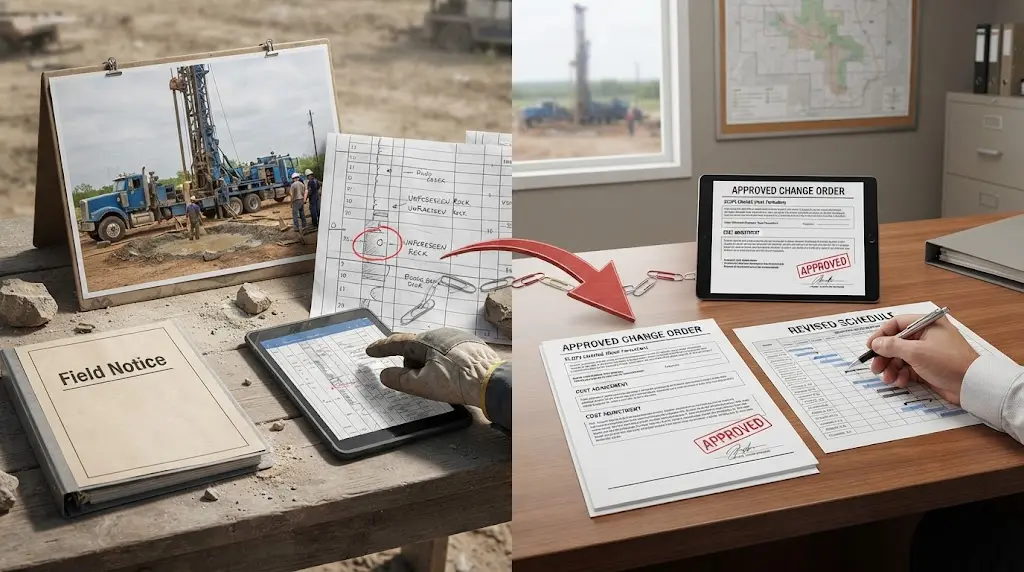

If the condition can be disturbed, document it before you disturb it.
A field notice example
This is a hypothetical example of format, not a claim about a real job:
At 2:40 p.m. on [date], drilling reached [depth] at [well ID]. The crew encountered [factual observation], which differs from the contract assumption in [proposal line or specification]. Work paused at the affected operation. The condition is recorded in drilling log [reference] and photos [references]. We request direction on [options]. Potential cost and time effects are listed as preliminary only and will be priced after the selected option is confirmed.
That notice does not overclaim. It does not call the formation “unforeseen” before comparing it with the contract. It does not promise a particular yield. It does not bury a request for more money in a vague sentence about difficulty.
How should you handle depth, yield, and second-well decisions?
Separate the technical outcome from the commercial authorization. More drilling may be a possible response to a low-yield result, but it is not automatically the correct response and it is not automatically included.
Additional depth
The change order should state:
- Contracted depth or depth allowance.
- Actual depth at the decision point.
- The reason additional depth is proposed.
- Whether the owner requested a target, the contract used a unit rate, or the contractor has a right to stop or propose options.
- Added depth quantity and rate.
- Added casing, seal, development, testing, disposal, or restoration.
- Effect on pump setting, water line, electrical work, and schedule.
- Whether a revised permit, inspection, or technical approval is needed.
Avoid writing “drill until water is found.” That sentence carries no measurable endpoint, cost control, or decision authority. Use options instead:
| Option | Decision the owner or authorized reviewer makes | Commercial record |
|---|---|---|
| Stop and complete at current condition | Accept the result under the contract's performance terms | Completion record, test data, credit or no-change statement |
| Continue to a stated depth or quantity | Authorize a defined additional scope | Per-foot or per-hour change, limits, time, and tests |
| Change method or design | Approve a revised technical approach | New materials, method, technical review, price, and permit check |
| Abandon or relocate | Stop current work and define next work | Abandonment, restoration, second mobilization, new well or proposal |
The EPA water-well manual includes contract provisions for test holes and test wells and discusses how a contractor may determine whether a final well can be completed to the contract's intent. That is historical contract language, not a universal rule, but it shows why the contract should state what happens if the planned completion cannot be achieved. See the EPA manual.
Yield or water-quality result
Record the test method before arguing about the result. At minimum, the job file should identify the test date, pumping rate, duration, drawdown or water-level observations, recovery observations, equipment used, sample or laboratory record where relevant, and the contract's stated acceptance or reporting method.
Do not turn a measured result into a guarantee that the contract never made. The change-order question is narrower: what additional work, if any, did the parties authorize after the result?
Second well or abandonment
A second well is usually a large enough scope change to require more than a line added to an invoice. It can change site selection, permit work, mobilization, access, restoration, schedule, testing, and customer expectations. Use a new change order only when the original agreement clearly allows the second well as a controlled option. Otherwise, prepare a new proposal or amendment.
Abandonment also deserves its own line. Identify who performs it, which standard or authority governs, what materials and records are required, what restoration is included, and whether the original work receives a credit. Do not assume a failed well disappears from the job file because the productive well was never completed.
How should a pump change be documented?
A pump change is not just an equipment substitution. It can alter the hydraulic design, setting, controls, wire, pipe, tank, electrical scope, startup, test, warranty, and schedule.
Use a component map:
| Component | Original contract record | Revised record | Check before approval |
|---|---|---|---|
| Pump | Model, capacity, setting, included installation | Model, capacity, setting, reason | Measured well data, pump selection, warranty |
| Drop pipe or discharge | Material, diameter, length, fittings | Revised material, diameter, length | Compatibility, friction, installation method |
| Wire and controls | Wire, control box, disconnect, protection | Revised electrical components | Electrical scope, code, licensed trade where required |
| Pressure system | Tank, switch, controls, pressure range | Revised tank or constant-pressure components | System design, space, startup and test |
| Wellhead and seal | Cap, seal, pitless adapter, sanitary detail | Revised headworks | Well standard, inspection, access, drainage |
| Testing and startup | Included test or commissioning | Revised test, acceptance, documentation | Who witnesses, what result is recorded |
| Warranty and service | Original warranty and responsible party | Revised warranty and exclusions | Written manufacturer and installer terms |
The change order should state whether the revised pump is owner-selected, contractor-recommended, required by measured conditions, unavailable from the supplier, or required by a regulator or engineer. Those are different commercial stories.
It should also state what happens to the original equipment. Is it canceled before delivery, returned with a restocking cost, stored, credited, or installed elsewhere? Keep the answer in the form.
A pump recommendation can change the equipment scope without changing the drilling scope.
That distinction protects both sides. A pump change should not quietly reopen a completed drilling price, and a drilling change should not quietly include a new electrical or pressure-system design.
What permit and regulatory checks belong in the form?
The permit check should be a field, not a footnote. A signed change order cannot waive a regulator's requirement.
Requirements differ across the United States. California's Department of Water Resources says well construction, alteration, and destruction are subject to well standards and local enforcing agencies, and its pages describe permitting, inspections, and completion reports. California also requires a completion report within 60 days for covered well construction, alteration, or destruction. Those are California requirements, not a national deadline. Review California's well standards and completion-report page.
For any change, ask:
- Does it change the well's depth, diameter, casing, screen, seal, use, location, or construction method?
- Does it change the pump capacity, water withdrawal, discharge, electrical service, or public-water interface?
- Does it trigger an inspection, revised permit, notice, engineering review, laboratory test, or completion report?
- Does it affect environmental, safety, traffic, utility, or disposal controls?
- Does the contract require written direction from an engineer, owner representative, or public contracting officer?
- Does the company's license or subcontractor scope cover the revised work?
Record the name of the authority or reviewer, the date contacted, the direction received, and the attachment. If no permit or review is required, write who checked and on what basis. “No permit impact” is a conclusion that should have an owner.
Who can approve the change?
The person who notices a change is not necessarily the person who can authorize money. The estimator who prices it is not necessarily the person who can change a public contract. The owner who asks for a different pump may not have authority to bind a commercial property owner.
Build an authority list before mobilization:
| Role | Can observe or request | Can direct field protection | Can approve price | Can approve time | Record to keep |
|---|---|---|---|---|---|
| Driller or crew lead | Yes | Under safety or contract rules | Usually no | Usually no | Field note, log, photo |
| Project manager | Yes | If delegated | If delegated | If delegated | Change request, pricing backup |
| Owner representative | Yes | If contract allows | Per contract | Per contract | Written direction, signature |
| Engineer or inspector | Yes | Per contract | Often recommendation only | Often recommendation only | Field order, inspection, recommendation |
| Regulator | Regulatory direction | Regulatory direction | No private price authority | Regulatory schedule only | Permit or written instruction |
| Company owner or authorized officer | Yes | Yes | Per company and contract | Per company and contract | Executed change and register |
For a public job, the named contracting officer or delegated official may be the only person who can issue a contract modification. FAR 43.202 says change orders are issued by the contracting officer except where authority is delegated. A private contractor should read its own agreement for the equivalent rule. See the federal authority provision and the contract-specific documents first.
Do not let a crew text, “Customer said go ahead,” become the only evidence for a high-value addition. Send the exact scope and price to the authorized person, state whether the direction is approval or a request to prepare a proposal, and save the response.
What should you attach to a change order?
Attach evidence that lets a person who was not on the rig understand the event. The record should be concise, labeled, and tied to the form number.
Recommended attachments:
- Original scope excerpt or contract line.
- Field notice or change request.
- Photos or video with date, location, depth, and direction where possible.
- Drilling log, sample record, water-level measurement, pump test, or inspection note.
- Revised sketch, design, equipment schedule, or specification.
- Supplier quote, delivery record, return fee, or material substitution record.
- Labor, equipment, standby, remobilization, disposal, or subcontract backup.
- Permit, inspector, engineer, or regulator correspondence.
- Revised schedule or milestone notice.
- Completion evidence, actual quantities, test records, and final invoice reconciliation.
Caltrans asks change-order requests to document the need for the change and provide enough information to show that the request meets policy. Its review questions include whether the change is necessary to complete the work contemplated, its overall effect, available funds, and contract-time impact. That is public-agency procedure, but it is a useful office checklist for any contractor. Read the Caltrans guidance.
Name files consistently:
[job-number]-[CO-number]-[date]-[record-type]-[short-description]
For example:
2417-CO-03-2026-08-20-drilling-log-caving-at-480ft.pdf
Do not overwrite the original photo, estimate, or proposal. A change record is stronger when the history remains visible.
How should you run the approval workflow?
The workflow should be fast enough for field work and strict enough to protect the margin. Use one owner for the record.
Before mobilization
- Put the change clause, notice method, unit rates, allowances, emergency language, and authority list in the job packet.
- Separate drilling, casing, screen, development, test, pump, electrical, restoration, permit, and cleanup items.
- Mark which quantities are estimates and which are fixed limits.
- Write the stop or decision points for depth, yield, obstruction, water quality, pump selection, and access.
- Tell the crew which facts must be recorded before the condition changes.
At the field event
- Record the date, time, depth, location, equipment, and observed condition.
- Protect people, property, groundwater, and the work.
- Take photos and update the log before continuing where practical.
- Contact the project manager and authorized decision maker.
- Send a notice even if the price is not yet known.
In the office
- Locate the original contract item and assumption.
- Classify the event as clarification, notice, change, correction, or new scope.
- Confirm the permit and technical review path.
- Build the price with quantities, units, rates, credits, and backup.
- State the schedule effect and revised milestone.
- Send the request with a response deadline tied to the field decision.
At approval
- Make the exact change visible.
- State what remains unchanged.
- Identify the effective date.
- Obtain the required signature or written direction.
- Issue the approved version to the field, office, billing, and project file.
At completion
- Measure actual quantities.
- Attach final logs, photos, tests, deliveries, and invoices.
- Update the well log, completion report, as-built, warranty, and customer handoff when affected.
- Update the change-order register.
- Reconcile the contract sum and open claims.
Do not wait until monthly billing to discover that three different versions of CO-02 exist in text messages, an estimate app, and the accounting system. Use one number, one final file, and one register entry.
What should the change-order register track?
The register is the control panel for the job. It lets the owner see whether changes are pending, approved, performed, billed, or still exposed.
| CO no. | Event date | Description | Requested by | Status | Price delta | Time delta | Permit check | Approved date | Billed / closed |
|---|---|---|---|---|---|---|---|---|---|
| CO-01 | [date] | [short description] | [name] | [notice / priced / approved / performed / closed] | $[ ] | [ ] days | [owner] | [date] | [yes / no] |
| CO-02 | [date] | [short description] | [name] | [notice / priced / approved / performed / closed] | $[ ] | [ ] days | [owner] | [date] | [yes / no] |
| CO-03 | [date] | [short description] | [name] | [notice / priced / approved / performed / closed] | $[ ] | [ ] days | [owner] | [date] | [yes / no] |
Add fields for:
- Original contract sum.
- Approved changes to date.
- Pending exposure.
- Credits to date.
- Revised contract sum.
- Amount invoiced and collected.
- Open reservation or claim.
- Person responsible for the next action.
The register should not become a second accounting system. Its job is to show the relationship between the operational event and the contract. Link each row to the final form and supporting folder.
Every price change needs a unit, a quantity, and a reason.
What does a complete hypothetical change look like?
Consider a hypothetical job with a signed scope for a well, casing, development, testing, and a separate pump package. The contract contains a unit price for additional drilling but does not say that added depth includes additional casing, development, or testing.
At the contracted decision depth, the driller records a formation that will not support the planned completion method. The crew pauses the affected operation, records the depth and material, takes photos, updates the log, and sends a written notice. The project manager compares the condition with the original assumption and asks the authorized owner representative to choose between stopping, continuing to a defined depth, or changing the completion method.
The contractor prepares three options:
| Option | Scope | Price fields | Time fields | Decision evidence |
|---|---|---|---|---|
| A | Stop and complete current work | Credit or no change, completion and test records | No change or revised test date | Current depth, test, acceptance terms |
| B | Continue drilling and add casing | Additional feet, casing, grout, development, test, standby | Added drilling and test days | Formation log, method, selected depth |
| C | Change completion method | Deleted original item, revised material and method, technical review | New delivery and installation date | Revised design, compatibility, permit check |
The owner chooses Option B. The change order identifies the original contract line, the observed condition, the selected added scope, the unit rates, the time extension, the permit check, and the signatures. The crew receives the approved version. At completion, the actual depth and material quantities replace estimates in the closeout section, and the invoice references CO-04.
Nothing in this example proves that the contractor is entitled to payment. The entitlement depends on the actual contract and rules. The example shows the record sequence that makes the issue reviewable.
The same pattern applies to a pump change. If the well test shows that the originally listed pump package is not the selected configuration, the form should show the original equipment, revised equipment, reason, compatibility check, price delta, electrical or control effect, warranty, and authorization. It should not simply show “upgrade pump” on an invoice.
What mistakes create the most change-order risk?
Most problems are process failures, not dramatic legal theories. The team knew something changed but did not preserve the baseline, authority, or measurement.
Mistake 1: Calling every extra a change order
Some work is already included. Some work is a correction. Some work is a new project. Calling everything an extra damages credibility and makes the real changes harder to approve.
Compare the requested work with the exact contract item before pricing.
Mistake 2: Waiting until the invoice
The invoice is too late for conditions that were visible on the rig. A late explanation can still be useful, but it is weaker than a contemporaneous notice, measurement, and authorized decision.
Mistake 3: Recording only the dollar amount
“Add $____ for difficult drilling” does not tell the owner what the money buys. State the trigger, work, unit, quantity, rate, time, and attachments.
Mistake 4: Using a verbal authorization from the wrong person
The person at the site may have authority to choose a location but not to add cost. The owner may have authority over a private job but not a public contract. Build the authority path into the job packet.
Mistake 5: Treating a unit rate as a complete answer
An additional foot of drilling may require casing, grout, development, testing, standby, disposal, or restoration. State what the unit includes and list other affected items.
Mistake 6: Turning a technical recommendation into a guaranteed result
Drilling deeper, changing a screen, or selecting a larger pump can be a reasoned option. It is not a promise of water quantity, pressure, or quality unless the contract actually contains that promise and the contractor can stand behind it.
Mistake 7: Ignoring permits and reports
A commercial agreement cannot make an unapproved construction method acceptable. Check the authority, record the result, and update required well records.
Mistake 8: Forgetting deleted work
If the owner removes an item, show the credit, the work no longer included, and any cost already incurred. Otherwise the final contract sum becomes hard to audit.
Mistake 9: Leaving the form open after the work is done
An approved estimate is not a closeout. Reconcile actual quantity, equipment, time, tests, invoice, warranty, and well records.
Mistake 10: Copying a public form without reading the private contract
Public-agency forms may include authority, funding, bonding, schedule, and notice rules that do not fit a private job. Use their structure as a checklist. Use the signed agreement as the governing source.
When should you not use this template as-is?
Do not use the template unchanged in five situations.
- The contract names a mandatory form. Use the contract form and attach the template as backup only if allowed.
- The job is a federal, state, municipal, or utility contract. Follow the named contracting officer, engineer, inspector, notice channel, change clause, funding, bond, and record requirements.
- The change affects regulated well construction or water withdrawal. Get the required permit, inspection, engineering, or agency direction before treating the commercial approval as enough.
- The proposed work is outside the original contract's purpose. Use a new proposal, amendment, or contract when the new work is not a modification of the original job.
- The dispute is material or adversarial. Preserve the records and ask qualified construction counsel to review entitlement, notice, payment, lien, warranty, and damages issues.
The template is most useful as a disciplined operating layer. It is not a substitute for contract drafting or legal review.
How can a well company make the process easier before the next job?
Build the system into estimating and dispatch. Separate likely change points in the schedule of values: mobilization, access, drilling, casing, screen, grout, development, testing, pump equipment, electrical work, restoration, standby, disposal, permits, and reporting.
Put stop points in the work order for the contracted depth, an altered formation, yield or water-quality results, a different pump, blocked access, a regulator instruction, and any work that will soon be buried or made unobservable. Each stop point needs an authorized contact and a record requirement.
Give the first person who sees the condition a field card with the job number, contract number, contacts, stop points, photo and log rules, emergency protection rule, notice channel, and one instruction: do not promise a price.
After several jobs, review the register for recurring depth changes, weak assumptions, late permit discoveries, slow approvals, unbilled work, credits, and warranty questions. Use that evidence to improve estimates and scope language.
If the register shows that jobs are being won faster than crews, rigs, or office capacity can absorb them, connect the findings to well drilling contractor capacity planning before adding more demand.
What should an owner or operator check before signing?
Use this short review before approval:
- I can point to the original contract item.
- The observed condition or request is dated and located.
- The record shows what was known before disturbance.
- Added, deleted, and substituted work are separated.
- Quantities and units are visible.
- Rates or lump sum basis are explained.
- Credits are included.
- The revised contract sum is calculated.
- The time effect and milestone are stated.
- Permit, inspection, engineering, safety, and reporting effects are checked.
- The person signing has authority.
- The work to be performed is clear to the crew.
- The invoice, well record, warranty, and closeout file will reference the same change number.
If any answer is no, the document is not ready. It may still be ready as a notice or request for direction, but do not call a partially known price final.
What is the practical verdict?
Use the template when the signed well or pump contract no longer describes the work the team is being asked to perform. Start with the baseline. Preserve the condition. Price the delta. Check the permit path. Obtain authority. Close the record.
Do not promise that a form will win every payment dispute. A good form gives the dispute fewer facts to argue about, and it gives the owner a clear decision before the crew buries the evidence in the ground.
Before the next mobilization, adapt the blank fields to your contract, state, service mix, rates, permits, and approval chain. Then make the form part of the job packet, not an emergency document found after the invoice is challenged. If the same operating gaps are also limiting qualified calls or booked work, Brictale's free territory audit is the practical next step.