Bad dispatches usually begin as vague promises made during a rushed phone call.
The caller says the well is not working. The office hears emergency. The crew drives out and finds a pump replacement request outside the service area, a locked gate, a road the rig cannot use, or a project that needs a different license and permit path. The cost is not only fuel. It is a lost slot for work the company could have accepted.
The fix is a short operating decision before dispatch. You need enough information to know what the company does, where the work is, what the caller observed, what should happen next, and whether the right crew can do it safely. You do not need a perfect diagnosis on the first call.
A qualified lead is not the same thing as a dispatchable lead.
What does it mean to qualify a well drilling lead before dispatching?
Qualifying a well drilling lead means deciding whether an inquiry fits your service, territory, operating conditions, and next available action before committing field time. The result can be a dispatch, a scheduled estimate, a remote triage step, a hold for information, a referral, or a decline.
That definition matters because “qualified” is often used to mean three different things:
- Fit: the inquiry concerns work your company performs for a customer you serve.
- Readiness: the caller can take the next step and has supplied enough information to begin it.
- Dispatchability: your company can send the correct person and equipment to that location within a credible operating window.
A new well project may have strong fit but no dispatchable next step until the site, access, permitting path, and project stage are clear. A no-water call may have high urgency but still need a pump technician rather than a drilling crew. A commercial inquiry may be inside the territory but require a proposal, insurance documentation, or a different scheduling path.
The office should record those distinctions. Otherwise, the owner sees “twenty leads,” the dispatcher sees interruptions, and the field team sees a list of visits that should never have been placed on the calendar.
The National Ground Water Association’s public contractor guidance gives a useful picture of why well work needs more than a generic home-service intake. It discusses licensing, insurance, written contracts, scope, timing, and cost components for well construction. Those are not all first-call questions, but they show the kind of project detail that may matter before an estimate or production commitment. National Ground Water Association, How to Hire a Water Well Contractor
Which decision should the dispatcher make first?
The first decision is not “Is this a good lead?” It is “What is the safest and most useful next action?” Use the Dispatchable Lead Gate to make that decision in order.
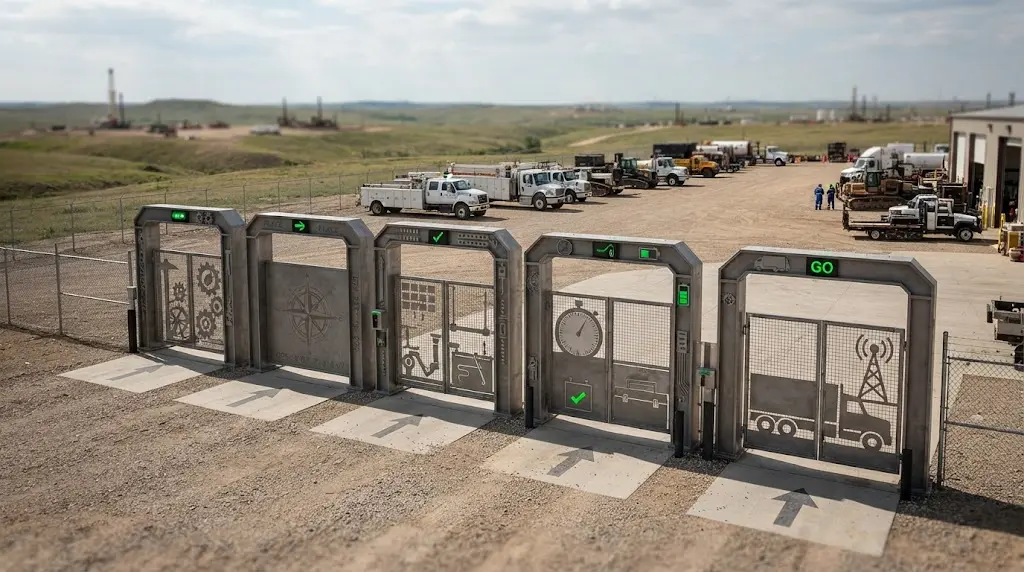
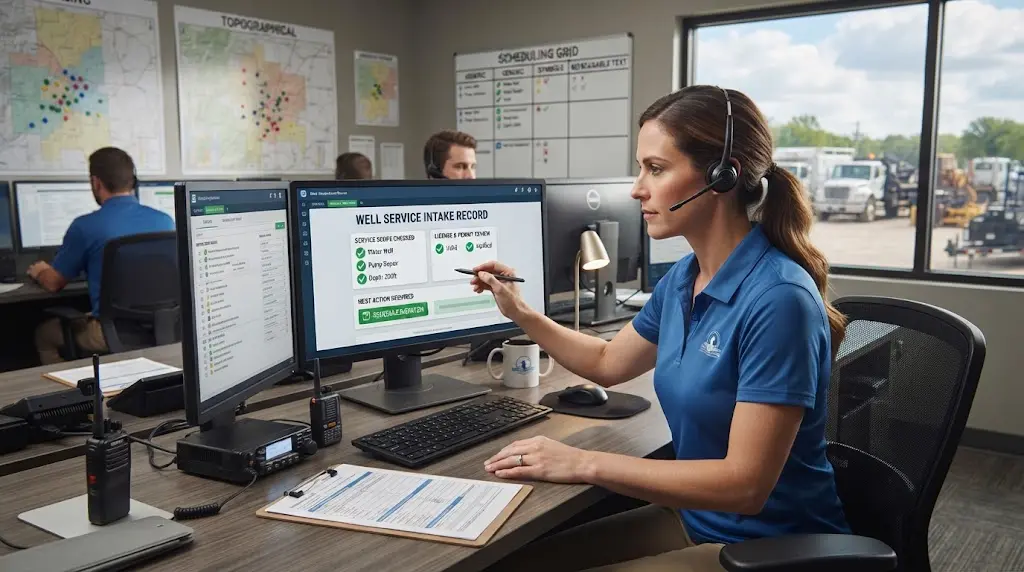
The framework is a Brictale operating recommendation, not an industry standard and not a legal test. Its purpose is to keep an office from skipping the questions that protect service quality and crew time.
| Gate | What you need to know | If clear | If unclear | If no |
|---|---|---|---|---|
| Fit | Do we perform this work for this type of customer or property? | Continue intake. | Route to an estimator or technical review. | Refer or decline. |
| Place | Is the address serviceable with the required travel, route, and access? | Continue intake. | Request a pin, photos, route details, or site review. | Decline or refer. |
| Condition | What did the caller observe, how urgent is it, and are there known hazards? | Choose the correct queue. | Use remote triage or a qualified review. | Escalate, stop, or refer before dispatch. |
| Readiness | Can the caller authorize access and take the next step at a realistic time? | Offer the next appointment or estimate. | Hold with a named follow-up. | Do not reserve scarce field capacity. |
| Dispatchability | Is the right crew, equipment, time window, and pre-work requirement available? | Confirm dispatch. | Schedule the right first step later. | Do not promise a visit the operation cannot support. |
This sequence prevents a common mistake: letting a dramatic symptom jump past a hard service or safety mismatch. It also prevents the opposite mistake, where an office rejects a potentially good job simply because the caller cannot identify the pump model or explain the geology.
The gates should produce one of six outcomes:
- Dispatch: the correct field resource can be sent under the company’s normal safety and scheduling process.
- Schedule estimate or site review: the opportunity fits, but scope or site facts are not ready for production work.
- Remote triage: a qualified person can gather more information or identify the right service path without a full visit.
- Hold: the job may fit, but a named missing fact blocks the next action.
- Refer: the inquiry is legitimate but outside your service, territory, licensing, or equipment fit.
- Decline: the request is not a serviceable opportunity or cannot be accepted under your operating rules.
Use those labels in the CRM, call log, or dispatch board. “Bad lead” is not a useful operational reason. “Outside pump-repair territory,” “new well project needs site review,” and “unsafe access pending route check” tell the owner what to fix or leave alone.
How should you pass the service-fit gate?
Confirm the exact service line before discussing a field appointment. A company cannot qualify a lead against a vague promise to handle “anything with water.”
Start with a plain question:
“What are you hoping we can do for you?”
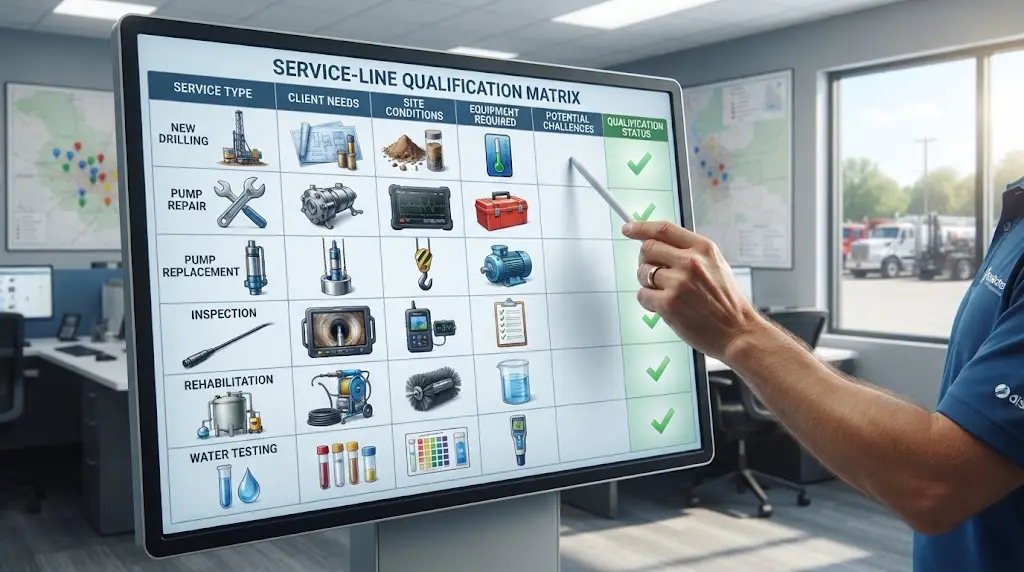
Then translate the answer into the closest internal service category. Common categories include:
- new residential well drilling;
- commercial or agricultural well drilling;
- pump repair or diagnosis;
- pump replacement or installation;
- pressure tank or pressure switch work;
- well rehabilitation or redevelopment;
- well inspection or flow testing;
- water testing coordination;
- abandonment or plugging;
- water treatment or filtration; and
- work for another contractor, developer, municipality, or property manager.
The caller’s words matter more than the label. “The well is dead” might mean a failed submersible pump, a tripped breaker, a pressure problem, a dry-season yield concern, a frozen line, or a new-property due-diligence question. The office should record what was observed, then route the job to the right technical path.
What service-fit questions belong in the first conversation?
Ask only questions that can change the next action. A useful first pass is:
- What service or outcome are you calling about?
- Is this a new project, a repair, a replacement, an inspection, or an existing job?
- Is the customer residential, agricultural, commercial, municipal, or another contractor?
- Is there an existing well or pump on site?
- What happened, or what are you trying to accomplish?
- Has another company already inspected or diagnosed it?
- Is there a deadline tied to a closing, tenant, crop, construction schedule, or loss of water?
Do not turn the intake person into a driller. The purpose is routing, not remote diagnosis. If the caller says “no water,” capture the observation. Do not promise that the pump is bad, that the well needs to be drilled deeper, or that a repair will solve the problem before the company’s qualified person evaluates it.
How should licensing and scope affect the fit decision?
Treat licensing and permit capability as a check before accepting work, not as a detail to discover after a crew arrives. Requirements vary by state and by the type of work. Iowa, for example, lists separate certification areas for general fundamentals, well drilling, pump installation, and well plugging. That is a state example, not a national rule, but it illustrates why “we do wells” is too broad for an internal service matrix. Iowa Department of Natural Resources, Well Contractor Certification
Your intake record should therefore include:
- the service category;
- the state and local jurisdiction;
- whether a permit or notification may be involved;
- the license or certification scope your company uses for the work;
- whether a subcontractor or partner would be required; and
- the person responsible for confirming the regulatory path.
The dispatcher does not need to give legal advice. The dispatcher does need to stop a vague promise from becoming a field commitment.
How should you pass the territory and place gate?
Confirm the job address early, then separate marketing territory from dispatch territory. Google says a Business Profile service area helps customers know where the business can provide products or services and recommends specific, accurate areas. Google also says local results are mainly based on relevance, distance, and prominence. Those statements describe discovery, not your profit model. Your company still has to decide whether the address works for the crew, route, equipment, and schedule. Google Business Profile Help, Manage your service areas Google Business Profile Help, local ranking tips
Ask for the service address, not only the caller’s mailing address. If the caller is a builder, property manager, or contractor, the job location may be different from the office location. If the address is not known, ask for the nearest road, county, parcel, or a map pin and mark the lead as a place-information hold.
What location facts change the dispatch decision?
The address is the beginning. For well work, the following details can change the right vehicle, crew, or next step:
- county and state;
- distance from the company’s normal operating base;
- whether the location is a residence, farm, commercial site, subdivision, or active construction project;
- road surface and recent weather conditions;
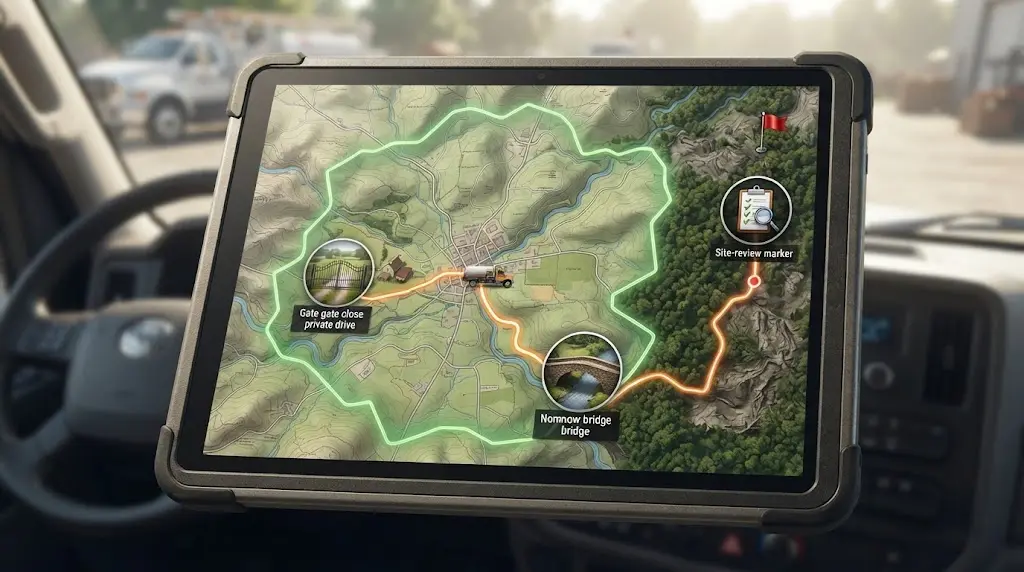
- gate, bridge, culvert, driveway, grade, and turning space;
- whether a rig, trailer, service truck, or crane can reach the work area;
- overhead lines, buried services, or other visible site constraints;
- whether the customer can provide access during the proposed window;
- whether the wellhead or pump equipment is visible and reachable;
- whether the site is occupied, leased, under construction, or controlled by another party; and
- whether a previous contractor left records, materials, or an unfinished excavation.
You do not need every answer for every call. You do need to know which missing answer blocks the next action.
OSHA’s rig-transport and rigging-up guidance identifies unstable or slippery conditions, fixed objects, electrical service lines, and vehicle incidents as potential hazards. It recommends inspecting the route in advance for adequate vehicle access and surface conditions. That supports a simple operating rule: if a heavy-equipment route is uncertain, schedule a route or site review instead of promising that a rig can arrive. OSHA, Transporting Rig and Rigging Up
An address is not proof that the job is accessible.
Should service area be a radius, a list of towns, or a dispatch rule?
Use three different records:
- Public service area: the towns, counties, or places you honestly serve and can represent accurately.
- Economic territory: the area where the service line usually makes sense after travel, equipment, and schedule constraints.
- Job-specific acceptance: the final decision for this address, route, access condition, and date.
Google’s current guidance says a service area cannot be set as a radius in the Business Profile interface and says the overall area generally should not extend beyond about two hours of driving time from the business base, with exceptions for some businesses. Treat that as a platform guideline, not as permission to accept every job inside two hours. Google Business Profile Help, Manage your service areas
If your marketing lists a huge region but the dispatcher declines half of it, the answer is not to hide the declines. Review whether the public service information, page targeting, campaign settings, or intake routing is attracting work the company does not want. Google’s business-profile rules also require accurate representation of the real business and service area. Google Business Profile Help, Guidelines for representing your business
How should you handle the condition and urgency gate?
Ask what the caller observed, how urgent the operational consequence is, and whether anyone or anything is in immediate danger. Do not confuse urgency with a guaranteed emergency service promise.
Use three labels:
- Emergency escalation: an approved danger or severe loss-of-service condition that follows your company’s emergency procedure.
- Priority service: an active problem that needs prompt review but does not justify an unsafe or impossible promise.
- Planned work: a new project, replacement, inspection, upgrade, or non-urgent issue that can follow the normal estimate and scheduling process.
The office should know what each label means in your company. If “emergency” simply means the caller sounds worried, the queue will fill with inconsistent promises. If “emergency” means any no-water call, the company may still need to distinguish an occupied medical facility from a vacant seasonal property. The purpose of the label is to select the next action, not to dramatize the call.
What should the caller be asked about a pump problem?
Ask for observations in everyday language:
- Is there no water, low pressure, intermittent pressure, or a visible leak?
- Is the issue at every fixture or only one location?
- When did it start?
- Is the pump running continuously, cycling, making noise, or silent?
- Is there power at the property, and has anyone already checked the breaker or control box?
- Is water present near electrical equipment?
- Is there flooding, an open excavation, exposed wiring, a gas odor, or another immediate hazard?
- Has someone already changed a switch, opened equipment, or attempted a repair?
- Is the site occupied, and does the loss of water affect livestock, tenants, a business, or a construction schedule?
Do not give the caller a test that could expose them to electrical or mechanical danger. The dispatcher can record what the caller saw and send the question to a qualified technician. The office should also avoid turning “no water” into a pump-replacement promise. A pump, pressure system, power supply, well yield, line, or control component may be involved.
The EPA’s private-well guidance illustrates why water-related calls can require different workflows. EPA says testing and treatment decisions depend on the test result, the contaminant, and the well condition, and it points readers to certified laboratories for drinking-water testing. That does not tell a contractor how to dispatch a job, but it does support routing a water-quality request differently from a mechanical pump failure. US EPA, Protect Your Home’s Water
What should the caller be asked about a new well project?
New drilling leads need project questions rather than pump-symptom questions. Ask:
- What is the intended use: residential supply, agricultural use, commercial use, irrigation, monitoring, or another purpose?
- Is the property already owned, under contract, or being evaluated?
- What is the site address and jurisdiction?
- Is there an existing permit, well record, soil or site information, or prior proposal?
- What has already been decided about the well location or water need?
- Is the caller asking for a feasibility conversation, a site visit, a proposal, or a scheduled drilling date?
- Who else must approve the work?
- Is there a construction, closing, occupancy, agricultural, or other timing requirement?
- What access is available for the rig and support equipment?
- Are there known overhead lines, buried utilities, wetlands, steep grades, narrow bridges, or restricted gates?
These questions do not promise a yield, depth, date, or outcome. They help the company determine whether it is talking about an initial review, a proposal, a permit-related step, or production work.
How should the readiness gate work without rejecting good leads?
Readiness means the caller can take the next step, not that the caller knows every technical answer or has already chosen your company. Keep the gate practical.
Check four kinds of readiness:
| Readiness area | What to confirm | What it changes |
|---|---|---|
| Authority | Is the caller the owner, property manager, builder, general contractor, or another authorized contact? | Who must receive the proposal, approve access, or attend the site review. |
| Information | Do you have the service address, observed need, and enough context for the next person? | Whether to schedule, hold, or request records/photos. |
| Timing | Is the requested date a preference, a hard deadline, or an emergency consequence? | Queue priority and the promise the office can safely make. |
| Commitment | Is the caller willing to schedule the appropriate next step, provide access, or continue the review? | Whether to reserve a slot or keep the opportunity in follow-up. |
Do not force every lead through a budget question. Budget can be relevant for planned drilling, large commercial work, and complex proposals, but a low-information urgent pump call may need a diagnostic decision first. “What budget do you have?” can create false rejection when the real question is whether the company can inspect and price the work.
For planned work, ask about project stage instead:
- Are you comparing contractors, ready for an estimate, or trying to schedule work already approved?
- What would make the project move forward?
- Who needs to review the proposal?
- What information must be included for that approval?
- What timing constraint matters most?
Those questions help the estimator prepare without pretending that the caller must buy on the first call.
What if the caller is a tenant, buyer, builder, or property manager?
Do not automatically mark the lead bad. Mark the authority status and identify the next person who must be included.
- Tenant: confirm who owns or manages the property and whether the tenant can provide access.
- Buyer under contract: confirm whether the buyer, seller, agent, or lender controls the inspection request and deadline.
- Builder or general contractor: record the project owner, jobsite address, scope, schedule, and procurement requirements.
- Property manager: record the management company, owner contact, access rules, and after-hours process.
- Agricultural operator: record the operation, water-use objective, season or production consequence, and decision maker.
- Commercial or municipal contact: record the entity, site access process, insurance or vendor requirements, and proposal path.
The lead becomes dispatchable when the next action has a named owner and a realistic window. A contact who cannot authorize access may still be valuable, but the company should not send a crew into a location without a clear site handoff.
How should the dispatchability gate protect crew capacity?
Dispatchability is where the lead becomes an operating commitment. Confirm the correct resource, time window, equipment, travel, access, and pre-work requirements before the appointment is presented as firm.
Use a short final check:
- Is this the right service queue?
- Is the location accepted for this crew and vehicle?
- Is the proposed time window realistic under current capacity?
- Is the field person equipped for the next decision?
- Has the customer been told what the visit is and is not?
- Are access, gate, route, utility, permit, or safety requirements assigned to someone?
- Is the appointment confirmed in the system with the right contact and address?
The last question matters. “We’ll try to get someone out” is not the same as a confirmed dispatch. Use a status that matches the company’s actual commitment:
- request received;
- information needed;
- awaiting technical review;
- estimate requested;
- appointment proposed;
- appointment confirmed;
- dispatched;
- completed;
- follow-up required; or
- closed with reason.
A dispatch is a promise about people, equipment, time, and site conditions. Treat it as more than a calendar entry.
OSHA’s safety program guidance says well operations begin with planning and calls for risk assessments, hazard analyses, job safety analyses, operating procedures, training, and emergency response planning as work is planned. Its language is direct: “Very little is routine about well site operations.” Use that principle to require a job-specific handoff when the request involves unfamiliar equipment, an unusual site, a new rig setup, or a changed condition. OSHA, Safety and Health Program
The dispatcher does not perform the JSA. The dispatcher records enough information for the qualified field or safety person to decide what review is needed before work begins.
Which pre-dispatch site and safety questions matter?
Ask about conditions that can affect people, equipment, access, or the work method. Do not use the list as a substitute for a competent person’s site review or the company’s safety program.
Route and access
- What is the exact job address and best entrance?
- Is the route paved, gravel, dirt, steep, narrow, soft, muddy, icy, or recently damaged?
- Is there a bridge, culvert, gate, low clearance, sharp turn, or weight restriction?
- Can the required truck, trailer, rig, or support vehicle reach the work area?
- Is there enough room to turn, set up, and leave safely?
- Who will open the gate, and is the gate unlocked during the appointment window?
- Are there photos, a map pin, or a prior site record?
Electrical and overhead conditions
- Are overhead power lines near the rig path or proposed setup area?
- Are there visible service lines, exposed wiring, or electrical equipment near water?
- Has anyone reported a power problem or attempted a repair?
- Is the caller asking the crew to work in a wet or flooded electrical area?
Ground and weather conditions
- Is the work area stable and accessible today?
- Has there been flooding, heavy rain, snow, freeze, erosion, or a recent land disturbance?
- Is the property in an active construction zone?
- Are animals, loose materials, open pits, or other hazards present?
Underground and site information
- Is the planned work digging, boring, excavation, trenching, or rig setup?
- Has 811 been contacted where applicable?
- Are there known private lines, septic components, fuel tanks, irrigation systems, or other underground features?
- Is the planned work location marked or still being selected?
- Does the customer have relevant well, pump, permit, or site records?
The Common Ground Alliance says anyone planning to dig should contact 811 or the applicable state center, provide the address and project details, wait for utility responses, and confirm that utilities have responded before digging. State processes and timing vary, so the article cannot turn that into a universal scheduling promise. The operational point is simpler: underground utility status belongs in the pre-work checklist. 811 Before You Dig
If the caller cannot answer a safety question, create a review task. Missing information is a hold, not permission to guess.
What questions should the office ask on the first call?
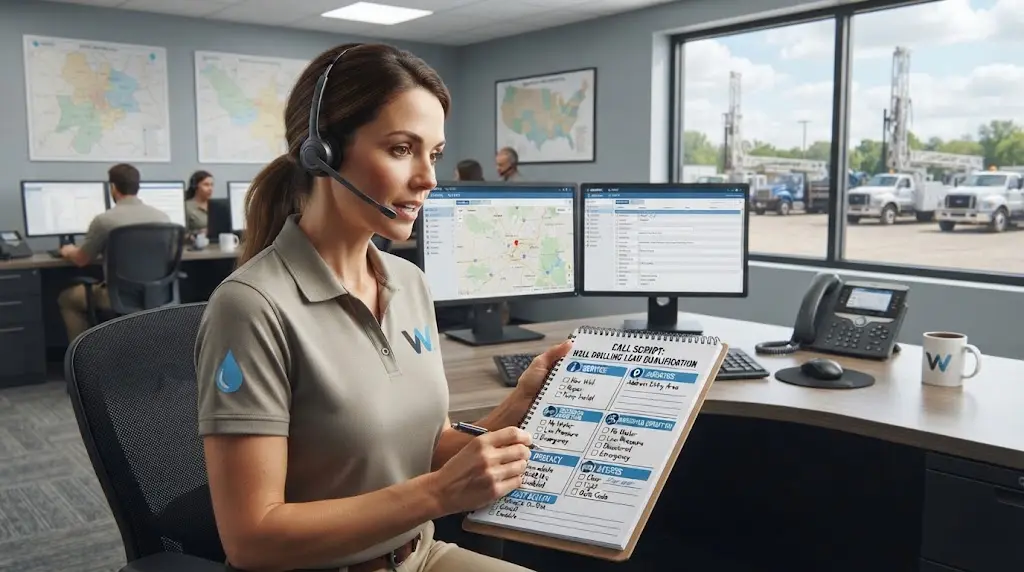
Use a short script that collects the minimum facts for the next decision. A script should make the office consistent, not make the caller feel cross-examined.
A general first-call script
Opening and service fit:
“Thanks for calling. What would you like us to help with?”
“Is this a new well project, an existing well or pump problem, an inspection, a replacement, or another type of work?”
“What have you observed, or what outcome are you trying to get?”
Place:
“What is the service address, including the county and state?”
“Is that where the work will happen, or is there another jobsite address?”
“Are there any access, driveway, gate, bridge, slope, overhead-line, or wet-ground conditions we should know before deciding the next step?”
Condition and urgency:
“When did this start, and what is the consequence right now?”
“Is anyone in immediate danger, or is there an exposed electrical, open excavation, flooding, gas, or other safety concern?”
“Has anyone already inspected or changed anything?”
Readiness:
“Who will approve the work and provide access?”
“What next step are you looking for: a technical conversation, an estimate, a site review, or a service appointment?”
“Is there a date or deadline we need to understand?”
Close:
“I have [repeat the service, address, observed need, and timing]. The next step is [outcome]. We still need [missing fact], and [person] will follow up by [time or date if your company can actually make that commitment].”
Do not insert a response-time promise unless the company has approved it and can meet it. A precise promise that is missed damages trust more than a clear statement that the office is reviewing the request.
What should a form ask before it creates a dispatch request?
Keep the first form short. Ask for:
- name and callback number;
- service address;
- service type;
- plain-language description of the need;
- urgency or consequence;
- preferred contact time;
- access notes;
- photos or records when useful; and
- consent or notice required by the company’s communication process.
Do not make a form require a technical pump diagnosis, exact well depth, or a budget number that a caller may not know. Use a follow-up question only when its answer changes routing. A form that captures ten irrelevant fields creates a longer queue without making the next decision clearer.
What should an answering service be allowed to do?
Give the answering service a narrow authority boundary. It may collect the approved questions, identify a safety escalation, route emergency calls according to company rules, and offer only approved next steps. It should not diagnose, quote an unapproved price, promise a crew, or expand the public territory.
Provide the service with:
- accepted service categories;
- obvious out-of-scope categories;
- territory rules;
- emergency escalation instructions;
- access and safety questions;
- appointment types it may offer;
- information that requires owner or technical review; and
- reason codes for hold, referral, and decline.
Review a sample of calls with the answering service. If the service sends every caller to dispatch, the problem is not that the leads are “too good.” The handoff rules are incomplete.
How should qualification differ by service line?
Use the same five gates, but change the questions and the field resource. A pump repair call and a new drilling inquiry should not share one generic form.
| Service line | First decision | High-value intake facts | Likely first action | Common wrong dispatch |
|---|---|---|---|---|
| New well drilling | Is this a real project your company can assess and propose? | Use, address, jurisdiction, project stage, timing, access, records, decision maker | Site review, proposal process, or technical call | Sending a production crew before scope and site conditions are known |
| Pump repair | Is there an active service need your pump team can safely evaluate? | Symptoms, water status, power observations, equipment access, urgency, address | Technician triage or service appointment | Promising a replacement before diagnosis |
| Pump replacement | Is replacement the requested or verified next step? | Existing equipment, application, access, power, scope, timing, decision maker | Estimate or technician review | Sending the wrong crew or assuming a standard part |
| Well inspection or testing | What decision will the inspection or test support? | Transaction, compliance, water-quality concern, records, lab or reporting need | Inspection/test workflow | Treating every testing call as drilling demand |
| Rehabilitation | Is the existing well a candidate for the company’s method? | History, yield concern, records, contamination or sediment concern, access, objective | Technical review or site assessment | Dispatching without a defined outcome |
| Commercial/agricultural | What operational or production need is at stake? | Entity, site, water use, schedule, procurement, access, insurance, decision authority | Estimator or project intake | Treating a larger project like a residential service call |
New well drilling leads
A new drilling lead should usually pass through project intake before a rig is scheduled. The caller may want a feasibility discussion, a bid, a permit-related step, or a production date. Those are different commitments.
Ask about the intended water use, property status, jurisdiction, existing records, project stage, desired timing, decision maker, and equipment access. If the caller has not selected a location, do not pretend the drilling site is ready. If the project is tied to a closing or construction deadline, record the deadline and who controls it. A deadline is useful information, not automatic priority.
The next action may be a site visit by an estimator or qualified person. The purpose is to reduce uncertainty before a rig is sent. The company should tell the caller what that visit will cover and what it will not guarantee.
Pump repair leads
Pump repair intake should capture observations, not diagnoses. A caller can often say there is no water, low pressure, short cycling, noise, visible leakage, or intermittent operation. They may not know the pump type, control system, depth, or failure mode.
Ask whether the condition affects the whole property, when it started, whether power or water is present, whether there is visible danger, and whether a prior repair was attempted. Confirm that the pump equipment is accessible and that the right person can meet the technician.
If there is a safety concern, the office should follow the company’s safety escalation. Do not ask an unqualified caller to open electrical equipment or perform a risky test. The field team can decide what diagnostic method is appropriate.
Pump replacement leads
Replacement requests need an estimate or technical review unless the company has verified the equipment and scope through its own records. Ask for the existing system information when available, but do not make the caller prove the part number before accepting a conversation.
Useful details include the reason for replacement, present symptoms, system type if known, access, electrical context, water-use requirement, and the date the customer needs a decision. Photos can help the office route the inquiry, but they should not be treated as a substitute for a qualified assessment.
Inspection, testing, and water-quality leads
Ask what decision the customer needs to make. Is the request connected to a property transaction, a compliance requirement, a suspected water-quality problem, a low-yield concern, a dispute, or routine maintenance?
The correct next step may involve a certified laboratory, inspector, technician, or another specialist. EPA’s public guidance says private-well testing should use certified laboratories and that treatment choices depend on the contaminant and well condition. Use that as a routing boundary, not a promise that every contractor performs every test. US EPA, Protect Your Home’s Water
Commercial and agricultural leads
Commercial and agricultural work often has a different approval and access path. Collect the entity name, site address, use case, project stage, deadline, site contact, decision maker, procurement requirements, and any known documentation requirement.
Do not reject a larger lead because it cannot be scheduled like residential repair. Put it in a project-intake queue with a named owner. Do not dispatch a residential service truck simply because the caller used the word “pump.”
When should you dispatch, schedule, hold, refer, or decline?
Choose the least expensive next action that can resolve the next important uncertainty without creating a false promise. Dispatch is one option, not the default reward for a caller who sounds serious.
| Situation | Recommended outcome | Why |
|---|---|---|
| Service and address fit, symptoms are clear enough, access is accepted, and the correct crew is available | Dispatch | The next field action is known and supportable. |
| Service fits, but the site or project scope needs inspection before production work | Schedule estimate or site review | A smaller or different first step prevents an expensive mismatch. |
| Caller has a plausible fit but cannot provide one fact that changes routing | Hold with a named owner and due date | Uncertainty is visible and recoverable. |
| The inquiry needs a different contractor, trade, lab, or jurisdiction | Refer | The customer gets a clear path and the company avoids a bad promise. |
| Work is outside service, licensing, territory, or safety rules | Decline clearly | A false commitment creates risk for the customer and crew. |
| Immediate danger or an approved emergency condition exists | Follow emergency escalation | The normal queue may not be the safe path. |
What does “hold” mean?
Hold must be an active status, not a place where leads disappear. Every hold needs:
- the missing fact;
- who will obtain it;
- the follow-up date;
- the next status if the answer is received; and
- the close reason if the answer never arrives.
Examples:
- “Need exact job address before territory decision. Office to text link today.”
- “New drilling project may fit. Estimator to review site records before appointment.”
- “Commercial pump request. Need procurement contact and access rules.”
- “Route uncertain after recent rain. Request driveway photos before rig review.”
A hold protects good opportunities from being discarded while keeping them out of the confirmed dispatch queue.
A hold with an owner protects a good lead better than a silent rejection.
When is a referral better than a decline?
Refer when the need is legitimate but outside your scope and you have a responsible referral path. Decline when you cannot recommend a provider, the request violates your operating rules, or the facts do not support a safe or honest commitment.
Do not promise that another contractor is available, licensed, affordable, or suitable unless you have verified what you are saying. A simple explanation is enough: “We do not handle that service in that area, so we are not the right company to dispatch.”
When should you not dispatch even if the lead sounds valuable?
Do not dispatch when:
- the address is unknown or outside the accepted territory;
- the service is outside the company’s scope or applicable credential path;
- the required equipment cannot reach or set up at the site;
- the caller reports a hazard that has not been escalated or controlled;
- the site contact cannot provide lawful access;
- the customer expects a diagnosis or outcome the company cannot promise;
- the proposed appointment is not actually available;
- the work needs a proposal, inspection, permit, or technical review first; or
- the only reason to dispatch is that the lead source counts it as a conversion.
The last point is commercial discipline. A platform may count a call based on duration or another configured conversion rule. Google Ads also supports importing calls that conclude offline and align with CRM or sales records. The company should use its own qualified, estimate, booked, completed, and revenue stages to decide whether a source is valuable. Google Ads Help, Measure calls from ads Google Ads Help, Import phone call conversions
What should the CRM or dispatch record contain?
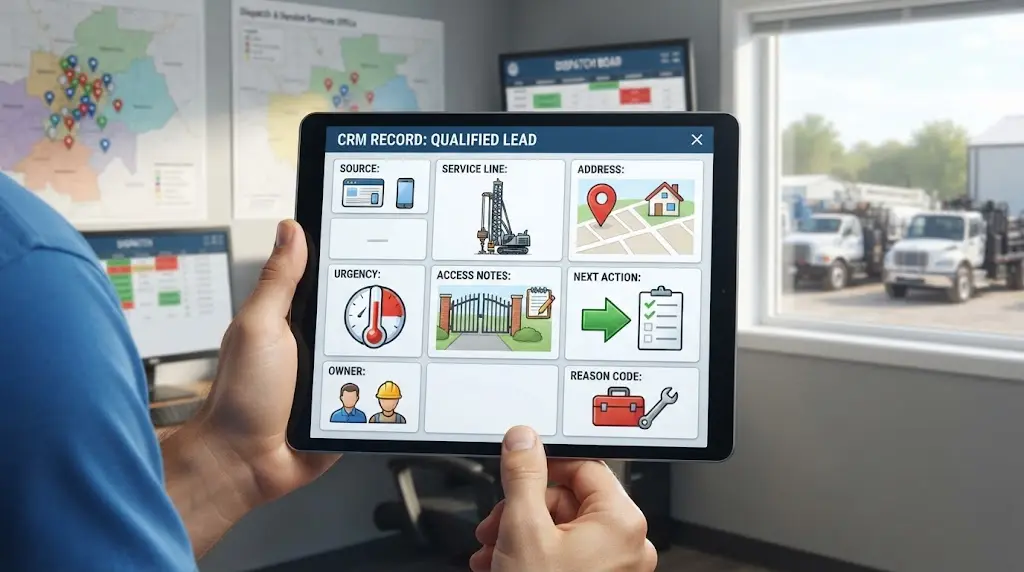
Record enough to reconstruct the decision without listening to the call again. You do not need a complicated field-service platform to start. A shared lead record can work if every person uses the same names and statuses.
Required fields
| Field | Example value | Why it matters |
|---|---|---|
| Source | Google Business Profile, organic page, referral, paid search, repeat customer | Connects demand to outcome. |
| Contact | Name, phone, email, preferred contact method | Makes follow-up accountable. |
| Service line | New drilling, pump repair, replacement, inspection | Routes the lead correctly. |
| Job address | Full address, county, state, map pin if needed | Supports territory and access decisions. |
| Property/customer type | Residential, agricultural, commercial, municipal, contractor | Changes workflow and authority path. |
| Observed need | Caller’s words, not an unverified diagnosis | Preserves the actual problem. |
| Urgency | Emergency escalation, priority, planned | Controls queue and promises. |
| Access notes | Gate, route, grade, equipment, contact | Protects the field handoff. |
| Authority | Owner, manager, builder, tenant, buyer, unknown | Prevents access and approval surprises. |
| Next action | Dispatch, estimate, triage, hold, refer, decline | Makes the decision visible. |
| Owner | Dispatcher, estimator, technician, manager | Prevents orphaned follow-up. |
| Reason code | Outside territory, missing address, site review needed | Enables pattern review. |
| Status date | Date and time of each change | Shows delay and follow-up. |
| Outcome | Estimate, booked, completed, lost, referred | Connects intake to business result. |
Avoid recording sensitive information that the team does not need. Keep notes factual and neutral. “Caller reports no water since yesterday” is more useful than “customer is difficult” or “bad lead.”
Which reason codes should you start with?
Start with a short list and add codes only when the team needs a real distinction:
- service not offered;
- outside territory;
- address or access unknown;
- unsafe or uncontrolled condition;
- wrong customer or property type;
- licensing or permit review needed;
- capacity unavailable;
- project not ready;
- no decision maker or access contact;
- referred to another service;
- duplicate or existing customer record;
- unreachable after approved follow-up; and
- customer declined next step.
Do not use “unqualified” as the only close reason. It prevents the owner from seeing whether the problem is marketing targeting, public service information, intake quality, territory policy, or capacity.
How should marketing learn from qualification outcomes?
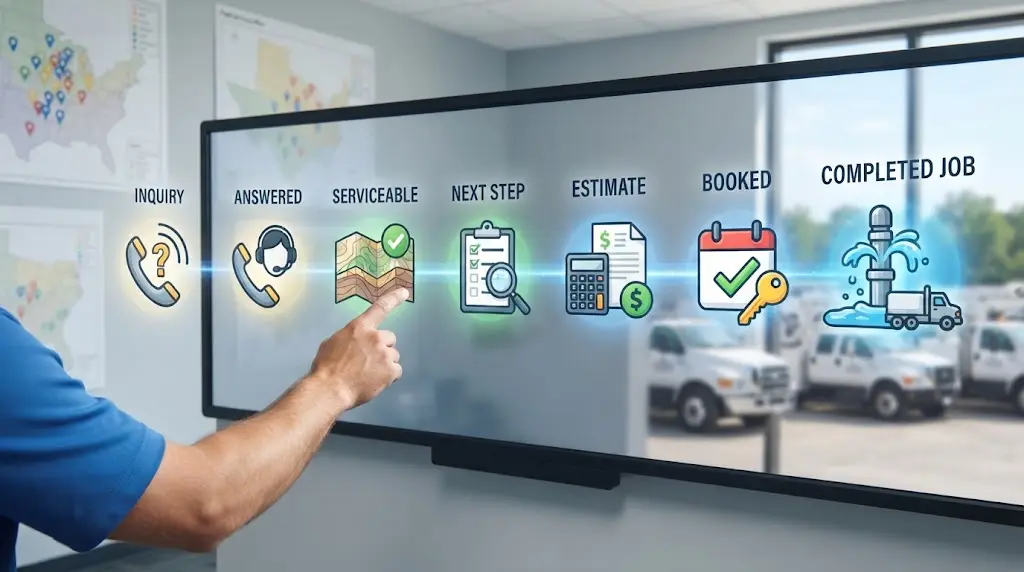
Review the path from source to booked work. A call is an event. A qualified opportunity is a business judgment. A booked job is an operating result.
Use a simple funnel:
inquiry → answered → serviceable → next step accepted → estimate or visit → booked → completed → revenue
The exact stages can differ by company. The separation should not.
Google’s call-conversion documentation describes duration-based calls, call analysis in eligible settings, and imported call conversions that align with other sales records. Those tools can help advertising platforms receive better signals, but they do not replace the contractor’s own definition of serviceable work. Google Ads Help, Measure calls from ads
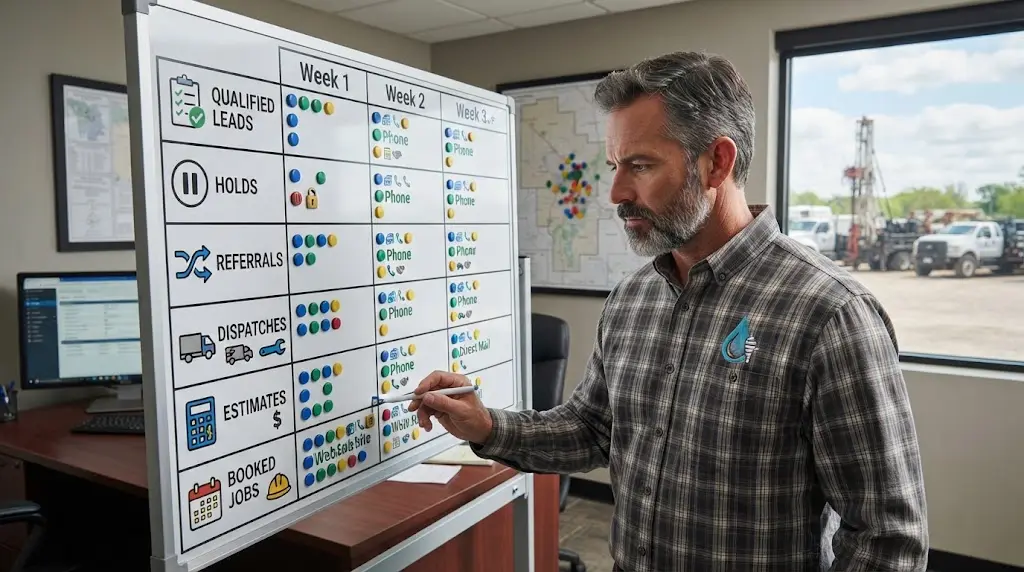
Review each source by:
- number of inquiries;
- answer rate;
- service-fit rate;
- territory-fit rate;
- next-step acceptance;
- estimate or visit rate;
- booked-job rate;
- completion rate;
- average or total revenue where the company tracks it; and
- close reasons.
Do not publish or act on a universal benchmark unless you have reliable company data. A small company with one dispatcher and a full drilling season may prefer fewer, better inquiries than a company with open crews and a short service cycle. The decision is operational.
What if a marketing source produces many calls but few dispatchable jobs?
Find the first repeated mismatch. If most calls are outside the territory, fix targeting and service-area communication. If most are for work you do not perform, fix page and profile categories, ad copy, and intake routing. If the calls fit but are not answered, fix the phone path. If calls are qualified but capacity is full, stop increasing demand until the operation can fulfill it or use a clear waitlist.
The diagnosis should be specific. “Lead quality is bad” is a conclusion. “Forty percent of answered calls last month were for pump repair outside the pump team’s territory” is a usable observation if the company’s records support it.
What if a source produces few calls but a high booking rate?
Do not shut it off because volume is lower. Check service mix, job value, seasonality, and capacity. A narrow source that sends the right type of commercial or drilling inquiry may deserve protection even when it never produces the raw call count of a broad campaign.
This is why qualification belongs in the marketing feedback loop. The goal is not to make every source look like the same funnel. The goal is to know what kind of work each source sends and whether the company wants more of it.
What does a five-minute qualification procedure look like?
Use the following procedure for a new inquiry. Adapt the order to emergency policy and the service line.
Step 1: Capture the inquiry and source
Record the caller, contact details, source if known, time, and exact service request. If the source is not available, mark it unknown rather than guessing.
Step 2: Confirm service and job address
Ask what the caller needs and where the work will happen. Check whether the service fits your published and internal service matrix. If the address is outside the normal territory, do not let the conversation proceed as if dispatch is available.
Step 3: Classify condition and urgency
Record observations, consequence, start time, and any safety concern. Use the company’s approved emergency escalation. Avoid diagnosis and avoid promises that are not backed by the schedule.
Step 4: Check access and readiness
Confirm who can provide access, whether the caller can take the next step, and whether route, gate, equipment, utility, or site facts require review. Ask for a map pin or photos only when they help resolve a real decision.
Step 5: Select the next action
Choose dispatch, estimate, triage, hold, refer, or decline. Assign the owner and status. If the appointment is confirmed, repeat the address, scope of the visit, contact, time window, access requirement, and any information the customer must provide.
Step 6: Close the loop
After the next step, update the record. Was it accepted, rescheduled, estimated, booked, completed, lost, referred, or closed? Add the reason. A qualification system without outcome updates becomes a second inbox.
Step 7: Review the exceptions
Each week, inspect the holds, declines, no-shows, reschedules, and jobs where the field team reported a mismatch. Those exceptions show where the script, service policy, marketing, or capacity plan needs repair.
What are the common mistakes in lead qualification?
The most expensive mistakes are usually small process failures repeated across many calls.
Counting every call as a qualified lead
A call is a contact event. It may be a duplicate, an out-of-area request, a wrong service, a vendor, a job already in progress, or a valid opportunity. Keep the stages separate.
Asking for a technical diagnosis from the caller
Callers know what they observed, not always what component failed. A forced diagnosis creates bad routing and false promises. Record symptoms and send technical questions to the qualified person.
Treating urgency as a scheduling guarantee
A customer’s urgent consequence deserves a clear response path. It does not create equipment, crew, safe access, or an available slot. Escalate according to policy and state the next action honestly.
Sending a rig because a new-well lead sounds serious
A serious project may still need a proposal, site review, permit check, access review, or estimator conversation. Match the resource to the next decision.
Using one territory for every service
Pump repair, emergency service, drilling, commercial projects, and agricultural work may have different travel economics and equipment requirements. Maintain service-specific territory rules.
Treating an incomplete lead as a bad lead
An unknown address or missing decision maker may be a recoverable information gap. Use a hold with a follow-up owner. Do not mix recoverable gaps with true out-of-scope declines.
Asking budget too early or never asking about commercial readiness
Budget is not a universal gate. But planned projects need a path to approval, a timeline, and a person who can decide. Ask questions that change the next action.
Ignoring route and site conditions
The customer may say the truck can reach the well. The customer may be right about a pickup and wrong about a rig, trailer, crane, or support vehicle. Ask the question that matches the equipment.
Treating 811 as an afterthought
The timing and legal details vary, but underground utility coordination is not a detail to invent at the gate. Record whether it is required and who owns the next step. 811 Before You Dig
Letting the platform define lead quality
An ad platform’s conversion setting can count calls by duration or another rule. That can be useful for campaign measurement, but the contractor still decides whether the work is serviceable and profitable. Feed later outcomes back where the system supports it.
Writing insulting close notes
“Bad lead” and “difficult homeowner” do not explain the decision. Use factual reason codes. They are better for training and safer for the company’s internal record.
What is a hypothetical example of the gate in action?
The following is hypothetical. It is not a Brictale client result and it is not an industry benchmark.
A caller says, “Our well is not working and we need someone today.” The office records the source and asks what the caller observed. The caller reports no water at the house since the morning, but cannot identify whether the pump runs. The address is inside the company’s normal pump territory. The property is occupied, and the caller says there is no visible flooding or exposed wiring. The pump equipment is in a locked outbuilding, and the owner can provide access after work.
The first decision is not “replace the pump.” The gates produce this result:
- Fit: pump diagnosis is an accepted service.
- Place: address fits, but access is only available in a defined window.
- Condition: no-water situation is priority, with no reported immediate hazard.
- Readiness: owner can provide access and wants a diagnostic visit.
- Dispatchability: the pump technician has a suitable opening in the approved window.
Outcome: propose or confirm a pump diagnostic appointment, record the observed condition, access contact, and no-water consequence, and tell the caller what the visit covers. Do not promise the failed component, repair price, or same-day result unless the company’s process supports that promise.
Now change one fact. The same caller says the road is soft after flooding, the outbuilding is surrounded by standing water, and electrical equipment is exposed. The lead may still be important, but it is no longer an ordinary dispatch. Outcome: follow safety escalation and obtain qualified review before sending a person into the area.
Change another fact. The address is outside the pump team’s accepted territory, but the caller has a legitimate emergency. Outcome: explain the boundary, follow the company’s referral or escalation policy if one exists, and do not let the caller interpret a marketing service-area listing as a guaranteed visit.
The framework does not remove judgment. It makes the judgment visible and repeatable.
When should a company improve qualification instead of buying more leads?
Improve qualification first when the company cannot explain what happens to an inquiry after it arrives. That usually shows up as missing addresses, unassigned follow-ups, repeated questions, unclear close reasons, untracked referrals, or field teams discovering the mismatch at the jobsite.
Improve the public service and territory information when the office repeatedly gets work the company does not perform or cannot reach. Google’s guidance says businesses should keep service-area information accurate and represent the real business consistently. A precise intake process cannot fully compensate for public signals that invite the wrong demand. Google Business Profile Help, Guidelines for representing your business
Improve capacity planning when the company is qualifying good inquiries correctly but cannot make credible commitments. The well drilling contractor capacity planning guide is the relevant sibling for crew, equipment, service mix, and demand decisions.
Improve call tracking when the team cannot tell whether a qualified opportunity came from Maps, organic search, paid search, a referral, or a repeat customer. The well drilling call tracking checklist can help inspect the path from visibility to answered call and booked outcome.
More demand is not the right repair for an intake process that cannot distinguish a job from a phone event.
What is the final rule for qualifying before dispatch?
Qualify to the next safe operating decision. Confirm fit, place, condition, readiness, and dispatchability. Then choose the smallest responsible next step and record why.
Some inquiries deserve a truck. Some deserve an estimator. Some need a technical review, a missing address, a route check, a permit conversation, a referral, or a clear decline. Treating those outcomes as identical is how owners lose both crew time and good opportunities.
Brictale helps well drilling and pump companies get more qualified calls and booked jobs. The free territory audit is the right next step when you want to compare the work your marketing attracts with the services, areas, and capacity your company actually wants.